The Curse of Skeleton Munroe

Category: minor super-hero

  • MINOR SUPER-HERO 039: THE DEVIL’S DAGGER

    (Master Comics 001-020, 1940-1941)

    Devil’s Dagger! I love this guy. He has a lot of familiar things going on: a wealthy young man named Ken Wyman who works as a reporter in order to get the latest crime news and heads out at night in his souped-up car (the excellently named Speed Ghost) to kick butt accompanied by Pat Gleason, ex boxer and member of the surprisingly large Chauffeur/ Sidekick club.

    There are two really interesting things about the Devil’s Dagger: 1. really good costume. 2. he’s a mission-driven vigilante. Once he rids Carterville of the sinister Jeff Marlowe… he finds out about Jeff’s boss, Mr H. But once he gets rid of him, that’s it! Wyman unmasks, retires, maybe takes the job at his father’s bank, who knows? It’s so rare for a super-hero to have a finite career, not just in the Golden Age but any time! How refreshing!

    Of course after saying that I would be a monster to suggest that the Devil’s Dagger be brung back, and I am not! I do however think that the identity would make for quite a fun legacy hero! Picture it: Carterville has once again become a crime-ridden hellhole, perhaps even under the thumb of a superannuated Mr H (or a corrupted Ken Wyman!), and someone stumbles across the unpublished memoirs of Ken Wyman and takes inspiration from them – maybe an underpaid employee at the Daily Blade, now stripped of assets by venture capital and printing a ten-page synopsis of the top clickbait of the week? Heck, maybe this time it’s a whole group of dagger-wielding vigilantes. Fun!

  • MINOR SUPER-HERO 038: THE THUNDERER

    (Daring Mystery Comics 007, 1941)

    Lot to like about the Thunderer: great name, trend-based origin (ham radio enthusiast who finds crime on the airwaves/ rigs up a microphone to enhance his presence with a booming voice), nice-looking costume that was ultimately his downfall (because Marvel Comics 1000 established that virtually every Marvel character who wore a full-face black mask were wearing the same mask, and some of them retroactively had to have died for the chain of mask-wearers to continue). Lot to like.

    Perhaps my favourite thing about him, however, is the fact that he turns down his amplifier in the 4th panel above, which heavily implies that he has been talking to himself at top volume while bounding over the rooftops. Just great stuff.

  • MINOR SUPER-HERO 038: THE THUNDERER

    (Daring Mystery Comics 007, 1941)

    Lot to like about the Thunderer: great name, trend-based origin (ham radio enthusiast who finds crime on the airwaves/ rigs up a microphone to enhance his presence with a booming voice), nice-looking costume that was ultimately his downfall (because Marvel Comics 1000 established that virtually every Marvel character who wore a full-face black mask were wearing the same mask, and some of them retroactively had to have died for the chain of mask-wearers to continue). Lot to like.

    Perhaps my favourite thing about him, however, is the fact that he turns down his amplifier in the 4th panel above, which heavily implies that he has been talking to himself at top volume while bounding over the rooftops. Just great stuff.

  • MINOR SUPER-HERO 037: THE PHANTOM BULLET

    (Daring Mystery Comics 002, 1940)

    There’s a lot of people on the internet who like to opine on the morality of bat-themed rich-guy vigilantism, but I gotta tell you that it could have been a whole lot worse. Case in point, the Phantom Bullet, a rich guy who gets ahold of an untraceable ice pellet gun and immediately thinks “what this city needs is a whole lot more extra-judicial killings.”

    But instead of becoming an unstoppable media juggernaut, the Phantom Bullet made just one Golden Age appearance (like so many of his Daring compatriots) and returned only once, seventy years later, to die.

  • MINOR SUPER-HERO 036: THE TOUGH KID SQUAD

    (Tough Kid Squad 001, 1942)

    I occasionally opine about the relative obscurity of one super-hero or another and it’s tricky to judge such a thing objectively, especially when it’s about a suite of characters who are all 100% unknown to the world at large. Despite this I am confident in my assertion that the Tough Kid Squad are the most obscure Marvel characters ever to receive their own title, even if it did only last one issue.

    The Tough Kid Squad is an obvious attempt by Marvel to replicate the formula of the Young Allies, but the technology to boil down a concept and recast it misfired somehow. The real key to a 40s kid gang is the mix of personalities – as seen in the Young Allies’ Smart Kid, Fat Kid, Tough Kid, Racial Stereotype and two Super-Hero Kids. The Tough Kid Squad on the other hand, is as follows:

    Wally Danger: Together with his brother Wally forms the Danger Twins, the Super-Hero kid Element of the team. Orphaned at a young age, the twins were raised separately after Tom was stolen by a crook to be his protege. They both benefit from a serum that their father gave them as infants which enhances their trained abilities. Wally mostly acts as the Smart Kid.

    Tom Danger: Raised to be a crook but his better nature shone through when he met his long-lost twin, Tom is a Tough Kid to his core.

    Derrick Dawes: A former school bully who was befriended after a beating from Tom. Tough Kid.

    Butch: A guy on the school football team who is befriended off-panel. Supposedly a Fat Kid based on the action but is drawn as and acts like a Tough Kid.

    Eagle: The football team also had a Racial Stereotype to befriend, albeit one who mostly acts like a Tough Kid. Eagle also presents the conundrum common to comic book racial stereotype characters: that because part of the joke of them is that they are acting against stereotype by being the hero of the piece they are often driving the action in the most interesting ways. 

    The main point of this breakdown is that true to its name the Tough Kid Squad is a real one-note kid gang. It is in fact weirdly tough to figure out if there is a true knockoff kirby in the bunch, in fact – they’re kind of all part of one gestalt knockoff kirby, with Eagle looking most the part and Tom acting it.

    Obviously I think the name should be brung back, and I’m kind of disappointed in Marvel for not dredging it up during the 50-State Initiative time – it might have been the only thing to make the fact that Hellcat was the entire Alaska Initiative team all by herself more fun. As for the members themselves… they are a bit generic, but the fact that the Danger Twins are all hopped up on serum offers the easy possibility for a couple of unaging characters to have been secretly operating for the last 80+ years, which is always fun.

  • SEMI-MINOR SUPER-HEROS: FIGHTER PILOT EDITION

    Conundrum: Golden Age fighter pilot characters are essentially a very minor subset of super-heroes, and they are also very boring to me. I  feel a compulsion to write something about them and also to slump sideways in my seat when contemplating their existence.

    Solution: since the only really interesting thing about them is their cool names, I will list those.

    the Flying Flame (Daring Mystery Comics 006, 1940)

    the Flying Fox (More Fun Comics 037, 1938)

    the Hell Diver (Hit Comics 014, 1941)

    the Scarlet Ace (Amazing-Man Comics 013, 1940)

    the Sky Devils (Daring Mystery Comics 002, 1940)

    the Spitfire (Crack Comics 015, 1941)

    the War Bird (Slam-Bang Comics 003, 1940)

  • MINOR SUPER-HERO 035: THE HUMAN TOP

    (Red Raven 001, 1940)

    The Human Top is a guy who gets spinning powers after a science accident. The only really noteworthy things about him are that cool collar on his costume and the fact that he’s one of the very few Golden Age Marvel characters to have never had any sort of modern appearance. Spinning powers aren’t cool, I suppose.

    It’s kind of a shame that this is the first of only two appearance of the Human Top and the only one written by Dick Briefer – I really like the weird hyperbole and turns of phrase. Ah well, there’s always Frankenstein to look forward to.

  • MINOR SUPER-HERO 035: THE HUMAN TOP

    (Red Raven 001, 1940)

    The Human Top is a guy who gets spinning powers after a science accident. The only really noteworthy things about him are that cool collar on his costume and the fact that he’s one of the very few Golden Age Marvel characters to have never had any sort of modern appearance. Spinning powers aren’t cool, I suppose.

    It’s kind of a shame that this is the first of only two appearance of the Human Top and the only one written by Dick Briefer – I really like the weird hyperbole and turns of phrase. Ah well, there’s always Frankenstein to look forward to.

  • MINOR SUPER-HERO 034: ELECTRO

    (Marvel Mystery Comics 004-019, 1940-1941) 

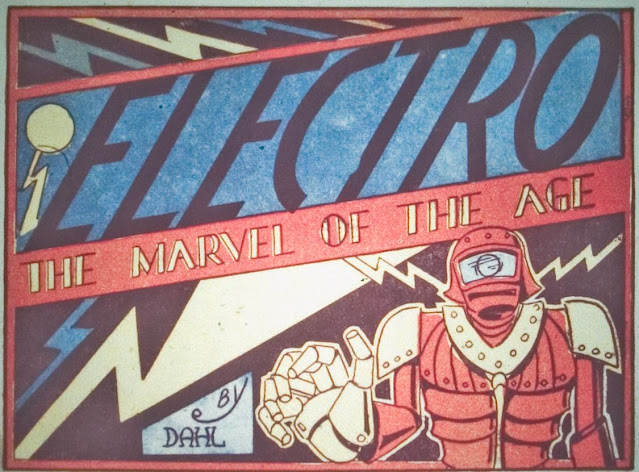
    Hey look, it’s Electro, Marvel of the Age! I love that guy!

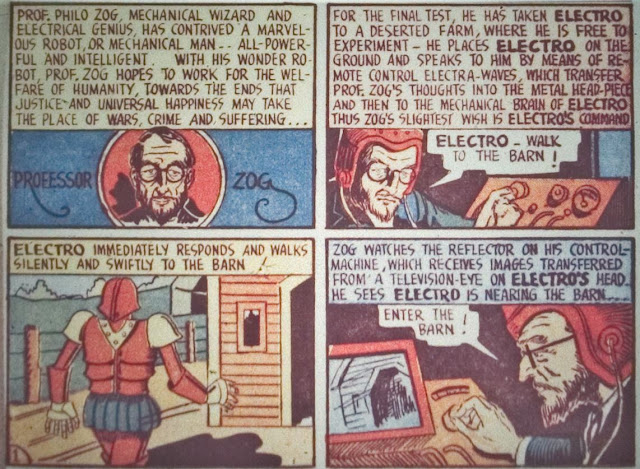
    Or rather I love Electro’s creator/ mental pilot, Professor Philo Zog (later amended to Zogolowski because heaven forfend that someone have a weird name). It’s not often that a weird nerd with a scraggly beard gets to be the hero.

    I also love Zog’s plan: hire a bunch of husky young men to act as his agents in various parts of the US, who then call in Electro as necessary. They eventually get phased out in favour of more Zog-time but I love them while they last. Also, in their first appearance they’re referred to as Zog’s “Machine of Righteousness” and that’s what I think of them as because as a name, it rules.

    Zog later shows up in a period piece or two, but it’s Electro who eventually gets brung back by J. Michael Straczynski in The Twelve, making this the inaugural edition of THE TWELVE REPORT, a review of just how our pals fared in that book.

    Electro got done somewhat dirty by J. Michael: The incident that put the other eleven heroes in suspended animation also severed the mental connection required to drive the robot. and Zog subsequently died of mental withdrawal. It might have taken a while though? His daughter Elizabeth shows up in the series and she is definitely not drown or styled as the 60+ year-old she would have to be if Zog kicked the bucket in 1945.

    As for Electro itself, it was basically a narrative device in the book, acting as a combo murder weapon and witness. Ultimately it ends up being driven around the Middle East by the Laughing Mask. Ho hum.

    Maybe I’ll work out a 1-12 scale of how well I reckon the characters in The Twelve ended up being treated but it’s hard to do with only one of them, you know?

  • MINOR SUPER-HERO 033: THE GHOST OF FLANDERS

    (Hit Comics 018-025, 1941-1942)

    I know I talk about how wild the origins of various characters are a lot on here, and I don’t think that I can justify declaring one or another “the most wild” anymore, but the Ghost of Flanders would absolutely have to appear on any reasonably comprehensive Top Ten Characters Who Will Amaze and Befuddle You With Their Wild Origins list.

    The Ghost of Flanders is in reality Rip Graves, who enlisted in the US Army during WWI and was basically immediately captured (as the Battle of the Marne took place in July 1918) and spent the rest of the war in a prison camp. This is not especially wild, although it does allow us to know that Graves is 37, a bit older than your typical super-hero (and of course if some enterprising comics writer decides to bring back the Ghost of Flanders for some reason he will automatically be the oldest living WWI veteran)

    The first really wild thing about Rip Graves is this: he is the Unknow Soldier, as in Tomb of the. Now, I looked up the Tomb of the Unknown Soldier the first time I read this story, and checked again just now, and not only is there, you know, a human corpse buried in it but it’s one that they went to reasonable lengths to make sure was, you know, unknown (in short, they located six unidentified US casualties and then had someone choose one at random). “This guy who we know the identity of but don’t have a body for” is almost exactly the opposite of that, in fact.

    Wanting to serve his country but not wanting to own up to being alive because for some reason he believes that the powerful symbolism of the Unknown Soldier will be ruined if it isn’t him specifically, Rip does a normal comics thing and decides to become a costumed vigilante. And what does every costumed vigilante need?

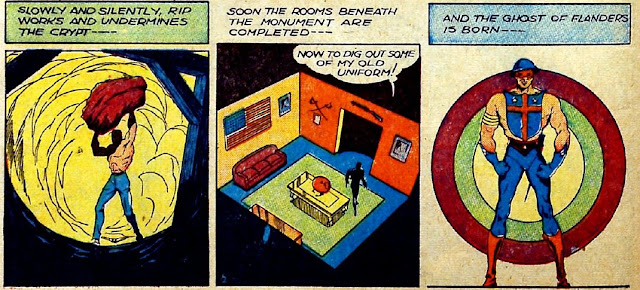
    A secret HQ under a solemn national war monument! Yes, the first thing that Rip Graves does is dig himself out a little man cave underneath the Tomb of the Unknown Soldier, because it’s his.

    Other things about the Ghost of Flanders include:

    -he is the only WWI-themed super-hero that I know of

    -his calling card is a red poppy (natch)

    -he uses WWI-era equipment including bayonets and a biplane, in a kind of natural extrapolation of something like the archer-hero and other users of archaic weaponry

    -I can’t say why he chose the unwieldy Ghost of Flanders name over the excellent Unknown Soldier, but it would take nearly thirty years for someone to take advantage of the excelent name that was just laying there.

    In conclusion: the Ghost of Flanders, a bog-standard 1940s super-hero boom character in most ways, but one that makes me feel crazy to think about too much.