The Curse of Skeleton Munroe

Category: minor super-hero

  • MINOR SUPER-HERO 032: HERCULES

    (Hit Comics 001-021, 1940-1942)

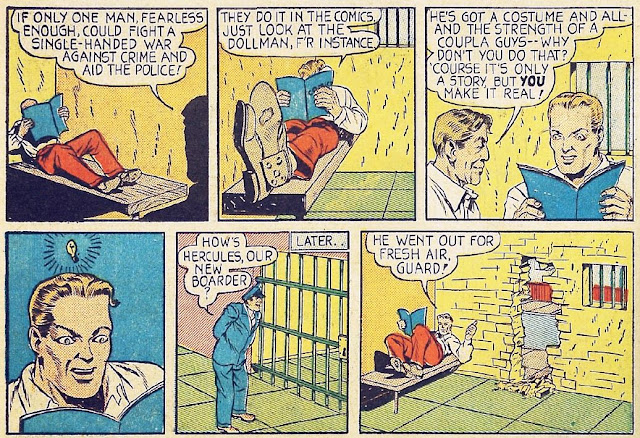
    There’s nothing too special about Hercules – he’s a super-strong guy who shrugs off small-arms fire and is a champion of the people after seeing his mother ruined by unscrupulous businessmen – but I really like the callout text at the start of his first adventure. He’s not an alien, you rubes! No mad scientist created our boy Joe Hercules! No, he’s just a regular super-powered American with no explanation! Named Joe Hercules, I must repeat. Check and mate, I think, all other other comics.

    Sadly for Hercules, he never really hits the big time. He gets a mention in James Robinson’s Starman but only to say that he has Alzheimer’s, in one of those “all the old heroes who weren’t in the JSA are doddering wrecks now” bits of colour he loves so much.

    ADDENDUM:

    Hercules does have the distinction of being part of the small-but-significant number of super-heroes who got their inspiration by reading about other super-heroes in the comics, specifically Doll Man.

  • MINOR SUPER-HERO 031: THUNDERBOLT

    (Flash Comics v1 007, 1940) 

    The epitome of minor: Johnny Thunder spent one issue as a costumed hero named Thunderbolt. It’s possible that he tried his hand at the costumed crimefighter game some other time – I’m hardly a Johnny Thunder expert – but this is the only time I know of.

  • MINOR SUPER-HERO 031: THUNDERBOLT

    (Flash Comics v1 007, 1940) 

    The epitome of minor: Johnny Thunder spent one issue as a costumed hero named Thunderbolt. It’s possible that he tried his hand at the costumed crimefighter game some other time – I’m hardly a Johnny Thunder expert – but this is the only time I know of.

  • MINOR SUPER-HERO 030: THE RED TRIANGLE

    (Feature Comics 046, 1941)

    An exciting development! Up until now our minor super-heroes have been of two flavours: the stars of minor super-hero strips or a new identity adopted by the stars of crime or adventure strips – the key word in either case is star – they are the focus and driving force of the strip.

    The Red Triangle is our first example of another type of super-hero: the single issue guest star. These are far more common in the Silver Age, when they pop up every so often to complicate the main hero’s life for an adventure before retiring in shame or glory. I don’t have a full classification scheme for them yet, but I suspect that there will be a distinction between at least two types: the one who is making an attempt at being a big-time super-hero and the one who temporarily adopts an alternate persona to achieve a goal, with the Red Triangle being the latter.

    So: the Red Triangle is a masked vigilante who gets involved with a Reynolds of the Mounted case, which actually and weirdly makes him one of the earliest Canadian super-heroes.

    The Red Triangle, real name Baxter, is a man who got mixed up in a counterfeiting gang and when they wouldn’t let him back out, disappeared and adopted a new vigilante identity. It’s unclear whether he spent the year that he was the Triangle getting into any other crimefighting adventures – the crooks all know his name, but that might just be because he’s been hassling them specifically. 

    Once the gang’s been rounded up, Baxter takes the usual path that this style of minor super-hero does and hangs up the Red Triangle identity to return to the simple life of a hotelier.

  • MINOR SUPER-HERO 029: THE BOYVILLE BRIGADIERS

    (Feature Comics 045, 1941)

    It’s a tale as old as time, by which I mean about a year: noncostumed adventurers adopting costumed identities to keep up with the oncoming juggernaut that is the Golden Age super-hero boom. In this case, it’s Rusty Ryan and the other unusually muscular teens of the Boyville orphanage, who up until now were more of a high school sports type of bunch, dealing with the plague of unscrupulous gamblers betting on local hockey games and catching the occasional band of counterfeiters.

    As the Boyville Brigadiers, Ryan and his cohorts are even more dull than what I just described. Rather than the Kirby-style boy gang dynamic of making every member their own distinct style of weirdo, the Brigadiers barely have names, let alone personalities. The only really interesting thing about them, in fact, is how weirdly similar their costumes are to Captain America’s. 

    Still, they go on the list of patriotic heroes. Hooray!

  • MINOR SUPER-HERO 028: USA, THE SPIRIT OF OLD GLORY

    (Feature Comics 042-048, 1941)

    USA, the Spirit of Old Glory might just be the most overtly patriotic super-hero concept ever, which is saying something. Especially as she is a Quality Comics character, a company that also featured Uncle Sam (the literal Spirit of America) and Miss America (literally given her powers by the Statue of Liberty) in their roster.

    USA was originally a little girl who saw Betsy Ross sew the first American flag and was just so friggin’ jazzed about the whole thing (and by that locket full of threads) that she immediately ran out into the rain and died. Betsy Ross dropping that last stitch was so metaphorically powerful that an anime dust ring blew out from it and knocked that kid into the Spirit Realm.

    Then, in 1941, she returns! Conspicuously aged up about a decade so that she can fly around with her back arched all the time without it being weird! And she uses her magic flag and torch of liberty to kill lots of spies and traitors!

    Cards on the table: I’m a Canadian, so I’m always looking at American patriotism through an anthropological lens – Canadian patriotism is mostly about being quietly smug about not being American. Like I said before: this is possibly the most ultrapatriotic origin story of all time: the creation myth of America, as it is happening, is so powerful that it creates this super-human. Uncle Sam might be the spirit of America, but the other countries all have spirits too – John Bull shows up once or twice to help beat ass and all of the Nazi-occupied countries languish in a sort of mystic otherworld waiting to be liberated. Uncle Sam being an unstoppable juggernaut is just American exceptionalism, while this here is the mythologization of America.

    ADDENDUM:

    USA’s second appearance introduces perhaps the most on-the-nose weakness for a patriotic hero:

    Yes, all one must do to thwart her is to literally hide behind the flag. These men are kidnapping a man’s child in order to prevent him from testifying about their spy activities, and she knows that. Remarkable!

    ADDENDUM II:

    Surprising nobody, when USA adopts a secret identity in order to do defense work, she goes by the name Usa.

  • MINOR SUPER-HERO 027: THE DESTROYING DEMON

    (Feature Comics 039-040, 1940-1941) 

    This is a bit of a complicated one. So: “Captain Bruce Blackburn – Counterspy” was a strip that started in Feature Comics 032 in media res with the cover of the titular Captain and his colleague Lieutenant Jackson having been blown. The two then fake their deaths and a government plastic surgeon alters their appearances so that they are virtually identical, thus allowing them to operate as an incredibly efficient spy team with a flawless ability to generate alibis.

    Then, in Feature Comics 038, Blackburn, posing as a man named Black, joins the Un-American Band, a thinly-veiled analog of the German-American Bund, a group whose shadow loomed much larger in the pages of the comics than they ever did in history. And in Feature 039, Blackburn, as Black, encounters this guy:

    “Colossal Guy” here does two things: 1. prove my thesis that kids playing super-heroes in comics is always great and 2. give Bruce Blackburn a good idea.

    See, the Un-American Band, being pseudo-Germans, are all intensely superstitious. This is a known thing about Germans and pseudo-Germans! Thus, the simple application of a cheap devil costume and a bungee rig is enough to throw their entire plot into confusion.

    Sadly, Blackburn only wheels out the Destroying Demon (AKA the Destroying Devil, AKA the Avenging Demon) rig one more time, to contend with a force of crypto-Nazi dwarf saboteurs posing as refugee orphans. He does borrow a technique from the Jay Bird and dangle perilously from a plane for this one, though. I really wish he’d kept it up and that this strip had just kept adding more and more layers: government agent who faked his own death and was surgically altered to look like another guy posing as a bundist who is also a super-hero and then the other guy ends up posing as his arch-enemy and then they both pretend to be space aliens battling for control of Earth’s water and then…

    The Destroying Demon is one of the few Golden Age hero identities that I wouldn’t like to see as a returning legacy character. Rather, I want it to reappear as an officially sanctioned super-hero identity for government agents in the DCU – just agent after agent complaining about having to dress up like a pantomime devil in order to infiltrate a super-hero fight club or whatever. Fun!

  • MINOR SUPER-HERO 026: ZERO, GHOST DETECTIVE

    (Feature Comics 032-074, 1940-1943)

    Eyyy, it’s Zero the Ghost Detective!

    I have a blanket love of the psychic detective genre and unusually for the Golden Age Zero’s cases almost always end up being actually supernatural as opposed to being a crook in a sheet – the above panels are from a case wherein a bitter old man dies and comes back as a three-fingered ogre to drag the rest of his family into death with him. It’s usually something gruesome and lots of people get killed by ghosts. What fun!

    Zero himself is a bit of a cypher as his adventures never really dip into his private life but does that really matter? He should absolutely be brought back as a foil to Dr Thirteen. Oh how they would annoy one another!

  • MINOR SUPER-HERO 026: ZERO, GHOST DETECTIVE

    (Feature Comics 032-074, 1940-1943)

    Eyyy, it’s Zero the Ghost Detective!

    I have a blanket love of the psychic detective genre and unusually for the Golden Age Zero’s cases almost always end up being actually supernatural as opposed to being a crook in a sheet – the above panels are from a case wherein a bitter old man dies and comes back as a three-fingered ogre to drag the rest of his family into death with him. It’s usually something gruesome and lots of people get killed by ghosts. What fun!

    Zero himself is a bit of a cypher as his adventures never really dip into his private life but does that really matter? He should absolutely be brought back as a foil to Dr Thirteen. Oh how they would annoy one another!

  • MINOR SUPER-HERO 025: ACE OF SPACE

    (Feature Comics 038-041, 1940-1941)

    Pretty fond of the Ace of Space. As you can see above he has the fairly common origin of finding an alien spaceship and [getting powers accidentally from alien technology/ getting powers as a reward for helping the alien/ looting the deceased alien/ taking on the dying alien’s mission and technology]. In this case, he has to defend the Earth from invading Slogoms. 

    Also, I demand that you appreciate that cool looking alien. What a cool guy!


    The alien’s power belt gives A.C. “Ace” Egan the standard power array of enhanced flight, strength and speed, plus telepathy and, best of all, makes him 9 feet tall. He also inherits the alien’s spaceship, which can usefully turn invisible. 

    As with most forgotten DC/ Marvel super-heroes I reckon that Ace of Space should be brung back as a legacy hero (or as himself after having relativistic adventures in his spaceship! I’m easy!) because if there’s one thing that I love about a sprawling shared super-hero universe it’s all the weirdos and obscurities. Any group shot at a super-meeting would only be enhanced by a 9 foot tall dude in jodhpurs and a flight helmet. Or his great grand-niece who is still 9 feet tall but dresses like a rockabilly lady – as I said, I’m easy.

    (the Slogoms are also very cool aliens)