The Curse of Skeleton Munroe

Category: minor super-hero

  • MINOR SUPER-HERO 017: WARLOCK THE WIZARD

    (Nickel Comics 001-007, 1940)

    Warlock the Wizard, in addition to having a name built to confuse someone familiar with modern D&D classes, is an interesting member of the Magic Guy type of Golden Age super-heroes, in that while he has some innate skill at magic he is much more of a magic item user than a lot of his contemporaries (and yes I am aware that this makes him closer to an Artificer than either a Warlock or a Wizard). This introduces a bit more uncertainty into a Warlock adventure as it is possible that he will be separated from his source of power, something that is quite a bit harder to do in a Zatara story, say

    Warlock’s tools of the trade (pictured above) are:

    -Hugin the raven. Acts as a familiar, scout, fetcher-of-other-tools, messenger and occasional subject of transformation magic.

    -the Hand of Abraxas. Speak the magic word (conveniently, it is Abraxas) and the hand detaches from the stick and grows huge. Acts as transport, muscle etc. Since we’re already talking D&D, it’s basically a wand of Bigby’s Hand spells.

    -the Lamp of the Gods. This is the big gun, which is why it only comes out occasionally and at the end of adventures. It seemingly offers consequence-free favours from the gods of assorted pantheons, including stuff like borrowing the Hammer of Thor to smite someone or petitioning Neptune for rain. 

    One more thing that I appreciate about Warlock is the repeated insistence that most people fear and hate him – a somewhat unusual thing in 40s comics and so a refreshing one.

    As always, my attitude about magic item-using characters is that they should be BROUGHT BACK, preferably as legacy characters. Picture this: some workaday schlub decides to befriend their neighbourhood crows ravens and it just so happens that one of them is Hugin and in return for a generous attitude toward sharing table scraps they get the Lamp of the Gods left on their front steps. Good stuff!

  • MINOR SUPER-HERO 016: THE MOTH

    (Mystery Men Comics 009, 1940)

    The Moth might just be the platonic ideal of a certain kind of super-hero. Specifically, the kind that would be equally likely to show up for three issues during the height of the Golden Age hero boom and also in a super-hero parody any time from the 60s to today.

    I sincerely think that if I spent an afternoon looking through every issue of normalman and What The-! and so forth that I could find (or if I could ever track down a copy of The Mad Book of Almost Superheroes, for that matter), someone identical to the Moth would be hanging out in the background of a panel somewhere.

    As far as the man himself goes: a perfectly decent regular Golden Age super-hero: no origin or secret identity, can fly, drops “egg bombs” despite a troubling lack of pockets… the complete package.

  • MINOR SUPER-HERO 015: THE VOICE

    MINOR SUPER-HERO 015: THE VOICE

    (Feature Comics 032-037, 1940)

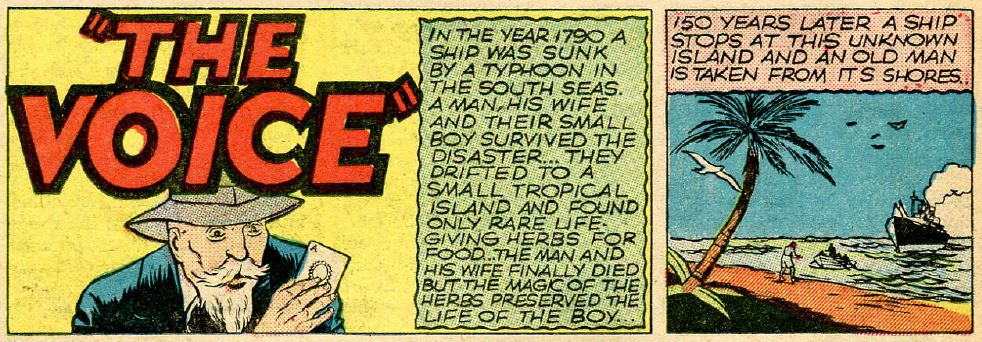
    Of the dozen or so heroes and villains named the Voice, this is the best of them all, hands down. Let’s review:

    -shipwrecked on an island in 1790, lives off of special herbs that extend the human lifespan and empower the body

    -finally picked up in 1940, moves to NYC at 150-something years old

    -successfully synthesizes the herb’s properties, ensuring that his life will continue indefinitely. Decides to fight crime

    -learns ventriloquism and close-up magic

    The last is my favourite part: he’s an old man who can pick up a car, for example, but most of his cases are solved with the application of a thrown voice or two. Plus that blonde guy in the second set of panels is his neighbour who just happens to be nearby when Mr Elixer – did I mention that his non-super-hero name is Mr Elixer? – decides to fight crime and is basically conscripted into being his butler.

    Really really good dumb fun comic stuff. BRING BACK the Voice!

  • MINOR SUPER-HEROES 007-014: AMAZING-MAN COMICS ROUNDUP 1939

    (Amazing-Man Comics 005-026, 1939-1942)

    All the ephemeral Golden Age heroes who stalked the pages of Amazing-Man Comics:

    The Iron Skull! I love him. His origin and so forth is doled out after a few issues so initially you don’t know that he is a cyborg war casualty in the far future world of 1970. The most important things are there from the start, though: his huge anime eyes and the fact that every bullet or attack made against him unerringly hit him in his invulnerable head.

    SKULL SCORE: 2/5 Not very skully but he gets a point for the lack of nose.

    Minimidget: Just a super-small guy with a problematic name. He and his galpal Ritty were shrunk and employed as henchmen by a pervert scientist before redeeming themselves via acts of public service. 

    Chuck Hardy: Chuck and Jerry, a couple of deep sea divers, end up in the subterranean land of Aquatania, beneath the Marquesas Islands. They turn out to be super-strong there for murkily-explained reasons and have adventures with the monstrous flora and fauna and the various near-human races. The best part is absolutely the little lobster antennae that all of the various types of Aquatanians have.

    Mighty Man is a huge dude who is the last descendant of folk who settled in a valley where everything is huge. After murdering a bunch of evil cowboys, he emerges from his valley to fight crime. Eventually he gets the power to change size.

    UPDATE 1940

    The Shark! A water-based hero who can talk to sea life and must hit the water regularly, which is about standard for water guys!

    ADDENDUM: Later on he meets his father Neptune and his adventures turn into father/son outings, which rules.

    UPDATE 1940

    Magician from Mars: Not only is Jane 6em35 an Earthian/Martian hybrid from an unspecified future, and not only was she accidentally irradiated as a baby in a way that activated a lot of vague superpowers (including flight, super-strength and a seemingly complete control over matter) but she is a practical and morally flexible hero who takes advantage of the chaos surrounding a rocket crash to make off with $3 million in gold before saving the day. Very fun. Plus: jodhpurs!

    The Cat Man: a very marginal entry on this list. In his first appearance, he develops his signature technique of dressing like an old lady and having his trained cat scratch people with poisoned claws to murder three former criminal confederates, which isn’t particularly heroic? His second appearance is in more of a vigilante role as he murders a gang of wanted men. How could I not include this loveable murderous scamp, really?

  • MINOR SUPER-HERO 006 AMAZING-MAN

    (Amazing-Man Comics 005-026, 1939-1942, plus various other Centaur books)

    Amazing-Man is not particularly obscure: he was supposedly the inspiration for both Iron Fist and Peter Cannon, Thunderbolt and eventually ended up dropped whole cloth into both one of the Malibu universes and the Marvel Universe (which, yes, means he’s technically in the Marvel Universe twice but if Malibu comics ever comes back in any substantial way I will make and consume an edible hat).

    The thing I always focused on in descriptions of Amazing-Man’s origin were the tests he took to prove that his training was complete. Test 1, put on by underutilized character the Strongest Man in Tibet: hold back an elephant.

    Test 2 is set by the Great Question, a member of the Amazing-Man Training Committee who also happens to be a super-villain, surprising few: fight a cobra without the use of your limbs. This is the one that made the cover, and with good reason – he really chomps that snake good!

    It’s unclear whether Lady Zina is on the selection committee or if they just have a knife-thrower on retainer, but “has a knife thrown through his neck” is definitely the thing about Amazing-Man that stuck with me from my many readings of Jeff Rovin’s Encyclopedia of Superheroes back in the day. That it’s actually a test of his resistance to pain diminishes the weirdness of it only a little.

    Test 4 is just languages and trivia, bit of an anticlimax.

    BUT! Amazing-Man is a genuinely fun comic and I found myself actually reading the text story starring him in the first issue, AND GLAD I AM THAT I DID – it details the test of his musical abilities, and how the final part of the test was to sing a powerful song perfectly. How was that perfection measured? A man strapped to some sort of music-powered death chair nearby died. It is possible that more than one super-villain was on Amazing-Man’s training committee.

    I have not yet read all of Amazing-Man Comics so there may be more tests to be revealed – watch this space!

    UPDATE: No further trials from his initial time before the Council of Seven have surfaced but check out this, from a secondary trial about a year later:

    Purification by fire: a classic (Amazing-Man 011, 1940)

  • MINOR SUPER-HERO 006 AMAZING-MAN

    (Amazing-Man Comics 005-026, 1939-1942, plus various other Centaur books)

    Amazing-Man is not particularly obscure: he was supposedly the inspiration for both Iron Fist and Peter Cannon, Thunderbolt and eventually ended up dropped whole cloth into both one of the Malibu universes and the Marvel Universe (which, yes, means he’s technically in the Marvel Universe twice but if Malibu comics ever comes back in any substantial way I will make and consume an edible hat).

    The thing I always focused on in descriptions of Amazing-Man’s origin were the tests he took to prove that his training was complete. Test 1, put on by underutilized character the Strongest Man in Tibet: hold back an elephant.

    Test 2 is set by the Great Question, a member of the Amazing-Man Training Committee who also happens to be a super-villain, surprising few: fight a cobra without the use of your limbs. This is the one that made the cover, and with good reason – he really chomps that snake good!

    It’s unclear whether Lady Zina is on the selection committee or if they just have a knife-thrower on retainer, but “has a knife thrown through his neck” is definitely the thing about Amazing-Man that stuck with me from my many readings of Jeff Rovin’s Encyclopedia of Superheroes back in the day. That it’s actually a test of his resistance to pain diminishes the weirdness of it only a little.

    Test 4 is just languages and trivia, bit of an anticlimax.

    BUT! Amazing-Man is a genuinely fun comic and I found myself actually reading the text story starring him in the first issue, AND GLAD I AM THAT I DID – it details the test of his musical abilities, and how the final part of the test was to sing a powerful song perfectly. How was that perfection measured? A man strapped to some sort of music-powered death chair nearby died. It is possible that more than one super-villain was on Amazing-Man’s training committee.

    I have not yet read all of Amazing-Man Comics so there may be more tests to be revealed – watch this space!

    UPDATE: No further trials from his initial time before the Council of Seven have surfaced but check out this, from a secondary trial about a year later:

    Purification by fire: a classic (Amazing-Man 011, 1940)

  • MINOR SUPER-HERO 005: RED, WHITE AND BLUE AND DORIS WEST

    (All American Comics 001-071 plus appearances in All-Star, World’s Finest, New York World’s Fair Comics and Comics Cavalcade, 1939-1946)

    They keep coming up, so I might as well spare a word for Red, White and Blue. The concept is simple: three childhood friends, each of whom went into a different branch of the armed forces (and each of whom has a convenient nickname) work for G-2/ US military intelligence to root out enemy plots, most often in partnership with G-2 operative Doris West. Red Dugan (Marine) is their leader, while Whitefield “Whitey” Smith (Army) provides muscle and Heermance B. “Blooey” Blue (Navy) is mainly comic relief.

    Their stories are great looking and generally pretty entertaining but if they have one great flaw it’s in the character personalities: Whitey and Blooey are both complete comic relief dum-dums, which leaves Red and Doris to do a lot of the heavy lifting in terms of moving the actual plot forward, which theoretically works great because they’re both portrayed as quite competent, particularly Doris. What really drags a lot of the stories down, though, is Red’s constant macho assertions that Doris shouldn’t go into danger and his pooh-poohing of her hunches etc as mere womanly fabulation. So many Red, White and Blue stories have an interminable middle portion in which Doris has basically figured everything out and Red refuses to listen to her.

    I’m less familiar with the RWB stories that take place after the US enters the war and the boys are deployed. The few I’ve read from that era take the form of letters home to Doris or one of their parents telling of their war exploits. I’ll check back in if there’s anything worth writing about there (especially if we eventually learn Red’s real first name – secret knowledge).

  • MINOR SUPER-HERO 004: THE THREE ACES

    (Action Comics 018-063, 1939-1943)

    The Three Aces consist of Gunner Bill (blonde, bland), Fog Fortune (fat, Cockney – the kind of character who starts out 1% comic relief and increases by increments until he is unrecognizable. In this case he gets fatter and more faux-Cockney until his word balloons are up to 1/2 apostrophe) and Whistler Will (dark haired ladies man – more on him in a moment). They’re fairly standard aviator type heroes except for a couple of things: they have a greater than average rate of running into stuff like lost civilizations and minor super-villains and they have Whistler Will.

    Okay, maybe I’m bigging up Will a bit. For most of their adventures he’s just your standard square-jawed lothario, but in Action Comics 022 they did a peek into his backstory and it made a big impression on me:

    Whistler Will is some sort of feral desert child or fey spirit of the American Southwest or something, an implacable and free spirit of justice. He has a mystic othersense that tells him in this issue that his adopted sister is in trouble with enough advance notice to fly across the continent to help her. He does stuff like this fairly regularly and his mystic senses express themselves as eerie whistling. All of this is very cool. All of this is never referenced again.

    Anyway, the Three Aces all fought in WWI so I guess I’ll mark them as dead, with a dead? for Will because maybe he just went back to his home in the halls of Avalon or wherever.

  • MINOR SUPER-HERO 003: THE FLYING FOX

    (More Fun Comics 037-051, 1938-1940)

    Rex Darrell! The Flying Fox! One of the most dull Golden Age aviator heroes, but as with so many of them, he has a cool name so here he is.

  • MINOR SUPER-HERO 002: THE GUARDIAN ANGEL

    (All American Comics 025-028, 1941)

    On the list of Obscure Comic Book Characters, Hop Harrigan doesn’t rate very high. Any discussion of Golden Age comic books will eventually mention the teen aviator whose feature was popular enough to support a fan club, radio serial and movie and also ephemeral enough to have completely disappeared from public consciousness around 1948 CE.

    Most writeups of Hop will mention that he adopted a couple of costumed identities over the years, and while I have yet to read any comics featuring him as the Black Lamp, here’s the lowdown on his brief time as the Guardian Angel: his pals Prop Wash and Ikky Tinker are recruited by the US Government to act as deniable assets/ air pirates in situations where direct action would cause diplomatic complications, such as a Nazi-coded ambassador fleeing the country with an attaché of documents that the CIA would like to look at, please. Hop is deliberately left out of this scheme because he is a minor.

    Inevitably, they get in over their heads on these missions and are recued by the Guardian Angel, who is in reality Hop in disguise, flying an experimental VTOL seaplane that the other two… just forgot that they owned? In any case, the ruse only lasts for a few issues.