The Curse of Skeleton Munroe

Category: minor super-hero

  • MINOR SUPER-HERO ROUND-UP 096

    Even the most minor of super-heroes gets the chance to shine brightly in the Round-Up.

    Super-American:

    I can’t decide if I’m surprised or not that the development of the archetype of the patriotic hero was so rapid as to produce a character called “Super-American” less than a year after the debut of Captain America. He’s simultaneously straight out to the sketchbook of a 60s underground comix guy (or indeed a more modern edgy comics guy) and a perfectly ordinary 1940s comic book character. Regardless: Super-American!

    Super-American is an unnamed resident of the year 2350, who journeys back in time after Dr Allen Bruce uses his Chronopticon device to ask the President of 24th Century America for a little help with all the fascist spies and so forth who are causing trouble in 1940s America. 

    This is way too early for a pop time travel story to get too worried about issues of causality and so forth, so I guess we must assume that Super-American uses the kind of time travel where your time travel escapades already happened so you can’t actually change your own present. Or maybe the kind where the time you leave from is inevitable, so your actions in the past merely cause it to happen in a different way. Or even the kind where messing around in the past causes a divergent timeline, but the new futures he creates are similar enough to still produce a Super-American.

    Thanks to good old-fashioned futuristic technology, Super-American is endowed with powers such as super strength and speed, invulnerability and flight. Plus, he’s super-duper patriotic! Like, annoyingly so! As one might expect of someone who willingly wears that helmet. (Fight Comics 015, 1941)

    Categorized in: Language (Superlatives (Super)), Locations (Specific Locales), Origins (Displaced in Time)

    Captain Fight:

    Patriotic hero Captain Fight is actually Jeff Crockett, gym teacher at Freeville High in Freeville, Maryland. Despite being held in contempt by his male students for turning down a career in prizefighting due to a conviction that violence should not be used frivolously, Crockett does not hesitate to don a sporty outfit and deal out fistic justice to the enemies of America when they show their faces in his specific small town. (Fight Comics 016, 1941)

    Categorized in: Activities (Fighting), Day Jobs (High School Teachers), Generica (Captains)

    Yank Adams: 

    Unusually for a boy sidekick, Yank Wilson is not an easily-adoptable orphan, instead, he is one of Jeff “Captain Fight” Crockett’s students and also the son of local inventor and espionage target Professor Adams. Yank recognizes Crockett through his weird mask pretty much instantly and a crime-fighting team is formed. (Fight Comics 016, 1941)

    Categorized in: Day Job (High School Student), Origins (Sidekicks)

    Zanzibar the Magician:

    Zanzibar is a standard unit of magical super-hero who adventured in a variety of Fox Features books from 1939 to early 1942. Though his adventures are decently entertaining fare I’m afraid that the most interesting fact I can give you about Zanzibar himself is that at one point he switches from a red fez to a blue one. (Mystery Men Comics 001, 1939)

    Categorized in: Locations (Place Names as Proper Names), Magic Users (Magicians), Powers (Various Magic)

  • MINOR SUPER-HERO ROUND-UP 096

    Even the most minor of super-heroes gets the chance to shine brightly in the Round-Up.

    Super-American:

    I can’t decide if I’m surprised or not that the development of the archetype of the patriotic hero was so rapid as to produce a character called “Super-American” less than a year after the debut of Captain America. He’s simultaneously straight out to the sketchbook of a 60s underground comix guy (or indeed a more modern edgy comics guy) and a perfectly ordinary 1940s comic book character. Regardless: Super-American!

    Super-American is an unnamed resident of the year 2350, who journeys back in time after Dr Allen Bruce uses his Chronopticon device to ask the President of 24th Century America for a little help with all the fascist spies and so forth who are causing trouble in 1940s America. 

    This is way too early for a pop time travel story to get too worried about issues of causality and so forth, so I guess we must assume that Super-American uses the kind of time travel where your time travel escapades already happened so you can’t actually change your own present. Or maybe the kind where the time you leave from is inevitable, so your actions in the past merely cause it to happen in a different way. Or even the kind where messing around in the past causes a divergent timeline, but the new futures he creates are similar enough to still produce a Super-American.

    Thanks to good old-fashioned futuristic technology, Super-American is endowed with powers such as super strength and speed, invulnerability and flight. Plus, he’s super-duper patriotic! Like, annoyingly so! As one might expect of someone who willingly wears that helmet. (Fight Comics 015, 1941)

    Categorized in: Language (Superlatives (Super)), Locations (Specific Locales), Origins (Displaced in Time)

    Captain Fight:

    Patriotic hero Captain Fight is actually Jeff Crockett, gym teacher at Freeville High in Freeville, Maryland. Despite being held in contempt by his male students for turning down a career in prizefighting due to a conviction that violence should not be used frivolously, Crockett does not hesitate to don a sporty outfit and deal out fistic justice to the enemies of America when they show their faces in his specific small town. (Fight Comics 016, 1941)

    Categorized in: Activities (Fighting), Day Jobs (High School Teachers), Generica (Captains)

    Yank Adams: 

    Unusually for a boy sidekick, Yank Wilson is not an easily-adoptable orphan, instead, he is one of Jeff “Captain Fight” Crockett’s students and also the son of local inventor and espionage target Professor Adams. Yank recognizes Crockett through his weird mask pretty much instantly and a crime-fighting team is formed. (Fight Comics 016, 1941)

    Categorized in: Day Job (High School Student), Origins (Sidekicks)

    Zanzibar the Magician:

    Zanzibar is a standard unit of magical super-hero who adventured in a variety of Fox Features books from 1939 to early 1942. Though his adventures are decently entertaining fare I’m afraid that the most interesting fact I can give you about Zanzibar himself is that at one point he switches from a red fez to a blue one. (Mystery Men Comics 001, 1939)

    Categorized in: Locations (Place Names as Proper Names), Magic Users (Magicians), Powers (Various Magic)

  • MINOR SUPER-HERO ROUND-UP 095

    There really are a lot of these guys, aren’t there?

    Hurricane:

    As presented, Hurricane is a real mythological mash-em-up: “son of Thor” but also “last descendant of the Ancient Greek immortals,” and arch-enemy to the Roman god Pluto. Pantheism, baybee!

    Hurricane’s whole deal is in being super fast, like mythically fast. The fact that he has a divine opponent is quite nice, in that it offsets some of the tendency of speedster characters to walk all over their opponents as can be seen above.

    As befits a divine being with such a diverse background, Hurricane also has a Swiss Army Knife of as-needed powers, including weather control, flight, invisibility and changing into his super-suit in a flash of radiance. His signature (non-speed-related) power is the ability to stick a couple of little wings onto an object or person to give them the power of super-fast flight while looking cute.

    Hurricane is one of several older characters to eventually be retconned as former identities of Makkari of the Eternals, but we will deal with that if we ever get to the mid-70s. (Captain America Comics 001, 1940)

    Categorized in: Origin (Deities), Powers (Super Speed, Various), Weather (Hurricanes)

    Tuk:

    Speaking of retcons, here we have Tuk, Caveboy, hero of the year 50 000 BCE! Orphaned as a baby and raised by Ak, last of the Shaggy Ones, Tuk (referred to throughout as one of the Hairless Ones, natch) is the child of two mysterious figures who Ak believed to be some sort of divine being, but who refer to themselves as exiles from a place called “Attilan.” 

    The real-world explanation for this is surely that Jack Kirby liked the idea of an ancient and mysterious super-kingdom with a name that could have eventually mutated into “Atlantis” over time and used it more than once. The rise of continuity perverts and the fact that Kirby also used Attilan as the name of the Inhumans’ home city means that Tuk has now been given the status of first generation Inhuman offspring, and his eventual interbreeding with early humanity is part of the reason that they are so genetically flexible and keep developing super powers all over the place.

    Tuk is joined on his travels by Tanir, a Cro-Magnon man and the very first archery-based super-adventurer, at least chronologically. While Tuk has been minorly enshrined in Marvel Comics history, Tanir has largely been ignored, and that’s a shame. (Captain America Comics 001, 1940)

    Categorized in: Origin (Heroes of the Past, Human Offshoots), Power (Weapons Masters (Bow))

    Father Time:

    It’s Father Time! Possibly my favourite under-used Golden Age Marvel super-hero!

    Father Time is really Larry Scott, a man whose father John is found guilty of murder and fast-tracked for execution, quite possibly because he keeps saying that he is innocent. In a series of events that hopefully ends up haunting that judge for the rest of his days, Larry manages to acquire the evidence to prove that his father is innocent, only to arrive mere moments too late to save him.

    Larry’s takeaway from all this is that time is always on the side of crooks rather than the law, and so he sets out to re-balance things by adopting the costumed persona of Father Time and beating criminal ass. It’s a simple but effective origin, if much more pro-legal system than one might otherwise expect. 

    Some notable Father Time innovations: the use of a scythe as both a throwing weapon and urban traversal aid, an extremely unique mask design (eyebrow to upper lip with a full nose cutout!) complimenting a decent over-all look, and the use of a calling card in the form of a clock face with an attached skull and crossbones. (Captain America Comics 006, 1941)

    Categorized in: Abstract Concepts (Time), Famous Figures (Father Time), Origin (Motivated by Loss)

    Spy Fighter **UPDATE**:

    Despite the fact that I am a spreadsheet-keeping, blog-writing, categorization fan, I do in fact think that a slavish dedication to continuity can stifle creativity. So what if the details of a character’s backstory are inconsistent across appearances as long as it’s all fun, right? That said… this “Spy Fighter” episode is set in 2041 CE, while the first one is set in 1997 CE, meaning that poor Saber here has been battling the enemies of Greater America for 44 long years. He still looks great, though. (Fight Comics 012, 1941)

    While Fight Comics 013 continues this trend with a story set in 2042 (45 years!), the final three Spy Fighter stories abandon the science fiction and super-hero aspects of the character altogether. The Spy Fighter in Fight Comics 014 through 016 is effectively a separate character who is a non-powered espionage agent supporting the Allied forces in Egypt and the surrounding region – a true fall from grace for an interestingly weird character.

  • MINOR SUPER-HERO ROUND-UP 094

    Super-heroes, coincidentally arranged in ascending order of notability!

    Kalkor:

    A faithful priest of Isis c.1000 BC, Kalkor is restored to life at the same time as Nagana, the Queen of Evil, as a foil to her power. He is empowered with the same immortality and comic book magic as Nagana so that he may combat her effectively (and perhaps as a way for Isis to make up for crushing him to death as a byproduct of collapsing a temple on Nagana to put an end to her evil ways).  

    Important note: though many Golden and Silver Age super-heroes may act like they have taken a vow of celibacy, Kalkor is one of the few who may have actually done so, as part of his Christianity-influenced version of Isis-worship. (Fantastic Comics 022, 1941)

    Kalkor is not really a super-hero in the traditional sense – he doesn’t roam around looking for guys mugging old ladies or Fifth Columnists sabotaging munitions factories. Instead, he follows Nagana around and foils whatever scheme she pursues in her ongoing effort to conquer the world. And like many characters who operate purely in reference to the actions of others, Kalkor is kind of dull.

    In order to get around our era more easily, Kalkor adopts the funny-about-twenty-years-ago-our time alias of John Kerry. He also seems to shop at the same Big Coat Store as fellow Fox super-hero Samson.

    Categorized in: Day Job (Priest), Origin (Divine Empowerment, Mystic Mutate, Resurrected Mystic Champion)

    the Gladiator:

    The Gladiator is Dan Kenneth, a “famous art connoisseur.” This baffled me hardcore until I realized that there was a pretty good chance that he was in fact an art conservationist or something like that, and sure enough a critical aspect of the villain’s scheme in his first outing is having Kenneth “recondition” a painting he has just bought, and in his second and final appearance they just go ahead and call him an art dealer.

    Kenneth gets mixed up in an overly-complicated plot by the aforementioned client to steal his own painting and still get cash – not insurance fraud but a second, stupider thing, see the upcoming entry on the Monster for further details – that is in fact so ridiculous that he can’t even convince the police to help him out. What else can he do but engage in a bit of vigilante justice in such a situation. He puts on a Roman gladiator outfit that he happens to have laying around, grabs his favourite cestus and bowling pin and sets out to meet his destiny. And then, as so frequently happens, the one-time foray into vigilante justice becomes a full-fledged hobby. (Fantastic Comics 023, 1941)

    Categorized in: Activities (Gladiators), Day Job (Art Dealer), Powers (Weapons Master)

    the Avenger:

    The Avenger is maybe the third most popular Street & Smith pulp character, and as such was adapted to comics in the early 40s and again every time the old gang gets together for another shot at the comics page in DC Front Line or wherever. Alas, just like his pulp career, none of the Avenger’s forays into comic books last very long, especially as compared to those of Doc Savage or the Shadow.

    Maybe I’m wrong, but the problem with comic book adaptations of the Avenger always seems to be that they take a premise like “solder of fortune loses family to criminals and thus sets out to balance the scales, armed with face that can be moulded like putty, a gun called Mike, a knife called Ike and a diverse cast of assistants called Justice Inc” and boil it down to “unsmiling widower tackles depressing crime.” (Shadow Comics v1 002, 1940)

    Categorized in: Accessories (Sidekicks), Origin (Mental Mutate, Motivated by Loss), Power (Moldable Face)

    Betty Ross:

    Betty Ross, aka Agent X-13, is a government agent who first appears as the seemingly-elderly-but-really beautiful guardian of the curio shop that conceals the super-soldier facility where Steve Rogers becomes Captain America (okay, it’s not 100% clear that this is Betty Ross in the original comics, but retcons have firmly established that it is). She goes on to take part in many of Captain America and Bucky’s Golden Age adventures – more, in fact, than the original Cap/Bucky duo (retcons again, being deployed to explain how they kept having adventures after they were supposedly frozen and dead, respectively. Or frozen and frozen, depending on the retcon). Late in the WWII era she even adopts a costumed identity of her own: Golden Girl.

    Betty plays a big enough role in these Golden Age comics that I was tempted to give her a full-fledged Super-Hero page such as characters like Lois Lane or Alfred will probably get but alas, she has been almost entirely replaced by Peggy Carter in comics published in the Silver Age and beyond. Is this because she shares a name with the Hulk’s love interest (who she was made the great aunt of in yet another retcon)? Possibly! (Captain America Comics 001, 1940)

    Categorized in: Accessories (Rubberoid Mask), Day Job (FBI Agent), Team Membership (FBI)

  • MINOR SUPER-HERO ROUND-UP 093

    Fox Features, you burned hot and bright and brought us so many minor super-heroes.

    the Black Fury:

    The Black Fury, like Bob Phantom before him, is a newspaper gossip columnist who moonlights as a costumed vigilante. What are the chances that we would have two of those? I enjoy his costume even if it is somewhat generic even for 1941, though I am a bit upset that the glowing gemstone on his and his sidekick’s foreheads is never addressed. For instance: is it really glowing or is that a stylistic choice?

    As of his first appearance, John has already been the Black Fury for an unspecified amount of time, having adopted the mantle after his father was killed by gangsters for writing “anti-crime editorials” in the newspaper, a thing that comic book criminals react to like they are a farm lobby trying to influence government nutritional guidelines. (Fantastic Comics 017, 1941)

    Categorized in: Day Job (Newspaper Columnists), Origin (Crime Orphans), Supranormal Beings (Mythological – Furies)

    Chuck:

    John Perry relates his origin as the Black Fury to young Chuck Marley after Chuck’s own father, Police Sergeant Marley, is killed by henchmen of the evil Fang. Chuck is essentially bequeathed to Perry as the elder Marley lies dying, which is a very straightforward way for a hero to acquire a boy for sidekick duties.

    Chuck does not get his own super-hero name, alas (at least not right away, spoilers for some comics from 1942), but he does get his own costume, which is more than a lot of sidekicks can say. The fact that his costume is exactly the same as the Black Fury’s does make it a bit difficult to tell them apart at times but that’s a small price to pay for the peace of mind of knowing that Chuck’s identity is at least somewhat protected. (Fantastic Comics 017, 1941)

    Categorized in: Day Job (High School Students),  Origin (Crime Orphans), Origin (Sidekicks)

    the Banshee:

    The origin story of the Banshee involves a remarkable number of steps. First, Irishman Jim O’Donnell finds that his step-father has been murdered out on the moors by the evil Scorpion, who is only prevented from bumping off Jim as well because he is extremely superstitious, mistakes a wailing wind for the cry of a banshee and runs off.

    Jim discovers that the Scorpion has set out for the United States and, unable to secure a visa (“I am seeking vengeance on my step-father’s killer” seemingly not good enough. Probably they would have let him in if it was his full-on father, though) stows away on a steamship. He is spotted disembarking in New York, making him one of the small group of super-heroes whose civilian rather than super identities are wanted by the authorities and the only one that I am aware of who is wanted for entering the country illegally.

    But just why is the Scorpion in America? Why, to murder Jim’s step-father’s niece, who, as his only remaining blood relative, will inherit some land that is rich in gold and which the Scorpion is trying to get his mitts on. Just why Jim is out of the picture is unexplained – he and his step-dad have a relationship that is at the very least strong enough for a vengeance quest, so why shouldn’t Jim be in the will?

    Jim once again benefits from the Scorpion’s banshee-focused superstitions after he falls through a load of bedsheets and onto the villain’s head, with an assist by a distant police siren. This might just be the rarest and dumbest of super-hero costume origins, the Dressed by Slapstick approach.

    Having enacted his vengeance, Jim decides to remain in the US and continue his fight against crime as the Banshee. He throws together a more super-heroic version of his accidental costume and crashes on Joan’s couch while he figures out what to do about work, and it’s okay that Joan kind of becomes his love interest because she is only his step-cousin. 

    All this just to have an Irish guy fighting crime in NYC.  (Fantastic Comics 021, 1941)

    (from Fantastic Comics 022 on, Jim adopts a simpler version of his initial pass at the super-hero look. He also adopts the “banshee wail” as his calling card rather than simply relying on it to happen diegetically as needed)

    Categorized in: Accessories (Style – Calling Cards, Costume Origins),  Origin (Crime Orphans), Supranormal Beings (Banshees)

    Samson **UPDATE**:

    Some time in mid-to-late 1941, Fox Features presumably decided to round out a few of their more prominent characters such as the Flame, the Green Mask and Samson and give them a supporting cast so that they weren’t just ping-ponging from adventure to adventure without any sense of continuity. In Samson’s case, he gained a love interest with the very on-the-nose name of Lila Dee, along with a moderately annoying comic relief character in the form of perpetually-horny artist J. Rembrandt Speedball.

    The same issue marks the very first time that someone thought to have David use a sling instead of just going around lassoing people the whole time. Credit to Al Carreño for that one. (Fantastic Comics 022, 1941)

    This is also when Samson takes a stab at having a secret identity, but since he still has to have his trademark shoulder-length hair and that is a Huge Giveaway in 1941, this involves wearing a Very Big Coat with a Very Big Collar that he can pull up around his ears. Did he even try a wig before going coat shopping, you reckon? (Fantastic Comics 023, 1941)

  • MINOR SUPER-HERO ROUND-UP 093

    Fox Features, you burned hot and bright and brought us so many minor super-heroes.

    the Black Fury:

    The Black Fury, like Bob Phantom before him, is a newspaper gossip columnist who moonlights as a costumed vigilante. What are the chances that we would have two of those? I enjoy his costume even if it is somewhat generic even for 1941, though I am a bit upset that the glowing gemstone on his and his sidekick’s foreheads is never addressed. For instance: is it really glowing or is that a stylistic choice?

    As of his first appearance, John has already been the Black Fury for an unspecified amount of time, having adopted the mantle after his father was killed by gangsters for writing “anti-crime editorials” in the newspaper, a thing that comic book criminals react to like they are a farm lobby trying to influence government nutritional guidelines. (Fantastic Comics 017, 1941)

    Categorized in: Day Job (Newspaper Columnists), Origin (Crime Orphans), Supranormal Beings (Mythological – Furies)

    Chuck:

    John Perry relates his origin as the Black Fury to young Chuck Marley after Chuck’s own father, Police Sergeant Marley, is killed by henchmen of the evil Fang. Chuck is essentially bequeathed to Perry as the elder Marley lies dying, which is a very straightforward way for a hero to acquire a boy for sidekick duties.

    Chuck does not get his own super-hero name, alas (at least not right away, spoilers for some comics from 1942), but he does get his own costume, which is more than a lot of sidekicks can say. The fact that his costume is exactly the same as the Black Fury’s does make it a bit difficult to tell them apart at times but that’s a small price to pay for the peace of mind of knowing that Chuck’s identity is at least somewhat protected. (Fantastic Comics 017, 1941)

    Categorized in: Day Job (High School Students),  Origin (Crime Orphans), Origin (Sidekicks)

    the Banshee:

    The origin story of the Banshee involves a remarkable number of steps. First, Irishman Jim O’Donnell finds that his step-father has been murdered out on the moors by the evil Scorpion, who is only prevented from bumping off Jim as well because he is extremely superstitious, mistakes a wailing wind for the cry of a banshee and runs off.

    Jim discovers that the Scorpion has set out for the United States and, unable to secure a visa (“I am seeking vengeance on my step-father’s killer” seemingly not good enough. Probably they would have let him in if it was his full-on father, though) stows away on a steamship. He is spotted disembarking in New York, making him one of the small group of super-heroes whose civilian rather than super identities are wanted by the authorities and the only one that I am aware of who is wanted for entering the country illegally.

    But just why is the Scorpion in America? Why, to murder Jim’s step-father’s niece, who, as his only remaining blood relative, will inherit some land that is rich in gold and which the Scorpion is trying to get his mitts on. Just why Jim is out of the picture is unexplained – he and his step-dad have a relationship that is at the very least strong enough for a vengeance quest, so why shouldn’t Jim be in the will?

    Jim once again benefits from the Scorpion’s banshee-focused superstitions after he falls through a load of bedsheets and onto the villain’s head, with an assist by a distant police siren. This might just be the rarest and dumbest of super-hero costume origins, the Dressed by Slapstick approach.

    Having enacted his vengeance, Jim decides to remain in the US and continue his fight against crime as the Banshee. He throws together a more super-heroic version of his accidental costume and crashes on Joan’s couch while he figures out what to do about work, and it’s okay that Joan kind of becomes his love interest because she is only his step-cousin. 

    All this just to have an Irish guy fighting crime in NYC.  (Fantastic Comics 021, 1941)

    (from Fantastic Comics 022 on, Jim adopts a simpler version of his initial pass at the super-hero look. He also adopts the “banshee wail” as his calling card rather than simply relying on it to happen diegetically as needed)

    Categorized in: Accessories (Style – Calling Cards, Costume Origins),  Origin (Crime Orphans), Supranormal Beings (Banshees)

    Samson **UPDATE**:

    Some time in mid-to-late 1941, Fox Features presumably decided to round out a few of their more prominent characters such as the Flame, the Green Mask and Samson and give them a supporting cast so that they weren’t just ping-ponging from adventure to adventure without any sense of continuity. In Samson’s case, he gained a love interest with the very on-the-nose name of Lila Dee, along with a moderately annoying comic relief character in the form of perpetually-horny artist J. Rembrandt Speedball.

    The same issue marks the very first time that someone thought to have David use a sling instead of just going around lassoing people the whole time. Credit to Al Carreño for that one. (Fantastic Comics 022, 1941)

    This is also when Samson takes a stab at having a secret identity, but since he still has to have his trademark shoulder-length hair and that is a Huge Giveaway in 1941, this involves wearing a Very Big Coat with a Very Big Collar that he can pull up around his ears. Did he even try a wig before going coat shopping, you reckon? (Fantastic Comics 023, 1941)

  • MINOR SUPER-HERO ROUND-UP 092

    MINOR SUPER-HERO ROUND-UP 092

    Who ever thunk that there could be quite so many minor super-heroes?

    Invisible Scarlet O’Neil:

    Young Scarlet O’Neil, being the kind of person who will touch an arc of mysterious energy in her scientist father’s lab, finds herself rendered invisible, a condition that she eventually learns is reversed by touching a certain nerve in her wrist.* She uses this power to fight mid-tier injustice eventually (I am assured) parleys it into a career as a newspaper reporter. Before that, she functions as a very low-level vigilante – she solves some crimes, yes, but also gets mixed up in a lot of people’s personal lives. She is also one of the few invisible characters to regularly suffer any consequences for going out in public without reflecting any light: she is regularly beaned by baseballs, pushed into traffic, etc.

    Sticklers might note that “Invisible Scarlet O’Neil” was a comic strip first and that what I am showing here are images from the comic book reprints of such, and I must confess that I do not have the wherewithal to source comic strip dates every time I want to refer to this character. All references to her will be from the Eastern Color comics. (Famous Funnies 081, 1941)

    *As presented, the timeline is extremely sad: 1) her father accidentally causes her to become invisible by not taking her poor lab safety practices into account 2) he works to find a cure but cannot 3) he dies, presumably in despair over his child’s life of invisible obscurity 4) she figures out the nerve thing

    Categorized in: Body (Invisible), Origin (Mysterious Ray Mutate), Power (Invisibility)

    Fearless Flint, the Famous Flint Man:

    Jack Bradley, a worker on the carving of Mount Rushmore (and let me tell you: every time I think that I’m done being surprised by the real-world events that super-hero origins are being roped into I am dead wrong) is flung down the face of the mountain when his pneumatic drill is sabotaged. Instead of being killed horribly as one might expect, Jack survives because the flint shards that litter the Rushmore debris field merge with his skin rather than shredding it. Now, upon touching any metal, he turns to red hot flint complete with little sparks flying off of him, and becomes super strong and invulnerable. A few things:

    – Flint’s elemental transformation is very on brand for the small stable of Eastern Color super-heroes, cv Hydroman, the upcoming Man o’Metal, etc.

    – Despite the fact that he requires the touch of metal to transform, Flint notably fails to consider carrying any around with him in any of the half dozen of his adventures I have flipped through. He always needs one of his enemies to bop him with a metal weapon or push him into a railing or drop a chandelier on his head, and in later adventures simply turns to flint when he gets angry.

    – Flint’s drill was sabotaged by agents of the Lava Man, his first enemy, whose appearances are serialized across half a dozen issues in 1942 and who we will be covering once that year rolls around. I will give you a spoiler, however: he has absolutely no reason to have sabotaged the construction of Mount Rushmore, so either this was a classic example of the Reel (agents of a super-villain go far afield for no reason other than to draw the hero to a second location and move the plot forward) or the Lava Man is very sympathetic to the plight of the Sioux people.

    – Finally, I looked very hard and while I can’t say this with 100% certainty I can do so at 95%: the Black Hills in general and Mount Rushmore in particular do not seem to be particularly rich in flint. But maybe that’s the secret to Flint’s transformation, that they were magic flint shards that shouldn’t ought to have been there.

    All in all a true oddball of a character as befits a member of the Eastern Color stable. (Famous Funnies 089, 1941)

    Categorized in: Element (Minerals (Flint)), Origin (Material Mutate), Power (Phyiscal Transformation, Super Strength)

    the Sixth Column:

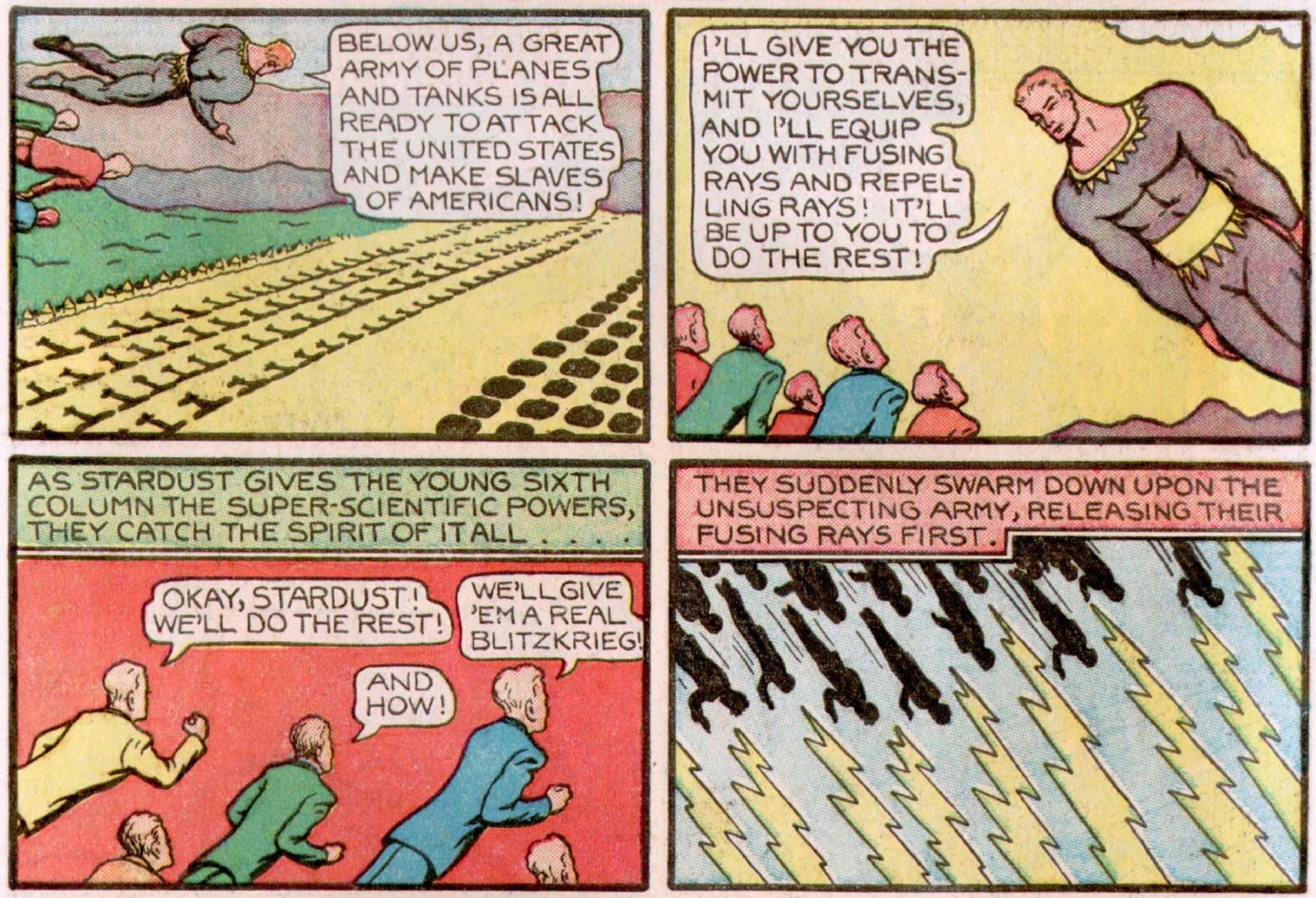
    Nineteen Forty-One: Stardust the Super Wizard, concerned about a mass mobilization of Axis fifth columnists into the Americas, vows to form a sixth column to counter their efforts. As his agents, he chooses the boys of the United States (more on this). Also please note that in between declaring that he would found the Sixth Column and actually getting around to doing so, Stardust roots out and murders every Fifth Columnist in America as part of his defense of Earth against the Martian Sky Demons.

    With no counter-espionage work to do, the Sixth Column is instead given a portion of Stardust’s power (flight, fusing rays to mess up the enemy’s war machines, repelling rays to levitate the enemy troops) and set loose as a super powered child army versus an Axis invasion force that is approaching from South America. (Fantastic Comics 014, 1941)

    The Sixth Column returns in Fantastic Comics 015, and this time they get official Stardust the Super Wizard outfits. In addition to the star-metal costumes (possibly invulnerable), the boys are equipped with mind-reading devices to root out fifth columnists and metal-repelling rays to protect the US from enemy missiles. Curiously, this time they are not given the power of flight.

    The thing that I find myself thinking while reading the two stories featuring the Sixth Column is “why is Stardust doing this?” It’s not for any lack of ability to keep on top of things, that’s for sure, as the boys do not do anything that Stardust hasn’t already done on a bigger scale, and in any case he is monitoring them the entire time as seen here when they lose control of a missile and destroy an ocean liner and he jumps in to take over immediately.

    Is it meant to be some sort of mentoring? Of ensuring that there will be a new stardust? Is he just bored? He’s probably just bored with crime fighting while being so grotesquely overpowered, isn’t he.

    Categorized in: Alphanumeric (Six), Origin (Sidekicks), Powers (Various) 

    Stardust the Super Wizard **UPDATE**:

    And speaking of Stardust the Super Wizard: we’ve seen him shapeshift before and we’ve seen him impossibly grab a man by the torso before but in this, his very last appearance, he combines the two by grabbing the villain “Slant-Eye” with a gross tentacle hand. It truly is an iconic image for the guy to go out on. (Fantastic Comics 016, 1941)

  • MINOR SUPER-HERO ROUND-UP 091

    Have a few mid-tier minor super-heroes, for a change.

    the Black Terror:

    Pharmacist Bob Benton is the kind of guy who will step in when a little kid is being roughed up by thugs, but despite this he is pretty relentlessly bullied by city Comptroller Rodney Clark* and (in a less overt but still insidious way) their mutual love interest Jean Starr.

    * Clark is such a bully, in fact, that I assumed that he was going to eventually turn out to be crooked but instead he gets murdered** after a couple of issues.

    ** In fact I was wrong when I wrote this: he is merely almost  murdered and seemingly never recovers sufficiently to return to the comic. I guess I was just hoping that he would get murdered because he is, again, such a bully.

    Perhaps because of this, Benton spends his spare time working on a “tonic for run-down people,” or so he says. I assume that he’s going for something closer to anabolic steroids, and thanks to his new assistant Tim Roland (the kid who was getting beaten up earlier), he stumbles upon the formula for something even better: formic ether! 

    Thanks to those sweet sweet formic ether fumes, Benton becomes a super-human and in a real break for society decides to keep on being a decent guy rather than setting out for revenge on all those people who pushed him around when he was weak (though he does take the opportunity to give Rodney Clark a black eye every issue until he’s murdered he retires). He gets his super suit in the most efficient way possible: by sending Tim down to the costume shop to see what they have in stock.

    The formic ethers give Benton tremendous strength and a sort of mid-tier invulnerability: he can shrug off a sock on the jaw no problem, and eventually proves to be bulletproof, but he gets knocked around and knocked out an awful lot. (Exciting Comics 009, 1941)

    Tim Roland:

    Though Bob tells Tim that he can’t join him on his quest for vigilante glory, he also just kind of leaves a smoking bottle of super power serum sitting out where anyone can get it – frankly he’s lucky not to have to team up with Rodney Clark. Instead, Tim – who has had the foresight to pick up a second costume for himself, but not to pick a super-hero name – huffs a little formic ether and gets straight to busting heads.

    Tim is the rare Golden Age sidekick who appears to be legitimately around eight to ten years old, instead of a stocky thirteen to fifteen like so many of his peers. Even more remarkably, he stays roughly in this age bracket for a couple of years, as far as can be ascertained (multiple artists mean that his height fluctuates quite a lot, but he pretty consistently wears short pants in his civilian identity). He’s also one of those orphan boys who just kind of falls into a super-guy’s orbit and becomes adopted by default. (Exciting Comics 009, 1941)

    The Black Terror dabbles in the common practice of leaving a calling card in his first appearance, and makes the baffling decision to go with his domino mask as a design, rather than the cool skull-and-crossbones on his chest.

    Categorized in: Accessories (Calling Cards), Body (Emotions – Terror), Origins (Chemical Mutates), Origins (Sidekicks)

    the Sphinx **UPDATE**:

    The Sphinx adopts the identity of the Domino Kid in order to have a very brief boxing career. (Exciting Comics 012, 1941)

    Categorized in: Origins (Secondary Identities)

    the Liberator:

    Like many super-heroes, the Liberator starts out as a weedy nerd. Specifically, he is Dr Nelson Drew, lecturer in Chemistry at Claflin College. He is, troublingly, in love with Annabel, one of his students, who also serves as one of his major bullies – she is not only bored by chemistry (but you chose to take the course, Annabel!) but also scornful of Drew for caring about it when so much is afoot in the world, but… I don’t actually know what her problem is? Like, chemistry was wildly consequential to the US war effort? Perhaps if he taught a social science I could see her point of view, if not agree with it. 

    While doing a little light research into Ancient Egyptian poisons (okay, this is arguably inconsequential), Drew discovers the lost formula for a drug called Lamesis which will supposedly make one into their physical ideal. Though skeptical, he brews up a batch and since his lab safety appears to be nonexistent (troubling indeed for a guy who is researching poisons) he immediately gets a snootful of the stuff, and  turns into a big ol’ hunk. I really enjoy how viscerally unpleasant the transformation process looks here – sadly this transformation conceit doesn’t last more than a couple of issues.

    This unexpected transformation isn’t a dream come true for Drew, and he spends his first outing in his new body – the Lamesis turns out to be a temporary thing, you see – trying to figure out how to turn back, and engages in his first bout of super-heroism after discovering that the scientist he was trying to consult with had been murdered by fascists. 

    I also enjoy the origin of the Liberator’s costume: there are plenty of super-heroes going around in their old Halloween costumes, but he might be the only one who gets his outfit by stealing someone else’s. Would he have become such an explicitly patriotic hero if he hadn’t ended up in a star-spangled shirt? (Exciting Comics 015, 1941)

    Categorized in: Accessories (Drugs), Day Jobs (College Professors), Origins (Patriotic Heroes)

    VERY MINOR UPDATES:

    John Thesson, aka the Son of the Gods, after being a character of no fixed address for his first several appearances, finally settles down: he was in Washington DC in Exciting Comics 006, but it wasn’t until 007 that it became clear that that is where he chose to hang his hat and offer his services to the US Government.

    The Mask sheds two of his assistants, Silk and Butch, as of Exciting Comics 007, and becomes of interest to the law somewhere between 009 and 010. 

  • MINOR SUPER-HERO ROUND-UP 090

    MINOR SUPER-HERO ROUND-UP 090

    We’re simply up to our eyeballs in minor super-heroes!

    K-9:

    K-9, an injured German Shepherd (they call him a police dog but I think that that’s as an alternate breed name due to the war, like how the British call them Alsatians) nursed back to health and given a terrible name by scrappy teen Tip Starr, is given ample opportunity to fight crime thanks to his association with Tip’s brother, Police Detective Dick Starr. (Dynamic Comics 001, 1941)

    Categorized in: Alphanumeric (K, 9), Animals (Dogs), Origin (Animals)

    Dynamic Boy:

    When orphan Kent Banning is severely injured while rescuing Doctor Brown’s unnamed daughter from a burning schoolhouse, Brown returns the favour by injecting him with a mysterious fluid that he got from a dying Tibetan Lama. This fluid not only saves Kent’s life but endows him with the standard array of super-powers: enhanced speed and agility, super strength and the power of flight. He also adopts the lad, which makes the chaste romance between Kent and “She Seriously Never Gets A Name” Brown just a little bit weird. She does make him a costume, which is nice. And it clearly has room for him to grow into!

    Probably the best thing about Dynamic Boy is just how lanky and awkward he is. Contextually, he’s about the same age as Robin and most of the other sidekicks in Golden Age comics, i.e., somewhere between 12 and 15 years old, but Dynamic Boy really feels like it, particularly in the sequence above, where he learns that he can fly by tripping over his own feet. (Dynamic Comics 002, 1941)

    Categorized in: Generica (Boys), Language (Superlatives – Dynamic), Origin (Mystic Mutates)

    Lady Satan:

    Lady Satan’s career begins after an ocean liner is sank by Nazi bombers and an unnamed woman (there is some impression that she uses Satan as her surname while adventuring, but whether it is her real name is hard to say) is the only survivor. Swearing vengeance, she heads back to Europe to vex the Axis.

    I really like Lady Satan! For one thing, she just kind of relies on the mystery inherent in being a hot lady in a mask and doesn’t even switch to a secret identity to seduce horny Nazis into revealing their secrets. For another, she’s supremely adaptive. Got captured and about to be shot as a spy? No problem, Lady Satan will merely steal the executioner’s pistol, take him hostage, steal a plane, crash into the pursuing planes, parachute into a handy river, steal a car and be in Berlin at the same time as the fellow she was caught trying to rob in the first place. Just a very competent character.

    She also packs a chlorine gas gun, which is horrifying to contemplate firing at another person, let alone firing it in an enclosed space. I suppose that war crimes don’t apply to you if you are a stateless vigilante, but everybody has to breathe. (Dynamic Comics 002, 1941)

    Categorized in: Famous Figures (Satan), Origin (Vengeance Quest), Royalty (Ladies)

    the Green Knight:

    Contrary to his name, the Green Knight is more of an archer-type hero than some sort of armoured bruiser or dashing cavalier. He is also our first Florida-based super-hero, as far as I can figure (many before him have visited, certainly, but none before have deigned to live there).

    As the Green Knight explains to Lance Cooper, an orphan boy who he rescues from a vampire in the Everglades, he is in actuality Denis Knight, a rich guy who collects Medieval weapons and has a rose-tinted view of knighthood that informs his forays into vigilante justice.

    Speaking of Lance, he abbreviates the usual perfunctory super-hero boy-adoption process even further by just coming out and asking to join up with Knight. He gets a mini version of the Green Knight’s costume (and sadly loses his cheeky little orphan cap in the process) and follows him into battle for the remainder of his two-adventure career as Lance, which is a very annoying name indeed. Is it just using his regular name like so many kid sidekicks do, or are they doing a bit of a winking acknowledgement that his name already fits the knightly theme? Would it kill them to give him a spear? (Dynamic Comics 002, 1941)

    Green Knight Categorized in: Colours (Green), Famous Figures (Arthurian)*, Royalty (Knights)

    Lance Categorized in: Locations (Florida), Objects (Lances), Origins (Sidekicks)

    * the character does not have anything to do with Arthuriana thematically, but the name “the Green Knight” is nonetheless enough of a reference for me

  • MINOR SUPER-HERO ROUND-UP 089

    Just when you think that there couldn’t be any more super-heroes, another batch appears.

    Major Victory:

    After an unnamed soldier stationed at US Army Camp Courage dies in an attempt to prevent the camp’s arsenal from being bombed, his body is hauled away by angelic figures and ushered into the presence of a star-spangled old man.

    This, it turns out, is Father Patriot, a new and legally distinct anthropomorphic personification of the spirit of the United States. Were the folks at Chesler concerned about using Uncle Sam due to the fact that Quality Comics was already doing so? Perhaps! Regardless of his origin, Father Patriot revives the soldier as an exemplar of the self-sacrificing military hero. Unusually for a character who has been restored to life by a mystical force, Major Victory (as he is dubbed) does not come back with any powers but is instead gifted with a costume, an airfield base complete with high-powered radio receiver and an airplane and just told to have at it.

    Major Victory is not entirely without supernatural enhancement, however: if he’s ever in a big enough jam then Father Patriot can ring the Liberty Bell to give him a rush of strength sufficient to snap a steel chain.  (Dynamic Comics 001, 1941)

    Categorized in: Generica (Majors), Origin (Patriotic Heroes), Origin (Resurrected)

    Dynamic Man:

    I’m really kicking myself here. Back when I started this blog I was focusing on super-villains and only really talking about the weirder super-heroes, and while I eventually realized my error and started talking about every super-hero at least a little (hence the round-up framework – if I only have a small amount to say about any one hero there are three more to bulk out the post) I’m still playing catch-up. This is all to say that if I’d done things right to start with I’d already have an entry on the Marvel Comics Dynamic Man to point to instead of an assertion that one is coming up in a few month when Mystic Comics comes back around in my reading list.

    This is especially galling because both the Marvel and the Chesler Dynamic Mans are androids who emerge from their birthing tubes as their creators are dying in front of them. This is a fun coincidence, probably! There are of course plenty of differences between the two: the Chesler Dynamic Man is created specifically to combat the villainous Yellow Spot, while the Marvel one is more of an exercise in creation for its own sake. Chesler Dynamic Man is also possibly a magical construct rather than a humanoid robot. My evidence for this amounts to the fact that he was created by “authority on ancient black magic” Dr Moore, who talks about giving him “the power of steel, the speed of an eagle and the wisdom of the sages,” which is pretty poetic if you’re talking about an android and might be literal if you’re growing some sort of super-homunculus.

    Dynamic Man is a hero of the Superman variety, with the powers of flight, super strength and a general invulnerability to harm. He also wears these gloves that I find very distracting – sure, that long point that extends up the forearm is an interesting addition to the costume, but how does it stay in place? Does Dynamic Man have to apply a little spirit gum to his arm every time he gets dressed?

    Finally, Dynamic Man flies with every limb maximally akimbo, and continues to do so throughout his super-heroic career. It’s honestly kind of charming. (Dynamic Comics 001, 1941)

    Categorized in: Generica (Mans), Language (Superlatives – Dynamic), Origins (Magical Constructs)

    Hale the Magician:

    It’s 1541 and the young Englishman Hale (no first name given) and his father are the only two good – though still fairly racist – Europeans in South America and thus object to the brutal treatment of the indigenous peoples by the Spanish. They head up into the mountains to pledge their support to Chief Xingu of the Maoni Indians and soon find themselves locked in battle with a group of angry conquistadors. It’s a short-lived battle, as Xingu reveals himself to be a master of science and magic by producing a lightning storm from his spear. The Spanish sensibly flee, but not before killing Hale Sr.

    Thanks to his selfless heroism (and after passing a series of challenges), Hale the Younger is essentially adopted by Xingu, who teaches his new ward all the technomagical secrets of the Maoni. Together, they create the Magic Spearhead, an artifact that contains the sum of all those powers, but before they can test it out Hale is struck down by a jealous rival. Xingu places Hale’s body in a special tomb with the promise that he will return to life one day

    Cut to 1941, the prophesied time of Hale’s revival, and scientist Henry Starrett and his daughter Lois are on-hand to witness the grand event. After waiting for months, they run out of food and Starrett makes the oafish decision to smash open the tomb with a big stick. This vandalism must have been part of the prophecy, because smashing the tomb kills Starrett and restores Hale to life in what is possibly some sort of inadvertent sacrifice.

    Thanks to the Magic Spearhead, Hale has all of the limitless power of his fellows in the fraternity of comic book magicians and he returns to the States with Lois to use those powers for the good of mankind. In an extremely frustrating development, Hale never sees fit to attach the Magic Spearhead to a spear body, making it more like a weird magic knife, but maybe it’s just me and nobody else is bothered by this. I mean, Xingu had his magic coming out of a full-sized spear, Hale. (Dynamic Comics 001, 1941)

    Categorized in: Accessories (Spears), Magical Professions (Magicians), Origins (Resurrected)

    the Black Cobra:

    The Black Cobra is a standard unit of costumed vigilante. In day-to-day life he is Jim Hornsby, son and office clerk of District Attorney Hornsby, but when danger looms he suits up and starts slinging fists. It’s not a great costume, mind you, both because it’s too busy and, importantly not black. Plus I checked out his other appearances and that is the best that that cowl is ever going to look.

    The Black Cobra also has the one variation on the meek alter ego that is more grating than the disappointed love interest: the emotionally abusive disappointed parent. Hornsby Senior in contention for Worst Father in Comics. (Dynamic Comics 001, 1941)

    Categorized in: Animals (Cobras), Colours (Black), Day Jobs (Clerks)