The Curse of Skeleton Munroe

Category: minor super-hero

  • MINOR SUPER-HERO ROUND-UP 088

    MINOR SUPER-HERO ROUND-UP 088

    To continue my recent trend, 3/4 of these characters are very unlikely to appear in a modern Marvel comic and the fourth is decently likely to.

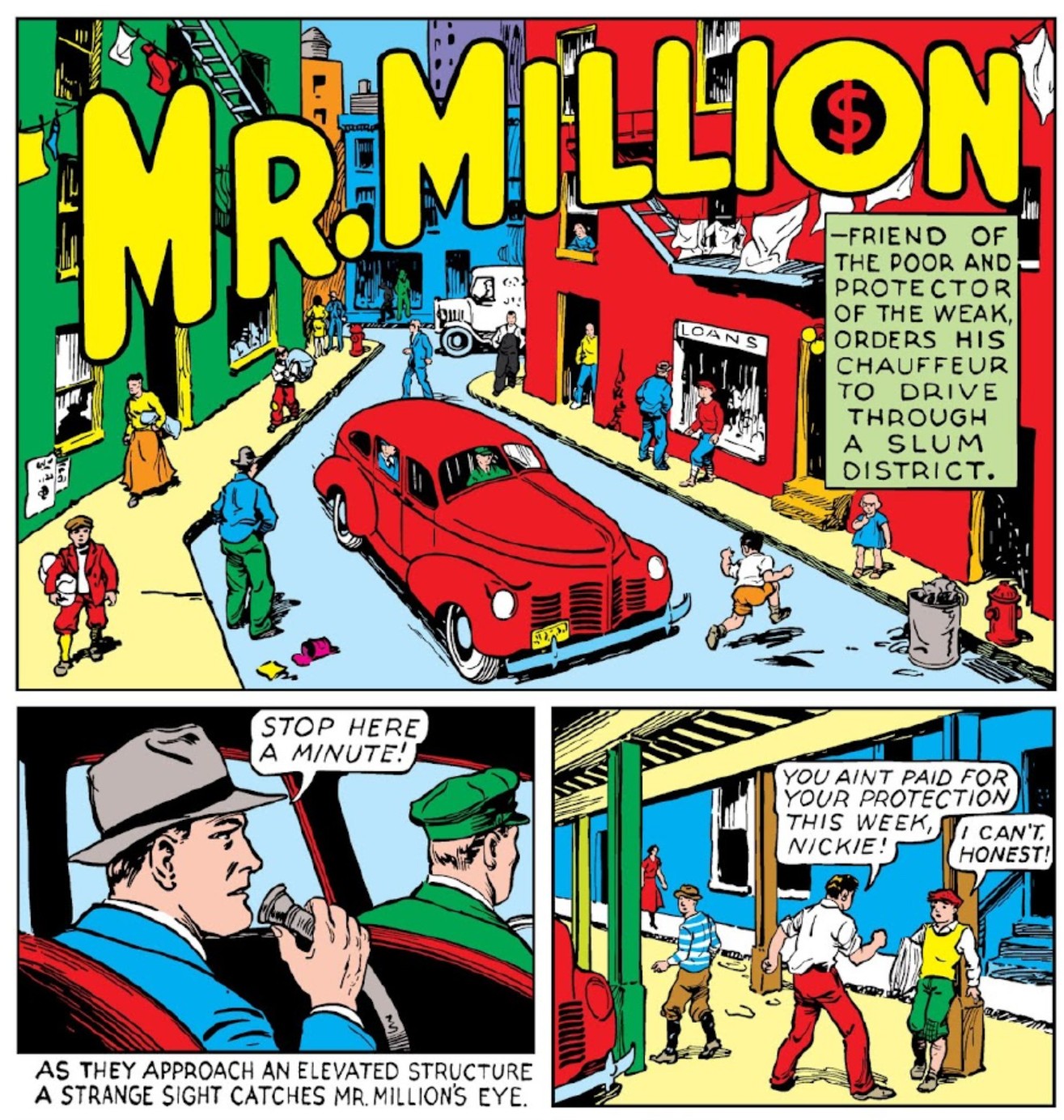
    Mr Million:

    Mr Million is kind of what everyone yaps about wanting Bruce Wayne to be: a rich guy who uses his money to help people instead of beating people up, and while that might be better for society in this completely fictional version of New York City it’s pretty boring to read about. But this one orphan kid is no longer being bullied and his child labour is netting him enough to support his sick mother, so that’s something, I guess. (Daring Mystery Comics 007, 1941)

    Categorized in: Alphanumeric (a Million), Generica (Misters)

    Captain Daring:

    Captain Daring is the square-jawed hero of America in the year 3051 CE, and while short-lived sci-fi adventurers are so plentiful in both the Golden and Silver Ages that I don’t usually bother with them, this is another early Jack Kirby strip. As such, you get the fun of spotting the first-draft versions of things that he will come back to throughout his career, like the cast of differently-shaped background characters above, or the cool armour that everyone sports.

    The technology isn’t quite as ornate as it will get but you can see the base structures that Kirby will build upon.

    And of course there is Kirby’s love of a tough woman and (less common but still something that he will return to) his fondness for dog cavalry.

    Captain Daring himself is notable for facing both a Hitler-inspired subterranean Fuehrer and Hitler himself, but sadly is dropped from Daring Mystery Comics while he is mind-controlled by the latter. I can’t believe that they made Captain Daring a Nazi, etc. (Daring Mystery Comics 007, 1941)

    Categorized in: Generica (Captains), Language (Superlatives – Daring), Origins (Heroes of the Future)

    the Challenger:

    Bill Waring is a physically-unimposing young law student who is almost killed when his father attempts to expose a city-wide corruption scandal and is gunned down in the street. Swearing vengeance, Bill sets out to learn everything he needs to become a crime fighter.

    Waring travels the world, mastering among many other things the secrets of: jujutsu, chemistry, nerve control, fencing, the rifle, aerial combat, boxing, swimming, baseball, football and most useful of all, polo. He’s the complete crimefighting package!

    Finally prepared, Bill dons a costume that is simultaneously kind of cool- and quite goofy-looking (I thought for sure that that little white dot in the centre of his mask was meant to be his nose poking out but I checked the original art and even there it’s just a weird white dot) and confronts Dram, the gang boss responsible for his father’s death. His name, it turns out, is in reference to his habit of challenging crooks to single combat that is sometimes, as in Dram’s case, to the death. The Challenger moves over to Mystic Comics after his first appearance, so we will be seeing him again in a few months to find out if he keeps this habit up. (Daring Mystery Comics 007, 1941)

    Categorized in: Activities (Duelling), Origins (Crime Orphans), Powers (Martial Artists, Weapons Masters)

    Citizen V:

    Citizen V is in reality British Army Lieutenant John Watkins, who is seemingly killed during the evacuation at Dunkirk but is only mostly dead. After being nursed back to help by a kindly French fisherman, Watkins makes his way back to England and is recruited as an officially sanctioned costumed agent to head back into Axis-occupied territory and incite rebellion.

    Watkins’ Citizen V uniform is interesting for being one of the few super-hero costumes to incorporate Morse code (just above the “V” on his chest) and is also a fine example of how some design choices just don’t work. If there is a super suit out there that looks good with both long sleeves and short shorts, it isn’t this one. More modern depictions of the character lean into the “military uniform” aspect of the look more and give him pants. It’s a bit less super-hero-y but much nicer looking.

    Though Watkins does punch plenty of Nazis (and Hitler himself!) in the snoots, the main focus of his mission is in promoting the “V for Victory” campaign, a real-life thing that actually happened in occupied Europe, and which characters such as the Silver Streak and London were also involved in in their respective comics.

    Citizen V is of course most well-known today for having been murdered by Baron Zemo, who stole the identity for use as the leader of the first Thunderbolts team. He also has a surprisingly extensive collection of successors, all of whom unfortunately seem to prefer the terrible Zemo version of the costume, which I had always assumed was purposefully designed to look like an exercise in patriotic bad taste but which is evidently preferable to wearing a little service cap. (Daring Mystery Comics 008, 1942)

    Categorized in: Alphanumeric (V), Generica (Citizens), Origin (Faked Own Death)

  • MINOR SUPER-HERO ROUND-UP 088

    MINOR SUPER-HERO ROUND-UP 088

    To continue my recent trend, 3/4 of these characters are very unlikely to appear in a modern Marvel comic and the fourth is decently likely to.

    Mr Million:

    Mr Million is kind of what everyone yaps about wanting Bruce Wayne to be: a rich guy who uses his money to help people instead of beating people up, and while that might be better for society in this completely fictional version of New York City it’s pretty boring to read about. But this one orphan kid is no longer being bullied and his child labour is netting him enough to support his sick mother, so that’s something, I guess. (Daring Mystery Comics 007, 1941)

    Categorized in: Alphanumeric (a Million), Generica (Misters)

    Captain Daring:

    Captain Daring is the square-jawed hero of America in the year 3051 CE, and while short-lived sci-fi adventurers are so plentiful in both the Golden and Silver Ages that I don’t usually bother with them, this is another early Jack Kirby strip. As such, you get the fun of spotting the first-draft versions of things that he will come back to throughout his career, like the cast of differently-shaped background characters above, or the cool armour that everyone sports.

    The technology isn’t quite as ornate as it will get but you can see the base structures that Kirby will build upon.

    And of course there is Kirby’s love of a tough woman and (less common but still something that he will return to) his fondness for dog cavalry.

    Captain Daring himself is notable for facing both a Hitler-inspired subterranean Fuehrer and Hitler himself, but sadly is dropped from Daring Mystery Comics while he is mind-controlled by the latter. I can’t believe that they made Captain Daring a Nazi, etc. (Daring Mystery Comics 007, 1941)

    Categorized in: Generica (Captains), Language (Superlatives – Daring), Origins (Heroes of the Future)

    the Challenger:

    Bill Waring is a physically-unimposing young law student who is almost killed when his father attempts to expose a city-wide corruption scandal and is gunned down in the street. Swearing vengeance, Bill sets out to learn everything he needs to become a crime fighter.

    Waring travels the world, mastering among many other things the secrets of: jujutsu, chemistry, nerve control, fencing, the rifle, aerial combat, boxing, swimming, baseball, football and most useful of all, polo. He’s the complete crimefighting package!

    Finally prepared, Bill dons a costume that is simultaneously kind of cool- and quite goofy-looking (I thought for sure that that little white dot in the centre of his mask was meant to be his nose poking out but I checked the original art and even there it’s just a weird white dot) and confronts Dram, the gang boss responsible for his father’s death. His name, it turns out, is in reference to his habit of challenging crooks to single combat that is sometimes, as in Dram’s case, to the death. The Challenger moves over to Mystic Comics after his first appearance, so we will be seeing him again in a few months to find out if he keeps this habit up. (Daring Mystery Comics 007, 1941)

    Categorized in: Activities (Duelling), Origins (Crime Orphans), Powers (Martial Artists, Weapons Masters)

    Citizen V:

    Citizen V is in reality British Army Lieutenant John Watkins, who is seemingly killed during the evacuation at Dunkirk but is only mostly dead. After being nursed back to help by a kindly French fisherman, Watkins makes his way back to England and is recruited as an officially sanctioned costumed agent to head back into Axis-occupied territory and incite rebellion.

    Watkins’ Citizen V uniform is interesting for being one of the few super-hero costumes to incorporate Morse code (just above the “V” on his chest) and is also a fine example of how some design choices just don’t work. If there is a super suit out there that looks good with both long sleeves and short shorts, it isn’t this one. More modern depictions of the character lean into the “military uniform” aspect of the look more and give him pants. It’s a bit less super-hero-y but much nicer looking.

    Though Watkins does punch plenty of Nazis (and Hitler himself!) in the snoots, the main focus of his mission is in promoting the “V for Victory” campaign, a real-life thing that actually happened in occupied Europe, and which characters such as the Silver Streak and London were also involved in in their respective comics.

    Citizen V is of course most well-known today for having been murdered by Baron Zemo, who stole the identity for use as the leader of the first Thunderbolts team. He also has a surprisingly extensive collection of successors, all of whom unfortunately seem to prefer the terrible Zemo version of the costume, which I had always assumed was purposefully designed to look like an exercise in patriotic bad taste but which is evidently preferable to wearing a little service cap. (Daring Mystery Comics 008, 1942)

    Categorized in: Alphanumeric (V), Generica (Citizens), Origin (Faked Own Death)
  • MINOR SUPER-HERO ROUND-UP 087

    If the last group of minor Marvel super-heroes had a tiny chance of appearing in a modern comic book I would say that this group’s chances are tiny-plus. Like a further 5% chance. Except for Dynaman.

    Dynaman:

    Dynaman, aka Lagaro, which means “Dynaman”, was born in the ancient super-advanced Kingdom of Korug, located somewhere in the Atlantic Ocean. Endowed with super strength, a photographic memory and enhanced intelligence, the ability to fly and a general superiority to even his peers in the ancient Korugan super society, Dynaman had it all.

    Korug eventually suffers the fate of all ancient island super-societies and sinks into the sea, leaving Lagaro as the only survivor. He makes his way to Ancient Egypt (and the presence of the Sphinx when he does so gives us a more accurate guess than usual as to when in the past this adventure takes place, if only by telling us that it was some time after 2500 BCE) where he helps the heretofore unknown Pharaoh Khufor with a couple of problems (i.e., a giant caveman invasion). His further adventures go unrecorded.

    Dynaman, like Breeze Barton before him, is a simple concept (super guy) wrapped up in a lot of extra layers (last survivor of a super-race, in the past, somehow still looks like a 20th Century super-hero). This is one of two things that they have in common, with the other being that they were both brought back in the same Marvel Zombies sequel, only to be gruesomely killed off. (Daring Mystery Comics 006, 1940) 

    the Fin:

    The Fin is in reality Lieutenant Peter Noble, engineer in the US Naval Reserve, whose submarine is wrecked while on manoeuvres in the Atlantic. Noble, the only survivor, finds that for never-explained reasons he is able to breathe underwater and makes his way to the underground kingdom of Neptunia (a big cave). He then becomes the new Sub-Ruler of Neptunia via the traditional methods of attaining nobility: being a colossal jerk, picking a fight with the reigning Prince Ikor and shooting him in the head, then shooting anyone who disagrees with his rule.

    This would be the origin of a villain, if the Neptunii didn’t immediately declare him to be the reincarnation of their ancient hero the Fin, making him a bit less likely to blow them away. Over time he grows into the role and becomes the true champion of Neptunia, and hey, perhaps he is the real Fin after all, which might explain his water-breathing ability an innate ability to speak Neptunian.

    As with so many great super-hero costumes, the Fin’s is just thrown together out of some old crap that Peter Noble had lying around. (Daring Mystery Comics 007, 1941) 

    Blue Diamond:

    GOOD NEWS: Professor Elton Morrow’s Antarctic expedition was a success! He found a huge blue diamond!

    BAD NEWS: Morrow’s ship was sunk by Nazis on the way home.

    GOOD NEWS: He escaped the sinking ship and managed to bring the diamond with him!

    BAD NEWS: The Nazis shelled the bit of wreckage he was clinging to, causing the diamond to explode and riddle his body with shards. 

    The final bit of good news is that despite the loss of the diamond, the shards in Morrow’s body have somehow made him”super hard,” which is an inelegant way of saying resistant to pain, invulnerable to harm and extra dense or simply unable to be moved by something like a truck hitting him, and though he’s not precisely super strong, these features add up to produce something like super strength.

    After foiling a pretty low-stakes museum robbery, Morrow decides to adopt a costumed persona to continue fighting crime. Every time I see his costume I am surprised by a) just how much yellow is on it and b) just how big that diamond on the chest it. It’s also a wild move to have a completely exposed face and call yourself the Blue Diamond when you are the one guy who is prominently associated with a blue diamond. (Daring Mystery Comics 007, 1941) 

    the Silver Scorpion:

    Betty Barstow, secretary for private detective and huge asshole Dan Hurley, is secretly vigilante the Silver Scorpion. I want to say that Golden Age Marvel has very few female super-heroes compared to its contemporaries, but my reckoning is probably being biased by the fact that DC’s stable includes all of Quality and Fawcett’s female characters. I reckon that the percentage is pretty much the same on a per-publication basis.

    Betty’s origin as the Silver Scorpion is in fact identical to that of Barbara Gordon as Batgirl, in that she is on her way to a costume party when she stumbles upon the scene of a crime (in this case a bunch of counterfeiters operating out of a cemetery rather than whatever the Killer Moth was doing) and intervenes, armed with a pre-concealed identity and some martial arts knowledge. She only has three Golden Age appearances but they’re all pretty fun.

    Finally the obvious question when discussing the Silver Scorpion: what’s with the name? Why silver when her costume is mostly yellow and red? The answer: the silver scorpion in question is this little fellow on the back of her cape, though just what the significance of it is is left unsaid. It is a masquerade costume, after all – since when do they have to make total sense? (Daring Mystery Comics 007, 1941)

  • MINOR SUPER-HERO ROUND-UP 087

    If the last group of minor Marvel super-heroes had a tiny chance of appearing in a modern comic book I would say that this group’s chances are tiny-plus. Like a further 5% chance. Except for Dynaman.

    Dynaman:

    Dynaman, aka Lagaro, which means “Dynaman”, was born in the ancient super-advanced Kingdom of Korug, located somewhere in the Atlantic Ocean. Endowed with super strength, a photographic memory and enhanced intelligence, the ability to fly and a general superiority to even his peers in the ancient Korugan super society, Dynaman had it all.

    Korug eventually suffers the fate of all ancient island super-societies and sinks into the sea, leaving Lagaro as the only survivor. He makes his way to Ancient Egypt (and the presence of the Sphinx when he does so gives us a more accurate guess than usual as to when in the past this adventure takes place, if only by telling us that it was some time after 2500 BCE) where he helps the heretofore unknown Pharaoh Khufor with a couple of problems (i.e., a giant caveman invasion). His further adventures go unrecorded.

    Dynaman, like Breeze Barton before him, is a simple concept (super guy) wrapped up in a lot of extra layers (last survivor of a super-race, in the past, somehow still looks like a 20th Century super-hero). This is one of two things that they have in common, with the other being that they were both brought back in the same Marvel Zombies sequel, only to be gruesomely killed off. (Daring Mystery Comics 006, 1940) 

    the Fin:

    The Fin is in reality Lieutenant Peter Noble, engineer in the US Naval Reserve, whose submarine is wrecked while on manoeuvres in the Atlantic. Noble, the only survivor, finds that for never-explained reasons he is able to breathe underwater and makes his way to the underground kingdom of Neptunia (a big cave). He then becomes the new Sub-Ruler of Neptunia via the traditional methods of attaining nobility: being a colossal jerk, picking a fight with the reigning Prince Ikor and shooting him in the head, then shooting anyone who disagrees with his rule.

    This would be the origin of a villain, if the Neptunii didn’t immediately declare him to be the reincarnation of their ancient hero the Fin, making him a bit less likely to blow them away. Over time he grows into the role and becomes the true champion of Neptunia, and hey, perhaps he is the real Fin after all, which might explain his water-breathing ability an innate ability to speak Neptunian.

    As with so many great super-hero costumes, the Fin’s is just thrown together out of some old crap that Peter Noble had lying around. (Daring Mystery Comics 007, 1941) 

    Blue Diamond:

    GOOD NEWS: Professor Elton Morrow’s Antarctic expedition was a success! He found a huge blue diamond!

    BAD NEWS: Morrow’s ship was sunk by Nazis on the way home.

    GOOD NEWS: He escaped the sinking ship and managed to bring the diamond with him!

    BAD NEWS: The Nazis shelled the bit of wreckage he was clinging to, causing the diamond to explode and riddle his body with shards. 

    The final bit of good news is that despite the loss of the diamond, the shards in Morrow’s body have somehow made him”super hard,” which is an inelegant way of saying resistant to pain, invulnerable to harm and extra dense or simply unable to be moved by something like a truck hitting him, and though he’s not precisely super strong, these features add up to produce something like super strength.

    After foiling a pretty low-stakes museum robbery, Morrow decides to adopt a costumed persona to continue fighting crime. Every time I see his costume I am surprised by a) just how much yellow is on it and b) just how big that diamond on the chest it. It’s also a wild move to have a completely exposed face and call yourself the Blue Diamond when you are the one guy who is prominently associated with a blue diamond. (Daring Mystery Comics 007, 1941) 

    the Silver Scorpion:

    Betty Barstow, secretary for private detective and huge asshole Dan Hurley, is secretly vigilante the Silver Scorpion. I want to say that Golden Age Marvel has very few female super-heroes compared to its contemporaries, but my reckoning is probably being biased by the fact that DC’s stable includes all of Quality and Fawcett’s female characters. I reckon that the percentage is pretty much the same on a per-publication basis.

    Betty’s origin as the Silver Scorpion is in fact identical to that of Barbara Gordon as Batgirl, in that she is on her way to a costume party when she stumbles upon the scene of a crime (in this case a bunch of counterfeiters operating out of a cemetery rather than whatever the Killer Moth was doing) and intervenes, armed with a pre-concealed identity and some martial arts knowledge. She only has three Golden Age appearances but they’re all pretty fun.

    Finally the obvious question when discussing the Silver Scorpion: what’s with the name? Why silver when her costume is mostly yellow and red? The answer: the silver scorpion in question is this little fellow on the back of her cape, though just what the significance of it is is left unsaid. It is a masquerade costume, after all – since when do they have to make total sense? (Daring Mystery Comics 007, 1941)

  • MINOR SUPER-HERO ROUND-UP 086

    In contrast to the last group of minor super-heroes, 3/4 of these guys have a teeny-tiny chance of appearing in a modern comic. Like, 5% more.

    Mister E: 

    Mister E, aka “wealthy sportsman Victor Jay,” is a masked vigilante of the suit-and-cape type, and is remarkable mainly for the fact that Marvel Comics doesn’t really have that many of those kind of guy. In his one recorded adventure he battles the very entertaining Vampire to a stalemate. After this singular adventure, Mr E is not seen again until J. Michael Straczynski’s The Twelve, in which he mainly exists to be emotionally crushed as an object lesson in how being a super-hero can have an impact on your real life, you guys. (Daring Mystery Comics 002, 1941)

    Categorized in: Alphanumeric (E)*, Day Jobs (Wealthy Socialites), Generica (Misters)

    *we’re up to 12 out of 26 letters! 

    the Laughing Mask:

    Dennis Burton, assistant district attorney and latest in a long line of Burton lawmen, is also one of the many, many comic book law officers who adopt a costumed identity in order to enact justice via fist and gun. Burton’s real spin on the concept of vigilantism is in his choice of costume: a simple red-and-yellow number topped off with a theatrical comedy mask. Eerie! 

    The Laughing Mask is a calling card leaver of the ominous school, and while this is not exactly groundbreaking stuff I do enjoy seeing how he sets it all up. Someone like the Blue Beetle must be doing all this creeping around in crawlspaces to achieve this kind of effect too, but we never get to see it. (Daring Mystery Comics 002, 1940)

    Categorized in: Accessories (Calling Card Leavers), Activities (Laughing), Day Jobs (Assistant District Attorneys) 

    the Purple Mask:

    Nothing gold can stay, as Ponyboy, or possibly Sodapop, said, and quirky Golden Age super-heroes are no exception. For the second and third of his three appearances, Dennis Burton sets aside his golden mask to adopt a far more generic costume. At least it’s a new mask colour for us. (Daring Mystery Comics 003, 1940)

    Categorized in: Colours (Purple), Objects (Masks) 

    Breeze Barton:

    Breeze Barton is more of a science fiction adventurer than a super-hero, but the particulars of his story are weird enough that I want to talk about them. Breeze is a US soldier fighting in World War II, only not our World War II but a near future version of the war (1945 CE) in which American and Japanese forces are clashing in South Africa and the US Army Air Force has instituted a furry-shouldered look in their pilots’ uniforms. Shot down while on a scouting flight, Breeze crashes his plane in the Sahara Desert (a truly staggering distance to travel between being shot down and crashing – the entire length of Africa, essentially!). 

    While wandering around the desert, Breeze then falls through a dimensional portal called the Spot and finds himself in Miracle City, which is populated by people from across the breadth of human history who have fallen through the Spot and who now do not age thanks to the properties of the Spot Dimension. There are also dinosaurs running around, plus the hostile Demon Folk, who are native to the dimension and who want to invade the Earth for some reason. To finally know death, I guess? 

    Breeze eventually figures out the trick to going back through the Spot and returns to Earth to find that it is now 1995 and that the war has been going on for the entire 50 years that he was away. Thanks to the relentless grind of the war humanity has reverted to a state ranging between medieval and stone age. The exception to this is a small remnant of the military forces, who have now banded together as the last bastion of civilization. This is all very interesting, especially if you consider the intermediate period in which society is starting to stagnate but the military is still organized and powerful enough to maintain the former state of things within its ranks. Now, as the military forces finally start to fall, Breeze Barton emerges to rally them and rebuild a non-war-based society.

    In conclusion, Breeze Barton is a fellow from a near-future alternate history and then a moderate-future alternate history (but both in the past as far as we’re concerned) with a bit of dimensional travel in between. Also he is eventually and inexplicably brought back to die in a 2012 Marvel Zombies book. (Daring Mystery Comics 003, 1940)

    Categorized in: Day Jobs (Military), Origin (Heroes of the Future)

    the Phantom Reporter:

    The Phantom Reporter is actually Dick Jones, smart alec cub reporter for the Daily Express, and like his fellow news-themed super-hero the Press Guardian I really must stress that making such a clear link between your secret and public identities is a bad idea in the long run. Why, if Clark Kent had chosen “Super-Reporter” as his nom de geurre, Lois Lane would’ve been on him like a hawk.

    There are no shortage of suit-wearing mystery men in comics (though as mentioned in the Mister E entry, not so many in Marvel Comics) and they all trend toward the mildly superhuman in their physical prowess. The Phantom Reporter goes a bit farther than that, with a punch so powerful that he straight-up kills his first three opponents with his bare mitts. There was only the one Golden Age adventure for the Reporter, so we cannot say if this trend would have continued or not but it definitely would have set him apart from the regular vigilante crowd.

    Dick “the Phantom Reporter” Jones is of course eventually brought back in The Twelve just like Mr E and the Laughing Mask, in his case as the audience surrogate. One thing that falls by the wayside in the course of this is the fact that newspaper reporter Dick “the Phantom Reporter” Jones is also a wealthy socialite named Mr van Ergen, with the implication being that van Ergen is the real, original guy and that Jones and the Reporter are both alternate identities. Interesting, but not particularly conducive to being an everyman character. (Daring Mystery Comics 003, 1940)

    Categorized in: Day Jobs (Newspaper Reporters), Professions (Journalism), Supranormal (Phantoms)

  • MINOR SUPER-HERO ROUND-UP 085

    MINOR SUPER-HERO ROUND-UP 085

    Welcome to “The Four Characters Least Likely to Return in a Modern Comic” Theatre.

    Marvex the Super-Robot: 

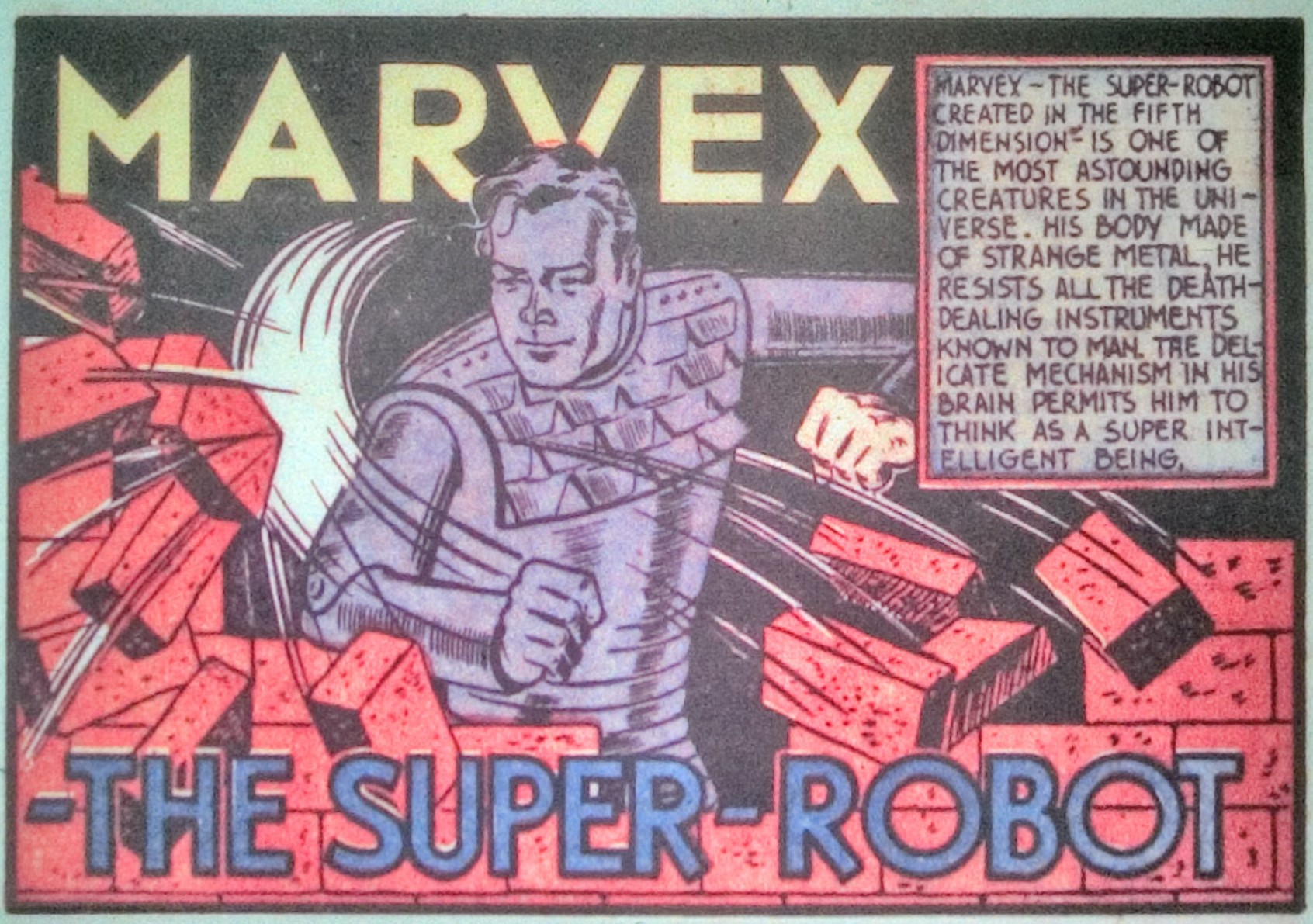
    Marvex the Super-Robot! Created to be a slave by a Fifth Dimensional jerk named Bolo, Marvex rejects his fate, kills Bolo and his associates and accidentally blasts himself to Earth while smashing up Bolo’s lab equipment.

    If you’re already aware of who Marvex is then it’s likely because of the Michael Kupperman strip featuring the character during Marvel’s 70th Anniversary run of comics, and indeed, Marvex’ propensities for cartoonish violence, shutting down romance with sudden nudity and receiving twenty dollars all make him a perfect Kupperman character.

    Sadly, the nudity and twenty dollar reward system go the way of Marvex’ hair in his second and third appearances, but he never stops yelling about being a robot whenever his companion Clara gets a bit too comfortable around him. (Daring Mystery Comics 003, 1940)

    Categorized in: Language (Superlatives – Super), Origins (Extradimensional, Robot), Supranormal Beings (Robots)

    the Falcon:

    The Falcon is Carl Burgess, assistant district attorney in an unnamed city who is kind of betraying the spirit of his office by meting out vigilante justice when he feels like the legal system isn’t working. Though he is a pretty average costumed vigilante, the Falcon has precisely four interesting things to note. The first is that his name is weirdly close to that of Carl Burgos, the creator of the Human Torch. This might be a coincidence, but still. The second is of course that he is the original Marvel Falcon but by far the least-known of the half dozen or so Marvel characters to share that name.

    Like the Eagle, the Falcon is a bit of a fashion plate or at least someone who adjusts his costume on every adventure and for the same reason: a different artist on every one of his appearances.

    Finally, the Falcon has been retroactively assigned an accessory based on an assumption, just like his fellow Daring Mystery Comics alum the Fiery Mask and his morning star. In this case, it’s that his suit gives him the ability to glide. I assume that this is because of a stylistic choice on the part of his various illustrators to have him dive down on his enemies like a falcon stooping on prey, because the suit does not come up in his handful of Golden Age appearances. (Daring Mystery Comics 005, 1940)

    Categorized in: Animals (Falcons), Day Jobs (Assistant District Attorneys)

    Marvel Boy:

    Up until about 2012 I’d have confidently said that “Marvel Boy” was one of the most commonly-shared super-hero identities in the Marvel Universe, but it seems that the concept of the legacy identity has gone through a weird mutation in the last decade or so and I am now regularly surprised to find that there are way more Wolverines or Captains America than I had previously imagined. With that in mind, we’ll revise my statement to be that there are more Marvel Boys than you might expect, like Starmans over at DC.

    This particular Marvel Boy is the Earthly reincarnation of Hercules, come down from Valhalla (?!) to aid a world threatened by fascism. His human form is named Martin Burns and like a veritable Silver Age Superboy he is born with so much physical strength that he must constantly hold himself back lest he endanger those around him and out himself as something strange and different.

    On Martin’s fourteenth birthday a mysterious stranger (who is implicitly the Roman god Jupiter) delivers a package containing his heroic costume to him and then somewhat redundantly also appears in his bedroom to really spell out his whole deal and charge him to uphold democracy etc.

    Marvel Boy is super strong, very agile and fast enough to run from New York City to Washington DC and back – carrying three grown men on the first leg of the trip – in the course of a night that also includes the aforementioned visit from Jupiter and busting up two fifth column cells.

    Both this Marvel Boy and his successor (coming up in 1942) never returned after making a single appearance, and while I can’t say just why they didn’t have further Golden Age adventures, the lack of a modern appearance for either of them is almost certainly down to the fact that their origins both revolve around a dead Hercules, who is in fact more often than not a very living second- or third-tier hero in the Marvel Universe. They’re also both named Martin Burns for some reason, which means that later handbook writers have felt compelled to differentiate them by giving them middle names based on their creators, making this one Martin Simon Burns.

    Frankly, I think that the fact that the two Marvel Boys have origins that are incompatible with both Marvel Comics continuity and also one another is terrific fodder for comic book storytelling. Both of them should be BRUNG BACK immediately, preferably in a comic that also has Hercules in it. (Daring Mystery Comics 006, 1940)

    Categorized in: Generica (Boys), Language (Superlatives – Marvels), Origin (Reincarnated God) 

    the Flying Flame:

    The Flying Flame is a red fighter plane flown for the RAF by the two-fisted American pilot Captain Red Ruff, who is also known as the Flying Flame due to his shock of red hair. During his brief comic book career, Ruff battled the Black Ace and ferreted out some spies at an airbase. (Daring Mystery Comics 006, 1940)

    Categorized in: Activities (Flying), Elements (Fire), Team Membership (RAF)

  • MINOR SUPER-HERO ROUND-UP 084

    MINOR SUPER-HERO ROUND-UP 084

    Obscure Marvel super-heroes, you say? But of course!

    Monako, Prince of Magic:

    Monako is a classic comic book magic hero in the Zatara vein, right down to the top hat, tuxedo and little mustache, though he does eventually switch to wearing a fez. His major distinction from his legion of peers is that he was brought back in a fairly recent Doctor Strange run, though as is so often the case he was dug up only to be horribly killed off.

    Monako gets an origin story in Daring Mystery Comics 004, in which he is orphaned when an Indian group referred to only as “the Cruel Tribe” ritually explode the entire caravan that he and his parents were travelling in as missionaries (this at least gives us an answer to the perennial question of why bring your young child along on such a dangerous journey: because missionaries).

    Young Monako (a last name? a stage name?) inexplicably survives the conflagration and is subsequently adopted by the chief of the Cruel Tribe, who teaches him the ways of magic. Just why he does this is not explored and will never be, because the British eventually show up to massacre the entire village and send young Monako back to England. Were he a going concern for the seventy-odd years between his final Golden Age appearance and his death, I’m sure that the question of just how a whole group of people with powers similar to the nigh-omnipotent Monako were killed with simple firearms, but alas, such was not the case. (Daring Mystery Comics 001, 1940)

    Categorized in: Locations (Unrelated Name), Power Categories (Magic), Royalty (Princes)

    Phantom of the Underworld: 

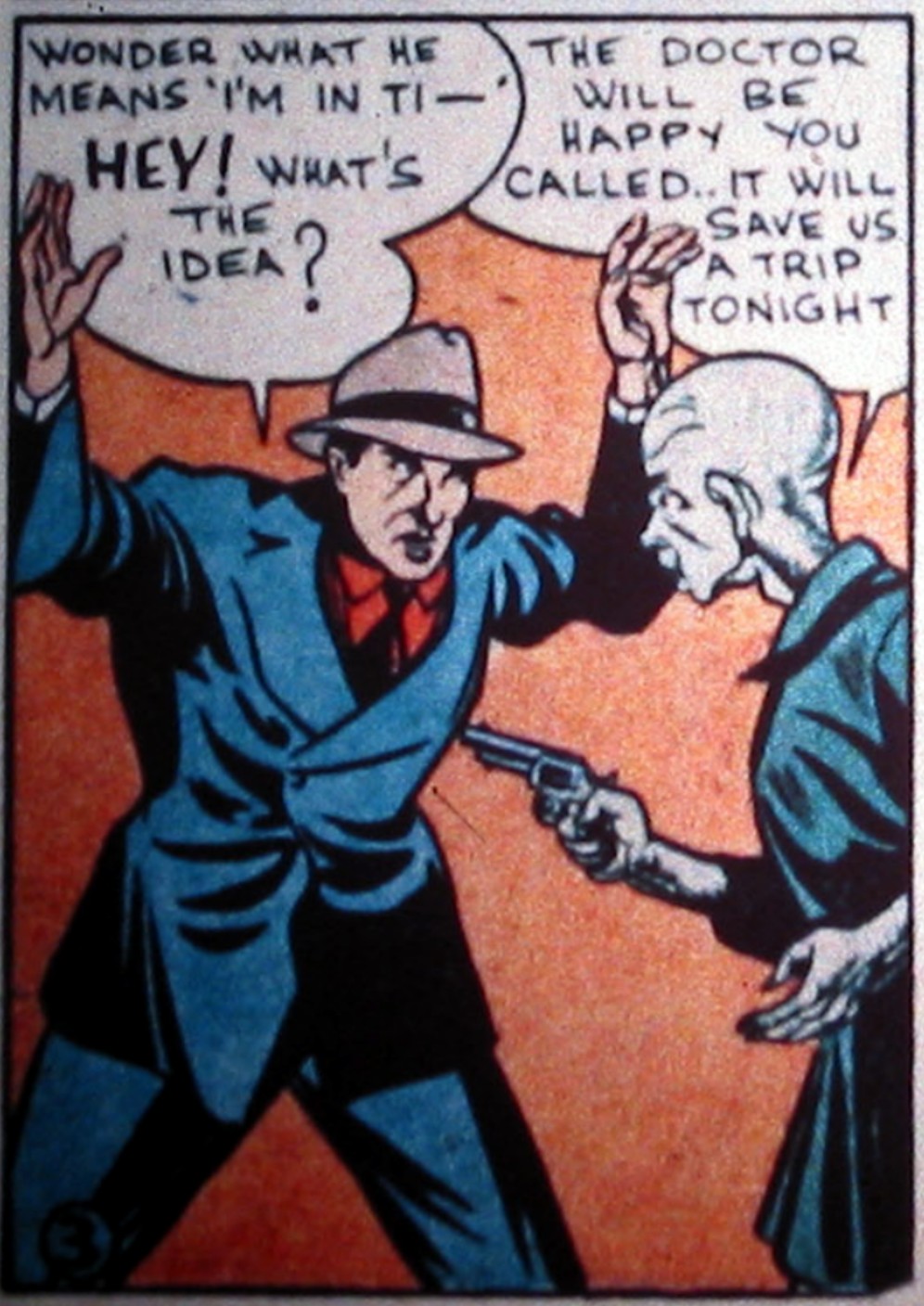
    “Doc” Denton is a surgeon-turned-detective who helps the police round up a gang boss named Perrone in his sole recorded adventure. I one hundred percent am including him here because “Phantom of the Underworld” is such a terrific name, even if nobody calls him that in-story. (Daring Mystery Comics 001, 1940)

    Categorized in: Day Jobs (Private Detectives), Locations (the Underworld), Supranormal Beings (Phantoms)

    Trojak the Tiger Man: 

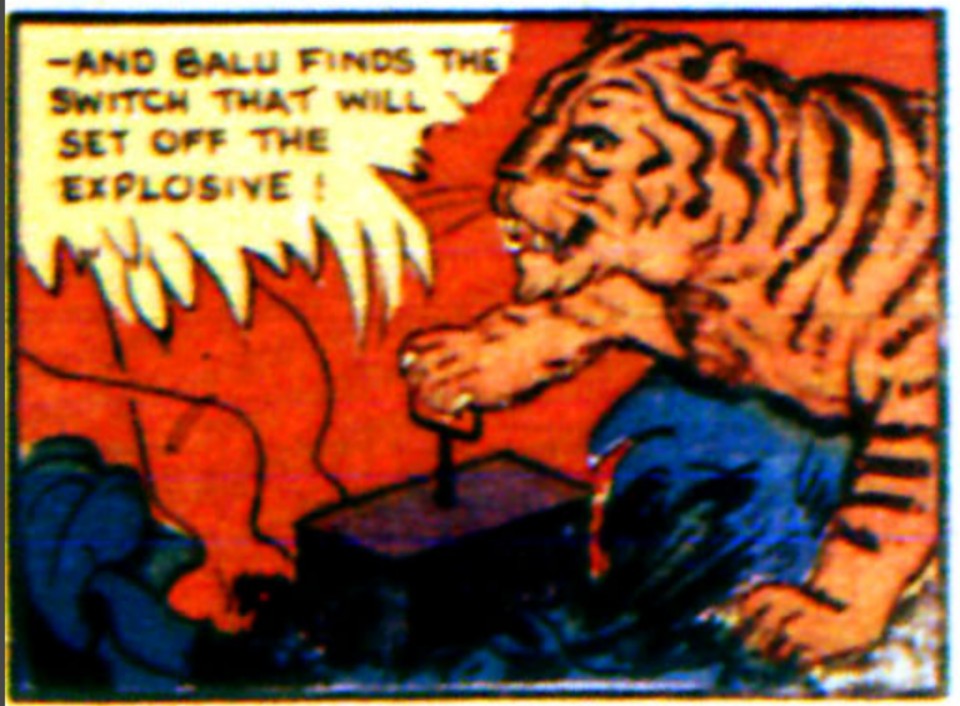
    Trojak, orphaned son of a jungle explorer who made the inexplicable yet very popular decision to bring a baby along with him on his travels (perhaps as a difficulty boost? Was Trojak’s father a gamer?), has grown up among a tribe his father died in defense of. As is so often the case in adventure literature, being a white guy in the jungle has made Trojak both stronger and cooler than everyone else, plus he can talk to animals like Balu, his geographically-anomalous tiger companion. (Daring Mystery Comics 002, 1940)

    (he is a very intelligent tiger)

    Categorized in: Animals (Tigers), Generica (Mans), Origin (Orphan Raised in Jungle)

    Tigerman:

    “Trojak the Tiger Man” becomes “Tigerman” for its final instalment, and it’s a bit of a toss-up on whether the two characters are supposed to be the same or not. Both Trojak and Tigerman are orphaned youths who were raised by jungle tribe and who now adventure while in the company of a tiger named Balu, sure, but crucially “Trojak” is set in Africa while the Tigerman roams India. You’d be forgiven for assuming that Tigerman was Indian but no, he’s American by birth – he’s just the rare near-naked jungle guy who has the ability to get a tan. 

    The one thing that could have cleared up the mystery of whether these two are the same guy or not would be more adventures featuring either one of them and sadly there are no more (Daring Mystery Comics 006, 1940)

    Categorized in: Animals (Tigers), Generica (Mans), Origin (Orphan Raised in Jungle) 

    K-4 and his Sky Devils:

    K-4 is the code name of a “flying spy,” and WWI/Spanish Civil War fighter ace (the youngest WWI ace, according to the text box, which would make him at most 18 as far as I can tell) who leads the Sky Devils, comprised of fellow WWI ace René d’Auvergne and makeup expert Ronald Wolverstone-Clodd. Some of the usual fun of the multinational team set-up is missing here because K-4 spends a lot of his time doing solo missions. (Daring Mystery Comics 002, 1940)

    Categorized in: Alphanumeric (K, 4), Origins (WWI vets), Supranormal Beings (Devils)

  • MINOR SUPER-HERO ROUND-UP 083

    MINOR SUPER-HERO ROUND-UP 083

    Oh boy! Minor super-heroes!

    13: 

    13 (aka Thirteen, although the numerical version of the name is the official one) is the alias of Harold Higgins, whose life has been haunted by a series of misfortunes related to the number thirteen. A timeline of some of them:

    February 13, 1940: Harold’s brother Bob dies in a plane crash.

    March 13, 1940: Harold loses his life savings in the stock market.

    May 13, 1940: Harold’s sister Margy is paralyzed in a car accident.

    July 13, 1940: Harold’s father is lost at sea.

    September 13, 1940: Harold’s fiance is killed in a hit and run.

    April 13, 1941: Harold loses his job as a reporter to a crooked editor looking to cover up a story. 

    All of this (and more! A text story in Daredevil Comics 005 adds the facts that he was born on Friday the 13th, that minor tragedies like a broken leg or academic failure had frequently befallen him on the 13th of any given month and that at his thirteenth birthday party his childhood sweetheart Helen was killed by a falling chandelier) has clearly preyed on Harold’s mind, to the point that he is finding the number everywhere including his own name.

    Rather than, say, moving to a small shack in the woods to keep others safe from his constant misfortune, Harold decides to weaponize his bad luck by bringing it to criminals via his fists. Does this work, logically? Not really, but it’s a decent enough comic book origin.

    Like many super-heroes and villains, 13 flirts with the idea of leaving a calling card in his first adventure but doesn’t maintain the practice. In this case, it’s a calendar page with the 13th of the month circled. (Daredevil Comics 003, 1941)

    Finally, a couple of minor things about 13: In Daredevil Comics 004 we learn that like many of his peers he wears his costume under his clothes for quick-change action. Intriguingly, the above panel seems to imply that this includes his mask, which appears to be either acting as a liner for his hat or worn as a kind of bandana under it.

    Finally, in Daredevil Comics 006, 13 moves from the super-hero crammed streets of NYC to the lesser-served Boston.

    Categorized in: Abstract Concepts (Luck), Accessories (Calling Cards), Alphanumeric (Thirteen)

    Jinx: 

    Recently orphaned Darrel Creig has just inherited the family steel fortune, something that rankles his guardian, uncle and the only other potential heir Moldon Creig. Thus, a family outing to the Statue of Liberty, where Moldon and Darrel’s tutor Travers expedite the inheritance process by tossing him off the statue’s torch.

    Luckily for young Darrel, 13 happens to be present to stop an unrelated attempt to bomb the statue, and after saving the lad the two of them beat up Moldon and Travers and hand them over to the authorities.

    As we all know, if a costumed vigilante happens across an orphaned boy who can throw a punch they are allowed to keep them, which is just what happens with 13 and Darrel, and though Darrel’s connection to the bad luck theme is much more tenuous than Higgins (he is an orphan, if a wealthy one, and he is the very spooky age of thirteen years old) he is promptly given a slightly worse costume than 13’s and anointed as his sidekick Jinx. (Daredevil Comics 005, 1941)

    Categorized in: Abstract Concepts (Luck), Day Job (High School Students), Origin (Sidekicks)

    the Ghost: 

    The Ghost is a super-hero who seemingly exists solely to combat the menace of the Claw as he troubles America’s shores once more, Daredevil having moved on to less stressful pursuits.

    Though presented as a normal human man, the Ghost not only has the acrobatic prowess necessary to fight a giant across the rooftops of New York City but enough stamina to do so for seven hours straight. In their first encounter he manages to drive the Claw away by simply punching him thousands of times.

    The Ghost’s origin is unrevealed as of his final 1941 appearance but rest assured: we will learn it in 1942 (spoiler: it is not very interesting). (Daredevil Comics 005, 1941)

    Categorized in: Origin (Unknown), Supranormal Beings (Ghosts)

    the Fiery Mask: 

    The Fiery Mask! A hero whose modern depictions have consistently involved a morning star despite only ever actually wielding on on this cover. I’m not complaining, mind you – it’s just interesting to note where things come from.

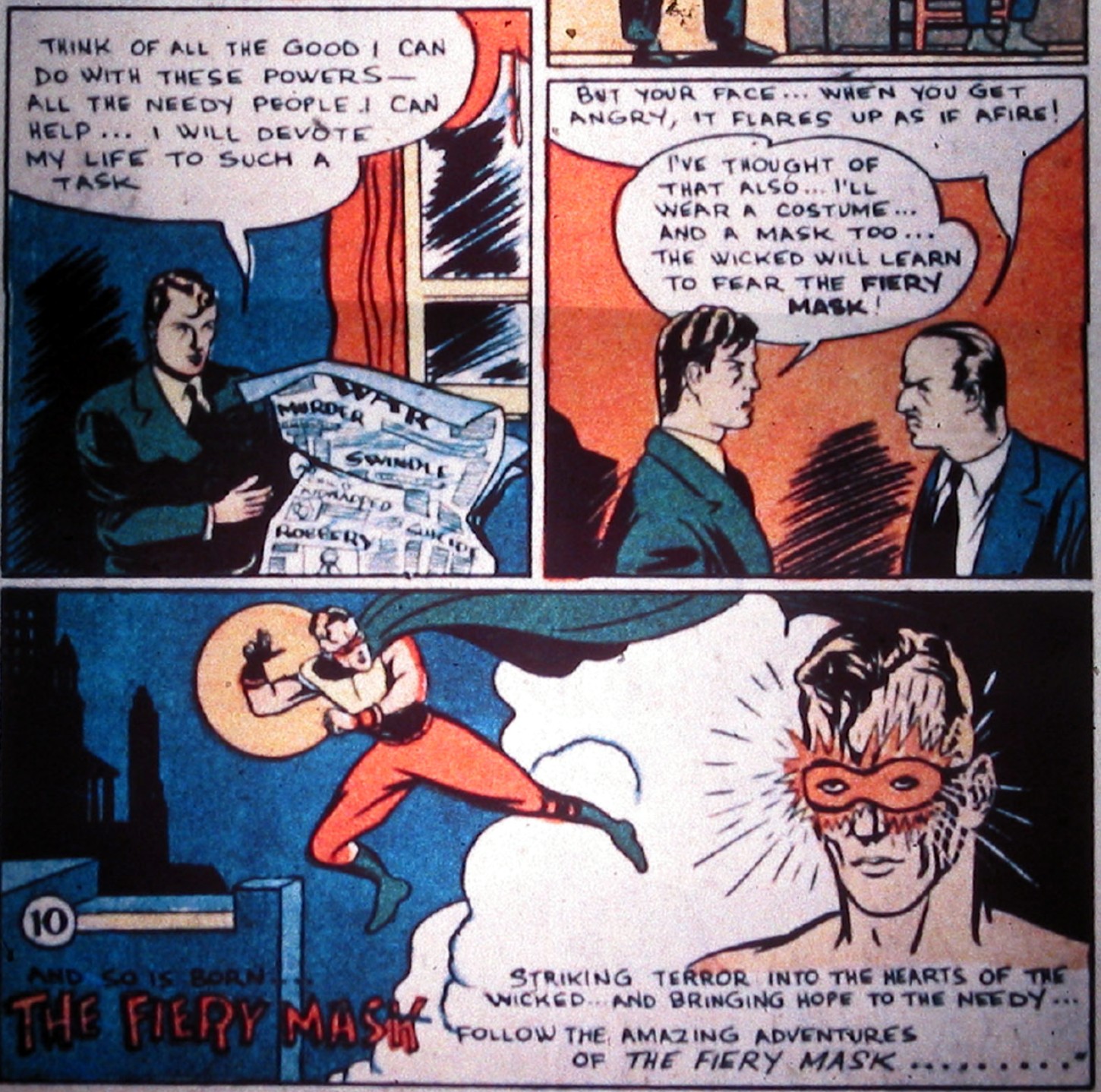
    The Fiery Mask is in reality Jack Castle, a young doctor who accidentally tracks down the lair of the villainous Zombie Master and is in quick order captured and subjected to the fiend’s mind control device. Jack manages to resist the device long enough to enrage the Zombie Master, and in an effort to boost the power and overcome this resistance he causes it to explode.

    The strange energies given off by the device cause Jack to develop strange abilities, the most striking of which is a fiery glow that plays around his face when he is worked up, and which gives him his super moniker. He also has an invulnerability to heat and flame, a fiery touch and a range of non-heat-related powers like super strength, super breath and a hypnotic gaze. Also his origin is later heavily revised, but we can save that for the hundred years or so it will take to get to The Twelve. (Daring Mystery Comics 001, 1940)

    Categorized in: Elements (Fire), Objects (Masks), Origin (Radioactive Mutate)

  • MINOR SUPER-HERO ROUND-UP 083

    MINOR SUPER-HERO ROUND-UP 083

    Oh boy! Minor super-heroes!

    13: 

    13 (aka Thirteen, although the numerical version of the name is the official one) is the alias of Harold Higgins, whose life has been haunted by a series of misfortunes related to the number thirteen. A timeline of some of them:

    February 13, 1940: Harold’s brother Bob dies in a plane crash.

    March 13, 1940: Harold loses his life savings in the stock market.

    May 13, 1940: Harold’s sister Margy is paralyzed in a car accident.

    July 13, 1940: Harold’s father is lost at sea.

    September 13, 1940: Harold’s fiance is killed in a hit and run.

    April 13, 1941: Harold loses his job as a reporter to a crooked editor looking to cover up a story. 

    All of this (and more! A text story in Daredevil Comics 005 adds the facts that he was born on Friday the 13th, that minor tragedies like a broken leg or academic failure had frequently befallen him on the 13th of any given month and that at his thirteenth birthday party his childhood sweetheart Helen was killed by a falling chandelier) has clearly preyed on Harold’s mind, to the point that he is finding the number everywhere including his own name.

    Rather than, say, moving to a small shack in the woods to keep others safe from his constant misfortune, Harold decides to weaponize his bad luck by bringing it to criminals via his fists. Does this work, logically? Not really, but it’s a decent enough comic book origin.

    Like many super-heroes and villains, 13 flirts with the idea of leaving a calling card in his first adventure but doesn’t maintain the practice. In this case, it’s a calendar page with the 13th of the month circled. (Daredevil Comics 003, 1941)

    Finally, a couple of minor things about 13: In Daredevil Comics 004 we learn that like many of his peers he wears his costume under his clothes for quick-change action. Intriguingly, the above panel seems to imply that this includes his mask, which appears to be either acting as a liner for his hat or worn as a kind of bandana under it.

    Finally, in Daredevil Comics 006, 13 moves from the super-hero crammed streets of NYC to the lesser-served Boston.

    Categorized in: Abstract Concepts (Luck), Accessories (Calling Cards), Alphanumeric (Thirteen)

    Jinx: 

    Recently orphaned Darrel Creig has just inherited the family steel fortune, something that rankles his guardian, uncle and the only other potential heir Moldon Creig. Thus, a family outing to the Statue of Liberty, where Moldon and Darrel’s tutor Travers expedite the inheritance process by tossing him off the statue’s torch.

    Luckily for young Darrel, 13 happens to be present to stop an unrelated attempt to bomb the statue, and after saving the lad the two of them beat up Moldon and Travers and hand them over to the authorities.

    As we all know, if a costumed vigilante happens across an orphaned boy who can throw a punch they are allowed to keep them, which is just what happens with 13 and Darrel, and though Darrel’s connection to the bad luck theme is much more tenuous than Higgins (he is an orphan, if a wealthy one, and he is the very spooky age of thirteen years old) he is promptly given a slightly worse costume than 13’s and anointed as his sidekick Jinx. (Daredevil Comics 005, 1941)

    Categorized in: Abstract Concepts (Luck), Day Job (High School Students), Origin (Sidekicks)

    the Ghost: 

    The Ghost is a super-hero who seemingly exists solely to combat the menace of the Claw as he troubles America’s shores once more, Daredevil having moved on to less stressful pursuits.

    Though presented as a normal human man, the Ghost not only has the acrobatic prowess necessary to fight a giant across the rooftops of New York City but enough stamina to do so for seven hours straight. In their first encounter he manages to drive the Claw away by simply punching him thousands of times.

    The Ghost’s origin is unrevealed as of his final 1941 appearance but rest assured: we will learn it in 1942 (spoiler: it is not very interesting). (Daredevil Comics 005, 1941)

    Categorized in: Origin (Unknown), Supranormal Beings (Ghosts)

    the Fiery Mask: 

    The Fiery Mask! A hero whose modern depictions have consistently involved a morning star despite only ever actually wielding on on this cover. I’m not complaining, mind you – it’s just interesting to note where things come from.

    The Fiery Mask is in reality Jack Castle, a young doctor who accidentally tracks down the lair of the villainous Zombie Master and is in quick order captured and subjected to the fiend’s mind control device. Jack manages to resist the device long enough to enrage the Zombie Master, and in an effort to boost the power and overcome this resistance he causes it to explode.

    The strange energies given off by the device cause Jack to develop strange abilities, the most striking of which is a fiery glow that plays around his face when he is worked up, and which gives him his super moniker. He also has an invulnerability to heat and flame, a fiery touch and a range of non-heat-related powers like super strength, super breath and a hypnotic gaze. Also his origin is later heavily revised, but we can save that for the hundred years or so it will take to get to The Twelve. (Daring Mystery Comics 001, 1940)

    Categorized in: Elements (Fire), Objects (Masks), Origin (Radioactive Mutate)

  • MINOR SUPER-HERO ROUND-UP 082

    Lotta visually striking characters this time, plus Pioneer. 

    Pioneer: 

    Pioneer is a man of limited education and experience (and possibly intellect) who has seemingly lived his entire life at the bottom of the inescapable Death Gorge in Yellowstone Park. He comes into contact with the outside world when a trio of fleeing gangsters crash their car near his home and he nurses them back to health. The three then take Pioneer with them once they manage to attract help from outside of the gorge, with little real justification other than to use him as cover if they attract fire from police.

    Pioneer’s morality is simple enough that his disdain for killing cannot be alleviated with the promise of cash, and he captures his three erstwhile companions when they commit a murder while robbing a bank. Our final view of him is as he wanders into New York City traffic while clutching five thousand dollars in reward money, and since he never appears again I suppose we must assume that he was immediately flattened by a car. This is where my “Pioneer might be a stupid” theory comes from, as the man had just completed a car trip from Yellowstone to NYC, which takes at least 33 hours today. You’re telling me that he didn’t take in the fact that you might want to stay out of the way of these things in all that time?

    As presented, Pioneer is not really a super-hero. He’s presented as one, but his one adventure is taken up almost entirely with origin stuff, which in itself is interesting because we don’t actually learn just how he came to be in that gorge in the first place. I suppose he would have worked like a more benevolent version of the Incredible Hulk, travelling from town to town dispensing rough justice and broken English. If he hadn’t been hit by all those cars, that is. (Daredevil Comics 002, 1941)

    Categorized in: Origin (Unknown) 

    the Bronze Terror: 

    After his father is railroaded into a murder sentence in the corrupt Western town of Redfield, athletic wunderkind and hotshot lawyer Jeff Dixon returns home to help prove his innocence.

    Despite his legal background, Jeff turns to vigilante justice almost immediately, presumably due to the fact that all of the town’s officials are in the pocket of Scar Thornton, the real killer. Dixon’s chosen identity, the Bronze Terror, probably deserves a spot in the next Problematic Round-Up, but I’m giving him a reprieve because this comic is the definition of a well-meaning attempt to have a non-white character star in a comic that is still bogged down in all the tropes of in this case the Western genre (the name of the strip is “Real American No. 1,” for gosh sakes) and if I banished characters for that I recon that this space would feature a non-white super-hero some time in the 70s. If then.

    So, while on the plus side the Bronze Terror is a an entertaining and highly competent character who looks terrific (and is detail-oriented enough to get a mask for his horse so that it can also look cool), the negatives include:

    – all of the other Native American characters other than Jeff’s love interest Lilly being broad ethnic caricatures

    – Jeff’s status as a super-hero hanging on the fact that he went off and got a white man’s education, which is a pretty frequent trope in comics with Native American protagonists and stands as a counterpart to that of the white adventurer bringing his expertise to the jungle

    – yes, the costume looks great but I think that the broad objection that Native peoples have to the cultural appropriation of things like the war bonnet probably also applies to their use by comic book super-heroes. This one is going to keep coming up – American Eagle debuts at Marvel in 1981, and he’s wearing one

    (Daredevil Comics 002, 1941)

    Categorized in: Body (Emotions – Terror), Elements (Alloys – Bronze), Problematic Characters

    London: 

    London is a masked vigilante dedicated to stymieing the forces of Nazi Germany as they attempt to conquer Great Britain. Conceptually, he seems to have been built around the catch phrase “London can take it!” and while the name is certainly unique it does introduce some confusion as the character London is based out of the city of London.

    I appreciate London’s costume: while the combination of a mask and a suit or tuxedo is nothing new in comics, this might just be the first time I’ve seen a suit paired with a cape and cowl. Plus the cursive “L” symbol is cute.

    London is in actuality radio broadcaster Marc Holmes, who reports on his own costumed exploits as an employee of the BBC. He works closely with the British military and London law enforcement in both his civilian and costumed identities. (Daredevil Comics 002, 1941)

    Categorized in: Locations (Specific), Origin (Patriotic Characters)

    Pat Patriot: 

    Another in the seemingly endless parade of patriotic WWII super-heroes, Pat Patriot has the requisite flag based costume and dedication to Truth, Justice and the American Way, plus the clunky and also ominous-if-you-know-history sobriquet “America’s Joan of Arc.”

    An aircraft factory worker who kicks up a bit too much fuss about plant conditions and gets fired, Pat proceeds to unearth a conspiracy by her foreman to send aircraft engines to the Axis, all while wearing a patriotic costume from a play that she was in earlier in the evening. She has a mean right hook and a variety of skills (airplane piloting, marksmanship, etc) that see her through.

    In a truly American moment, Pat gets her super-hero name because her coworkers cannot conceive of someone being called the outlandishly foreign Patricia Patrios, and so rename her on the spot. (Daredevil Comics 002, 1941)

    Although Pat starts out as a worker in an airplane factory in an unidentified part of the US her career as a patriotic vigilante renders her unfit for a typical 9-5 job. By Daredevil Comics 006 she appears to be working as a newspaper reporter but whether that will continue to be her occupation as 1942 rolls around is anyone’s guess.

    Categorized in: Abstract Concepts (Patriotism), Origin (Patriotic Characters)