The Curse of Skeleton Munroe

Category: minor super-hero

  • MINOR SUPER-HERO ROUND-UP 081

    Lev Gleason characters filling every available ecological niche over here. 

    Thun-Dohr:

    We’ve seen it before and we’ll see it again: Thun-Dohr (Thun-dohr?) is a white guy brought up in the traditions of a Tibetan monastery and he’s just the best dang mystic anyone’s ever seen, much better than all those Tibetan monks could ever be. 

    Like Iron Fist, the 1970s version of this character archetype, Thun-Dohr was orphaned when his parents succumbed to the elements while attempting to reach the fabled monastery. Baby Thun-Dohr (and I can no longer think of new ways to ask why these people brought their baby along on this super dangerous expedition) was found and brought to safety by the monks, who acclaimed him as some sort of prophesied kid. 

    Thanks to his training in “the arts of the Gom-Pa,” Thun-Dohr has a wide variety of mystic powers, including invisibility, teleportation, invulnerability to a variety of environmental conditions, the ability to see the last moments of a person’s life in their corpse’s eyes, astral projection and so on and so forth. He also has a mystical bracelet that allows him to remain in mental contact with the 300+ year-old Dalai Lama (not the one you’re thinking of) who raised him as he goes out into the world to battle evil (i.e., the other guy from the same monastery who is attempting to end the world – could’ve used a prophecy telling them not to let him in, amirite?). (Silver Streak Comics 013, 1941)

    Categorized in: Day Jobs (Lamas), Elements (Thunder), Origin (Mystic Traditions)

    Undercover Man:

    Police Detective Phil Barrows is unpopular at the Centre Street Homicide Department due to his habit of working alone (I think? Nobody seems to like him and this is the only stated reason why) so what does he do? Create a secondary identity called the Undercover Man so that he can work even more alone while adopting a variety of disguises. During his one published adventure he takes down corrupt politician Eduardo Donati and while I’m not normally one to critique someone’s decision to adopt a costumed identity I think he probably could have done it as a regular cop if he’d tried to. (Captain Battle Comics 001, 1941)

    Categorized in: Day Jobs (Police Detective), Powers (Master of Disguise), Professions (Law Enforcement)

    Blackout: 

    Blackout is the new name adopted by Dr Basil Brusiloff after he is mutated by chemicals randomly mixed together during a Nazi air raid on the hospital in which he is working. Unlike many other super-heroes who undergo physical transformations, Brusiloff’s new, jet-black form appears to be a permanent change and not something that he can switch on and off.

    Blackout is able to fly at speed comparable to a fighter plane, but his main power is the ability to emit a thick black smoke from his pores, the specificity of which somehow makes it seem more gross than a smoke power usually does.

    In addition to being opaque, this smoke is thick enough to suffocate someone in an unventilated environment (this is also gross. Huff my gas, miscreants!). Blackout is able to direct this smoke and even shape it to some degree (such as when he forms a long tunnel out of it to shield fleeing civilians from Nazi eyes), but most remarkably is able to emit it in large enough quantities that at one point he escapes a sealed room by bursting the walls through sheer air pressure.

    Aside from his powers, there are two remarkable things about Blackout: firstly, his origin takes place in Belgrade, which makes him the first in what is sure to be a pretty short list of Yugoslavian superhumans. Secondly, Blackout is the subject of some very minor debate vis-a-vis just how hairy/furry he is, with the two sides boiling down to “the text never says he’s hairy so it must just be something else” versus “he looks very hairy.” I am inclined to side with the latter side. He looks very hairy!

    Related to the hairiness question is a third interesting thing about Blackout: it is quite possible that he is completely nude, aside from that stylish green mask. (Captain Battle Comics 001, 1941)

    Categorized in: Activities (Blackouts), Colours (Black), Origin (Chemical Mutates)

    Nightro: 

    Nightro is Hugh Goddard, a scientist who was betrayed and left to die by his associates after they found a rich radium deposit in Alaska and Goddard expressed his desire to donate it to medical research, and though I do have some sympathy for his partners’ position that as the expedition’s financial backers they should see some profit from the mine they resort to murder a bit too quickly for my tatse. Surely this is a case for the courts!

    If you look Nightro up online, odds are that you will be told that he is blinded by the ambient radiation from the deposit. This is not true! What actually happens is that he wanders around in the snow until he is found by some helpful Inuit fellows and ends up with an extreme case of snow-blindness. Radiation doesn’t even come up.

    Goddard eventually makes his way back to the US, where a Dr Frank Miller (!) discovers that polarized lenses will allow him to see. Unlike his blind super-hero contemporaries the Mask and Dr Mid-Nite, Nightro does not appear to have any kind of enhanced dark vision. Instead, his stated reason for adopting a costumed alias is that his goggles are too ugly for him to be accepted in polite society.

    Goddard continues to live as a blind man as part of maintaining his secret identity as Nightro, meaning that from his second appearance onward he has a seeing eye dog companion named Blackie. He is called the “Streamlined Robinhood,” supposedly because he takes money from crooks and redistributed it to the needy – I reckon that it’s just a way to attach a buzzword to the character – if he had debuted tenyears later he might’ve been “the Jet Age Robinhood.”  (Daredevil Comics 002, 1941)

    Categorized in: Accessories (Dogs), Locations (Temporal), Origins (Blind Characters)

  • MINOR SUPER-HERO ROUND-UP 081

    Lev Gleason characters filling every available ecological niche over here. 

    Thun-Dohr:

    We’ve seen it before and we’ll see it again: Thun-Dohr (Thun-dohr?) is a white guy brought up in the traditions of a Tibetan monastery and he’s just the best dang mystic anyone’s ever seen, much better than all those Tibetan monks could ever be. 

    Like Iron Fist, the 1970s version of this character archetype, Thun-Dohr was orphaned when his parents succumbed to the elements while attempting to reach the fabled monastery. Baby Thun-Dohr (and I can no longer think of new ways to ask why these people brought their baby along on this super dangerous expedition) was found and brought to safety by the monks, who acclaimed him as some sort of prophesied kid. 

    Thanks to his training in “the arts of the Gom-Pa,” Thun-Dohr has a wide variety of mystic powers, including invisibility, teleportation, invulnerability to a variety of environmental conditions, the ability to see the last moments of a person’s life in their corpse’s eyes, astral projection and so on and so forth. He also has a mystical bracelet that allows him to remain in mental contact with the 300+ year-old Dalai Lama (not the one you’re thinking of) who raised him as he goes out into the world to battle evil (i.e., the other guy from the same monastery who is attempting to end the world – could’ve used a prophecy telling them not to let him in, amirite?). (Silver Streak Comics 013, 1941)

    Categorized in: Day Jobs (Lamas), Elements (Thunder), Origin (Mystic Traditions)

    Undercover Man:

    Police Detective Phil Barrows is unpopular at the Centre Street Homicide Department due to his habit of working alone (I think? Nobody seems to like him and this is the only stated reason why) so what does he do? Create a secondary identity called the Undercover Man so that he can work even more alone while adopting a variety of disguises. During his one published adventure he takes down corrupt politician Eduardo Donati and while I’m not normally one to critique someone’s decision to adopt a costumed identity I think he probably could have done it as a regular cop if he’d tried to. (Captain Battle Comics 001, 1941)

    Categorized in: Day Jobs (Police Detective), Powers (Master of Disguise), Professions (Law Enforcement)

    Blackout: 

    Blackout is the new name adopted by Dr Basil Brusiloff after he is mutated by chemicals randomly mixed together during a Nazi air raid on the hospital in which he is working. Unlike many other super-heroes who undergo physical transformations, Brusiloff’s new, jet-black form appears to be a permanent change and not something that he can switch on and off.

    Blackout is able to fly at speed comparable to a fighter plane, but his main power is the ability to emit a thick black smoke from his pores, the specificity of which somehow makes it seem more gross than a smoke power usually does.

    In addition to being opaque, this smoke is thick enough to suffocate someone in an unventilated environment (this is also gross. Huff my gas, miscreants!). Blackout is able to direct this smoke and even shape it to some degree (such as when he forms a long tunnel out of it to shield fleeing civilians from Nazi eyes), but most remarkably is able to emit it in large enough quantities that at one point he escapes a sealed room by bursting the walls through sheer air pressure.

    Aside from his powers, there are two remarkable things about Blackout: firstly, his origin takes place in Belgrade, which makes him the first in what is sure to be a pretty short list of Yugoslavian superhumans. Secondly, Blackout is the subject of some very minor debate vis-a-vis just how hairy/furry he is, with the two sides boiling down to “the text never says he’s hairy so it must just be something else” versus “he looks very hairy.” I am inclined to side with the latter side. He looks very hairy!

    Related to the hairiness question is a third interesting thing about Blackout: it is quite possible that he is completely nude, aside from that stylish green mask. (Captain Battle Comics 001, 1941)

    Categorized in: Activities (Blackouts), Colours (Black), Origin (Chemical Mutates)

    Nightro: 

    Nightro is Hugh Goddard, a scientist who was betrayed and left to die by his associates after they found a rich radium deposit in Alaska and Goddard expressed his desire to donate it to medical research, and though I do have some sympathy for his partners’ position that as the expedition’s financial backers they should see some profit from the mine they resort to murder a bit too quickly for my tatse. Surely this is a case for the courts!

    If you look Nightro up online, odds are that you will be told that he is blinded by the ambient radiation from the deposit. This is not true! What actually happens is that he wanders around in the snow until he is found by some helpful Inuit fellows and ends up with an extreme case of snow-blindness. Radiation doesn’t even come up.

    Goddard eventually makes his way back to the US, where a Dr Frank Miller (!) discovers that polarized lenses will allow him to see. Unlike his blind super-hero contemporaries the Mask and Dr Mid-Nite, Nightro does not appear to have any kind of enhanced dark vision. Instead, his stated reason for adopting a costumed alias is that his goggles are too ugly for him to be accepted in polite society.

    Goddard continues to live as a blind man as part of maintaining his secret identity as Nightro, meaning that from his second appearance onward he has a seeing eye dog companion named Blackie. He is called the “Streamlined Robinhood,” supposedly because he takes money from crooks and redistributed it to the needy – I reckon that it’s just a way to attach a buzzword to the character – if he had debuted tenyears later he might’ve been “the Jet Age Robinhood.”  (Daredevil Comics 002, 1941)

    Categorized in: Accessories (Dogs), Locations (Temporal), Origins (Blind Characters)

  • MINOR SUPER-HERO ROUND-UP 080

    It’s a sidekick-heavy brew this time, chums.

    the Silver Streak **UPDATE**:

    It’s been a gradual thing but the Silver Streak has been getting closer and closer to not just going real fast and jumping far but actually flying. I don’t know if you can actually pinpoint the moment he made the transition but he is definitely on the “is flying” side of the equation by Silver Streak Comics 010, 1941. 

    Mercury:

    Although Whiz, King of Falcons is an exemplary sidekick to the Silver Streak, comic books are nothing if not prone to trends, and the trend for 1941 was for super-heroes to get kid sidekicks. And although there is only so much you can do to stand out among an army of gee-whillikering blonde boys, Mercury, aka the Boy Streak, aka Mickey O’Toole, does have a couple of aspects worth highlighting:

    The first of these things is his origin story. Mickey O’Toole is the appropriately hard-hitting son of the late boxer Slugger O’Toole, who was murdered mid-match because he wouldn’t take a dive. Mickey now shines shoes in order to provide for his widowed mother and disabled sister Mary. A sad tale indeed.

    The remarkable thing about Mickey’s sad backstory and struggling family the fact that it and they never come up again. Mickey starts hanging out with the Silver Streak and his family woes go right out the window. There’s even a hint at the end of his debut appearance that he will get the chance to bring the man who killed his father to justice, but writing duties on “Silver Streak” transfer from Bob Wood to Don Rico with the probably-pseudonymous Rex Richards in between and Mercury’s backstory gets lost in the shuffle.

    The second thing to note about Mercury is the origin of his powers: Silver Streak gives him a shot of secret super juice. Not anything to write home about in and of itself – every third super-hero is on some sort of serum or powder or elixir, after all – but because the common knowledge about this kid is that he got his powers from a Silver Streak blood transfusion. I myself asserted this in my entry on the guy! I mean, it’s not like we’re out there getting the origin of the Flash wrong or something but it is an interesting example of how misinformation can become more prevalent than fact (also this kind of clears up the mysterious origin of the Silver Streak’s own powers: he took the juice!) (Silver Streak Comics 011, 1941)

    Meteor:

    The third thing about Mercury is the fact that after two issues he is replaced by Meteor, the Boy Speed-King and no two of the half dozen nerds who care about this kind of thing can agree on whether Mercury and Meteor are the same kid with two different names or two different kids with no explanation of where the first one went or the second one came from, with the argument fr the second position boiling down to the fact that they never say that the two are the same. 

    Personally, I lean toward the “one kid, two names” hypothesis, as it’s slightly cleaner. Why invent a whole new kid? (Silver Streak Comics 013, 1941)

    Categorized in: Elements (Mercury), Locations (Space Places), Origins (Sidekicks) 

    Whiz, King of Falcons **UPDATE**: 

    Whiz, King of Falcons, the Silver Streak’s original sidekick, in perhaps his final appearance before he is supplanted by one or more flying kids, demonstrates the heretofore-unseen ability to talk. And to be an annoying smartass, if I’m honest. Whiz returns later on in Silver Streak’s career, so it’ll be interesting to see if he retains this ability. (Daredevil Comics 001, 1941) 

    Captain Battle:

    Captain Battle: patriotic hero, scientist, former soldier and in fact World War One veteran, in which conflict he lost his left eye. Lest we think him too old, the text is at pains to reassure us that he was in fact the youngest person to fight in the Great War, which I think is supposed to make him seem tough but mostly instills a deep horror in my being. Particularly after I looked it up and found that that would make him something like seven years old, at least until a few issues later when they clarify that he was the youngest member of the American Expeditionary Forces, making him a comparatively venerable 12 or so.

    Like many patriotic heroes there isn’t a lot going on with Captain Battle beyond his love of country, but here are all of the interesting trappings of his character:

    1. His assistant, Jane Lorrain: she’s got a rhyming name and she’ll push back on sexist language. Like many potentially interesting female supporting cast members she is pretty thoroughly sidelined once Battle gets a sidekick.

    2. His patriotism. Not only is he dedicated to the defense of the US but he has sworn to only defend the US. He helps save a British fleet in his first appearance explicitly because they act as a buffer between the Axis Axian Powers and America. Presumably he would otherwise let them be destroyed. Every once in a while when he is not directly helping an American he gets kind of huffy about it.

    3. His gadgets, while not unique, have very cool names, including the Curvoscope (remote viewer), the Dissolvo (death ray pistol) and the Luceflyer (jetpack). The Dissolvo is also really disgusting, as it melts its target into a quivering pile of goo. (Silver Streak Comics 010, 1941)

    Captain Battle gets a couple of issues of his own comic in 1941 and for precisely one story he makes an extremely feeble attempt at having a secret identity with no consideration for the fact that a) there aren’t a lot of guys running around with eye patches in any given area, which makes the usual secret id excuses appear even more ridiculous and b) Captain Battle’s real name is in fact Captain Battle. “You know, I never see Captain Battle and Captain Battle in the same room together…” Ridiculous.

    If I’m honest the story in question has a couple of indications that it originally starred another character and Captain Battle was a late addition, and if that is the case then the secret identity stuff is just a holdover from that. (Captain Battle Comics 001, 1941)

    Categorized in: Accessories (Various), Origins (Patriotic Heroes), Origins (WWI Vets)

    Hale Battle:

    The prevailing trend in 1941 was for super-heroes to have sidekicks and so Captain Battle eventually gets a sidekick. But just how does he acquire a boy? Very simply! See, Battle’s recurring foe the Black Dragon (tune in tomorrow for that jerk) had a thing where he turned people into giant bird-man minions called Deaglos, and the final Captain Battle/Black Dragon confrontation the surviving Deaglos were all restored to their human forms. Most of them were adult men who had lives to return to, but among them was one unclaimed boy.

    Note that the boy gives his name as “Nathan Hale” and Captain Battle immediately renames him “Hale Battle.” This is weird. It’s a weird thing to do. Particularly as “Nathan Hale” is a very patriotic American name, which Battle should totally be into! Also note just how small this kid is. This doesn’t last long, as he is definitely around the thirteen to fifteen year-old range that most Golden Age sidekicks fall into and is drawn to look more like it as time passes.

    Hale Battle is among the minority of Golden Age sidekicks who aren’t recruited as sidekicks but who insist upon becoming them. Not that Captain Battle puts up much resistance – once Hale gets this poor war refugee to sew him a uniform he’s got the job.

    Aside from these small points of interest, Hale Battle is one of the most generic sidekicks in comics. He does have a minor obsession with collecting souvenirs of his adventures, which is something I in turn enjoy writing about, but if I’m honest he approaches it without joy. It feels like an attempt to have more of a personality than a hobby. (Silver Streak Comics 012, 1941)

    Categorized in: Origins (Amnesiacs), Origins (Sidekicks) 

  • MINOR SUPER-HERO ROUND-UP 079

    Look anywhere and you won’t find finer minor super-heroes. That’s our guarantee!

    Dickie Dean, Boy Inventor **UPDATE**: 

    Dickie Dean, Boy Inventor, continues to live up to his moniker and churn out the boy inventions in 1941. Some highlights:

    – several different models of remote controlled robot

    – an autopilot for ships

    -a code-breaking machine

    – a device for viewing the past

    – force rays

    – a drilling machine

    – a rope that is attracted to hair

    – indestructible metal

    – an invisibility device

    – both a lightning cannon and a means of making natural lightning strike at specific targets 

    – an oil detector

    – a vertigo ray 

    To facilitate his boundless inventive genius, in Silver Streak Comics 015 Dickie salvages a bunch of treasure from the ocean floor and uses it to build and staff a laboratory complex with one security guard and such features as a huge uncovered pit of lye. The plot potential is enormous.

    This actually happened in Silver Streak Comics 006 in 1940 but I neglected to note it: Dickie Dean no longer lives in the real New Castle, Pennsylvania but the fictional Castleton, presumably also Pennsylvania. This also prompts him to change the “N” on his shirt to a “C”. For about five issues until someone forgot, that is. 

    Categorized in: Accessories (Various), Location (Castleton, Pennsylvania)

    the Daredevil II:

    After the second engagement between the Claw and the Daredevil in their ongoing battle for the future of the United States (watch this space), the Claw ends up in jail, unable to use his powers and one week away from execution. This, reasons Daredevil, is the perfect time to go fishing in the South Seas. And as soon as he leaves the Claw breaks jail and threatens the sovereignty of the nation once more. This is just basic narrative causality, friends.

    The Claw then has a series of triumphs, culminating in him capturing and killing what appears to be the Daredevil! It’s an ignominious end for the hero, so it’s a good thing that it wasn’t really him: the dead Daredevil turns out to be the original’s never-before-seen-or-mentioned, unnamed brother, who tried to stand in for his sibling in his absence despite not having been raised by boomerangs or whatever Daredevil’s current origin is, and paid the ultimate price for it. 

    “Daredevil II” Hill is not only never given a first name but is never mentioned and certainly never mourned after the above panel. It’s very sad, really. (Silver Streak Comics 009, 1941)

    Categorized in: Catalogue of Wounds, Origins (Legacy Characters)

    Secret Agent X-101: 

    Secret Agent X-101 is actually newspaper publisher Bart Benson of the Daily Record, and while he doesn’t bring anything too unique to the secret agent comics genre in his two appearances he is the first example I am aware of of the secret agent/ civilian life divide being treated like a super-hero and their secret identity, so that’s something. (Silver Streak Comics 008, 1941)

    Categorized in: Day Job (Newspaper Publisher), Profession (Espionage), Team Membership (US Secret Service)

    the Pirate Prince: 

    A
    pompadoured pirate captain who, along with a crew of lovable rogues
    named things like Merry, Flip and Gilly, battles against the slave trade
    and other sea-borne evils of the Age of Sail. Given that he robs Jean
    Lafitte of his ill-gotten booty in his first appearance, I’d wager that
    he operates somewhere around 1810 CE or so. 

    While this strip is pretty consistent in its anti-slavery, pro brotherhood-of-man stance, it is also a 1940s comic, so it features quite a lot of comic relief racial humour. It’s a real mixed message! (Silver Streak Comics 007, 1941)

    Categorized in: Origin (Heroes of the Past), Profession (Pirate), Royalty (Princes)

  • MINOR SUPER-HERO ROUND-UP 078

    Lev Gleason characters for EVERYONE!

    Daredevil **UPDATE**:

    Daredevil had but one appearance in 1940, so it’s no surprise that the character still had some changes and revisions to go once 1941 rolled around. Firstly, his costume gets an update, with yellow swapped out for red and the complicated “DD” design on the abdomen dropped entirely.

    The most dramatic change, however, is that the Daredevil can now talk. Just how Bart Hill’s traumatic muteness was alleviated is unaddressed – I’m sure that the real answer is that it was inconvenient to write around and so was quietly dropped, but imagining that his successful crimefighting career allowed him to let go of the past is nice.

    Finally, Bart is now a wealthy playboy with a fiance (Tonia Saunders) who isn’t too sure about marrying this manchild after all. Thankfully, Tonia discovers the truth about Bart’s double life in her first appearance, because the Clark/Lois dynamic can get a bit tedious when grafted onto every super-hero’s relationship by default.

    Our final update from Silver Streak Comics 007 is this revelation that the Daredevil’s mastery of the boomerang is so complete that, when thrown by the Claw, he can cause his own body to act like one. This here might just be a new contender for inclusion in lists of obscure and ridiculous super powers, folks.

    In Silver Streak Comics 008 & 009, Daredevil employs a couple of high-tech fighter planes called “the Airdevil,” which a top-notch example of a jokey super-accessory name. Both planes are destroyed during Daredevil’s clashes with the Claw, and he seems to have given up on the idea of the custom plane, at least for the year 1941.

    In Silver Streak Comics 015 Daredevil employs a decoy double named Chester to help in the capture of a villain named the Serpent. Who is Chester? No idea. Will he ever return? Probably not.

    Finally, in Daredevil Comics 002, Daredevil engages in what I would say is some Spider-Man style super-hero quipping as he battles this horde of silent men. Not that super-heroes aren’t constantly mouthing off, mind you, but it doesn’t have this kind of flow. I shall be looking out for more of this kind of patter to see how long it takes to become an established thing.

    Categorized in: Accessories (Airplanes), Day Job (Wealthy Socialite)

    Presto Martin: 

    Presto Martin, though voted “Least Likely to Succeed” in college, is now Captain of Detectives in the NYPD. More importantly for our purposes, he is a master of disguise who is for instance more than willing to take the place of a heavyweight boxer in the ring if it means that he can solve a big case. (Silver Streak Comics 007, 1941)

    Per Silver Streak Comics 008, Presto is aided in his work by a super-moldable plastic putty of his own concoction.

    Categorized in: Day Job (Police Captain), Powers (Master of Disguise), Team Membership (NYPD)

    Zongar, the Miracle Man:

    Zongar, the Miracle Man, is a functionally-omnipotent magical adventurer like so many of his peers, but rather than casting spells per se Zongar uses a mystical amulet to command the spirit Abaraxx to do his bidding. This might have lead to some interesting developments over time if, for example, a nogoodnik were to get ahold of the amulet but alas, Zongar had only one recorded adventure. (Silver Streak Comics 007, 1941)

    Categorized in: Abstract Concepts (Miracles), Accessories (Amulets)

    Cloud Curtis: 

    Dashing young aviator Cloud Curtis has developed the super plane Golden Bullet, which he flies both as a job and against the enemies of the US and which has one of the goofier features of any comic book super plane in the form of that big propeller located halfway down the fuselage. Curtis is assisted by the apelike Crusher McCoy and the avuncular Pop Whistler as he keeps the airways safe from a series of increasingly unlikely airplane-based threats. (Silver Streak Comics 007, 1941)

    Categorized in: Accessories (Airplanes), Day Job (Aviators)

  • MINOR SUPER-HERO ROUND-UP 077

    MINOR SUPER-HERO ROUND-UP 077

    Please enjoy about half of the Great Comics stable of characters.  

    Kangaroo Man:

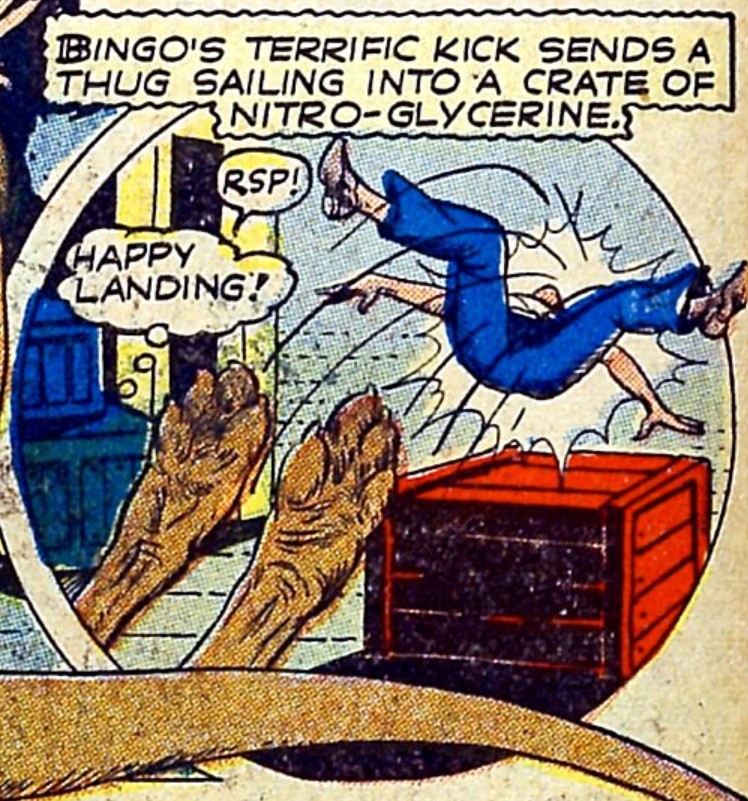
    The Kangaroo Man is Jack Brian, who gets his name thanks to his animal companion: Bingo, an astonishingly well-trained kangaroo. 

    Jack might be a pretty standard comic book adventurer, but Bingo, though his vocabulary is limited to a “rsp, rsp” sound, is of seemingly near-human intelligence and able to act essentially as another human character in the strip. Here’s Bingo parachuting out of an airplane, for example.

    Bingo also has a respectable body count for an animal hero – he does a lot of whacking explosives at people and people at explosives. (Choice Comics 001, 1941)

    Categorized in: Animals (Marsupials), Generica (Mans), Origins (Nonhuman)

    Atlas the Mighty:

    Atlas the Mighty has exactly one recorded adventure, in which he foils a band of fifth columnists who are stealing war materials in Oregon and then smuggling them to Canada. Or possibly the other way around. Though his name and his powers (super strength, invulnerability) evoke the Titan Atlas, Atlas the Mighty gets not one whiff of an origin and so any connection between the two is speculative at best. (Choice Comics 001, 1941)

    Categorized in: Famous Figures (Mythological), Language (Superlatives), Origins (Unknown)

    the Secret Circle:

    The Secret Circle are actually brothers Jim (heavyweight boxing champion), Larry (pole vault record holder) and Mac (track star) Storm. Does it bother me that there are three of them and they went with a circle rather than a triangle? Heck yes it does.

    Though there’s some indication that the Secret Circle are already established vigilantes, they really get going when gang boss Lou Pacone murders their father, Police Commissioner Storm (incidentally, this happens while all three brothers are out setting records in their chosen fields, and while I won’t go so far as to say that Commissioner Storm deserved to be murdered for being a bad father I will note that he would still be alive if he had taken the day off to support his sons instead of doing work that could have been delegated).

    Though Larry and Mac’s specialties do occasionally come in handy, all three Storm brothers spend most of their adventures punching out crooks, which kind of devalues Jim’s contributions. (Choice Comics 001, 1941)

    Categorized in: Generica (Circles), Origins (Crime Orphans)

    Fire-Eater: 

    Fire-Eater, aka Mike O’Malley, is a stage performer whose act consists of the same fire-eating and -exhaling that he employs in his crimefighting. This is very important for those of us who are interested in the in-universe origins of super-hero (and super-villain) costumes, because it means that Fire-Eater’s is in fact his stage outfit, and that he looks like that for professional reasons rather than as an expression of his secret inner self.

    Despite his name, Fire-Eater does not actually eat any fire in his two recorded adventures. Instead, he eats “sodium capsules” (yikes) that allow him to breath streams of flame hot enough to melt lead and iron, and with enough force to travel at least a few dozen feet. He also seems to be at least somewhat invulnerable to heat and flame, which is handy not just because he deals in the stuff but because like a lot of fire guys he mostly fights arsonists, together with his girlfriend, nurse Louise Peters (Choice Comics 001, 1941)

    Categorized in: Activities (Eating), Elements (Fire)

  • MINOR SUPER-HERO ROUND-UP 076

    Yet more super-heroes for your delectation.

    the Black Widow:

    There are a lot of Black Widows in comics, but Linda Masters is the first one who I have encountered who is actually a widow and not just a woman named after a spider as a way of emphasizing how creepy-deadly she is. And since her husband was Murdered by a Crime™, she expresses her grief by becoming a crimefighter.

    We don’t see a lot of the Black Widow’s modus operandi during her single recorded adventure, but she is handy with a gun and a judo throw. She spends most of her time standing outside in an overcoat in the rain, so we don’t even get much of a chance to observe her costume aside from the fact that it includes a black turtleneck with a particularly leggy spider logo on it. 

    She is also at least a better detective than the police in whatever NYC-alike city she calls home, given that the entirety of her first adventure takes place while they are misreading the directions she gave them to the villain’s hideout that she has already found. (Cat-Man Comics 001, 1941)

    Categorized in: Animals (Arachnids), Colours (Black), Family (Widows)

    the Flying Legion: 

    Headquartered out of a hollowed-out mesa, this combination air rescue/air vigilante corps is notable mainly for the fact that every single member seems to have a nickname, from leader Chute Harmon to his aides Wolf, Slip and Piston. Perhaps it’s part of the onboarding process. (Cat-Man Comics 002, 1941)

    Categorized in: Generica (Legions), Professions (Aviators)

    the Pied Piper: 

    The Pied Piper is a super-hero whose origin combines two popular tropes: that of the member of the legal system who discovers that the justice they seek can only be found outside of the normal bounds of the law and that of the framed person who must operate outside the law to clear their name (BONUS: he is also an example of a much less common trope, that of the super-hero who has a little mustache). Specifically, the Pied Piper is Stephen Prentice, a lawyer who finds himself framed twice in rapid succession and must turn to his mastery of the pipes to expose the corrupt judge and political boss behind the plot against him.

    (the second framing is for a pretty standard murder, but the first one does demand some comment. Prentice is framed for defending a guilty man for murder, with the really damning aspect being that he supposedly set out to do so while knowing that he was guilty. While I am admittedly not a lawyer I cannot imagine that this would be enough to ruin someone’s career, even in 1941. Which is probably why they doubled down and also framed him for murder, now that I think of it)

    As his name implies, the Pied Piper employs flute and recorder type instruments in his crimefighting, and while his first adventure heavily implies that he is using the power of suggestion to make his foes believe that the music has the power to compel them, subsequent stories make it clear that he is armed with one or more magical instruments acquired as part of his flute-collecting hobby.

    Some examples of just what a man can do when armed with a magical flute:

    – knock a man unconscious

    – compel a man to give a confession

    – kill animals 

    – collapse buildings 

    It really is a very useful item. (Cat-Man Comics 003, 1941)

    Categorized in: Accessories (Musical Instruments), Famous Figures (Literary), Professions (Law)

    the Hood: 

    The Hood, in reality FBI agent Craig Williams, is a non-super-powered vigilante who had only one appearance in 1941, and while I’m sure that there is more to say about him, almost all of it will have to come in the due course of time.

    Two things I can say about him are 1. his adventures are extremely dynamic and 2. he kind of looks like the Golden Age Atom. Chew on that for a while, I guess. (Cat-Man Comics 005, 1941)

    Categorized in: Objects (Hoods), Professions (Law)

  • MINOR SUPER-HERO ROUND-UP 075

    Every hero comes with a free sidekick! 

    the Deacon:

    An otherwise unnamed man headquartered in the disused Marshlands Church that is located in a kind of liminal space just outside of several urban areas (including but not limited to: Coast Town, Midland City and Central City), the Deacon was himself once a young criminal mastermind.

    Two years after his original gang is rounded up by the police, the future Deacon is still on the wrong side of the law as part of another crook’s gang, but he’s starting to have some doubts about the path his life is on, particularly the part where his boss Marty is going to murder a night watchman during their next job. He tips off the police and in return they shoot him in the arm as he runs away

    Making his way to the aforementioned abandoned Marshlands Church, the wounded ex-criminal puts on a suit of priest’s clothes that he finds there, and when Marty and his old gang track him down to extract some revenge for his betrayal he is able to muster up enough righteous vigour to beat them up and deliver them into the hands of the law.

    One thing about the  Deacon that might not be evident from my retelling is that despite the sort of gentle world-weariness that the character is portrayed with, based on the timeline presented in the story of his origin, he is at most about twenty-eight years old, and that is a pretty funny age to have already seen it all. (Cat-Man Comics 001, 1941)

    Mickey Matthews: 

    In common with his mentor, the Deacon’s sidekick Mickey Matthews is a former juvenile crook who decided that a life of crime was not for him and paid the price for it, in his case in the form of being beaten up and tossed out of a speeding car for dead. After the Deacon finds him and patches him up he decides to turn his life around and join his benefactor’s war on crime. (Cat-Man Comics 001, 1941)

    the Ragman:

    Millionaire newspaper columnist Jay Garson Jr has really been stirring up trouble with his column “Crime Does Not Pay,” so much so that he is lured into Central Park and murdered one night. Or so the criminal element think! What actually happens is that a nearby homeless man who looks exactly like Garson is accidentally killed instead of him, and so Garson swaps clothes with the corpse in order to fake his own death.

    Taking inspiration from his new wardrobe, Garson dubs himself the Ragman (also Rag Man and Rag-Man) and sets out to solve his own murder, and then decides to continue fighting crime rather than resuming his old life.

    Though Garson declines to inform his fiance Joan that he is in fact alive, he does continue to send his newspaper column to the Daily Star to get printed, much to the consternation of his editor. (Cat-Man Comics 001, 1941)

    Tiny: 

    Jay “Ragman” Garson might not have thought it necessary to loop in his fiance re: him being alive, but one person who he does make sure to inform is his chauffeur, Tiny, who immediately joins him as a sidekick. 

    Tiny is an annoying character to write about: he is a very good sidekick, especially by the standards of African American characters in 1940s comics, who tend to get assigned all kinds of stereotypes (laziness, superstition, cowardliness, stupidity) in the name of comic relief. Tiny doesn’t have any of those qualities – aside from a bit of understandable nervousness at meeting what he believes to be a dead man – but he certainly talks like a character who does. Various sources assure me that the accent is toned down eventually, but the 1941 version of the character makes it rough for someone (me) trying to find good pictures of him. (Cat-Man Comics 001, 1941)

    Categorized under: Minor Super-Heroes, Origin by Choice (Face Turn, Faking Your Own Death), Profession (Religious)

  • MINOR SUPER-HERO ROUND-UP 074

    Some more of those “minor super-heroes” you like so much. 

    the Cat-Man **Update**:

    Hey, it’s the Cat-Man! As you may or may not recall, the Cat Man (sans hyphen) debuted in Crash Comics Adventures in 1940 and was the only survivor of that comics short run. The most obvious change to his character is his costume, which goes from its former jungle chic look through a blue-and-orange phase  before settling on the orange-and-darker orange look that he will stick with for the rest of his career.

    In addition to the costumes and the hyphen, Cat-Man got a slight tweak to his origin: rather than being orphaned by a hostile tribe in India, David Merrywether’s parents are now said to have been killed by bandits in Burma. David also has a job now: he’s a private detective for the first four issues of Cat-Man Comics, after which he enlists and becomes a lieutenant in the US Army.

    The Cat-Man also gets a couple of new powers in 1941: he is able to see otherwise-invisible radiation and displays some degree of super strength.

    Finally: his nine lives. Though he still has this power, David manages to only die once during the whole of 1941, bringing his total remaining lives down to six.

    the Kitten: 

    Actually, not quite finally, as this is also the year that the Cat-Man gets a sidekick. While en route to investigate a series of train explosions, Lt David “the Cat-Man” Merrywether picks up a hitchhiking man and his niece. The man turns out to be a real scumbag, but the girl, named Katie Conn, turns on her uncle rather than see him rob and possibly murder Merrywether. Once the uncle is tossed in the hoosegow it’s a classic case of a child just entering a super-hero’s orbit and getting auto-adopted.

    Katie turns out to be the orphaned child of a pair of circus acrobats, which as we know is a perfect background for a potential super-hero’s sidekick to have. She also appears to be a few years younger than your typical kid sidekick – if they average in at about 13-15 I’d call her 11 or 12, though as usual the limitations of Golden Age art make estimating the age of kids difficult at best.

    Merrywether does his best to conceal his dual identity from his new ward but doesn’t quite manage it, and her self-assigned new role as the Cat-Man’s sidekick is announced in the final panel of the last Cat-Man story of 1941. More specifics on her in action as a sidekick in 1942. I will say that it’s nice to see a kid sidekick with both a costume and a code name. (Cat-Man Comics 005, 1941)

    Blaze Baylor: 

    Blaze Baylor is the son of the famous fire chief Smoky Baylor, who was killed by arsonists, and who is now a very specific anti-arson crimefighter. Though the name of the strip is “‘Blaze’ Baylor and the Arson Ring,” there is no indication in any of his adventures that the arsonists he battles are connected to one another in any way. (Cat-Man Comics 001 1941)

    Dr Diamond: 

    Dr Drake Gorden is bound for the South Seas when the freighter he is travelling on is sunk by a waterspout. He passes out after washing up on a beach at the base of an unscaleable cliff and is carried off by an eagle that takes him to the home of a frankly weird guy who has dressed him in a generic super-hero costume.

    This never-named man explains that thirty years prior he had come into possession of a legendary black diamond that conferred great physical power to its wielder, and that he had retired to the island to await the arrival of someone worthy enough to receive it. Dr Gorden, a man who he just met and who has spoken all of thirty-three words to him, several of which were to refer to a pair of brown pants as his “American clothes,” is his pick.

    Whatever the opposite of the Refusal of the Call part of the Hero’s Journey is, that’s what Dr Gorden has. He immediately renames himself Dr Diamond and launches into a monologue about just how hard he’s going to bust up crime that is so over the top that it would make me personally reconsider giving him any sort of power whatsoever. Despite my misgivings, Dr Diamond does an adequate job of using the powers conferred by the gem (super strength, enhanced speed, some degree of invincibility) to battle crime for four issues before fading into the mists of obscurity. (Cat-Man Comics 001, 1941) 

  • MINOR SUPER-HERO ROUND-UP 074

    Some more of those “minor super-heroes” you like so much. 

    the Cat-Man **Update**:

    Hey, it’s the Cat-Man! As you may or may not recall, the Cat Man (sans hyphen) debuted in Crash Comics Adventures in 1940 and was the only survivor of that comics short run. The most obvious change to his character is his costume, which goes from its former jungle chic look through a blue-and-orange phase  before settling on the orange-and-darker orange look that he will stick with for the rest of his career.

    In addition to the costumes and the hyphen, Cat-Man got a slight tweak to his origin: rather than being orphaned by a hostile tribe in India, David Merrywether’s parents are now said to have been killed by bandits in Burma. David also has a job now: he’s a private detective for the first four issues of Cat-Man Comics, after which he enlists and becomes a lieutenant in the US Army.

    The Cat-Man also gets a couple of new powers in 1941: he is able to see otherwise-invisible radiation and displays some degree of super strength.

    Finally: his nine lives. Though he still has this power, David manages to only die once during the whole of 1941, bringing his total remaining lives down to six.

    the Kitten: 

    Actually, not quite finally, as this is also the year that the Cat-Man gets a sidekick. While en route to investigate a series of train explosions, Lt David “the Cat-Man” Merrywether picks up a hitchhiking man and his niece. The man turns out to be a real scumbag, but the girl, named Katie Conn, turns on her uncle rather than see him rob and possibly murder Merrywether. Once the uncle is tossed in the hoosegow it’s a classic case of a child just entering a super-hero’s orbit and getting auto-adopted.

    Katie turns out to be the orphaned child of a pair of circus acrobats, which as we know is a perfect background for a potential super-hero’s sidekick to have. She also appears to be a few years younger than your typical kid sidekick – if they average in at about 13-15 I’d call her 11 or 12, though as usual the limitations of Golden Age art make estimating the age of kids difficult at best.

    Merrywether does his best to conceal his dual identity from his new ward but doesn’t quite manage it, and her self-assigned new role as the Cat-Man’s sidekick is announced in the final panel of the last Cat-Man story of 1941. More specifics on her in action as a sidekick in 1942. I will say that it’s nice to see a kid sidekick with both a costume and a code name. (Cat-Man Comics 005, 1941)

    Blaze Baylor: 

    Blaze Baylor is the son of the famous fire chief Smoky Baylor, who was killed by arsonists, and who is now a very specific anti-arson crimefighter. Though the name of the strip is “‘Blaze’ Baylor and the Arson Ring,” there is no indication in any of his adventures that the arsonists he battles are connected to one another in any way. (Cat-Man Comics 001 1941)

    Dr Diamond: 

    Dr Drake Gorden is bound for the South Seas when the freighter he is travelling on is sunk by a waterspout. He passes out after washing up on a beach at the base of an unscaleable cliff and is carried off by an eagle that takes him to the home of a frankly weird guy who has dressed him in a generic super-hero costume.

    This never-named man explains that thirty years prior he had come into possession of a legendary black diamond that conferred great physical power to its wielder, and that he had retired to the island to await the arrival of someone worthy enough to receive it. Dr Gorden, a man who he just met and who has spoken all of thirty-three words to him, several of which were to refer to a pair of brown pants as his “American clothes,” is his pick.

    Whatever the opposite of the Refusal of the Call part of the Hero’s Journey is, that’s what Dr Gorden has. He immediately renames himself Dr Diamond and launches into a monologue about just how hard he’s going to bust up crime that is so over the top that it would make me personally reconsider giving him any sort of power whatsoever. Despite my misgivings, Dr Diamond does an adequate job of using the powers conferred by the gem (super strength, enhanced speed, some degree of invincibility) to battle crime for four issues before fading into the mists of obscurity. (Cat-Man Comics 001, 1941)