The Curse of Skeleton Munroe

Category: minor super-hero

  • MINOR SUPER-HERO ROUND-UP 073

    It’s a fine day for a dose of minor super-heroes. 

    Alias X: 

    Alias, aka just X, is a mysterious master of disguise who has been cleaning up crime in NYC for the better part of a year and who, as of his first appearance, has now deigned to tell his origin story to Police Commissioner Malley and newspaper editor Hunch Armstrong.

    Turns out that X was a small-town taxi company owner who was railroaded and sent to prison for a crime he didn’t commit, and that after two years in prison he managed to escape, became a master of disguise by sheer willpower and set out to battle crime until he could track down the crooks who really committed the crimes he was convicted for and clear his name.

    The police commissioner must be a trusting guy, because he refrains from putting out an APB or whatever on Alias X after he hears this confession. 

    As far as I can tell from a skim of the 1942 portion of Alias X’s dozen or so adventures, he never catches up with the crooks who framed him – just one of the many loose ends of the comics. Please also note that Alias X is a calling card guy. (Captain Fearless Comics 001, 1941)

    Citizen Smith: 

    Citizen Smith! Plain old John Smith, who could be any one of us regular Americans! Just a regular guy! So why are we reading a comic book about him?

    Citizen Smith is in actuality John Smith, an aircraft factory worker in Washington DC and also an orphan consumed with the desire to know just who his parents were. While stewing on this after work one day he wanders up to the Tomb of the Unknown Soldier, where he receives both great news and a great shock as a ghostly figure appears and tells him that he, the Unknown Soldier, is Smith’s father.

    Smith’s new ghost dad charges him to keep America safe, with the promise that he will appear and aid his son if needed (sadly this does not occur in either of the two recorded Citizen Smith adventures). The newly-created Citizen’s Guardian of Liberty and Guardian of the American Way then sallies forth to whale on fifth columnists with his two good all-American fists.

    Now, I try to take comics as they are presented to me and not engage in a lot of “what if they were dead the whole time”-style fan theory nonsense but I will say that if I were writing a gritty early-2000s Citizen Smith reboot… all this ghost stuff would just be a hallucination brought on by his obsessions, right? Just a lonely man giving his life meaning by latching on to a powerful symbol to fill the hole in his life. But of course that is not who we are here. Citizen Smith is as he appears: a divinely ordained champion of the American Way. (Captain Fearless Comics 001, 1941)

    Miss Victory: 

    Miss Victory is Joan Wayne, a woman who works in Washington DC in secretarial and similar roles and who seems to have seen an opening for a two-fisted vigilante and filled it, no further origin necessary. There is some hint that her vigilantism is officially sanctioned in the first couple of panels of her first appearance, but if so she has very little oversight. She is much more willing to resort to violence than a lot of her female contemporaries, which is kind of refreshing.

    Miss Victory does share with our old friend the Eagle the inability to really settle on a costume design, so I’m sure that we’ll be revisiting her in that capacity. 

    Case in point: this revised version of her costume from her second appearance, in Captain Fearless Comics 002. As with most of her costume changes it’s a variation on the theme of her previous look and is probably explained by the fact that she  (Captain Fearless Comics 001, 1941) 

    Mr Miracle: 

    Mr Miracle is of course among the ranks of the obscure Golden Age characters who have the same name as a more well-known modern character, but he is also a member of a much more select fraternity: of characters whose origin involves a suicide attempt, though the precise reason that the unnamed man had for jumping is never given.

    The future Mr Miracle is pulled out of the water by a helpful stranger and brought to the great scientist Professor Rietz, who revives him via a twenty hour session under his “mind-ray,” only to be betrayed and shot by his assistant Sango at the final hour. Sango turns out to have been a foreign agent who was laying in wait for the mind-ray to be perfected, and now the hour has come.

    The still-unnamed man wakes to a ruined laboratory and a dying Rietz, who reveals to him in addition to saving his life, the mind-ray has given him great if unspecified powers. He then extracts a pledge from the man that he will use this power to aid mankind and promptly dies.

    The man creates a costume, renames himself Mr Miracle and sets out to use is vast array of abilities (transmutation, teleportation, telekinesis, intangibility, size control, flight, etc, etc. Though Mr Miracle is technically some sort of psychic mutate he is in effect a nigh-omnipotent comic book magic user) to bring Sango to justice. 

    Mr Miracle gets to honour the promise he made to Prof. Rietz precisely one more time (by sinking a u-boat) before fading into the mists of comic book obscurity. (Captain Fearless Comics 001, 1941)

  • MINOR SUPER-HERO ROUND-UP 072

    Extremely minor super-heroes? Don’t mind if I do!

    the Flag-Man:

    The Flag-Man is one standard unit of patriotic American super-hero: he loves the United States and is willing to put on a costume and punch guys until it is safe. And speaking of costumes: the Flag-Man and his pal Rusty are prime examples of how piggybacking off of the iconography of the American flag can really paper over some pretty bad costume design. I mean, tank-top and cape and flared gloves? Give me a break.

    The Flag-Man’s alter ego is Captain Hornet (occasionally Major Hornet), trouble-shooter for the President, who presumably knows about the whole Flag-Man thing.

    Since Captain Hornet/the Flag-Man seems the be dedicated to solving problems exclusively via the medium of hand-to-hand combat, he is in effect a fist that FDR can send to punch anyone he wants. Mostly Nazis, to his credit. (Captain Aero Comics 001, 1941)

    Rusty:

    Just as the Flag-Man is the elemental patriotic hero, his sidekick Rusty is the basic unit of kid sidekick: no last name, no alter-ego, just a scrappy teen who tags along on adventures. I do find him the most irritating of all the Golden Age sidekicks we have yet encountered, so that’s at least one distinction. (Captain Aero Comics 001, 1941)

    Solar, Master of Magic: 

    Solar, Master of Magic is as you might have guessed another of Golden Age comics’ many, many magic guys, which in practical terms means that he can do basically anything he wants to. In contrast to a lot of his peers, he chooses to use his fists as much or more than his magic. 

    Although Solar presents as a pure magic guy, he is in fact a magic item guy, with a magic cape of invisibility and a magic ring of doing everything else. It’s a minor distinction but it introduces the possibility of the source of his powers being stolen from him, which does in fact happen during the final of his four appearances. (Captain Aero Comics 001, 1941)

    Captain Fearless:

    Comics love to tie their characters to history, usually by making them the descendant of someone famous but often by inserting their ancestors into real events, as can be seen in the case of the Wizard. This might be the first time I’ve seen it done to this extent, however, as John Fearless here is not only the instigator of the Boston Tea Party, but a member of the First and probably Second Continental Congresses and could reasonably be expected to be a signatory of the Declaration of Independence. In other words, he’s a whole-ass made-up Founding Father!

    John Fearless goes on to die in one of the opening battles of the Revolutionary War, upon which… well, the speech balloon placement is annoying, but either he ascends into heaven as an otherworldly voice tells him that his patriotism will live on in his family line or an angelic being from the newly-formed United States of Heaven descends in full uniform to collect his soul and tell him the same. I prefer the latter, but who can tell.

    Regardless of the otherworldly voice’s source, its words prove true, as evidenced when young John Fearless VI, latest member of a family of patriots, visits his ancestor’s grave and then gets to meet that very ancestor.

    The ghost of John Fearless I relates the glorious history of the other four Captains John Fearless, fighting to protect the American values of justice and liberty for all (and also in the Mexican- and Spanish-American Wars) and gasses on for a while about patriotism and so forth.

    In contrast to his forebears, John Fearless VI’s assignment is not military but vigilante in nature, as the ghost of John Fearless I is concerned about the threat of fifth columnists and is of the opinion that a costumed crimefighter is the best way to root them out. To that end, his great-great-great grandson is outfitted with a not-great costume and sent off to battle.

    He also gets an antique powder horn that doubles as a musical one, and annoyingly does not blow it during his first case. Once he finally gets around to trying it out, it summons the ghost of the original Captain Fearless to help him out by invisibly beating people up and flying him around in his ghost arms.  (Captain Fearless Comics 001, 1941)

  • MINOR SUPER-HERO ROUND-UP 072

    Extremely minor super-heroes? Don’t mind if I do!

    the Flag-Man:

    The Flag-Man is one standard unit of patriotic American super-hero: he loves the United States and is willing to put on a costume and punch guys until it is safe. And speaking of costumes: the Flag-Man and his pal Rusty are prime examples of how piggybacking off of the iconography of the American flag can really paper over some pretty bad costume design. I mean, tank-top and cape and flared gloves? Give me a break.

    The Flag-Man’s alter ego is Captain Hornet (occasionally Major Hornet), trouble-shooter for the President, who presumably knows about the whole Flag-Man thing.

    Since Captain Hornet/the Flag-Man seems the be dedicated to solving problems exclusively via the medium of hand-to-hand combat, he is in effect a fist that FDR can send to punch anyone he wants. Mostly Nazis, to his credit. (Captain Aero Comics 001, 1941)

    Rusty:

    Just as the Flag-Man is the elemental patriotic hero, his sidekick Rusty is the basic unit of kid sidekick: no last name, no alter-ego, just a scrappy teen who tags along on adventures. I do find him the most irritating of all the Golden Age sidekicks we have yet encountered, so that’s at least one distinction. (Captain Aero Comics 001, 1941)

    Solar, Master of Magic: 

    Solar, Master of Magic is as you might have guessed another of Golden Age comics’ many, many magic guys, which in practical terms means that he can do basically anything he wants to. In contrast to a lot of his peers, he chooses to use his fists as much or more than his magic. 

    Although Solar presents as a pure magic guy, he is in fact a magic item guy, with a magic cape of invisibility and a magic ring of doing everything else. It’s a minor distinction but it introduces the possibility of the source of his powers being stolen from him, which does in fact happen during the final of his four appearances. (Captain Aero Comics 001, 1941)

    Captain Fearless:

    Comics love to tie their characters to history, usually by making them the descendant of someone famous but often by inserting their ancestors into real events, as can be seen in the case of the Wizard. This might be the first time I’ve seen it done to this extent, however, as John Fearless here is not only the instigator of the Boston Tea Party, but a member of the First and probably Second Continental Congresses and could reasonably be expected to be a signatory of the Declaration of Independence. In other words, he’s a whole-ass made-up Founding Father!

    John Fearless goes on to die in one of the opening battles of the Revolutionary War, upon which… well, the speech balloon placement is annoying, but either he ascends into heaven as an otherworldly voice tells him that his patriotism will live on in his family line or an angelic being from the newly-formed United States of Heaven descends in full uniform to collect his soul and tell him the same. I prefer the latter, but who can tell.

    Regardless of the otherworldly voice’s source, its words prove true, as evidenced when young John Fearless VI, latest member of a family of patriots, visits his ancestor’s grave and then gets to meet that very ancestor.

    The ghost of John Fearless I relates the glorious history of the other four Captains John Fearless, fighting to protect the American values of justice and liberty for all (and also in the Mexican- and Spanish-American Wars) and gasses on for a while about patriotism and so forth.

    In contrast to his forebears, John Fearless VI’s assignment is not military but vigilante in nature, as the ghost of John Fearless I is concerned about the threat of fifth columnists and is of the opinion that a costumed crimefighter is the best way to root them out. To that end, his great-great-great grandson is outfitted with a not-great costume and sent off to battle.

    He also gets an antique powder horn that doubles as a musical one, and annoyingly does not blow it during his first case. Once he finally gets around to trying it out, it summons the ghost of the original Captain Fearless to help him out by invisibly beating people up and flying him around in his ghost arms.  (Captain Fearless Comics 001, 1941)

  • MINOR SUPER-HERO ROUND-UP 071

    It’s time for another round of aviator-heroes, most of whom hail from Air Fighters Comics 001, a distinguished publication that was home to many storied characters. None of those characters appear here.

    the Black Commander: 

    A little while ago I covered the character Spitfire Ace and posited that he had one of the most complicated origins in comic books, and while the origin of the Black Commander doesn’t quite manage to take the crown away from its predecessor it is written as if creators Kermit Jaediker & Harry Anderson had read my comment and taken it as a challenge. Some notes:

    • Barry Haynes, an American pilot commanding an RAF squadron, agrees to go undercover to infiltrate a Nazi spy network for one Commander Northrup. He does so by getting caught selling information to a German spy, then effecting an escape on the morning of his scheduled execution.
    • Haynes flies a stolen plane across the English channel to “defect” to the Nazis, but is spotted by the Luftwaffe and shot down over France. His body shattered and near-dead, he is rebuilt with a completely different appearance by a surgeon named Dr Gort.
    • As Barry Haynes is believed dead, the Nazis send him back over the Channel to infiltrate the RAF and pave the way for a big air raid, under the new identity of Ronald Joyce.
    • Haynes/Joyce attempts to report the Nazi’s plans to Colonel Northrup, only to discover that he had been captured by the Axis some time earlier. Since Northrup was the only one who knew that Haynes was innocent and nobody in England knows Joyce, he steals an experimental plane called the Commander (but it’s painted black, see, hence the Black Commander) and foils the attack himself. Now he’s wanted by both sides while trying to help one.

    Presumably future adventures of the Black Commander would have seen him embarking on a quest to prove his innocence and/or rescue Commander Northrup but since he never returned we must assume that he never moved on from the last place we saw him: crashing on his aunt’s couch. (Air Fighters Comics v1 001, 1941)

    the Black Sheep Squadron: 

    The Black Sheep Squadron is your classic gang of highly-skilled misfits brought together and forged into a greater whole by a charismatic leader, in this case RAF Captain Logan Black. Only replace “charismatic” with “huge jerk.”

    Aside from Black’s odious personality, main problem with the Black Sheep Squadron is that we only really get to see one misfit, the girl-crazy Gunner Wilson, who’s always sneaking off to party. The whole appeal of a set-up like this is the eccentricities of the various squad-mates, and Reclining Redhead, Smoker and Bald are just not compelling enough personality traits to carry a series. (Air Fighters Comics v1 001, 1941)

    the Mosquito: 

    The Mosquito, aka Steve Stanton, is the rare entry in the “pilot with a cool name” brand of super-hero who kind of actually has a super-power. Raised on the slopes of Chile’s Mt Aconcagua, the highest mountain in the Americas (by an American father, as the text is at great pains to point out), Stanton has a much greater tolerance for high altitudes than other pilots. He’s also a short king, which is the origin of his name. Stanton is recruited from the US Border Patrol by Army Intelligence to deal with airplane based espionage in the US. (Air Fighters Comics v1 001, 1941)

    Captain Aero: 

    Our only recurring character for today is Captain Aero, a pretty standard two-fisted pilot-adventurer who is at least loosely affiliated with the US military and whose adventures tend to veer into the fantastic, as seen above as he discovers an artificial Nazi island that has been capturing Allied bombers using a super magnet and a fog generator.

    The most intriguing thing about Captain Aero is of course his name: is it a code name or one of comics’ many cases of nominative determinism?  (Captain Aero Comics 001, 1941) 

  • MINOR SUPER-HERO ROUND-UP 070

    MINOR SUPER-HERO ROUND-UP 070

    No more of those fancy-pants vigilantes that you’ve had a chance to have heard of: here’s some real minor super-heroes for you:

    the Rainbow: 

    The Rainbow, aka Jim Travis, may just be the first super-hero whose origin involves reading a comic book and taking inspiration from it, but unlike the other examples of this that I can think of Jim reads less like someone finding a solution to a problem that they have and more like one of those guys who is convinced that they could score a point off of a professional athlete if they tried. Most of his motivation honestly seems to come from a desire to prove his girlfriend wrong when she says that his idea is not good. 

    To his credit, Jim does put in a pretty good show as the Rainbow. He hops around the rooftops and foils some crooks with a few timely punches. Though the real-world reason that he only made one appearance was the fact that Centaur Comics was a very short-lived phenomenon that tailed off pretty sharply in 1941/1942, it is very tempting to imagine that the Rainbow’s second outing ended in some sort of career-ending and unpublishable disaster.

    Finally, the name: while the natural assumption is that Jim called himself the Rainbow after assembling such a multicoloured outfit (and making some real choices, too! The barely laced-up shirt, the cape depending from the cowl mask, the footie tights… this is one of the more eccentric costumes in comics, if only at a second or third glance), I personally think that the name was chosen solely in order to make the above very poor virtually incomprehensible joke. (The Arrow 003, 1941)

    Cosmo Mann: 

    Cosmo Mann is a scientific adventurer who has developed an extremely bulky ray gun with three different modes: a “Sun Ray” capable of vaporizing a tank, a paralysis ray and an ill-defined “G Ray” that seems to both increase the mass of the bullets being fired at him in the above demonstration and also melt them somehow. He also has a cool personal flight suit called the Sun Ray Suit that he dons in his second appearance to rescue his cigar-chomping aide Archy from the diabolical Commander Darke.

    Like all Progressive Publications characters, any enthusiasm I feel toward Cosmo Mann is tempered by the fact that he only ever appeared in three comics, one of which is currently lost to the ages. Still, I have to admit that he is a pretty cool guy. (Bang-Up Comics 001, 1941)

    Buzz Balmer: 

    Buzz Balmer is a young aircraft enthusiast whose father has just perfected his Minus-Ray shrinking device, and thanks to his youthful enthusiasm he ends up bounding directly into the Minus beam and becoming permanently shrunk to a few inches tall.

    Thanks to his guilty conscience, Professor Balmer makes sure to equip him with the very latest in shrunken aviation technology so that he can fly around the countryside making up excuses to kill the wildlife for fun. Eventually – perhaps thanks to all the favours that his dad has been calling in to procure ever-faster fighter planes – military intelligence gets wind of Buzz and recruits him as an asset. His second and final appearance is spent tooling around Europe for the Army.

    The most vexing thing about Buzz Balmer is that I want to say that his name is a pun on “buzz bomber” but I can only really find evidence of v1 Rockets being called that and they don’t start being used for three more years. While it seems like the term might have been used for something before that, any further web-based research is hampered by the popularity of both the Sonic the Hedgehog enemy and novelty fishing lures that also use the name. (Bang-Up Comics 001, 1941)

    Lady Fairplay: 

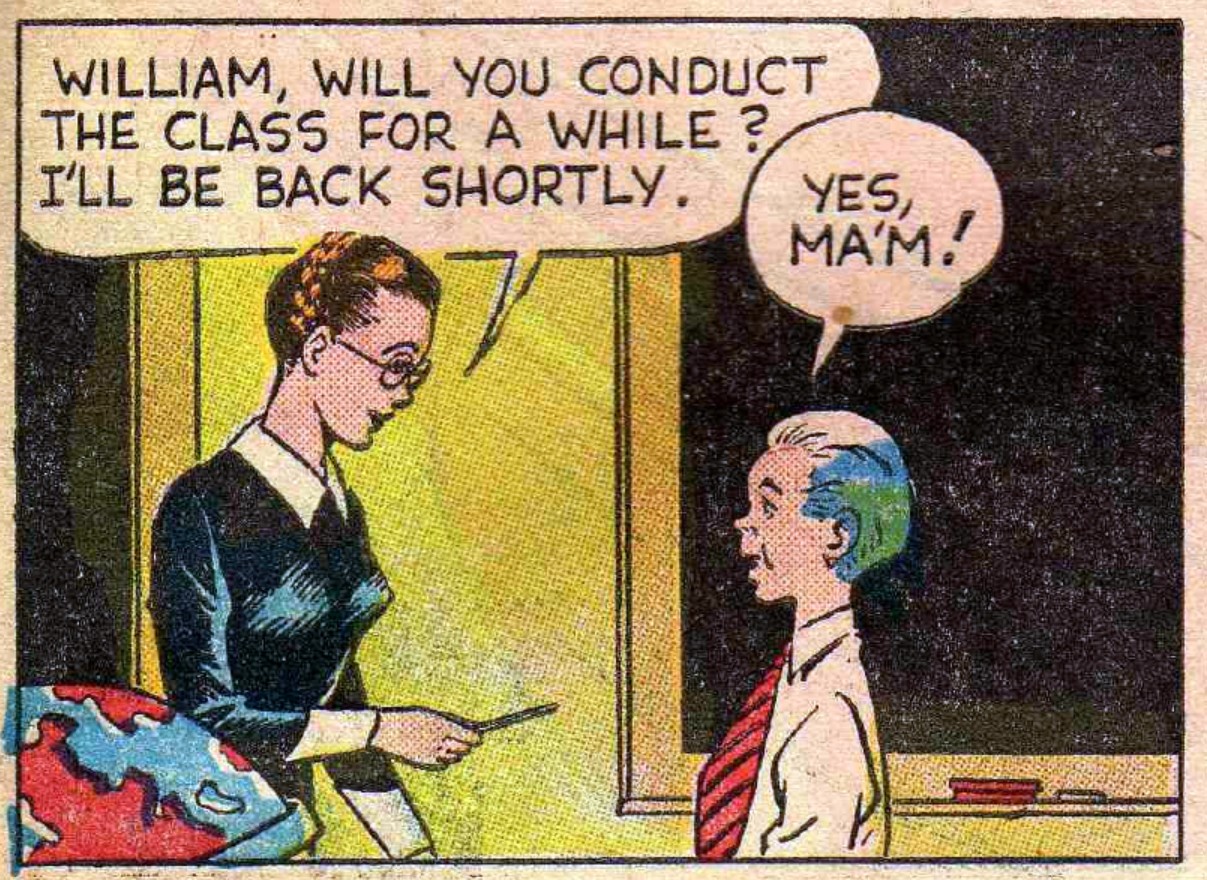
    Lady Fairplay, the “Goddess of Chastisement,” is actually Mary Lee, a mild-mannered schoolteacher given super powers by the never-seen Professor Amazo. I find her costume quite charming, particularly the scale-mail skirt.

    Here’s the thing about Lady Fairplay: she is a perfectly generic super-hero. She is super fast, super strong, agile enough to climb up the side of a plane while it is in flight. She drives around in a super car and ducks out of her day job to fight crime at the drop of a hat. 

    Perhaps the most extraordinary thing about Lady Fairplay is that she just leaves some kid named William in charge of her class while she runs off to fight crime. Good luck on the bullying, William! (Bang-Up Comics 001, 1941)

  • MINOR SUPER-HERO ROUND-UP 068

    MINOR SUPER-HERO ROUND-UP 068

    A few classic minor super-heroes. Bulletman and Bulletgirl in particular have just barely managed not to remain relevant – I suppose the pointy helmet is too much of a hurdle for the modern audience.

    Bulletman: 

    Jim Barr is perhaps the most thoroughly-motivated super-hero of the Golden Age. He is:

    a. from a long line of police officers

    b. the son of a famed police officer who was murdered for being too good a cop and who

    c. told the young Jim that he must become a police officer while on his death bed 

    d. and after all that he was too scrawny and bookish to be a cop and so had to settle for being a forensic scientist

    Jim ends up working in his father’s old station under the command of Sergeant Kent, a pro-torture bully who is often held up as the greatest of all the cops in the city, and who is also the father of love interest Susan Barr. 

    Jim’s personal project is a serum that will destroy “all germs and toxins” in the human body, including that which he believes to be the source of crime and violence. He chooses to test this serum out on himself and his body, freed from a variety of invisible ailments, develops into a physical paragon over the course of a night’s sleep.

    (Sergeant Kent really earns his reputation as a great police officer by failing to notice that his colleague has basically doubled in size over night. In his defense, Jim is wearing big clothes)

    Jim decides that the best way to use this new power is to operate outside of the law, probably due to all of his time hanging around with top cop Kent. He uses his now super intelligence to build the Gravity-Regulator Helmet, which allows him to fly and also generates a force field that augments his natural resilience to make him nigh-invulnerable and able to smash through things head-first (I swear that somewhere I read a story in which it was explained that it made him bulletproof by drawing the bullets to the helmet but danged if I can find it now.). His costume, yellow jodhpurs and all, is assembled out of things that were lying around at the police station, no mention of where. (Nickel Comics 001, 1940)

    If I had to classify Bulletman’s personality, I would go with “extremely no-nonsense” or maybe “wooden, which is why it is important that he is eventually joined by his female counterpart: 

    Bulletgirl: 

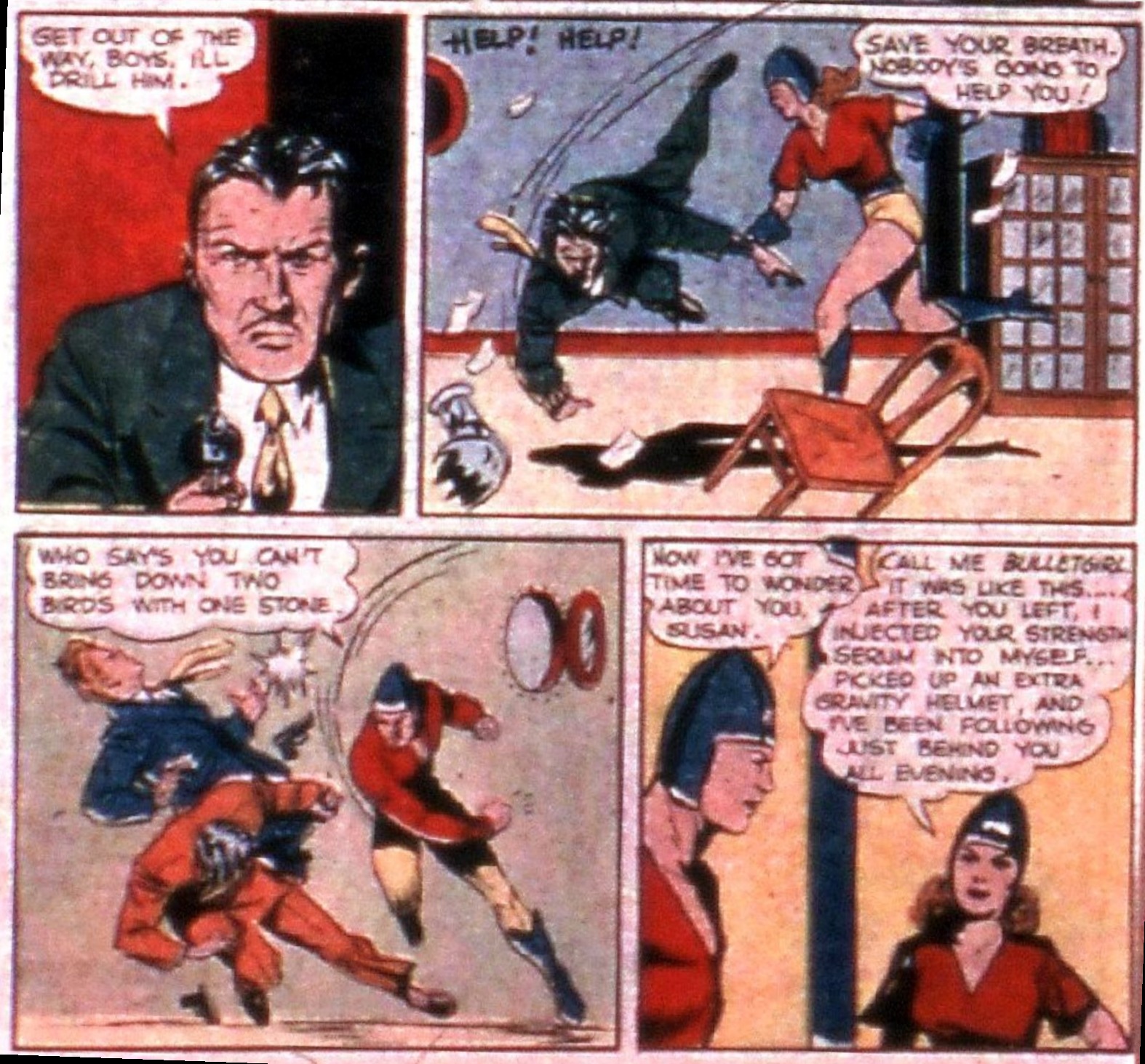
    Bulletgirl is the aforementioned Susan Kent, daughter to good cop/bad cop Sergeant Kent and member of Bulletman’s supporting cast from the beginning. For about the first year of Bulletman’s adventures she fills a low-effort version of the Lois Lane role: curious about the hero’s identity but not especially proactive about trying to uncover it. She also gets kidnapped and targeted for death a lot thanks to her father’s skill at making enemies. Then, in Master Comics 012, Bulletman is knocked out in a collision with Triple Threat’s super vehicle and Susan learns that he is actually Jim Barr. Jim obligingly tells Susan the secret of his origin but resolutely refuses to consider teaming up with her.

    Susan of course injects herself with the serum and crabs a spare Gravity-Regulator Helmet and costume (though she goes for hot pants over jodhpurs) the instant that Bulletman is out of the room, and This is a very good illustration of why I am so fond of Bulletgirl: she has all of the personality that Bulletman lacks. She’s scrappy and quippy and after an issue or two of “too dangerous for girls” chauvinism from Jim is a full partner in the superheroic exercise. She does get kidnapped and left behind a bit more than I’d like but that’s comic books in a nutshell. 

    In conclusion: Bulletgirl! (Master Comics 013, 1941)

    Minute-Man: 

    Like Jim Barr, Jack Weston is the son of a dead hero, though Jack’s father Robert Weston died during the Battle of Chateau-Thierry in World War I. We don’t get nearly as much background on Jack, other than the fact that he was raised by his father’s friend General Milton, but thanks to Milton, Jack becomes Minute-Man, a patriotic super-hero, in what is kind of presented as a draft.

    Jack is sent to join the Army as a lowly Private so that he can keep an eye out for sabotage and espionage affecting the armed forces. Despite having no super serum or particular special training, he proves to be physically near-superhuman as he engages a variety of costumed and non-costumed foes over the course of his mid-length career.

    Minute-Man also dabbles in leaving calling cards, which I always like to make note of. (Master Comics 011, 1941)

    Doctor Voodoo **UPDATE**: 

    In Whiz Comics 017, Doctor Voodoo returns home to find that Maxinya (the Heaven-Woman, natch) has gone missing. He tracks her abductors through the jungle until he comes across their destination: a European castle, smack in the middle of the Amazon. 

    The mystery deepens as Voodoo enters the castle and finds what seems to be an entire Medieval court, headed by the boorish King Richard, who seeks his aid in conquering the jungle. 

    Doctor Voodoo refuses to help King Richard, and so is forced to meet the knight Sir Ganal in combat. Voodoo prevails and wins Ganal over to his side, complete with a promise to reveal the origin of the castle’s presence in the jungle. Alas, this shall never come to pass, because the story does a hard pivot in the next issue. 

    King Richard plays the whole jungle conquest/attempted murder thing off as if it was some sort of test, and sends Doctor Voodoo off to meet with his court wizard. He. in turn, transports Voodoo back in time to the 1400s or thereabouts to retrieve a magical McGuffin called the Golden Flask, with another promise to explain what this whole affair is about once he returns.

    Unfortunately for all us completionists out there, the explanation never comes because Doctor Voodoo never returns. He bops around the oceans for about a year and actually does manage to get his hands on the Golden Flask but his feature is cancelled before he can return it to the wizard and find out just what the heck is going on. Maxinya is waiting for him still, presumably. (Whiz Comics 018, 1941)

  • MINOR SUPER-HERO ROUND-UP 067

    Something for everyone* in this one.

    *not really. 

    Zambini the Miracle Man: 

    Zambini the Miracle Man, aka Zambini the Great, is your fairly typical comic book magic man, albeit a bit more flamboyantly dressed than even that crowd normally are.

    Though Zambini has a lot of the regular magic abilities of his peer group his signature trick involves his magical Boomerang Amulet, which causes evil to rebound on its sender. This takes forms as diverse as a cobra returning to the one who released it to bombs flying back up to the plane that dropped them to magic spells rebounding on their casters. 

    (please also note the final panel above, in which Zambini is being made a Knight of Ritania, which I here recognize as an honour)

    Finally, while I generally do enjoy when a magic user has a weakness to counter their nigh-omnipotence, Zambini might just have the worst one in comics: the touch of a human hand renders him completely powerless and unable to resist, to the point that this Hundanian spy is able to gently lead him to their headquarters and he is only saved when her boss gets jealous – thank heavens that Hundania doesn’t have a robust anti-workplace romance policy. This weakness kind of falls by the roadside as time goes on but does occasionally crop up now and then in horrible ways. (Zip Comics 001, 1940)

    Perhaps the most interesting thing about Zambini is his magical system: for his first two appearances he casts spells by spouting nonsense words (as far as I can tell), but from Zip Comics 003 onward, he uses a version of Ubbi Dubbi that involves inserting the syllable “ab” instead of “ub”. I don’t know if it’s strictly better than speaking backward, Zatara style, but it certainly is unique.

    Atom Blake, Boy Wizard **UPDATE**:

    I had read the 1940-1941 issues of Wow Comics before embarking on my great comics-reading project, so I already knew going in that Atom Blake would essentially speed-run the process of getting tired of living among mere mortals and heading off into space, Dr Manhattan style, but I had forgotten that he is doing so in order to look for his long-lost father. Also, while I did remember that Blake duplicated himself before setting out I had misremembered it as him leaving behind a non-super version of himself on Earth while the superhuman part set off for adventure. What I’m saying here is that the version of Atom Blake that I had remembered is way more interesting than the actual character. (Wow Comics 002, 1941) 

    the Hunchback: 

    The Hunchback is in actuality wealthy playboy Allan Lanier, who became obsessed with the figure of Quasimodo after seeing the 1939 film version of the Hunchback of Notre Dame (or possibly a literal picture of the character – the text box isn’t 100% clear) and combined that with his interest in wiping out crime to become a weird spectre of the night, Batman-style.

    Lanier is refreshingly up-front about his interest in criminology, to the extent that he is seen droning on and on about it before a date with his fiance Betty Brenton. I don’t know if I’d like every fellow with a secret identity to abandon the “disaffected socialite” act, but it is nice to see the odd one do without it and just be a weird eccentric.

    The Hunchback really leans into two specific aspects of his inspiration: he is absurdly acrobatic, and he metes out insane and terrifying violence to his foes. The latter has git to be one of the better justifications for the dread a masked figure of the night inspires among the criminal fraternity.

    We’re on a bit of a run of characters who share their secret identity with their love interest and Alan Lanier is one of them: his fiance Betty has to be told before she will let the Hunchback help her (this might be the downside of the whole “reputation for insane violence” thing). (Wow Comics 002, 1941)

    In the Hunchback’s second adventure, in Wow Comics 003, Lanier switches to a slightly more conventional super-hero outfit. It’s a generic but not terrible design, and I always appreciate a character making a bold hat choice, but I think that it is perhaps a bit too twee for a character who is supposed to be some sort of rampaging engine of madness and destruction. The old uniform came back out of the closet for the Hunchback’s remaining appearances.

    Pinky the Whiz Kid: 

    Pinky the future Whiz Kid (not technically called that until 1942, but whatever, we’re loose and goosey around here) is already a fan of Mr Scarlet before he is rendered a crime orphan by the villainous Mr Hyde (upcoming), who seemingly randomly murders his mother.

    Pinky ends up at Oaklawn Orphanage, which just so happens to be run by Mr Hyde’s alter ego, Dr Jelke. When Hyde/Jelke and Mr Scarlet inevitably clash, Pinky is right there in his homemade sidekick costume to help out.

    Pinky is adopted by District Attorney Brian Butler, ostensibly to keep him out of trouble, but since Pinky has worked out that Brian is secretly Mr Scarlet he is able to blackmail him into becoming his sidekick. It sounds more sinister than it reads, honestly.

    The real downside to Mr Scarlet getting a sidekick is that Miss Wade, formerly a romantic sparring partner for Brian and occasional daring assistant in her own right, is relegated to the role of scolding caretaker as she sensibly attempts to prevent a teenager from flinging himself into danger. It’s a real loss to the comic.(Wow Comics 004, 1941)

  • MINOR SUPER-HERO ROUND-UP 066

    They’re just doing their best over here.

    Nevada Jones: 

    Nevada Jones starts out as a detective working for the Cattleman’s Association in what is probably meant to be the Old West (though at this point my trust in that fact is fragile) but in his second appearance is framed for murder and so adopts a masked alter ego. He also acquired a sidekick named Little Joe, who speaks with the cadence of a guy who was orphaned in the jungle and raised by apes rather than just being Mexican.

    The only really distinct thing about Nevada is that he never seems to actually adopt a new name for himself, he just doesn’t offer a name at all. This means that everyone calls him “masked man” or “stranger” the whole time. There’s an argument to be made that his masked identity is called “Quick-Trigger Man” but the aesthetic part of my soul won’t let me acknowledge it. (Zip Comics 001, 1940) 

    Kalthar: 

    Kalthar, aka God-Son, the Giant Man, King of the Jungle, is the son of an unnamed man who saved the Ugarnas (possibly Urgana? They are only ever referred to in the plural, alas) tribe from slavers but lost his life in the process. Raised by the grateful Urganas, Kalthar of course becomes much cooler than any of them and can speak the language of jungle animals. 

    Kalthar also has the support of Ta-Lo, possibly the only non-evil witch doctor in comics, who brews up a big batch of magic grains that allow him to grow into a fifteen foot tall, bulletproof giant. This is, as you might imagine, a pretty decisive advantage in jungle combat (he can for example punch out a bull elephant), so a large portion of each Kalthar story is spent with him tied up or otherwise unable to reach the magic grains in their hiding place in his hair. (Zip Comics 001, 1940)

    In Zip Comics 009, Kalthar marries Kate Goodwill, an explorer who he had been getting serious with over the prior few issues, but though the Next Issue blurb promises us further adventures of Kalthar and Kate, King and Queen of the Jungle this would be their final appearance. That’s a real shame, because if nothing else this arrangement would be a change from the usual chaste, long-term courtships you see in most jungle comics, where the jungle adventurer hooks up with the first white person they meet in their life but then constantly defers actually doing anything with the relationship. 

    the Devil’s Twins: 

    I just can’t resist a fighter pilot with a cool name, in this case brothers Tom and Tim Shane, aka the Devil’s Twins, aka the Devil’s Flying Twins (or should that be the Devil’s flying Twins), possibly aka the War Eagles unless that’s just the name of the strip. In addition to a great name, the twins have a totally stupid reason for being in the RAF: the German Ace Schultz once fouled them both in a polo match and now they want revenge on him. 

    The brothers earn their main nickname for being such colossal pains in the ass of their immediate superior, Captain Rex: they adopt unsanctioned but very effective tactics supposedly derived from polo, they constantly take off on self-ordained missions that draw unwanted attention to the airfield, they fall in love with the same woman and are huge babies about it, etc, etc. Just a couple of ding dongs. (Zip Comics 001, 1940)

    Mr Satan: 

    Mr Satan is really Dudley Bradshaw, “international detective and soldier of fortune,” who is so bored with the ins and outs of everyday life that he advertises for excitement in his local paper (and then later on he just follows the trouble-prone Doris O’Day around, despite the fact that she hates Dudley for not being as dynamic as Mr Satan). 

    Mr Satan’s purple bodysuit and horned cowl mask are both very charming and not a little reminiscent of the later Daredevil, and he has the distinction (along with most of the other heroes of Zip Comics) of never having been resurrected in any of the various revivals of the Archie/MLJ characters, a perhaps understandable decision in the case of a guy named Mr Satan, but a sad one. (Zip Comics 001, 1940)

  • MINOR SUPER-HERO ROUND-UP 066

    They’re just doing their best over here.

    Nevada Jones: 

    Nevada Jones starts out as a detective working for the Cattleman’s Association in what is probably meant to be the Old West (though at this point my trust in that fact is fragile) but in his second appearance is framed for murder and so adopts a masked alter ego. He also acquired a sidekick named Little Joe, who speaks with the cadence of a guy who was orphaned in the jungle and raised by apes rather than just being Mexican.

    The only really distinct thing about Nevada is that he never seems to actually adopt a new name for himself, he just doesn’t offer a name at all. This means that everyone calls him “masked man” or “stranger” the whole time. There’s an argument to be made that his masked identity is called “Quick-Trigger Man” but the aesthetic part of my soul won’t let me acknowledge it. (Zip Comics 001, 1940) 

    Kalthar: 

    Kalthar, aka God-Son, the Giant Man, King of the Jungle, is the son of an unnamed man who saved the Ugarnas (possibly Urgana? They are only ever referred to in the plural, alas) tribe from slavers but lost his life in the process. Raised by the grateful Urganas, Kalthar of course becomes much cooler than any of them and can speak the language of jungle animals. 

    Kalthar also has the support of Ta-Lo, possibly the only non-evil witch doctor in comics, who brews up a big batch of magic grains that allow him to grow into a fifteen foot tall, bulletproof giant. This is, as you might imagine, a pretty decisive advantage in jungle combat (he can for example punch out a bull elephant), so a large portion of each Kalthar story is spent with him tied up or otherwise unable to reach the magic grains in their hiding place in his hair. (Zip Comics 001, 1940)

    In Zip Comics 009, Kalthar marries Kate Goodwill, an explorer who he had been getting serious with over the prior few issues, but though the Next Issue blurb promises us further adventures of Kalthar and Kate, King and Queen of the Jungle this would be their final appearance. That’s a real shame, because if nothing else this arrangement would be a change from the usual chaste, long-term courtships you see in most jungle comics, where the jungle adventurer hooks up with the first white person they meet in their life but then constantly defers actually doing anything with the relationship. 

    the Devil’s Twins: 

    I just can’t resist a fighter pilot with a cool name, in this case brothers Tom and Tim Shane, aka the Devil’s Twins, aka the Devil’s Flying Twins (or should that be the Devil’s flying Twins), possibly aka the War Eagles unless that’s just the name of the strip. In addition to a great name, the twins have a totally stupid reason for being in the RAF: the German Ace Schultz once fouled them both in a polo match and now they want revenge on him. 

    The brothers earn their main nickname for being such colossal pains in the ass of their immediate superior, Captain Rex: they adopt unsanctioned but very effective tactics supposedly derived from polo, they constantly take off on self-ordained missions that draw unwanted attention to the airfield, they fall in love with the same woman and are huge babies about it, etc, etc. Just a couple of ding dongs. (Zip Comics 001, 1940)

    Mr Satan: 

    Mr Satan is really Dudley Bradshaw, “international detective and soldier of fortune,” who is so bored with the ins and outs of everyday life that he advertises for excitement in his local paper (and then later on he just follows the trouble-prone Doris O’Day around, despite the fact that she hates Dudley for not being as dynamic as Mr Satan). 

    Mr Satan’s purple bodysuit and horned cowl mask are both very charming and not a little reminiscent of the later Daredevil, and he has the distinction (along with most of the other heroes of Zip Comics) of never having been resurrected in any of the various revivals of the Archie/MLJ characters, a perhaps understandable decision in the case of a guy named Mr Satan, but a sad one. (Zip Comics 001, 1940)

  • MINOR SUPER-HERO ROUND-UP 065

    Our themes today are “scarlet,” “family tragedy,” and “inadvisable human experimentation.”

    Mr Scarlet: 

    Brian Butler, NYC* district attorney,** is frustrated by the limitations inherent in working within the law and so like so many of his peers adopts a costumed identity in order to get the better of crime via acrobatics and punching. A classic origin, but Mr Scarlet’s real claim to fame is in being created by Jack Kirby (with Ed Herron) and thus starting off with a real dose of comic book charisma that subsequent artist Jack Binder manages to keep going – both, for example, illustrate his acrobatic explots with such flair that to this day people assume that he’s meant to be flying.

    * although it’s referred to as “Gotham City” in the one caption that names his location, I simply must assume that it’s meant to be the NYC nickname rather than some Earth-S version of Batman’s hometown, earlier than both concepts even exist.

    ** he’s pretty consistently called a “special prosecutor”, but there’s just enough evidence to clarify that he’s a DA rather than an impartial lawyer brought in to prosecute cases involving possible conflicts of interest, which I just learned is what a special prosecutor is.

    Brian Butler’s secretary/love interest Cherry Wade learns his secret in Mr Scarlet’s first published adventure, and I must say as always that I appreciate a Golden Age comics with a straightforward hero romance to contrast with the widespread aping of the Clark Kent/Lois Lane situation. Even if it is an HR nightmare. (Wow Comics 001, 1940)

    Atom Blake, Boy Wizard: 

    Atom Blake, a youngster attending Lincoln High in Collegetown, USA, is curious about why he has a different last name than the people who are raising him, and perhaps more pointedly, why his is physically and mentally superhuman. His foster father, Professor Joseph Page, has the answer in the form of a note left for Atom by his biological father, Stuart Blake. Written in a mathematical code that Atom is instinctively able to read, the note tells of the elder Blake’s experiments in creating a super-element composed of all 93 known regular elements* and how the infant Atom was given treatments to make him super-human enough to utilize the power of the super-element (called sun-metal in later Atom Blake stories but not here) without evaporating like Blake Sr’s poor experimental orangutan.

    *always a good bit when it crops up. I just looked up the history of the discovery of elements to see how long the count of 93 was good for and it looks like about 4 years, though plutonium was discovered in 1941 but kept secret until 1948. More impressive is the fact that at least four of the elements known in 1940 weren’t yet discovered in 1923 when Blake did his work!

    An encounter between Atom and some bank robbers soon reveals that the super-element was stored in the ring that Stuart Blake left with Atom as a baby, and he gains access to a suite of deus ex machina powers. Will this sixteen or seventeen year old boy be able to deal with unlimited power in a healthy way? Stay tuned! (Wow Comics 001, 1940)

    UPDATE 1941 

    Steel Sterling: 

    John Sterling is your classic crime orphan: after losing his father to gangsters at a young age, he devotes his life to battling crime. But rather than become a living weapon through intense training, Sterling takes a note from his father’s death by gunfire and spends his formative years developing a chemical treatment that will give his body the properties of steel, dramatically catalyzed by a dip into a vat of molten metal in a sequence with more on-panel male nudity than you usually see. Please also note the final panel above, which showcases Sterling’s weird riveted metal briefs.

    And Sterling isn’t just blowing smoke about having all the properties of steel: in addition to being bulletproof and super strong thanks to his new density, he also has the magnetic properties of the alloy, which he, like many of his magnetic brethren, employs to fly around by “magnetizing himself to” various things. Later this is rounded up to simply being able to fly and thank goodness for that.

    Finally, Steel Sterling has one of the better secret identities, as he establishes private detective John Sterling as his own twin brother (and also as a sort of cowardly jerk so that he can establish the usual Lois Lane/Clark Kent dynamic with love interest Dora Cummings). (Zip Comics 001, 1940)

    the Scarlet Avenger: 

    I know I bagged on the Defender for just being the Avenger with the serial numbers filed off, but dang it if the Scarlet Avenger doesn’t feel even more like someone just took Richard Benson out back and slapped a little red paint on him. Real name Jim Kendall, the Scarlet Avenger loses his wife and child as a result of a gold robbery on the airplane they are riding in. Kendall alone survives the subsequent crash but loses the ability to form facial expressions, leading to his nickname as The Man Who Never Smiles. 

    The Scarlet Avenger’s calling card, seen above making the text box hard to read, is a flaming arrow for no discernible or stated reason. Later on it is often depicted with a decorative skull.

    The Scarlet Avenger lacks the ability to reshape his facial features that his inspiration possessed, and instead of being a master of disguise is more of a gadgeteer, variously employing a paralysis ray, bulletproof cloak, electrically wired suit that allows him to deliver lethal shocks, mind reading device, compact miniature parachute, shoe knife, personal smokescreen, rocket car and rocket ship in his pursuit of justice. 

    The other point of similarity between the Scarlet and regular Avengers is the extensive network of agents that both employ, though the Scarlet Avenger’s narrows somewhat over time as he begins a romantic relationship with Inez Courtney, aka Operative 1. More trouble for HR.  (Zip Comics 001 1940)