The Curse of Skeleton Munroe

Category: minor super-hero

  • MINOR SUPER-HERO ROUND-UP 064

    MINOR SUPER-HERO ROUND-UP 064

    Oh my gosh! It’s more minor super-heroes! 

    the Phantom Rider: 

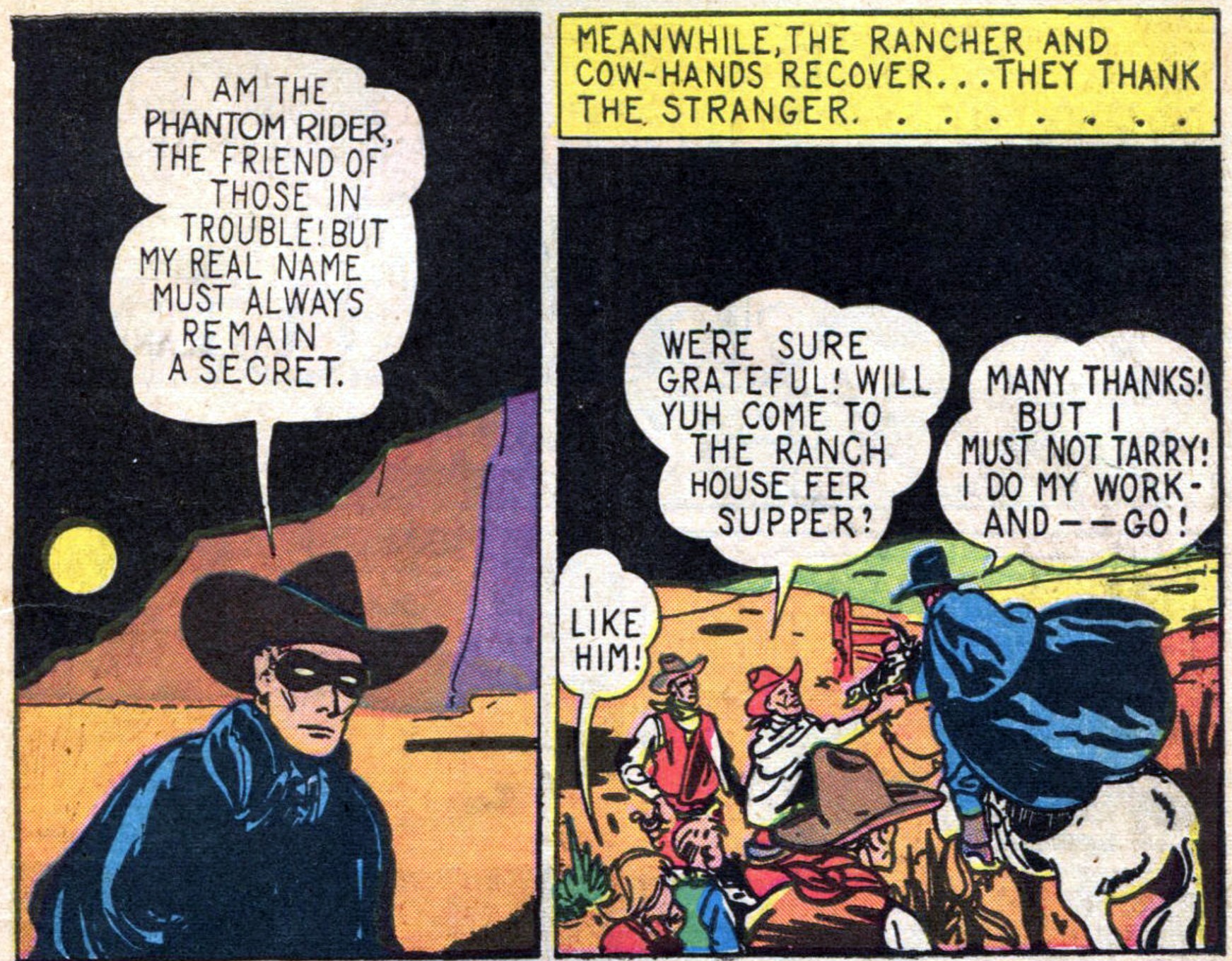
    The Phantom Rider is Tex Maxon, who was already a wandering cowboy who meted out justice for a while before getting into the masked vigilante game. Where a lot of masked cowboy vigilantes are doing a classic secret identity or concealing their identity for more specific reasons like being wanted for a crime they didn’t commit, the Phantom Rider thing honestly just seems like a fashion choice on Maxon’s part, like he found a big black cloak one day and decided to roll with it.

    The above speculation is undermined somewhat by the fact that the Phantom Rider outfit changes to this yellow cowboy shirt/jeans/mask combo pretty quickly, but maybe Maxon just found the cloak too cumbersome (or the artist found it too annoying to draw).

    Far more annoying is the fact that this strip that was clearly set in the Old West from long before the Phantom Rider identity was established switches to a Modern West setting in Wonderworld 015. Have some consistency, people. (Wonderworld Comics 011, 1940)

    **UPDATE** the Flame:

    Once again we have the origin of the Flame, and as I suspected the previous version of this that we had encountered was cut down from this one. Notably, this is the first time that the Flame is given any sort of name, Charteris, and the lack of a first name is even kind of textually supported: he is washed away in the flood immediately after being born – his parents might not have had time to name him yet. He is made Grand High Lama as a baby in this one too, which is still weird to me. (Wonderworld Comics 011, 1940)

    **UPDATE** Yarko the Great:

    In a bit of Silver Age “give everything a significant origin” style storytelling, the jewel on the front of Yarko the Great’s turban is revealed to be the Ada-La-Hoda, one of the Twin Jewels of Blood required for this one Chosen One to become ruler of all India, in a mystical sword-in-the-stone way. Unfortunately for him, his choice to wantonly murder anyone who might get in the way of his acquiring the gem leads Yarko to determine that he is unfit for the role and keep the dang thing in hopes that the next Seventh Son of the Seventh Son of the Order of Aribah might be more reasonable. (Wonderworld Comics 011, 1940)

    the Secret Band of the Purple Hood: 

    The Secret Band of the Purple Hood are a vigilante organization that operate in the city of Shanghai and who induct super-detective Dr Fung into their ranks mid-case as both he and they are attempting to battle the worshippers of Khwass, Great God of Vengeance. Sadly, as this adventure ends in a cliffhanger that is as far as I can tell never resolved, we don’t get to see the Secret Band do much more than beat up a couple of priests, but I’m just so chuffed to find a vanishingly-rare example of non-title-character masked vigilantism that I simply had to include them. (Wonderworld Comics 016, 1940)

  • MINOR SUPER-HERO ROUND-UP 063

    Pilots! Vexatious pilots! Will they give me no peace?  

    the Skull Squad: 

    Yet another gang of pilots with some pretty lacklustre skull theming to go with their name. The Skull Squad is an international affair, with American Jimmy Jones, Englishman Kent Douglas and Scotsman Jock “Sandy” MacGregor all flying a bomber for the RAF and predictably getting into wild and wooly scrapes. (Wings Comics 001, 1940)

    SKULL SCORE:  0.5/5 

    the Parachute Patrol:

    The Parachute Patrol are Tommy, Curly and Blimpo (and I know every kid gang has to have a fat kid or an ethnic kid with a cruel nickname, but “Blimpo” seems a bit extreme for a kid who is husky at best), three American teens who for some never-explained (I assume) reason live in a picket fenced neighbourhood in Central France, complete with an even more incongruous grumpy neighbour straight out of an Our Gang short. One must assume that they were originally based out of the US somewhere until someone raised the point that having them casually fly over the Atlantic Ocean in their single-engine plane in their first adventure strained credulity somewhat.

    The “parachute” in Parachute Patrol comes from their signature mode of transport, the parachute balloon, which allows them to smoothly ascend and descend from any height. (Wings Comics 001, 1940) 

    (The above only applies to the first appearance of the Parachute Patrol. From Wings Comics 002 onward the same three kids are a trio of British Boy Scouts who are loosely attached to the RAF and get into all kinds of scrapes with Axis spies and other threats. Blimpo is still called that, even though he’s about the same size as Tommy. The parachute balloon and Mrs Measly never appear again – the “parachute” in Parachute Patrol refers to parachute-spotting, i.e., looking for incoming paratroopers) 

    the Phantom Falcons: 

    A private air force founded by airplane manufacturer Davis and a handful of WWI fighter aces, the Phantom Falcons operate out of an underground air base that is probably somewhere in Switzerland but also probably moves around in order to facilitate storytelling. In their first appearance, young pilot Tom Slade stumbles across their operation and becomes the fifth Phantom Falcon. (Wings Comics 001, 1940)

    the Spitfire Ace: 

    Though the Spitfire Ace is ultimately just another WWII pilot with a cool nickname, he is remarkable for having what is one of the more complicated origins that I have ever read, and all to end up as an RAF pilot just like any number of characters who just volunteered. Here’s the skinny:

    -Tom Cassidy is a hard-boiled airplane salesman trying to sell fighter planes to the Polish government, and so is in Warsaw when the Nazis attack. Disgusted by the slaughter of civilians, he hops in his sample plane and attacks the Germans, putting in a good showing before being shot down by the Nazi ace Hornigg.

    -Hornigg blackmails the captured Cassidy by having his face disfigured and threatening to leave it that way. Cassidy is forced to participate in mock dogfights with Hornigg as a propaganda exercise, with himself as an example of a misguided former antagonist won over to the Nazi side. BUT! Cassidy is also learning all of Hornigg’s air combat tricks.

    -With the aid of a British secret agent, Cassidy and captured RAF pilot Captain Sheridan escape in a stolen plane. They are shot down near Dunkirk and Captain Sheridan is killed.

    -Cassidy takes Sheridan’s papers and joins the evacuation of Dunkirk. Once in England, he poses as Sheridan in order to have an opportunity to fight the Nazis again. He is able to claim that his face was injured and reconstructed thanks to his plastic surgery scars, and he is soon instated as RAF Captain Sheridan.

    Cassidy/Sheridan makes a name for himself thanks to his inadvertent training with Hornigg, and soon gets a chance to shoot his former captor down. Having done so kind of makes all of the above meaningless of course, but whatever. At this point, “Spitfire Ace” is just a regular aviation comic. (Wings Comics 004, 1940) 

  • MINOR SUPER-HERO ROUND-UP 062

    We’re awash in minor super-heroes! 

    Golden Arrow: 

    Golden Arrow has a more convoluted origin than an Western hero has any right to, but I’ll do my best to summarize it without one million images. He is Roger Parsons, whose father, Professor Paul Parsons, develops advanced ballooning technology just before WWI breaks out and determines to test it out before donating it to the US government. To that end, he bundles his wife and infant son into a balloon and sets out on a cross-country voyage that turns out to have been a bit too well-publicized, because he is shot down by the villainous Brand Braddock while passing over the Western deserts. While Brand squirrels away Parsons’ technology until the day he can safely sell it on, the infant Roger is found by a prospector named Nugget Ned, who raises him as his own son.

    Life in the West suits Roger, and he grows up to be a physical paragon, a crack shot with the bow and arrow (with which he uses impractical but iconic golden-headed arrows, and yes, I do believe there is a story in which a crook goes around committing minor crimes in order to profit from gathering them up afterward) and a superb horseman on his faithful steed White Wind. Nugget Ned eventually dies of being Old, but passes on the truth of Roger’s parentage before he goes. Roger then takes back the ballooning technology from Brand (plus his twin sons Bronk and Brute) and donates it to the US Government. Along the way, he kind of falls into being a Western vigilante.

    Golden Arrow is also one of my classic examples of a character egregiously transitioning from the Modern to the Old West, since he is so firmly established as being in the present from the start. As usual, it’s not easy to pin down exactly when it happens, but it does. (Whiz Comics 002, 1940)

    UPDATE 1941 

    Spy Smasher:

    Spy Smasher is Alan Armstrong, a wealthy Virginia playboy who battles espionage threats to American democracy. He uses both his geographic proximity to Washington DC (via his Virginia estate) and his engagement to Eve Corby (daughter of Naval intelligence officer and eventual Chief of the US Secret Service Admiral Corby) to keep abreast of just what those threats might be and then sally forth to punch them in the face – smashing them, if you will.

    Though this setup might at first seem to be a recipe for a comic about a hero battling an endless series of nondescript men in suits, it is in fact the complete opposite, as Spy Smasher only smashes the most eccentric and flamboyant of spies, starting with the Mask, who does, yes, wear a suit most of the time, but trust me on this. He’s nutty.

    Something that I had forgotten about Spy Smasher is that they were extremely coy about his identity for the first year or so. It’s not a particularly mysterious mystery, as Armstrong is literally the only suspect and there is some allusion to the reader being able to figure it out.. They do make an attempt to imply that Armstrong could be the Mask, but there’s a period where Eve Corby knows the secret while the reader theoretically does not at I gotta assume that she would put 2 and 2 together if Spy Smasher was not Armstrong but Armstrong was still mysteriously sneaking off just before Spy Smasher and the Mask had a scrap. Basically what I’m saying is that this comic needed more white guys.

    Spy Smasher’s main bit of crime espionage-fighting technology is the Gyrosub (also Gyro-sub, Gyro Sub), a compact vehicle that combines the functions of a car, an airplane, a boat and a submarine and has a wide array of deployable weapons and technology as the story demands them. (Whiz Comics 002, 1940)

    UPDATES: 

    Smasher Spy 

    Doctor Voodoo: 

    Jungle heroes are all kind of samey: they fall into a few broad archetypes and have variably racist adventures in an abstract Jungle that frequently feels simultaneously Asian, African and South American (and indeed one of Doctor Voodoo’s own adventures involves Arab slavers raiding the Amazon from a very Sahara-like desert*). What is remarkable about Hal “Doctor Voodoo” Carey here is how he is both a white child who grew up in the jungle and excelled at jungle skills beyond his native peers and also simultaneously a magic white man from far away who brings modern science and medicine to the wilderness. How is this? Why, it is because the comic treats being a white guy as a kind of magical property that Hal has, and so even though he has never left the Amazon and learned all of his medicine from observing his father and reading his old textbooks, Hal identifies as and acts as an American doctor throughout the series.

    Hal practices his medicine among the Blanca, a tribe of “White Indians”, which is a term that I think originated in the pulps and is basically meaningless except to signal to the reader that the Blancas can be viewed as fully human. They are also the ones who give him the name “Doctor Voodoo” after deciding that his medical knowledge is magical in nature. Which I guess that it kind of is, given my earlier assertions. Annoying! (Whiz Comics 007, 1940)

    *this happens in Whiz Comics 017 if you’re interested 

    Maxinya the Heaven-Woman: 

    Doctor Voodoo’s companion/ love interest is Maxinya, the Heaven Woman, who is yet another kind of jungle hero in that she was abandoned when her explorer parents were seemingly killed in the collapse of an ancient temple and subsequently raised by jaguars. She can talk the language of jaguars and has jungle life down but ends up not having a lot to due because the focus is on Hal and he is the kind of misogynistic 40s hero who inists that adventure is no place for a lady.

    Not enough time is spent on the fact that Maxinya’s companion Jappa is a jaguar who is large enough to carry two adult humans on his back, who communicates with Maxinya and later Doctor Voodoo in an actual spoken language, with words. I feel like there’s a story there. (Whiz Comics 007, 1940)

    (it only comes up once, so I wouldn’t necessarily call it an essential part of his character, but here’s Doctor Voodoo engaging in Blanca Death Combat against his arch-foe Okoro)

    UPDATE 1941 – Dr Voodoo is flung back in time. 
  • MINOR SUPER-HERO ROUND-UP 061

    Superfolk galore! 

    the Buzzard: 

    In an unnamed New-York-alike city, the gadgeteering mayor equips a young man with a suite of devices to help him engage in a vigilante crusade against crime. Chief among these gadgets is a gas that makes whomever it touches resemble a balding, big-nosed man in thick glasses and a tailcoat – the perfect disguise! Armed with this gas, plus some clawed gloves and a heat ray, the Buzzard begins tearing his way through the city’s underworld. 

    The gas also seems to allow the Buzzard to make his shadow resemble his namesake bird, an ability that is very useful for vexing the city’s Buzzard-hating police chief who, it turns out, is also the father of the Buzzard’s secret identity. 

    I unironically love the Buzzard and his whole weird setup, and while I find most modern revivals of public domain Golden Age characters to be a pretty mixed bag, I’m pretty bummed that none of them have elevated him out of his single issue obscurity – he’s got a real weirdo charm that the fiftieth version of the Nedor characters can’t approach. (Wham Comics 002, 1940) 

    the Cyclone: 

    The Cyclone is really Peter Grant, a young man who has a fairly unique version of the Batman origin, which of course is when a tragedy inspires an obsessive dedication to training and working toward some related goal, i.e., in Batman’s case the murder of his parents inspiring his eternal war against crime. The real twist in the Cyclone’s case seems to be the total absence of a motivation: Grant just woke up one day and decided to turn his body into a living weapon to aim at evil.

    The Cyclone is presented as being a regular human and so I had been assuming that the whirlwind patterns around his lower body when he jumps around were a stylistic choice meant to represent his fantastic leaping ability. They really are some enormous jumps, however, so it’s also possible that the Cyclone is meant to have some sort of wind-assisted jumping power. He only had three adventures, alas, so we shall never know. (Whirlwind Comics 001, 1940)

    Ibis the Invincible: 

    Ibis the Invincible, aka Prince Amentep, is a 12th Dynasty Egyptian who just kind of spontaneously comes back to life after 4000 years as a mummy. Why? Well, it’s not spelled out until the 1942 Ibis the Invincible series, but spoilers: his true love had been shot with an arrow that put her to sleep for those four millennia and he put himself in a magical sleep of his own in order to be with her again. 

    Ibis achieves this state of mystic sleep with the aid of the Ibistick, a magical wand capable of very nearly anything. Much like his fellow Golden Age magical super-heroes, Ibis’ near-omnipotence can occasionally seem plot-obliteratingly powerful. 

    The key difference between Ibis and his contemporaries, however, is that the Ibistick is a small object that is constantly being lost or stolen. Further, it requires absolutely no special knowledge to be used and can be operated by both children and animals with ease. More than a few of Ibis’ greatest foes (e.g., the Hobo-Millionaire) are simply regular humans armed with his own magic wand. The caveat to all this is the fact that the Ibistick will never harm its true owner, and will in fact inflict any baleful magic cast from it at him back on its wielder. This means that Ibis is able to defeat an evil wielder of the Ibistick by merely being annoying enough that they try to turn him into a toad or gold or ice or on on memorable occasion to mind control Taia into stabbing him to death and then wait for it to backfire on them. (Whiz Comics 002, 1940)

    UPDATE 1941 

    Taia: 

    Taia is the 4000-year-sleeping love for whom Ibis the Invincible made his way to the future. After a bit of moping around the globe he manages to track down her mummy and revive her, upon which they kind of implicitly are a married couple. While I very much enjoy Taia and the dynamic she has with Ibis, she does get a pretty raw deal – being your own husband’s de facto sidekick is bad enough, but Taia very rarely gets to be anything more than a kidnap victim/bargaining chip. The few modern versions of Ibis the Invincible try to do more with her, but they still don’t do much.

    Taia is said to be cousin to “Senwosri III” who is probably meant to be Pharaoh Senusret III, given that Taia and Ibis are said to be from the 12th Dynasty. So that’s something. (Whiz Comics 002, 1940)


  • MINOR SUPER-HERO ROUND-UP 060

    Some of those reeeeal obscure guys today. 

    Craig Carter:

    Archaeologist Craig Carter wants to give up all the stuffy academia and become a crime fighter, and since he lives in a comic book universe, the very day he tells his girlfriend about this objectively bad decision he receives a magical ring in the mail from an old colleague whose life he had saved. This ring grants its wearer the ability to summon the gods of antiquity to aid them – in Carter’s two adventures he summons Zeus, Mercury, Thor and Pluto, plus he gets Zeus to summon Pegasus for him, so presumably a whole world of magical beasts was also at his fingertips. Carter’s second adventure ends with Pluto deciding not to return to the ring, which presumably would have set him up as a long-term antagonist. Alas this was not to be, as his second appearance was also his final appearance.

    The ring is also hilariously sensitive with regards to its touch-activation, as seen here when a simple hand-pat causes Zeus to blow up the club. (Wham Comics 001, 1940)

    Detecto:

    Jack Strand is a radio scientist who has invented Detecto, a “wonder beam” that has “four unlimited powers”: the ability to send and receive short wave radio, an engine killing effect, a force field and the ability to paralyze living things. As in a few other cases that we have encountered, the line between Detecto as a beam and Detecto as a kind of ambient energy field is a bit blurry, but whatever it is, Strand installs a transmitter in his car, making it into what is essentially a magical object. Would he be better off with a more portable version of Detecto, particularly as at least one of the powers, the radio, is commonly possessed by many cars already? Maybe. Am I sad that this was the only story about Detecto? Certainly, particularly as this was very much a tale of highway-based crime and I would love to see Detecto go up against someone in an airplane or maybe a building. (Wham Comics 001, 1940)

    Blue Fire:

    Blue Fire is actually scientist Jack Knapp, who acquired his powers through the ever-popular method of an unexpected explosion in his chemistry laboratory. Please note also that he was about to drink an unspecified formula just before this explosion occurred – is it the same as the explosive chemical that gave him his powers or was he about to unlock an entirely different suite of abilities?

    Blue Fire takes his name from the halo of blue flames that surrounds him when his powers are active, Contrary to this external signifier, however, he does not have any kind of heat or flame based abilities but rather is an intangibility guy. This is by far the best thing about Blue Fire, by the way, and not just because of the name/power fakeout but because Blue Fire creator Louis Glanzman has effortlessly answered all of the nitpicky questions about intangibility (why can they still breathe? why don’t they fall through the floor? why can they pick things up?) by establishing that Jack Knapp is effectively the opposite of ooblek: he functions as if tangible until enough force is exerted by or on his body, so that he can pick up a book but that same book will pass right through him if thrown. It’s very neat and tidy!* 

    Blue Fire has to drink some of the chemical created in the initial explosion to activate his powers, after which he has them for two whole hours. This is an interesting twist to the whole question of a secret identity, lying somewhere between the Hulk’s “uncontrollable change for an indeterminate amount of time and the usual Archie Andrews-style running around in different hats that Superman and co. get up to. I’m surprised that I can’t think of another character with this kind of life-complicating power setup. (Wham Comics 002, 1940)

    *I am of course immediately imagining horror scenarios in which Blue Fire cannot breathe in a high wind or a high pressure atmosphere, where he jumps down from a small platform and then falls to the centre of the Earth, etc 

    Solarman: 

    Solarman and his mentor, the bat-eared Quino, are aliens from the enlightened planet Saturn who have been observing Earth for some time. Quino is so depressed over the crime and evil that is rampant on our planet that he almost heat-rays the entire thing before his Saturnian enlightenment kicks in and he reconsiders. Instead, the two hit upon a plan wherein Solarman will be blasted to Earth to fight crimes that the two have spotted via their viscopes and x-rayscopes.

    Though Solarman is said to have “many powers” by Quino, the only one he displays while on his sole recorded mission to Earth is some moderate super strength. Still, this is more than enough to beat up gangster Al Ravoni’s entire suite of henchmen and bring the fugitive himself to justice. Hopefully this kind of thing is enough to satisfy Quino’s righteous bloodlust. (Wham Comics 002, 1940)

  • MINOR SUPER-HERO ROUND-UP 060

    Some of those reeeeal obscure guys today. 

    Craig Carter:

    Archaeologist Craig Carter wants to give up all the stuffy academia and become a crime fighter, and since he lives in a comic book universe, the very day he tells his girlfriend about this objectively bad decision he receives a magical ring in the mail from an old colleague whose life he had saved. This ring grants its wearer the ability to summon the gods of antiquity to aid them – in Carter’s two adventures he summons Zeus, Mercury, Thor and Pluto, plus he gets Zeus to summon Pegasus for him, so presumably a whole world of magical beasts was also at his fingertips. Carter’s second adventure ends with Pluto deciding not to return to the ring, which presumably would have set him up as a long-term antagonist. Alas this was not to be, as his second appearance was also his final appearance.

    The ring is also hilariously sensitive with regards to its touch-activation, as seen here when a simple hand-pat causes Zeus to blow up the club. (Wham Comics 001, 1940)

    Detecto:

    Jack Strand is a radio scientist who has invented Detecto, a “wonder beam” that has “four unlimited powers”: the ability to send and receive short wave radio, an engine killing effect, a force field and the ability to paralyze living things. As in a few other cases that we have encountered, the line between Detecto as a beam and Detecto as a kind of ambient energy field is a bit blurry, but whatever it is, Strand installs a transmitter in his car, making it into what is essentially a magical object. Would he be better off with a more portable version of Detecto, particularly as at least one of the powers, the radio, is commonly possessed by many cars already? Maybe. Am I sad that this was the only story about Detecto? Certainly, particularly as this was very much a tale of highway-based crime and I would love to see Detecto go up against someone in an airplane or maybe a building. (Wham Comics 001, 1940)

    Blue Fire:

    Blue Fire is actually scientist Jack Knapp, who acquired his powers through the ever-popular method of an unexpected explosion in his chemistry laboratory. Please note also that he was about to drink an unspecified formula just before this explosion occurred – is it the same as the explosive chemical that gave him his powers or was he about to unlock an entirely different suite of abilities?

    Blue Fire takes his name from the halo of blue flames that surrounds him when his powers are active, Contrary to this external signifier, however, he does not have any kind of heat or flame based abilities but rather is an intangibility guy. This is by far the best thing about Blue Fire, by the way, and not just because of the name/power fakeout but because Blue Fire creator Louis Glanzman has effortlessly answered all of the nitpicky questions about intangibility (why can they still breathe? why don’t they fall through the floor? why can they pick things up?) by establishing that Jack Knapp is effectively the opposite of ooblek: he functions as if tangible until enough force is exerted by or on his body, so that he can pick up a book but that same book will pass right through him if thrown. It’s very neat and tidy!* 

    Blue Fire has to drink some of the chemical created in the initial explosion to activate his powers, after which he has them for two whole hours. This is an interesting twist to the whole question of a secret identity, lying somewhere between the Hulk’s “uncontrollable change for an indeterminate amount of time and the usual Archie Andrews-style running around in different hats that Superman and co. get up to. I’m surprised that I can’t think of another character with this kind of life-complicating power setup. (Wham Comics 002, 1940)

    *I am of course immediately imagining horror scenarios in which Blue Fire cannot breathe in a high wind or a high pressure atmosphere, where he jumps down from a small platform and then falls to the centre of the Earth, etc 

    Solarman: 

    Solarman and his mentor, the bat-eared Quino, are aliens from the enlightened planet Saturn who have been observing Earth for some time. Quino is so depressed over the crime and evil that is rampant on our planet that he almost heat-rays the entire thing before his Saturnian enlightenment kicks in and he reconsiders. Instead, the two hit upon a plan wherein Solarman will be blasted to Earth to fight crimes that the two have spotted via their viscopes and x-rayscopes.

    Though Solarman is said to have “many powers” by Quino, the only one he displays while on his sole recorded mission to Earth is some moderate super strength. Still, this is more than enough to beat up gangster Al Ravoni’s entire suite of henchmen and bring the fugitive himself to justice. Hopefully this kind of thing is enough to satisfy Quino’s righteous bloodlust. (Wham Comics 002, 1940)

  • MINOR SUPER-HERO ROUND-UP 059

    You thought that I couldn’t keep doing it but I can. MORE SUPER-HEROES 

    the Dart: 

    On the one hand, the Dart is just another guy with cape and a mask who fights crime alongside his kid sidekick, but on the other, he has a few interesting twists on what is already a tried-and-true formula:

    In the first place, the Dart was originally an Ancient Roman named Caius Martius who was magically sealed in a block of stone by his enemies, only to reemerge in the 20th Century. While this is only a moderately unusual origin for a super-hero, what is neat is that Caius Martius was effectively already a super-hero before he got cursed: he had his signature super-power of flight (referred to a “darting through the air,” hence the name) and was using it to fight “Roman racketeers.”

    Basically the first thing that Caius sees when he leaves the museum is a drive-by shooting, as the Ricarno Gang wipes out the Mariotti Gang, and more pertinently to his origin the parents of…

    Ace Barlow, the Amazing Boy: 

    Ace’s tragic orphaning at the hands of the Ricarno Gang leave him free to join up with Caius Martius as a crime-fighting team. Caius teaches Ace how to scrap, Roman-Style, and even more impressively goes to the trouble to teach him to fly rather than simply having an unpowered teenaged boy tagging along on all of his adventures like so many of his peers. (Weird Comics 005, 1940) 

    The Dart later gets a job as a teacher of Ancient Roman history at the school that Ace attends, and while this may seem like a good idea on the face of it, we must keep in mind that he slightly predates Julius Caesar, and so every time a kid asks a question about the Roman Empire, Caius is going to bug out his eyes and say “the Roman WHAT?”

    Also please note that while Caius Martius had the forethought to change his weird Roman name to something more modern to fit in, the change he made was to add “Wheeler” to the end, like having the last name “Martius” was the problem. (Weird Comics 006, 1940) 

    After their initial appearance, the Dart and Ace spend the rest of their 1940 appearances as nonsuper, nonflying vigilantes, but someone must have realized that that was the more boring option because the Dart was back to darting through the air in 1941.

    Finally, the creators of the Dart either vastly over-estimated the cutting power of a Roman short sword or intend for the Dart’s signature weapon to be magical in some way, because he sure does spend a lot of time carving through things that would stymie the vast majority of handheld tools.

    Dynamo **UPDATE**:

    I don’t know if it’s a new power per se, but in his first appearance in Weird Comics Dynamo continues his long habit of really expanding the limits of what you can do via control over electricity by employing it as a long-range listening device. (Weird Comics 008, 1940)

    Similar but unrelated: he can also hear radio broadcasts through his fingertips. (Weird Comics 009, 1940) 

    the Eagle **Update**: 

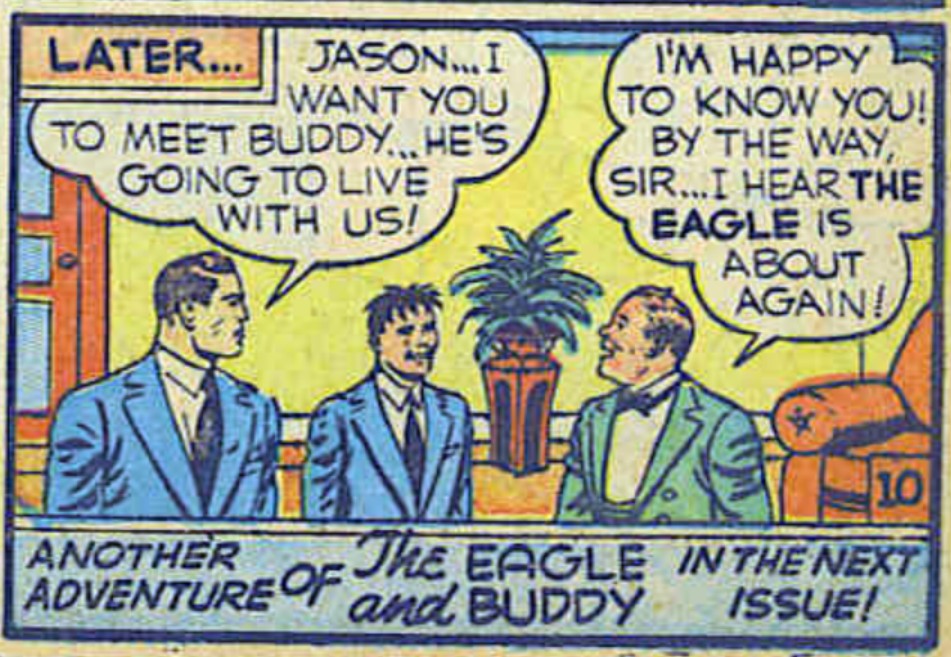
    The Eagle just can’t resist the lure of a new costume. Or Perhaps it’s the Eagle’s colourist, since as with several of his previous changes in outfit this one could just be some whimsical palette swap action. (Weird Comics 009, 1940)

    More importantly, that kid up there is the Eagle’s new sidekick:

    Buddy, the Daredevil Boy: 

    Buddy is a kid who was presumably doing a little track-and-field when he saw the Eagle’s archfoe the Beast about to murder him with a poisoned dart and jumped in to save the day. The Eagle proceeds to adopt Buddy in such an abbreviated and perfunctory fashion that it almost serves as a parody of the idea of the kid sidekick – he doesn’t even bother to establish that he’s an orphan first.

    Buddy might just be the most hard-done-by sidekick in Golden Age comics, at least as far as costumes go, as he’s stuck in that track suit until Weird Comics 017, while the Eagle just keeps on trying new outfits the whole time. I can only imagine how galling that must have been for him. (Weird Comics 009, 1940) 

  • MINOR SUPER-HERO ROUND-UP 059

    MINOR SUPER-HERO ROUND-UP 059

    You thought that I couldn’t keep doing it but I can. MORE SUPER-HEROES 

    the Dart: 

    On the one hand, the Dart is just another guy with cape and a mask who fights crime alongside his kid sidekick, but on the other, he has a few interesting twists on what is already a tried-and-true formula:

    In the first place, the Dart was originally an Ancient Roman named Caius Martius who was magically sealed in a block of stone by his enemies, only to reemerge in the 20th Century. While this is only a moderately unusual origin for a super-hero, what is neat is that Caius Martius was effectively already a super-hero before he got cursed: he had his signature super-power of flight (referred to a “darting through the air,” hence the name) and was using it to fight “Roman racketeers.”

    Basically the first thing that Caius sees when he leaves the museum is a drive-by shooting, as the Ricarno Gang wipes out the Mariotti Gang, and more pertinently to his origin the parents of…

    Ace Barlow, the Amazing Boy: 

    Ace’s tragic orphaning at the hands of the Ricarno Gang leave him free to join up with Caius Martius as a crime-fighting team. Caius teaches Ace how to scrap, Roman-Style, and even more impressively goes to the trouble to teach him to fly rather than simply having an unpowered teenaged boy tagging along on all of his adventures like so many of his peers. (Weird Comics 005, 1940) 

    The Dart later gets a job as a teacher of Ancient Roman history at the school that Ace attends, and while this may seem like a good idea on the face of it, we must keep in mind that he slightly predates Julius Caesar, and so every time a kid asks a question about the Roman Empire, Caius is going to bug out his eyes and say “the Roman WHAT?”

    Also please note that while Caius Martius had the forethought to change his weird Roman name to something more modern to fit in, the change he made was to add “Wheeler” to the end, like having the last name “Martius” was the problem. (Weird Comics 006, 1940) 

    After their initial appearance, the Dart and Ace spend the rest of their 1940 appearances as nonsuper, nonflying vigilantes, but someone must have realized that that was the more boring option because the Dart was back to darting through the air in 1941.

    Finally, the creators of the Dart either vastly over-estimated the cutting power of a Roman short sword or intend for the Dart’s signature weapon to be magical in some way, because he sure does spend a lot of time carving through things that would stymie the vast majority of handheld tools.

    Dynamo **UPDATE**:

    I don’t know if it’s a new power per se, but in his first appearance in Weird Comics Dynamo continues his long habit of really expanding the limits of what you can do via control over electricity by employing it as a long-range listening device. (Weird Comics 008, 1940)

    Similar but unrelated: he can also hear radio broadcasts through his fingertips. (Weird Comics 009, 1940) 

    the Eagle **Update**: 

    The Eagle just can’t resist the lure of a new costume. Or Perhaps it’s the Eagle’s colourist, since as with several of his previous changes in outfit this one could just be some whimsical palette swap action. (Weird Comics 009, 1940)

    More importantly, that kid up there is the Eagle’s new sidekick:

    Buddy, the Daredevil Boy: 

    Buddy is a kid who was presumably doing a little track-and-field when he saw the Eagle’s archfoe the Beast about to murder him with a poisoned dart and jumped in to save the day. The Eagle proceeds to adopt Buddy in such an abbreviated and perfunctory fashion that it almost serves as a parody of the idea of the kid sidekick – he doesn’t even bother to establish that he’s an orphan first.

    Buddy might just be the most hard-done-by sidekick in Golden Age comics, at least as far as costumes go, as he’s stuck in that track suit until Weird Comics 017, while the Eagle just keeps on trying new outfits the whole time. I can only imagine how galling that must have been for him. (Weird Comics 009, 1940) 

  • MINOR SUPER-HERO ROUND-UP 058

    A number of minor Fox Features characters for your perusal and delight.

    the Bird Man: 

    The Bird Man, descendant of “an ancient Indian god” (no further detail provided) uses his weird demigod wing-flaps to fly around the American Southwest and render aid to people. (Weird Comics 001, 1940)

    In Bird Man’s final appearance, in Weird Comics 004, he has conformed to the heroic norm a bit more by moving to a penthouse apartment in what might be NYC (please note that he keeps a little statue of his divine ancestor on top of his TV). He also has slightly more conventional wings in this appearance, but I have to say that I prefer the flaps.

    Typhon: 

    Typhon is a near-future undersea adventurer who not only has access to various super-submarines and ray guns and so forth but also sometimes has a magic ring that allows him to combat the various supernatural threats of the deep ocean. (Weird Comics 001, 1940)

    Thor, God of Thunder: 

    Thor, God of Thunder (the Norse god) gets restless one day in 1940 and decides to invest a mortal man with some of his power, making him Thor, God of Thunder (the super-hero). This is a not-uncommon origin story for a super-hero to have, but the really important thing to note is that the human, Grant Farrel, is not some paragon of virtue or descendant of Thor, and that he isn’t being sent out into the world to combat injustice on Thor’s behalf. No, he’s just kind of a sad sack who just got dumped and Thor hands him the power with a kind of “have fun with it” attitude. Grant seems like he might be the type to get into super-heroics of his own accord but he doesn’t really have any choice because Glenda, the girl who dumped him, is a real magnet for spy rings and secret invasions of France and so forth. They do eventually get back together, don’t worry.

    Like many of his contemporaries, Grant/Thor goes through a lot of different costume variants over the course of a short career, but the thing I really want to highlight is this very weird style of Viking helmet that both he and Original Thor wear in hist first three or four appearances. I mean, what’s with the discs? 

    Thor is of course wildly over-powered, as shown in this pretty awesome sequence in which he lassos an entire Luftwaffe attack on Paris and throws it at Berlin. He can also throw both his hammer and thunderbolts to devastating effect, and kind of alternates between flying under his own power and cartoonishly riding around on a big jagged bolt of lightning.

    In his final appearance, in Weird Comics 005, Thor is sans hammer for no particular reason. This doesn’t really slow him down but even so he gets a bit of divine aid via the gift of Thor’s strength-boosting gauntlet. (Weird Comics 001, 1940)

    Dynamite Thor:

    Dynamite Thor, the Explosion Man, is actually Peter Thor, wealthy mine owner and explosives expert. I was all ready to roast him for including his surname as part of his superhero identity, but on review of his five appearances it appears that the actual name he goes my is merely Dynamite. This also leaves me with no material with which to roast Thor’s fiance Glenda (same as our last Thor – what is it with Thors and Glendas?) for not realizing just who the mysterious man she so idolizes is.

    In his initial appearance, Dynamite Thor is merely a man with a belt-full of explosives and a pretty hammer-and nail approach to problem-solving. Crooks holed up in an old shack? Blow up the shack. Crooks getting away in a vehicle? A controlled explosion will bring a nearby object down and stop their flight. A big fire? Blow it up.

    By his second appearance in Weird Comics 007, someone had evidently decided that Dynamite Thor needed more of a hook or perhaps they just couldn’t figure out a good explosion-themed vehicle for him to fly around, because he gets his signature move which is absolutely the only reason that he is still talked about: he flies by the simple expedient of setting off a series of explosions under his ass. Finally, by his next appearance in Blue Beetle Comics 006, 1941, he is explicitly mentioned to be immune to these explosions, something that must have come as a great relief to him (edit to add: I was mistaken and they do make sure to mention that he is immune to explosions at the same time as he starts flying around on a column of them). (Weird Comics 006, 1940)

  • MINOR SUPER-HERO ROUND-UP 057

    Two MLJ Round-Ups in a row! They’re just churning out the heroes! 

    Galahad:

    Hey, it’s Galahad! Or rather a version of Galahad who is standing in for a pretty wide array of different Knights of the Round Table with lesser name brand recognition. It’s some clean-cut knightly action. (Top-Notch Comics 005, 1940)

    Shanghai Sheridan:

    Jack “Shanghai” Sheridan, aside from having a sounding like a cheeky nickname for a POW camp, is notable mostly for the fact that he is one of many characters who have “the Batman origin but for…”, in this case, the Batman origin but for the Japanese invasion of China. His adventures are nothing particularly special, alas. (Top-Notch Comics 005, 1940)

    Firefly:

    Oh hey, it’s the Firefly, wearing one of the great super-hero costumes of the Golden Age!

    The Firefly is really Harley Hudson, a young biochemist who sought to understand the tremendous proportionate strength possessed by insects and found that it was as a result of their “muscular coordination,” and further managed to unlock that same power within himself! Now he’s on an anti-crime crusade, and I’m not sure if he’s able to glow because of his muscular coordination abilities or he just has some phosphorescent paint slapped onto the front of his costume – the brief appearance of the character in the 60s Mighty Crusaders comic suggests the former, but they were also trying to make him some sort of equivalent of the Fireball and Inferno, so I don’t know if I’m going to take that as canon. (Top-Notch Comics 008, 1940)

    The Firefly also gets around in a “combination airplane and glider” called the Fireflier (or Fireflyer), which is an objectively great name for a subjectively terrible-looking vehicle. (Top-Notch Comics 009, 1940) 

    the Black Hood: 

    The Black Hood is perhaps the Archie/MLJ super-hero with the greatest number of different versions, both legacy and reboot-style. He also bumps the Wizard out of the top spot in Top-Notch as soon as he appears – someone at MLJ clearly really liked this guy from the start.

    This original Black Hood (and a pretty decent percentage of his successors) is named Kip Burland, and he was a New York cop until he attempted to arrest super-villain the Skull while he was doing some crime and ended up framed and then murdered for his troubles. Except the murder didn’t take, and Burland was found by an old hermit who nursed him back to health.

    In an amazing coincidence, the hermit in question turns out to be a former sheriff who was also framed by the Skull, and who took so long in training for his revenge/redemption that he grew too old for the job. This turns out to be a perfect combination: the Hermit teaches Kip all that he knows, and the Black Hood sallies forth to mete out justice to the Skull. (Top-Notch Comics 009, 1940)