The Curse of Skeleton Munroe

Category: minor super-hero

  • MINOR SUPER-HERO ROUND-UP 056

    Some hot Archie/MLJ super-hero action. 

    **Hero Update** Bob Phantom:

    Perhaps in honour of his making the jump from Blue Ribbon Comics to Top-Notch Comics, Bob Phantom gets two hitherto-unseen powers: super-breath powerful enough to turn aside oncoming bullets and the ability to summon cyclones by flapping his cape. (Top-Notch Comics 003, 1940) 

    Bob Phantom also demonstrates super strength sufficient to tear an airplane to pieces in mid air. (Top-Notch Comics 004, 1940)

    And not content with three new super powers, in Top-Notch 010, Bob is shown to be completely bulletproof.

    Bob Phantom’s modus operandi, to reveal crimes and taunt both police and criminals in his gossip column as Walt Whitman and then bust things up as Bob Phantom, has never been particularly kind to the police of his corner of MLJ New York, and at this point they openly hate him in both of his identities. (Top-Notch Comics 009, 1940) 

    **Hero Update** the Wizard: 

    The Wizard’s powers also get expanded once 1940 rolls around: not only can he now hypnotically mind control people with a mere glance but he can mentally contact his thralls across distances of at least 500 miles (the above message was broadcast from somewhere in the vicinity of Dallas to somewhere in Mexico). 

    1940 is also the year that the Wizard’s already-formidible strength was rounded up to full-on super, seen here as he is bodily heaving an entire u-boat Bundonian submarine out of the water with only the power of his little kicking feet to hold him up.

    The Wizard’s arsenal of weapons and gadgets also gets a fair few additions this year, including:

    – more rays guns than one would assume could fit in a suit with such clean lines: death rays, two different engine-killing rays (the vibra-ray gun and the neutronic ray gun), an explosive ray (the destructo-ray), a metal-melting ray (the VB-ray gun), a paralysis ray (the electrolysis ray), a rainmaking ray (the H2-VX-0 ray), fire-extinguishing ray (the Hydra Gun), and the dynamagno saw ray projector, a cutting ray which can be tuned to selectively destroy mechanical parts such as the wires that hold a plane together.

    – secret chemicals including: Secret Chemical L-77 (solidifies liquids), Ethyl Formula 2X-Y-BZ (superfuel additive) and Super-Caloric Capsules and Secret Formula Ho Mg 4, which put pep back in a weary Wizard’s step.

    – special vehicles, the greatest of which is the Contra-Gravity Flask, pictured above, which allows the Wizard to float harmlessly to the ground from a height or run through the air, merely by virtue of being in his pocket.

    (Top-Notch Comics 002, 1940) 

    I somehow also failed to note in the original Wizard entry that he is not only a calling card guy but an obnoxiously patriotic one. (Top-Notch Comics 001, 1939) 

    After being blinded by his enemies the Mosconians, the Wizard changes out his tuxedo costume for a more super-heroic one with even less room for ray guns. This is supposedly to protect him from getting acid splashed in his eyes again, but since the Mosconians don’t actually get a chance for a second try the actual mechanism by which the same mask but a different shirt might help in that situation is not explored. (Top-Notch Comics 007, 1940)

    Finally, Blane Whitney abandons the life of the wealthy playboy to become a crusading newspaper publisher with ex-fiance Jane Barlowe as his star reporter, though he of course does not get a break for this. (Top-Notch Comics 008, 1940)

    Roy the Super-Boy: 

    He’s not quite the Sensational Character Find of 1940, but Roy the Super-Boy is the Marvel of 1940 and that has to count for something. He’s also our first Archie/MLJ sidekick (yes, yes, Tommy the Super-Boy, but he was a reference to Roy and we only covered him first because of the alphabet and its tricks). Does he suffer the “just running around without a mask calling yourself by your own name” problem common to a lot of Golden Age sidekicks? Sure he does, but at least he has a partial code name. And I was wrong: he totally wears a mask most of the time! 

    As is often the case, Roy is just a scrappy young orphan making his way in the world as a bootblack, when he ends up in a fight with some grown-ass men and impresses the Wizard with his sweet moves and devotion to justice. He soon finds himself with an invite to a rich man’s private gymnasium!

    Thanks to an intensive training regimen, Roy is quickly developed into an impressive physical specimen. The Wizard claims that they are equivalent barring the Wizard’s mind-powers, but I haven’t seen Roy bench-press a submarine yet. (Top-Notch Comics 008, 1940) 

    Kardak the Mystic: 

    There is a general consensus online that Kardak the Mystic is the same character as the Mystic, who appeared in Top-Notch Comics 001 and 002, but I ain’t buying it. For one, where the Mystic was an ordinary stage magician who used his skills at slight-of-hand to battle crime, Kardak has actual magical power. For another, where the Mystic was already engaged to an unnamed woman in his first adventure, Kardak’s adventures are all set in motion when a girl he just met on a cruise to India is kidnapped by undersea creatures. Certainly, relationships break up all the time, but not the Mystic and Unnamed Woman! Their love is forever!

    Kardak’s adventures take him and his gal-pal Lorna from the bottom of the Indian Ocean to Louisiana, where they enter a series of extra-dimensional lands populated by hostile weirdos. It’s a pretty good setup to showcase the power of a magical hero without having story after story of him just destroying regular gangsters.

    Kardak also acquires the services of Balthar, a huge dude with a magic turban, and he’s just as annoying as Tong and the other members of the Shirtless Broken English Magicians’ Assistants Collective. (Top-Notch Comics 004, 1940) 
  • MINOR SUPER-HERO ROUND-UP 055

    Some more super-folk for your delectation. 

    Doc Strange:

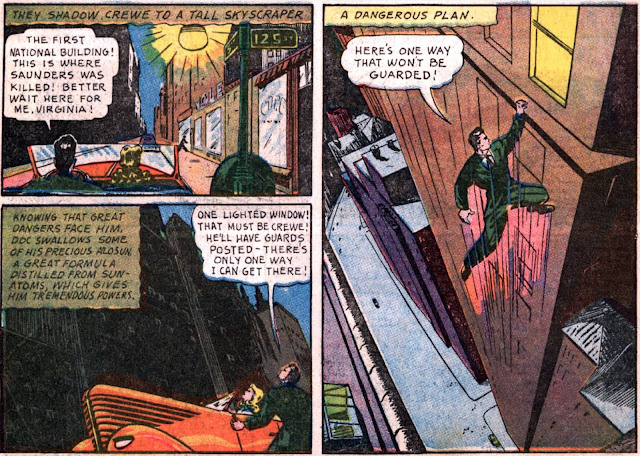
    Doc Strange (called “Dr Strange” for the first half dozen or so of his appearances, but why cause unnecessary confusion) is an almost prototypical scientist-hero: no real origin beyond being a well-known brilliant scientist who is primed and ready for adventure having just perfected Alosun, a “formula distilled from sun-atoms.” After taking his first dose of Alosun in his initial adventure, Strange has super-strength and invulnerability sufficient to take on an entire gang single-handed, and if he takes a supplemental dose he becomes exponentially more powerful.

    Doc’s sidekick Mike won’t be showing up until 1942, but in the meantime his fiance Virginia Thompson (as so often is the case, the woman he rescues during his first super-heroic adventure) acts as his adventuring companion/frequent kidnap victim in the meantime.


    In Thrilling Comics 007 Doc Strange mixes up a new formulation of Alosun that completes his powerset by allowing him to fly while under its effects. This is also the issue in which he stops fighting crime in suits and adopts his classic red t-shirt/blue jodhpurs/brown boots look. 

    Finally, I’ve noticed a lot of sites listing his name as “Hugo Strange” or “Thomas Hugo Strange” and while the Thomas is definitely an Alan Moore addition from Tom Strong I can only report that the Hugo has not yet appeared in the 1940 issues of Thrilling. (Thrilling Comics 001, 1940) 

    the Ghost:

    Young George Chance is orphaned in India and so is of course raised by yogis. He learns all of their magical secrets and is eventually sent out into the world to fight crime, as I assume all yogis are. I must say that it is something of a change of pace to see a magic-man come into his powers in India after such a long string of Tibetan origins.

    Like most magical heroes, the Ghost is a nigh-omnipotent force of nature who can be stopped only by a sneaky blow to the head, and even then only temporarily. His adventures are distinguished by the fact that his long-time foe is Professor Fenton, a scientist who has developed time travel technology, so the Ghost’s adventures are distinguished by the sheer variety of times and places he ends up.

    The Ghost takes his name from his early habit of painting his face (all the way to the back of his neck!) so as to resemble a skeleton while he is fighting crime. Sadly though the name sticks the look doesn’t. 

    In Thrilling Comics 008, the Ghost travels back to Revolutionary America and meets a patriotic woman named Betty Morris who ends up coming back to the 20th Century with him as his companion/love interest. I keep seeing claims online that she is his wife, but strongly suspect that that is another swipe from Alan Moore’s version of the characters. (Thrilling Comics 003, 1940)

    the Lone Eagle: 

    Another classic example of a pilot-hero-with-a-cool-name and not much else going on. The Lone Eagle does seem to have been a World War I veteran, which I always like to note. (Thrilling Comics 003, 1940)

    the Woman in Red: 

    The Woman in Red (an extremely good name) has what just might be the simplest origin story in comics: she is really Peggy Allen, undercover police officer, and the Woman in Red disguise is her way of investigating crimes without blowing her cover if she is caught snooping around. See? Simple! 

    Woman in Red mysteries tend to be structured as whodunnit murder mysteries, which I obviously like, and so Peggy is also frequently wanted by her comic foil, the bumbling Inspector Cavanaugh, as a suspect because he sees her creeping around the crime scene and doesn’t have a lot of critical thinking skills. (Thrilling Comics 002, 1940) 

  • MINOR SUPER-HERO ROUND-UP 054

    Whoops there are two more super-heroes in the Spirit Section. Should have included them with the Spirit himself, tsk tsk. 

    Lady Luck: 

    The Spirit’s home, the “Spirit Section” of newspaper comics also included two other Will Eisner-created but not -written or -drawn characters, the first of whom is Lady Luck. In actuality wealthy socialite Brenda Banks, Lady Luck is a costumed vigilante out of boredom with the day-to-day of high society. She is wanted by the law and specifically by her civilian life love interest Police Chief Hardy Moore, a cop so dumb that not only is he about to send a woman to the electric chair for the murder of her still-living husband in the above set of panels but he also is unable to recognize the object of his affections under the brim of a big hat (in fairness to him he does mention that Brenda and Lady Luck are very similar looking but then turns out to be cartoonishly easy to fool). Lady Luck does a bit of globetrotting here and there, but her focus is mainly on high society crimes. Her adventures are a bit lighter than the Spirit’s, but not by too much. (The Spirit Section, 2 June, 1940) 

    Mr Mystic: 

    The thing about the Spirit Section is that people love the Spirit and so his two companions tend to be overshadowed, particularly when it comes to widely-available archival work: the Spirit was reprinted while Lady Luck and our new friend here Mr Mystic languished in obscurity, and while Lady Luck’s adventures were eventually reprinted in Smash Comics, the archival record of Mr Mystic is much spottier.

    Mr Mystic is supposedly a retooling of Eisner’s prior effort Yarko the Great, and I can see it – luckily for him he got the look of Yarko rather than the terrible naming sensibility. Mystic is (or was, presumably) an American diplomat who, like so many characters before and after him, acquired great mystical powers from the mysterious and spiritual residents of Tibet, specifically a “council of seven Lamas,” and brought them back to the US to be put to use in beating up ne’er-do-wells. 

    Mr Mystic is a magic-using super-hero, which means that he is a nigh-omnipotent force of nature only occasionally slowed down by a lucky bop on the bean from a crook. His major mark of distinction from his peers is a literal one: a mystic tattoo on his forehead, which would mean that he’s almost certainly the first person to have to field a lot of well-meaning concern over the effect that that sort of thing would have on his employability. (The Spirit Section, 2 June, 1940)

    ADDENDUM:

    After all my talk about how a lot of the non-Spirit related parts of the Spirit Section were unavailable I thought to double check, and I had forgot that yes, they are. Granted, it’s as medium-quality photocopies, but that’s better than nothing, right?

    Having rediscovered that fact, I went back and read the first Mr Mystic story, and was shocked and surprised to learn that rather than being a student of the occult who spent long years studying in Tibet, our unnamed hero is a cultural attache serving somewhere in presumably-Eastern Europe when he is blown very off-course while fleeing an Axis invasion force. He crashes in Tibet and is given the forehead brand/tattoo that I did not realize was the sole source of his power while still unconscious. The whole thing is a pretty far cry from what I had imagined his origin to be!

  • MINOR SUPER-HERO ROUND-UP 054

    Whoops there are two more super-heroes in the Spirit Section. Should have included them with the Spirit himself, tsk tsk. 

    Lady Luck: 

    The Spirit’s home, the “Spirit Section” of newspaper comics also included two other Will Eisner-created but not -written or -drawn characters, the first of whom is Lady Luck. In actuality wealthy socialite Brenda Banks, Lady Luck is a costumed vigilante out of boredom with the day-to-day of high society. She is wanted by the law and specifically by her civilian life love interest Police Chief Hardy Moore, a cop so dumb that not only is he about to send a woman to the electric chair for the murder of her still-living husband in the above set of panels but he also is unable to recognize the object of his affections under the brim of a big hat (in fairness to him he does mention that Brenda and Lady Luck are very similar looking but then turns out to be cartoonishly easy to fool). Lady Luck does a bit of globetrotting here and there, but her focus is mainly on high society crimes. Her adventures are a bit lighter than the Spirit’s, but not by too much. (The Spirit Section, 2 June, 1940) 

    Mr Mystic: 

    The thing about the Spirit Section is that people love the Spirit and so his two companions tend to be overshadowed, particularly when it comes to widely-available archival work: the Spirit was reprinted while Lady Luck and our new friend here Mr Mystic languished in obscurity, and while Lady Luck’s adventures were eventually reprinted in Smash Comics, the archival record of Mr Mystic is much spottier.

    Mr Mystic is supposedly a retooling of Eisner’s prior effort Yarko the Great, and I can see it – luckily for him he got the look of Yarko rather than the terrible naming sensibility. Mystic is (or was, presumably) an American diplomat who, like so many characters before and after him, acquired great mystical powers from the mysterious and spiritual residents of Tibet, specifically a “council of seven Lamas,” and brought them back to the US to be put to use in beating up ne’er-do-wells. 

    Mr Mystic is a magic-using super-hero, which means that he is a nigh-omnipotent force of nature only occasionally slowed down by a lucky bop on the bean from a crook. His major mark of distinction from his peers is a literal one: a mystic tattoo on his forehead, which would mean that he’s almost certainly the first person to have to field a lot of well-meaning concern over the effect that that sort of thing would have on his employability. (The Spirit Section, 2 June, 1940)

    ADDENDUM:

    After all my talk about how a lot of the non-Spirit related parts of the Spirit Section were unavailable I thought to double check, and I had forgot that yes, they are. Granted, it’s as medium-quality photocopies, but that’s better than nothing, right?

    Having rediscovered that fact, I went back and read the first Mr Mystic story, and was shocked and surprised to learn that rather than being a student of the occult who spent long years studying in Tibet, our unnamed hero is a cultural attache serving somewhere in presumably-Eastern Europe when he is blown very off-course while fleeing an Axis invasion force. He crashes in Tibet and is given the forehead brand/tattoo that I did not realize was the sole source of his power while still unconscious. The whole thing is a pretty far cry from what I had imagined his origin to be!

  • MINOR SUPER-HERO SPECIAL: THE SPIRIT

    For almost two years, this blog had a huge post buffer thanks to its origins as a Twitter thread. At it’s height, the buffer was almost two months long, but for most of its life there were somewhere between two weeks and a month of pre-written posts sitting at my fingertips, and that meant that I could establish certain habits, like trying to make sure that a Minor Super-Hero Round-Up containing the relevant protagonist was published before talking about the villains that they had faced off against, stuff like that. But over time the buffer eroded, as do all things, to the point that now I’m posting about comics that I just finished reading, like some sort of animal.

    All this is to say that I don’t have the usual four super-heroes required for a proper Minor Super-Hero Round-Up but the villains are piling up in my now days-long buffer so here’s a special one-hero one-shot:

    the Spirit: 

    Yeah, yeah, I hear you: we all know who the Spirit is. Why, he’s got to be a median super-hero at least, right? Well, tough. I have too many categorizations to keep track of as it is, and as influential as the Spirit is odds are that your parents don’t have a clue about him, so he fits the brief as specified by yours truly.

    The Spirit is ambitious young private detective Denny Colt, who attempts to bring in criminal scientist Dr Cobra and is doused in suspended animation fluid for his trouble. Believed dead, Colt is buried in Wildwood Cemetery and upon waking decides to become a spooky vigilante, with a lot more emphasis on the “spooky” in the early days. 

    “The Spirit” might just be the perfect synthesis of the nascent super-hero genre and the established newspaper adventure comics. It also has a large barrier to entry for the modern reader in the form of Ebony White, the Spirit’s driver/sidekick/ethnic stereotype African American comic relief character. Frankly, I don’t really want to spend a lot of time talking about Ebony, so here’s his weirdly positive Wikipedia article that kind of deemphasizes the fact that Will Eisner removed Ebony from the comic after repeated complaints about him in 1946. And also completely omits the fact that Ebony was instantly replaced by Blubber, a sidekick/ethnic stereotype comic relief Inuit character, in what I personally have always seen as a fit of creative pique on Eisner’s part.

    Aside from Ebony, the Spirit’s supporting cast consisted of Police Commissioner Dolan, friend of Denny Colt and initially the only one to know the Spirit’s secret identity, and the Commissioner’s daughter Ellen, the Spirit’s primary love interest and thorn in his side. Over time, the Spirit would also collect a galaxy of femmes fatale occupying basically every square on the D&D alignment chart, but they’re a bit thin on the ground in the 1940 comics. 

    The Spirit is a two-fisted criminologist, probably the best to ever wear the “suit + domino mask” costume, and embodies the pulp detective technique of Getting the Tar Beat Out of You Until You Get to the Bottom of Things. And of course you probably already knew all of that.


    The Spirit also handed out little tombstone calling cards/messages for his first few appearances, which I think is neat. (The Spirit, “The Origin of the Spirit”, June 2, 1940)

    ADDENDUM:

    However could I have forgotten that the Spirit also had a flying car, and one of the goofiest-looking ones in comics, to boot. 

  • MINOR SUPER-HERO ROUND-UP 053

    They really do just keep coming. 

    **Update** The Arrow:

    While the Arrow has always been portrayed as a mysterious seven-foot-tall physical prodigy, this particular adventure really goes all in on his being super-humanly strong. This seems significant somehow, even if it is is second-to-last appearance by my reckoning. (The Arrow 002, 1940)

    **UPDATE** the Flame: 

    This is the first actual version of the Flame’s origin that I’ve encountered in a comic book, so here it is. It is also the first time that I’ve encountered the notion of baby the Flame being proclaimed as the Grand High Lama. It’s a weird detail! (The Flame 001, 1940)

    Phantasmo: 

    And speaking of the ancient secrets of Tibet…

    Phantasmo! He spent 25 years in Tibet learning mystic secrets and now he’s returned to the US to mete out supernatural justice! Phantasmo! His main deal is that he can project his astral body and that in that form he is basically omnipotent! Phantasmo! He can grow, shrink, heal, kill, he is an invulnerable and infinitely strong magic man! Phantasmo! He does have one key weakness: while his astral form is out and about, his physical body is vulnerable, so teenaged Whizzer McGee tags along on his adventures to watch over it! Phantasmo!

    Thanks to a combination of an already fairly minimal costume combined with his transparent nature and some odd colour choices, Phantasmo is possibly also the nudest Golden Age super-hero, at least in his cover appearances. (The Funnies 045, 1940)

    Update 1941

    the Black Knight: 

    A young village blacksmith who first helps the Good King Victor of England when his leg is broken in a boar hunt and then goes on to foil several simultaneous attempts on the monarch’s life, the unnamed youth receives the customary reward for doing an excellent job: additional responsibilities. The Black Knight acts as a sort of state-sanctioned vigilante, rooting out evil among the chivalry of England.

    And speaking of England, the more history-minded of you might have noted that “Good King Victor of England” I mentioned as being very much not an actual British monarch. This raises the question of just when the Black Knight stories are set: it’s broadly Medieval (5th to 15th Centuries), operating under the Chivalric Code (12th to 15th Centuries), the King has a Damascus steel sword (post 10th to 11th Century), there is talk of doctors being fairly available (13th Century at earliest)… so what does all this add up to? Absolutely nothing. The Black Knight exists in a pastiche of knight-haunted England that is as historical as your average retelling of the Arthurian mythos, and in fact the whole thing would be a lot neater if Victor were actually Arthur. We must work with what we have, I suppose. (The Funnies 046, 1940) 

    ADDENDUM: I wrote this before I had read the last couple of Black Knight stories for 1940, and immediately after posting it I cracked open The Funnies 049, featuring a tale in which the Black Knight helps defend Cornwall (becomes part of England proper around the 10th to 11th Century) from a force of Huns (4th to 6th Centuries) and their enslaved Viking (8th to 11th Centuries) crew, and let me tell you I was relieved.

    Update 1941 

  • MINOR SUPER-HERO ROUND-UP 051

    It’s Day Three of Round-Up Week here at the Curse of Skeleton Munroe. 

    **UPDATE** the White Streak:

    Novelty Press is back at it again, exercising their compulsion to tone down the “fantastic” in their comic book stories. The White Streak has gotten a job as an FBI agent, and so he gets plastic surgery in order to make his inhuman face into that of a square-jawed white guy. Now instead of being the utterly fantastical ancient android in a bright costume running around blasting people with electron vision and zooming through the skies on an electric ladder, he’s… the same thing but he looks like a normal guy. Plus he tries to limit his power usage so as to stay inconspicuous, so he sticks to x-ray vision and electrified punches. Very realistic stuff. 

    If this move was in the cards for the White Streak, this might also be the explanation we were looking for for why Dr Simms went off the rails and blew up his entire life as Dr Death: it was a good old-fashioned slash-and-burn of a comic book’s supporting cast before a change to the status quo. Feels like I’m in the Nineties again! (Target Comics v1 010, 1940)

    Galar: 

    A childhood friend of Spacehawk’s from the same near-human species as him, Galar is turned from his six hundred year-long career as a space pirate by the intervention of his old friend and sent out into the galaxy to act as the protector of some random solar system, which it turns out is the reason that Spacehawk is protecting our solar system: he just arbitrarily chose it. (Target Comics v1 011, 1940)

    the Stratosphere Patrol: 

    Speaking of Spacehawk, here’s “Spacehawks,” a Basil Wolverton strip that didn’t really get the room to shine before its home comic was given the axe. While “stratosphere” in the context of 1940s comics is often a flowery way to describe everything up to and including interplanetary space, the meaning here is quite literal: Steve Grover and Bart Bixby and their colleagues are charged with policing the vast array of air traffic that is constantly whizzing around in the near-future, and their greatest challenge occurs when they encounter an evil scientist who can go into the upper, upper atmosphere! Heady stuff. (Circus, the Comics Riot 001, 1938)

    the Ghost Rider: 

    There are a seemingly infinite number of masked cowboy vigilantes roaming the various Wests of assorted comic book universes, and the Ghost Rider is one of them. In his one recorded adventure he stops the wretched gambler and crime boss of the town of Last Chance, Poker Slade, from murdering miner Robert Burton and his daughter Rose and stealing their gold claim. Also, though it’s not particularly visible in the image above, this particular Ghost Rider is the only one to have a mustache.

    As always, there are no new super-hero names under the sun, and “Ghost Rider” might just be one of the ones to unexpectedly crop up the most times. (Amazing Mystery Funnies v2 004, 1939)

  • MINOR SUPER-HERO ROUND-UP 051

    It’s Day Three of Round-Up Week here at the Curse of Skeleton Munroe. 

    **UPDATE** the White Streak:

    Novelty Press is back at it again, exercising their compulsion to tone down the “fantastic” in their comic book stories. The White Streak has gotten a job as an FBI agent, and so he gets plastic surgery in order to make his inhuman face into that of a square-jawed white guy. Now instead of being the utterly fantastical ancient android in a bright costume running around blasting people with electron vision and zooming through the skies on an electric ladder, he’s… the same thing but he looks like a normal guy. Plus he tries to limit his power usage so as to stay inconspicuous, so he sticks to x-ray vision and electrified punches. Very realistic stuff. 

    If this move was in the cards for the White Streak, this might also be the explanation we were looking for for why Dr Simms went off the rails and blew up his entire life as Dr Death: it was a good old-fashioned slash-and-burn of a comic book’s supporting cast before a change to the status quo. Feels like I’m in the Nineties again! (Target Comics v1 010, 1940)

    Galar: 

    A childhood friend of Spacehawk’s from the same near-human species as him, Galar is turned from his six hundred year-long career as a space pirate by the intervention of his old friend and sent out into the galaxy to act as the protector of some random solar system, which it turns out is the reason that Spacehawk is protecting our solar system: he just arbitrarily chose it. (Target Comics v1 011, 1940)

    the Stratosphere Patrol: 

    Speaking of Spacehawk, here’s “Spacehawks,” a Basil Wolverton strip that didn’t really get the room to shine before its home comic was given the axe. While “stratosphere” in the context of 1940s comics is often a flowery way to describe everything up to and including interplanetary space, the meaning here is quite literal: Steve Grover and Bart Bixby and their colleagues are charged with policing the vast array of air traffic that is constantly whizzing around in the near-future, and their greatest challenge occurs when they encounter an evil scientist who can go into the upper, upper atmosphere! Heady stuff. (Circus, the Comics Riot 001, 1938)

    the Ghost Rider: 

    There are a seemingly infinite number of masked cowboy vigilantes roaming the various Wests of assorted comic book universes, and the Ghost Rider is one of them. In his one recorded adventure he stops the wretched gambler and crime boss of the town of Last Chance, Poker Slade, from murdering miner Robert Burton and his daughter Rose and stealing their gold claim. Also, though it’s not particularly visible in the image above, this particular Ghost Rider is the only one to have a mustache.

    As always, there are no new super-hero names under the sun, and “Ghost Rider” might just be one of the ones to unexpectedly crop up the most times. (Amazing Mystery Funnies v2 004, 1939)

  • MINOR SUPER-HERO ROUND-UP 050

    Novelty Press character round-up, more like.

    the Chameleon:

    An unnamed master of disguise (throughout his 1940 appearances, at least) who dispenses vigilante justice on an ad hoc basis, the Chameleon’s major distinction is that his name is always written in cursive. Other than that: he’s got a chauffeur/sidekick (Slim) and a bumbling police nemesis (Inspector Parks) and somehow manages to simultaneously be one of those heroes who is wanted by the law and whose identity and address are just kind of common knowledge. (Target Comics v1 006, 1940)

    the Blue Zombie:

    “Fantastic Feature Films” was a strip that ran in the first couple of years of Target Comics, with the same conceit as Ed Wheelan’s Minute Movies: that the stories being presented were films in which the were being portrayed by a pool of fictional actors – the titular Blue Zombie of this feature, for instance, was played by Orson Black, a Boris Karloff-style Man of a Thousand Faces. This is a fantastic fictional conceit and I am surprised that it hasn’t cropped up more over the years.

    In the fictional movie The Blue Zombie, Bolshemanian scientist Igor Zamoisky rebels against his country’s warmongering dictator and heads to the neighbouring country of Coreland in order to put his scientific discoveries to use in thwarting a Bolshemanian invasion. Discovering a lost Bolshemanian battalion that succumbed to the harsh Corelian winter, he attempts to restore one of them, his old friend Nicholas Samousk, to life. Instead of a restored Samousk, his experiment produces a bright blue zombie version of his friend who responds to his mental commands but cannot think for itself. Zamoisky restores the rest of the battalion in a similar fashion and uses them to crush the Bolshemanian invasion of Coreland, then sets off with his zombie army to free his homeland. 

    Obviously describing a one-off like the Blue Zombie as a super-hero is a bit of a stretch, but a) he’s not that far off of the Purple Zombie in his origin and general deal, b) I wanted an excuse to talk about the fictional-actors-in-fictional-film conceit and c) the Blue Zombie is a really good name. (Target Comics v1 006, 1940)

    the Target: 

    It’s always fun when an old-school anthology comic book gets a character to match its name fairly late in the game and to prove my point here’s the Target, showing up in the tenth issue of Target Comics.

    The Target makes his debut with a big advertising push to really get the word out that he is out to crush crime in his version of NYC: full page newspaper ads, messages on the radio, threatening telegrams sent directly to crooks… at one point a lady calls that number that used to tell you the correct time and a recording of the Target tells her to keep her nose clean. It’s really the opposite of the modern Batman as Urban Legend school of superhero mystique.

    The Target’s gimmick is also Batman adjacent: like 50s 60s 70s whichever era’s Batman first justified the yellow circle on his chest as a bulletproof target for crooks to aim at, the Target is running around with a literal target painted on his chest (and back) because he has a bulletproof leotard on underneath. Just why the fact that his legs are unprotected is a) necessary and b) emphasized is never really addressed.

    Finally, the Target has a thematically appropriate calling card, a dart. We’ll see how long he keeps using it for. (Target Comics v1 010, 1940)

    the Targeteers:

    The more astute readers among you might have noticed that I didn’t really go into the actual origin of the Target in his own entry, and that’s because it’s tied in with that of his sidekicks the Targeteers and so we’re covering them all at once.

    So: Niles Reed is a brilliant but aimless metallurgist whose only relative, brother and New York City District Attorney Bill Reed, is framed for murder and scheduled to be executed at Sing Sing.

    Niles dons a domino mask and attempts to bust Bill out during his final prison transfer but the guards manage to hit Bill during their escape. After a heartfelt “why me?” Bill dies and Niles buries him in an unmarked grave, which means that he’s still considered to be at large, an evocative detail that I had hoped would lead to something like Niles hinting that the Target is actually Bill to throw suspicion off of himself and flush out the crooks who framed him, it never really seems to come up again.

    This would ordinarily be the point in an origin story in which the costume would come into play, there’s one more step to the Target’s origin and that’s the Targeteers.

    See, Niles is wandering the streets at night, trying to figure out just what he can do in the face of an uncaring world in which innocent district attorneys are gunned down in the street for merely trying to break jail, when he runs off some thugs who are attempting to kill or at least maim two teenage boys, Dave and Tommy. It turns out that the kids are both orphans who also hate crime because the crooks had already killed their father (well, one father and one unofficial adopted father, but why get technical).

    Having two young wards who love to talk about getting real beefy and wiping out crime is the final catalyst for Niles, who remembers that he has some superscientific bulletproof material and three super-hero costumes just lying around, and since the three were playing darts when they came up with the idea the whole endeavour ends up being dart and target themed (and as this is possibly my favourite style of generic supersuit it’s nice to see three people running around in it at once).

    The two lads collectively go by the Targeteers, which is a nice change of pace from teen sidekicks who just go by their own names. Finally, according to some dialogue later in the comic the jailbreak, ad hoc funeral, befriending of the boys, making costumes and the initial Target adventure in the previous issue (including the entire publicity blitz) all take place in about a week, which is very efficient. (Target Comics v1 011, 1940)

  • MINOR SUPER-HERO ROUND-UP 049

    Pretty diverse bunch this time.

    the Lone Rider: 

    Another masked cowboy hero dispensing justice from the barrel of the gun in the Old Modern West to throw in the pile. The Lone Rider does have the distinction of having been created by Jack Kirby for a very short-lived comic strip and recycled by Eastern Color for comic book content. 

    Having read through a decent chunk of the Lone Rider’s appearances, I’m pretty sure that Texas never actually put in an appearance, and that Pepito had maybe one panel to shine in – those are the risks you run when you start off with a cast of characters entry, I suppose. (Famous Funnies 062, 1939)

    the White Streak: 

    Discovered by archaeologist Simms and his guide Ramon in a temple that is inside of a small mountain that has risen out of a dead volcano (which is in turn in the fictional country of Payan, in  actual South America), the White Streak is an android built by the ancient dead civilization of Utopia, which perished in war and gifted their creation to the future as a way to prevent war from destroying any more civilizations. And by “the White Streak” I mean “Manowar,” which was clearly intended to be his super-hero name but was changed  for some reason – he’s barely even referred to as the White Streak for the first issue. Whatever his name, he took his mission very seriously: if you were in the business of promoting or profiting from war you could expect a very violent visit from the White Streak.

    At first, Manowar’s powers were limited to his electric vision and a bit of enhanced agility, but over time they expanded to include super strength, an electrical force field that still sometimes unnervingly came out of his eyes, and electrical constructs (most frequently a ladder, for some reason). (Target Comics v1 001, 1940)

    UPDATES: 1940 

    Boystate: 

    Okay, so Boystate is an indeterminably large chunk of land somewhere in the US within a few hours drive from NYC, containing a city (Boyville, natch) and founded and run by a fellow known as the Skipper (the Confederate officer-looking fellow, above) and his aide the Captain (the other guy). Boystate is unsurprisingly populated by boys, and has as its charter a dedication to bringing those often troubled boys up to be fine upstanding men.

    Of course this is all taking place in a comic that is written and set in 1940, so the comic’s views on how boys might be guided into that upstanding manhood involve a lot of homemade militia activity and discipline through violence, as seen here as new recruit Speck is smacked down by Boystate Ranger V.Y.

    The other hallmarks of the Boystate comics are 1) a deep love of pointless callsigns – everyone is V.Y. or X-1 and travel from Point 6-A to Tower 2-R and on and on in a way that makes your eyes glaze over, and 2) an absurd variety of cosmic ray-powered sci-fi technology, courtesy of the Skipper’s genius.

    In addition to the identity-stripping numerical designations, Boystate is simply chockablock with pseudo-military ranks and divisions for the boys to aspire to join so that they can spend their time patrolling Boystate airspace and riding her borders and chasing down passing cars to check if they’re stolen… frankly, if they weren’t collectively the protagonists of a comic book series in which they are described a good and true and aspirational Americans I would be tempted to call Boystate a nightmarish authoritarian police state/cult. Did I mention that the Skipper not only has a machine that can take video of anywhere in Boystate but also one that can read minds? (Target Comics v1 001, 1940)

    Spacehawk:

    As a big fan of Basil Wolverton, I wish that he’d had more opportunities to create science fiction comics during the time that he was interested in doing so, but in the absence of that, Spacehawk is pretty great. A mind-reading physical titan of unknown origin who metes out justice to the scum of the Solar System, Spacehawk is much more of a space-based super-hero than his contemporaries, and his alien foes are appropriately Wolvertonian grotesques who reflect their evil nature in their outward appearances.

    Sadly, Novelty Press was The Company Where Whimsy Was Not Welcome, and in 1941 Spacehawk was relocated to Earth to battle the Axis instead of all of those unrealistic aliens. Don’t get me wrong: Basil Wolverton comics about Spacehawk beating up Nazis are still pretty great, just not as great as ones about him beating up aliens. The move to 1940s Earth does introduce the as-far-as-I-know never answered question of just where all of the humans in the earlier Spacehawk comics were from, which is a fun if brief diversion.

    Finally, there’s a very minor bit of suspense in the first few Spacehawk stories over just what he is under that mask of his – an alien? a robot? something weirder? – but it turns out that he’s a hunk. Spoilers, I guess. (Target Comics v1 005, 1940)