The Curse of Skeleton Munroe

Category: minor super-hero

  • MINOR SUPER-HERO ROUND-UP 041

    Another assortment of guys for your delectation.

    the Sky Wolf:

    Just another masked pilot in a souped-up named plane (originally the Silver Bullet, followed by the Golden Bullet), the Sky Wolf loses both his place in Silver Streak Comics and his plane’s name to fellow pilot Cloud Curtis once 1941 rolls around, and to add insult to injury, in 1942 the far more successful character of Skywolf debuts over at Hillman, ensuring that he doesn’t even have good SEO. (Silver Streak Comics 004, 1940)

    Whiz, King of Falcons:

    The Silver Streak is not immune to the sting of pride, so when aviator Sir Cedric Baldwin challenges him to a race around the world to prove who is the fastest man on Earth, he accepts, and is of course fast enough that he not only wins but is able to have a very culturally-sensitive adventure in Saudi Arabia along the way. Silver Streak is knocked out and captured at one point, and the falconry-obsessed villain takes advantage of this to inject his favourite bird with some super-fast blood. 

    Astonishingly, this works, despite our only account of the Silver Streak’s origin being as a result of hypnotic conditioning coupled with a near-death experience – perhaps the hypnosis was so deep that it mesmerized his very blood? That would explain the falcon’s immediate shift in loyalty from its owner to its super-heroic blood doner, at least.

    “Whiz, King of Falcons” is technically not this guy’s name until Silver Streak Comics 007, which was published in 1941, but I reckon that calling him “Unnamed Falcon Companion” here and then correcting it in six months’ time would be extremely wilfully obtuse of me. (Silver Streak Comics 006, 1940)

    UPDATE 1941 

    the Daredevil:

    The Daredevil is Bart Hill, a vigilante in the Batman mould, having lost his parents to a gang of crooks and subsequently vowed to revenge himself on crime. Further, those same crooks tortured Bart himself, rendering him mute in the process, and due to a boomerang-shaped brand they left on his chest he devoted himself to the study of the weapon, adopting it as one of his heroic signatures. The Daredevil is one of the longer-running non-Marvel or DC/Fawcett/Quality characters of the Golden Age so he will be making a few appearances here going forward, but there are a few notable things about him:

    – his origin will undergo some revision between his first and second appearances, most notably the fact that his muteness is discarded – presumably to enable for easier storytelling

    – his costume is also somewhat revised, which is fun particularly because, like his Silver Age namesake, he switches from a yellow to a red colour scheme

    – this Daredevil’s Golden Age popularity, combined with his public domain status, means that he’s a popular choice for modern revivals, but the fact that there is a currently-published character with the same name (and owned by Disney, to boot) means that nobody dares to actually call him Daredevil in their stories and so the more recent versions of him have a wide range of variably terrible alternate names including the Death Defying ‘Devil, the Daring Devil and Doubledare. (Silver Streak Comics 006, 1940)

    UPDATE 1941 

    Iron Vic:

    Iron Vic is a frustrating beast. He first appears as a mostly-dead body washing up near the island laboratory of Professor Carvel, who applies a “certain rare serum” to the task of saving his life before dropping dead from the strain. Vic, as the man comes to be known, is rendered both amnesiac and superhuman by the process. He has one proper super-heroic adventure against Carvel’s old colleague Dr Spagna before the strip transitions into one primarily about baseball (and in case you’re wondering there is no mention of the ethical quandary that a superhuman participating in regular human sports would cause). The really frustrating part is that Dr Spagna implies that he knows something about Iron Vic, but the Spagna story is never actually resolved anywhere. Vic is merely an amnesiac baseball player until I think he enters the Army at some point? WHERE OH WHERE IS MY RESOLUTION (Single Series 022, 1940)
  • MINOR SUPER-HERO ROUND-UP 040

    Lev Gleason’s finest!

    Lance Hale:

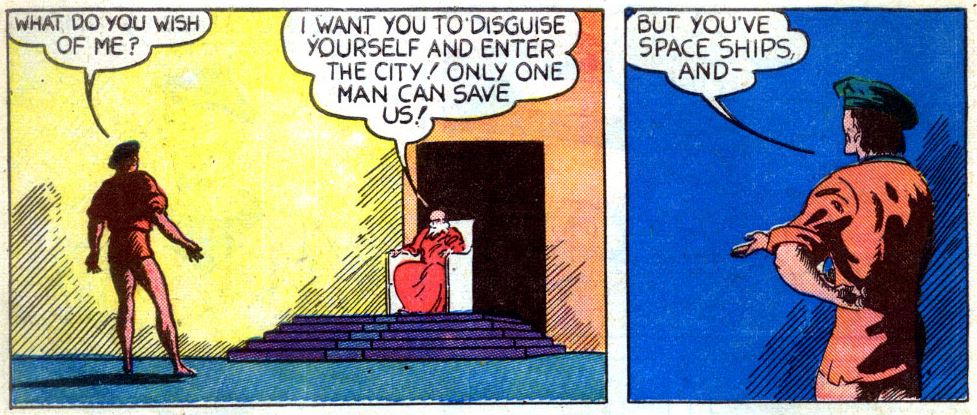
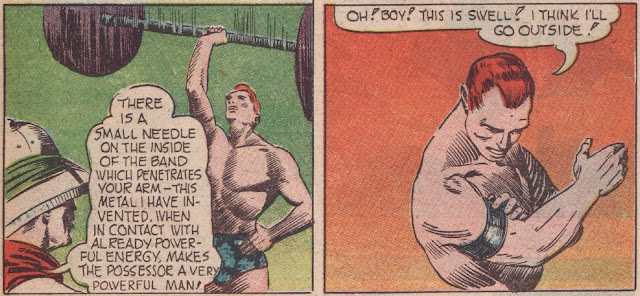
    Lance Hale is a soldier of fortune and jungle adventurer who is notable mainly for the fact that in his first appearance he is given super strength by a fellow with the pleasing name of Dr Grantland Grey so that he can help out on an expedition to the stars, and then after returning to Earth he just… stops using the armband that gives him his enhanced strength. He keeps on adventuring, don’t get me wrong, but as a regular jungle guy, ie, a colonialist race science fantasy figure. 

    Hale is slightly more interesting than his contemporaries in the jungle guy community by virtue of the variety of situations that he gets in: there’s the initial space trip that ends up turning into an interdimensional one and then a battle with invading animal men from a parallel world, a delve into a lost underground kingdom in which he incidentally becomes immortal, cursed demon-summoning gemstone action… I assume that the thrills are eventually going to stop coming but 1940 was almost all hits. (Silver Streak Comics 002, 1940)

    Mister Midnite **HERO UPDATE**:

    As you may or may not recall, Mister Midnite is a hero in the classic formal wear style who has one very specific power, to stop clocks by yelling “time stop!” Well! So we thought! It turns out that in his second appearance, Midnite demonstrates a second power, that of being teleported to a vaguely defined location, and also when he has shouts “time stop!” I really wish that there were more than two Mister Midnite stories so that we would have some more data to use in piecing all this together, but as of now I must assume that he has some sort of vaguely defined wishing power and that “time stop!” is its trigger phrase, like Johnny Thunder and “say you.” (Silver Streak Comics 002, 1940)

    the Silver Streak:

    The Silver Streak! Is notable for two (2) reasons, the first of which is that he is a the-title-of-the-comic-book character who doesn’t show up until issue 3, which is the opposite to how it often works, where the title character goes from proudly front and centre to gone in as many issues.

    The second and more interesting thing about the Silver Streak is his origin, which I have tried and failed to summarize in paragraph form, so here goes as bullet points:

    – the Silver Streak is a race car, or rather a series of race cars because every Silver Streak crashes, killing the driver. Nobody wants to drive for the Silver Streak team. The cars are crashing because they are being attacked by a giant fly.

    – the Silver Streak’s owner is Hindu mystic known only as the Swami. When an unnamed cab driver volunteers to drive the Silver Streak, the Swami hypnotizes him to be a great race car driver.

    – the unnamed driver is immediately killed by a giant fly.

    – BUT! The Swami has a hunch that the man is not in fact dead! He and a pal go to the cemetery and dig up the driver’s unmarked grave, and they are proved right! And what’s more, the prior hypnotic conditioning combined with the near-death experience has made the man (henceforth the Silver Streak) superhuman!

    The first adventure of the Silver Streak concludes with him stealing the latest prototype of his namesake car and using it to destroy the giant fly that “killed” him, and as presented he seems to have been on track to be a car-based super-hero. However, between Silver Streak Comics 003 and 004, the character was handed off from Jack Binder to Jack Cole and the Silver Streak became a guy with super speed, no car required. I don’t know if his origin is ever revised, but I do know that the Silver Streak has several sidekicks over the years and that they all get their powers via a blood transfusion from the man himself, so something’s going on there. Unless his blood was hypnotized too, of course – the Swami never returns, so his deal is never fully explored.

    Like a lot of super speed characters, the Silver Streak ends up being more about cool speed tricks than having a distinct personality, but he’s a fun read nonetheless. (Silver Streak Comics 003, 1940)

    UPDATE 1941 

    Dickie Dean, Boy Inventor:

    We love to see a boy inventor, if only because our brains have been warped enough by the Venture Brothers that we can’t help but imagine their dysfunctional adulthood, and by “we” I mean “I”. Dickie Dean here is particularly good fodder for that little thought experiment, as he is compelled to sign over his inventions to the US government by his misplaced sense of patriotism, so he’s either in for a rude awakening or an increasingly delusional relationship to reality as he gets older. 

    Some inventions that Dickie fails to patent in 1940 include: 

    – a device that can replay sound waves and visualize shadows up to 2-3 weeks old

    – a device designed to stop all war by making air as thick as molasses and thus preventing bullets etc from moving fast enough to do harm (importantly, this air is still breathable)

    – an enclosed, submersible speedboat equipped with a device that abates flood waters via rapid electrolysis

    He does sell a magnetic antigravity device for use as a mid-air brake for airplanes, but only because his father is in dire financial straits.

    Dickie Dean is also interesting for the fact that he is from New Castle, Pennsylvania, a real place with a regular amount of history but not otherwise a big name in city circles. Also I just reread the bit where I roasted Dickie for giving away his patents and I want to make it cleat that the part I think is foolish is giving them to, like, the FBI, not donating them to humanity. (Silver Streak Comics 003, 1940)
    UPDATE 1941 

  • MINOR SUPER-HERO ROUND-UP 039

    MINOR SUPER-HERO ROUND-UP 039

    We’re reading Shield-Wizard Comics, bay-bee, so here’s some stuff about the Shield and the Wizard.

    the Shield UPDATE:

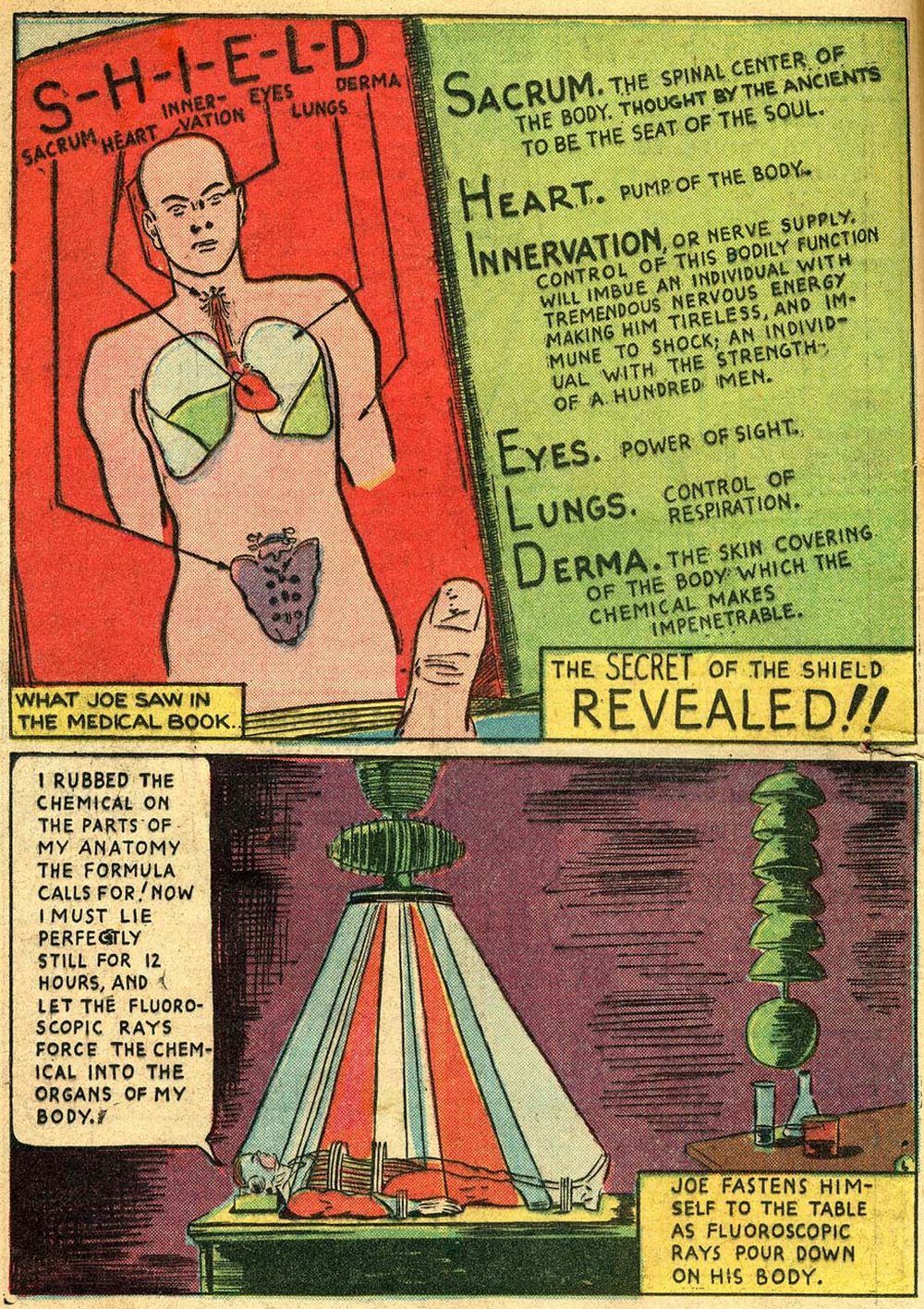
    In our original write-up of the Shield, we noted that the origin of his powers shifted from being solely down to his super-suit to being more of an ingrained thing over time, and the time is now! Yes, Shield-Wizard Comics 001 provides a slightly tweaked version of the Shield’s origin, in which Joe Higgins’ father Tom was not just a US Army Intelligence agent but a gifted scientist who discovered the secret of inducing superpowers but died juuuust before being able to tell Joe the full secret.

    Joe grows up to become a chemist himself but remains puzzled by his father’s last instructions to remember “anatomy formula S•H•I•E•L•D,” and with good reason, because it’s a nonsense jumble of anatomical parts that must have been put together only in the specific medical textbook that Joe eventually finds it in. But hey, he needed to find out where exactly to rub the chemical formula, and how would he otherwise know that it boiled down to “your eyes and skin, but especially the skin over your chest and groin” without that handy mnemonic device?

    The all-white costume that Joe is sporting before he settles down for a 12-hour session under the fluoroscopic ray shows up in at least a few retellings of the Shield’s origin going forward and I always thought that it was a pretty snappy look. Unfortunately, the rays dye his suit (and possibly his limbs?) in patriotic colours and so we get a red-white-and-blue Shield rather than merely a white one.

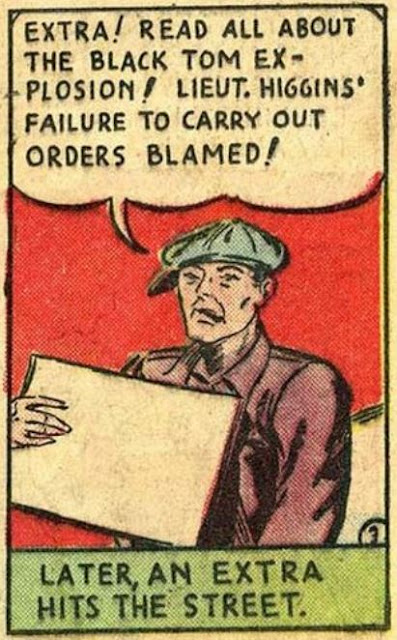
    The other tweak to the Shield’s origin is that rather than merely dying in the Black Tom Explosion of 1916, Tom Higgins is blamed for it, so the Shield now not only has a Batman-style motivation (spies killed my dad and now I must battle espionage) but also a Geoff Johns-Barry Allen-Flash one (I fight crime as part of my attempt to clear my father’s name). Thankfully, his first case involves rounding up the very German Hans Fritz and forcing him to confess, thus clearing Tom Higgins’ name without it becoming a whole thing. (Shield-Wizard Comics 001, 1940)

    the Wizard I:

    In the original account of the Wizard’s origin in Top-Notch Comics 001, the Whitney family’s close connection to American history is pretty thoroughly emphasized, with Whitneys present and getting things done at all major American wartimes. Well, Shield-Wizard Comics took up that gauntlet and ran with it: John Whitney organized the Mayflower expedition, and his son John Whitney organized the first Thanksgiving, and his son or grandson John Whitney thought up the idea of uniting the colonies. 

    But that wasn’t all: the third John Whitney’s son Blane (the main line of Whitneys only have time for three male names: John, Blane and Grover. All other named Whitneys are from dead end branches of the family tree, it seems) is just as super-human as his descendant, and in fact was the first of a line of Whitney family superhumans to call themself the Wizard (adopted as an ironic name after John Whitney was burned at the stake for witchcraft after acting on his son’s extrasensory visions to protect the colonies).

    The Wizard ends up making quite a big difference in the tides of the American Revolution, including:

    – informing Paul Revere that the British were approaching Concord and lighting the “one if by land, two if by sea” lanterns

    – showing up to participate in the fighting at Concord and turning the tide

    – wielding a cannon as a sidearm in the Battle of Bunker Hill and again at the Battle of Saratoga

    – saving Nathan Hale from being executed as a spy only not really because he chooses to die and be an inspiration instead

    – orchestrating the crossing of the Delaware and the surprise attack on the Hessian forces

    -very nearly getting Benedict Arnold before he gets away to join the British forces

    – proving instrumental in the capture of Major André

    – participating in several key battles, including the charge of Mad Anthony Wayne and the defeat of Cornwallis

    – orchestrating the support of the French for the revolution

     This original Wizard also creates a number of anachronistic inventions, including:

    – a glider that seems to function a bit more like a full-fledged airplane

    – a steam powered speedboat

    – something in between a deep sea diving rig and a scuba suit

    – a machine gun

    – radio communication

    – an electrified, battery-powered suit

    – a self-propelled sled

    – a tiny high-powered cannon

    All in all, the tale of the original Wizard holds up as a classic of the form, with the form being “super-heroes added to historical events.” Comics love to showcase the great moments of US history in particular, but as a comic book must prioritize action, any super-heroic character who is present must have an extraordinary amount of influence on history. It’s great! (Shield-Wizard Comics 001, 1940)

    the Wizard II:

    The second Wizard, like his father the original Wizard, is essentially a carbon copy of the modern character in appearance, name (Blane Whitney, natch) and abilities. Blane Whitney II also takes after his father in his commitment to inserting himself into important US historical events, including:

    – participating in various military engagements, including the defeat of the HMS Gurrierre, the Battle of Lake Erie, the Battle of the Thames (I think?) and the Battle of Bladensburg

    – saving William Henry Harrison from an assassination attempt

    – almost preventing the burning of the White House by the British

    – planning the defense of Fort McHenry and then participating in it

    – accidentally enabling Francis Scott Key to get inspired to write the Star-Spangled Banner

    This Wizard also has a lot of ahead of its time technology, including:

    – a version of his father’s glider

    – smoke (possibly tear gas) grenades

    – a dang tank

    The second Wizard obviously has less of a direct impact on the events of US history, if only because the War of 1812 has fewer Stand Up and Cheer moments than its predecessor. Still, he’s in there, and there’s every indication that we’d continue on to see a Civil War Wizard and a World War I Wizard and so forth, and the stated reason that we don’t see them is that as of Shield-Wizard Comics 003, the Wizard’s sidekick Roy the Super-Boy was too popular to not feature and so it was contemporary Wizard from then on out. (Shield-Wizard Comics 002, 1940)

    And speaking of Roy the Super-Boy:

    Tommy the Super-Boy:

    A part of any big project is choosing a methodology and then sticking to it and as my project is “reading all comics, in order” I had to figure out what “in order” meant. And while doing things in a month by month basis might be more true to the spirit of the experience, for my own sanity I opted to go alphabetical by year instead – the prep work alone for that other method hurts my head a bit to contemplate.

    All that is by way of explaining that Tommy, “the Original Super-Boy of History” (aka the original wonder-boy according to that one panel) is a retroactively created predecessor of the Wizard’s sidekick Roy the Super-Boy, who we will not meet until I have read the around 180 other comics between Shield-Wizard Comics 002 and Top-Notch Comics 008. He’s your classic orphan kid who gets to hang around a super-hero because he’s scrappy, and it turns out that that’s not unheard-of in historical youths.
    This particular scrappy kid, Tommy by name, is peeling potatoes when he meets an incognito Blane Whitney II and ends up discovering his secret identity after the Wizard participates in a sea battle and Tommy runs off afterward to berate Blane for cowardice, like a normal person does. And once you have discovered a super-hero’s identity, you get to become a super-hero! If you are a scrappy kid, of course. (Shield-Wizard Comics 002, 1940)

  • MINOR SUPER-HERO ROUND-UP 038

    Second- and third-tier Fox Features heroes: ACTIVATE

    Dynamo:

    Jim Andrews is an electrical scientist who heroically risks his own life by using his own body as a conductor to prevent some crazy bit of machinery from blowing the whole laboratory he works at to high heaven. And since he lives in a comic book world, the reward for his bravery is some super powers! He can now emit electricity, create an electrical forcefield, kind of fly by throwing a lightning bolt and then riding it through the air and even be super strong, with the minor caveat that he has to charge himself up from time to time (over time and for narrative convenience he also develops the powers to freeze water, to repair smashed up items by shooting electricity at them and to travel interstellar distances under his own power).

    Andrews originally calls himself Electro but swaps that name out for Dynamo in his second appearance. There is some speculation that the name change comes about because there was already an extant Electro over at Marvel.

    Dynamo’s costume choices over his two years of adventuring range from “generic” to “kind of dumb-looking,” and the real kicker is that the Fox Features cover artist consistently puts him in this incredible red number. (Science Comics 001, 1940)

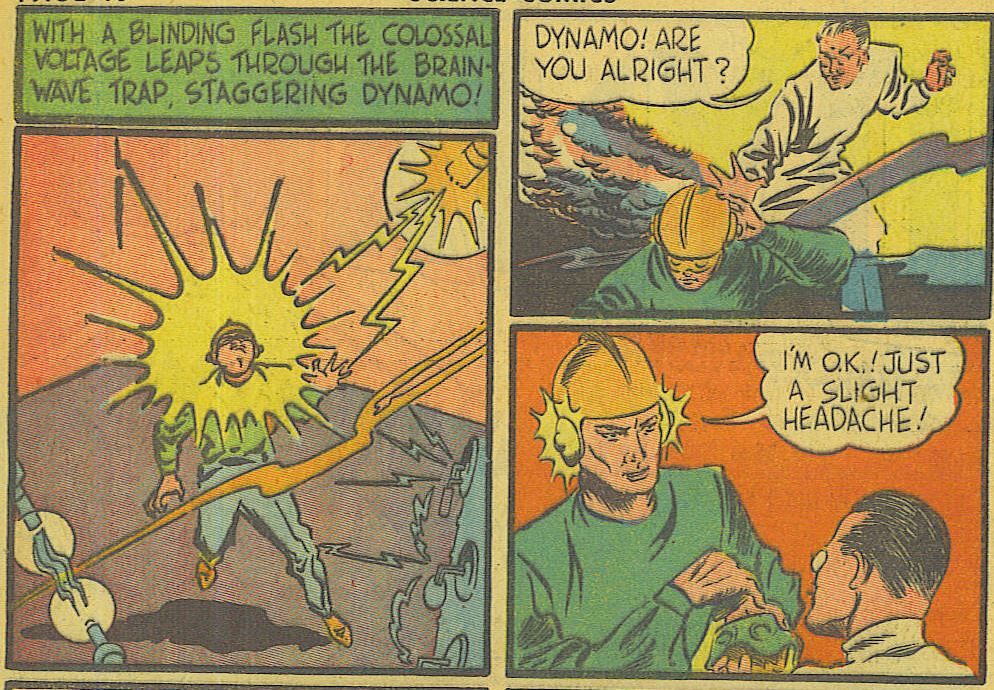
    ADDENDUM: In Science Comics 005, Dynamo, already wildly powerful, invents a device with the fairly ominous name the Brain-Wave Trap which allows him to read the minds of everyone on Earth and indeed for hundreds of light years around. Ir’s a significant power boost for something that is mainly used to keep the plot chugging along.

    UPDATE: Weird Comics 1940

    the Eagle:

    The Eagle is Bill Powers, a wealthy young gadabout who has developed an “anti-gravitation fluid” which allows him to fly when applied to his wing/flaps.


    The Eagle might just have the greatest number of costume variations before finding his groove, though I suppose a number of them can be ascribed to the whims of the colourist on any given day. While the flying squirrel style flaps are fun for their uniqueness and that fourth version has far nicer-looking wings than Hawkman was sporting at the same time I can absolutely understand the impulse to move toward a more traditional super-hero costume without a bunch of fiddly little feathers all over it. BUT! the Eagle’s costume has not reached its final form – something to look forward to once we get to Fox Features’ 1941 offerings. Or just look up on your own, I suppose.

    I don’t think that it’s intentional so much as a product of many busy hands being involved in making most if not all Fox Features comics, but Bill Powers is one of the better realizations of the “wealthy young playboy” super-hero alter ego. He really and truly comes off as someone who is just kind of doing things, including fighting crime, to keep himself occupied and the greatest example of that is all the little projects such as his “crime cartoons” or his “book on crime” that he keeps mentioning once and then never ever returning to. Plus he has a butler named Jason, whom I love.

    Finally, the Eagle might just have the most mysterious of all calling cards, an unseen “mark like that done by an eagle.” (Science Comics 001, 1940) 

    UPDATE: Weird Comics 1940

    Marga the Panther Woman:

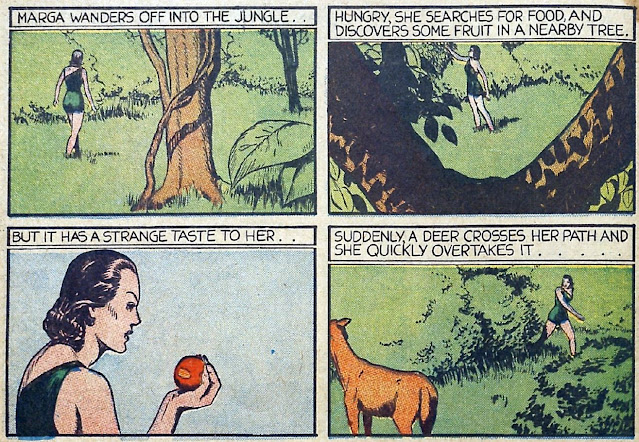
    Marga, formerly a nurse at the asylum housing the mad physiologist von Dorf, finds herself kidnapped and made into a panther/ human hybrid. Is there just a hint of weird race science in the way that Marga going from blonde to black haired is a sign of her primitive nature being brought forward? Maybe just a skosh.

    Marga adapts fairly well to her new situation, even when it means that she is now an obligate carnivore. She just kind of accepts that her life is no longer that of a nurse but that of a jungle predator.

    Marga’s first few adventures take place in what is pretty clearly the future but a series of comics with different creative teams ends with her being a contemporary 1940 figure. (Science Comics 001, 1940)

    Navy Jones:

    Navy Jones (and let me tell you I groaned audibly about two hours after I fist read that name, when I figured out that it was a pun on Davy Jones) is a submarine commander of the future who meets with disaster when his submarine hits a free-floating mine and everyone on board but him is killed. Lucky for Jones, he is picked up by some passing Fish-Men and taken to their city, where he befriends their king.

    Things take a turn when the evil Prime Minister uses the presence of this outsider in the halls of power as a catalyst for rebellion, and Navy Jones is almost killed. In another stroke of fortune, the king happens to be a skilled surgeon and saves Jones’ life at the cost of his ability to breathe air. Jones rescues the kidnapped Princess Coral from the Prime Minister and puts down the rebellion, becoming the city’s champion (and in a final stroke of luck, the Fish-Men are the kind of comic book species where the more aristocratic you are, the more human you look, so Jones’ new Princess love interest is barely a fish at all!). (Science Comics 001, 1940)

  • MINOR SUPER-HERO ROUND-UP 038

    MINOR SUPER-HERO ROUND-UP 038

    Second- and third-tier Fox Features heroes: ACTIVATE

    Dynamo:

    Jim Andrews is an electrical scientist who heroically risks his own life by using his own body as a conductor to prevent some crazy bit of machinery from blowing the whole laboratory he works at to high heaven. And since he lives in a comic book world, the reward for his bravery is some super powers! He can now emit electricity, create an electrical forcefield, kind of fly by throwing a lightning bolt and then riding it through the air and even be super strong, with the minor caveat that he has to charge himself up from time to time (over time and for narrative convenience he also develops the powers to freeze water, to repair smashed up items by shooting electricity at them and to travel interstellar distances under his own power).

    Andrews originally calls himself Electro but swaps that name out for Dynamo in his second appearance. There is some speculation that the name change comes about because there was already an extant Electro over at Marvel.

    Dynamo’s costume choices over his two years of adventuring range from “generic” to “kind of dumb-looking,” and the real kicker is that the Fox Features cover artist consistently puts him in this incredible red number. (Science Comics 001, 1940)

    ADDENDUM: In Science Comics 005, Dynamo, already wildly powerful, invents a device with the fairly ominous name the Brain-Wave Trap which allows him to read the minds of everyone on Earth and indeed for hundreds of light years around. Ir’s a significant power boost for something that is mainly used to keep the plot chugging along.

    UPDATE: Weird Comics 1940

    the Eagle:

    The Eagle is Bill Powers, a wealthy young gadabout who has developed an “anti-gravitation fluid” which allows him to fly when applied to his wing/flaps.


    The Eagle might just have the greatest number of costume variations before finding his groove, though I suppose a number of them can be ascribed to the whims of the colourist on any given day. While the flying squirrel style flaps are fun for their uniqueness and that fourth version has far nicer-looking wings than Hawkman was sporting at the same time I can absolutely understand the impulse to move toward a more traditional super-hero costume without a bunch of fiddly little feathers all over it. BUT! the Eagle’s costume has not reached its final form – something to look forward to once we get to Fox Features’ 1941 offerings. Or just look up on your own, I suppose.

    I don’t think that it’s intentional so much as a product of many busy hands being involved in making most if not all Fox Features comics, but Bill Powers is one of the better realizations of the “wealthy young playboy” super-hero alter ego. He really and truly comes off as someone who is just kind of doing things, including fighting crime, to keep himself occupied and the greatest example of that is all the little projects such as his “crime cartoons” or his “book on crime” that he keeps mentioning once and then never ever returning to. Plus he has a butler named Jason, whom I love.

    Finally, the Eagle might just have the most mysterious of all calling cards, an unseen “mark like that done by an eagle.” (Science Comics 001, 1940) 

    UPDATE: Weird Comics 1940

    Marga the Panther Woman:

    Marga, formerly a nurse at the asylum housing the mad physiologist von Dorf, finds herself kidnapped and made into a panther/ human hybrid. Is there just a hint of weird race science in the way that Marga going from blonde to black haired is a sign of her primitive nature being brought forward? Maybe just a skosh.

    Marga adapts fairly well to her new situation, even when it means that she is now an obligate carnivore. She just kind of accepts that her life is no longer that of a nurse but that of a jungle predator.

    Marga’s first few adventures take place in what is pretty clearly the future but a series of comics with different creative teams ends with her being a contemporary 1940 figure. (Science Comics 001, 1940)

    Navy Jones:

    Navy Jones (and let me tell you I groaned audibly about two hours after I fist read that name, when I figured out that it was a pun on Davy Jones) is a submarine commander of the future who meets with disaster when his submarine hits a free-floating mine and everyone on board but him is killed. Lucky for Jones, he is picked up by some passing Fish-Men and taken to their city, where he befriends their king.

    Things take a turn when the evil Prime Minister uses the presence of this outsider in the halls of power as a catalyst for rebellion, and Navy Jones is almost killed. In another stroke of fortune, the king happens to be a skilled surgeon and saves Jones’ life at the cost of his ability to breathe air. Jones rescues the kidnapped Princess Coral from the Prime Minister and puts down the rebellion, becoming the city’s champion (and in a final stroke of luck, the Fish-Men are the kind of comic book species where the more aristocratic you are, the more human you look, so Jones’ new Princess love interest is barely a fish at all!). (Science Comics 001, 1940)

  • MINOR SUPER-HERO ROUND-UP 037

    MINOR SUPER-HERO ROUND-UP 037

    More cream rises from the milky depths of the Golden Age!

    Red Roberts, the Electro Man:

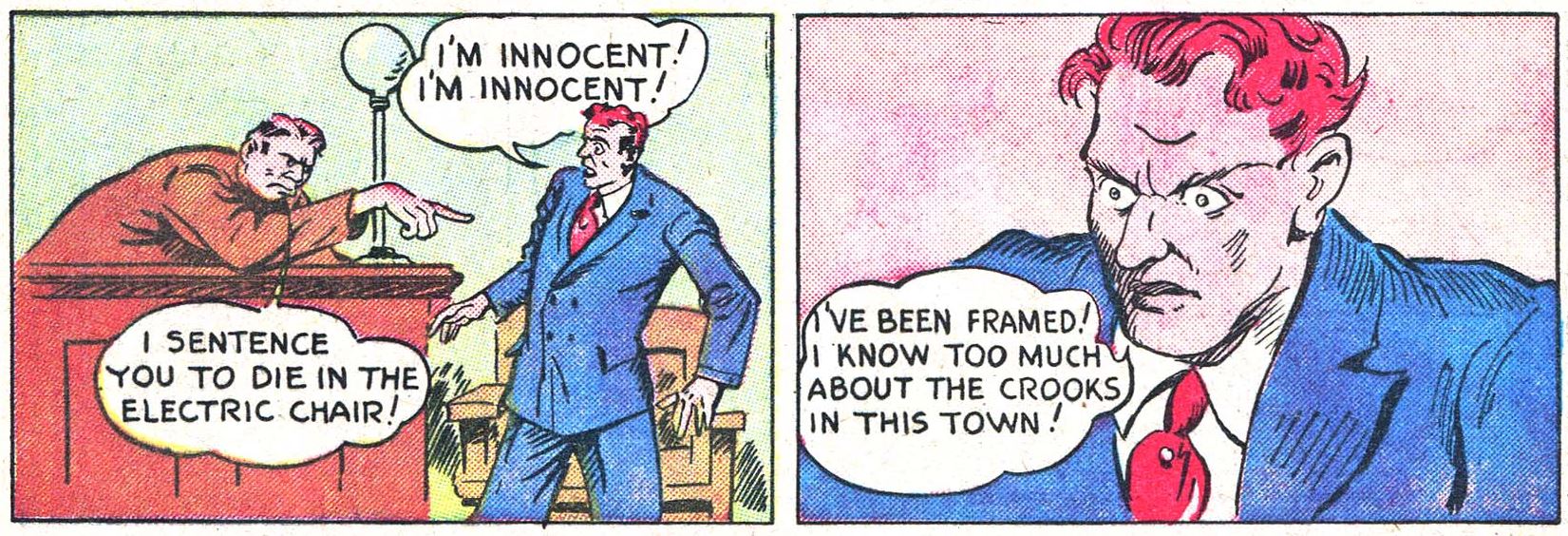
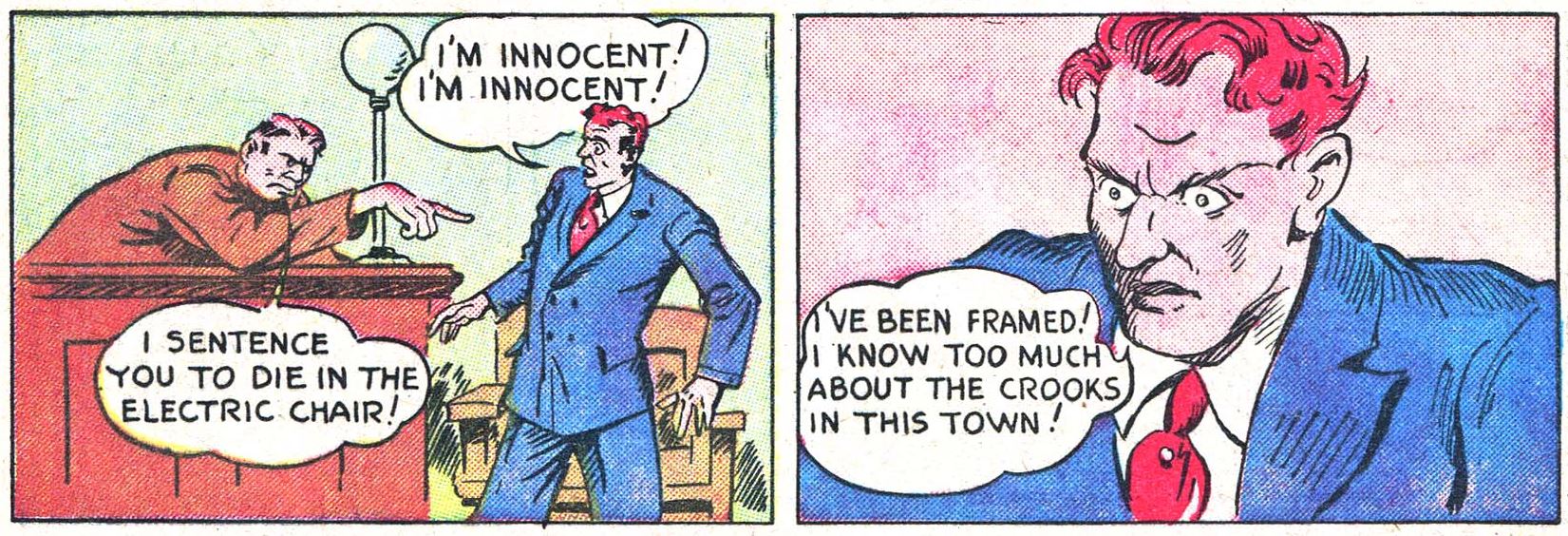
    It’s unclear what Red Roberts’ actual job is, but he is a guy who Knows Too Much about the corruption in the unnamed city he lives in and so he is framed for murder and fast-tracked to the electric chair.

    Luckily for Roberts, this is a comic book universe and being an innocent person sentenced to be executed via the electric chair means that you get sick-ass electricity powers instead of dying like everyone else. Red Roberts quickly parleys these powers into revenge on the city’s crooked mayor and his cronies and then cleans up crime around town for a couple of issues more for good measure. He doesn’t bother with a secret identity because at least half a dozen people were there to witness his origin, which must feel quite freeing. (Rocket Comics 001, 1940)

    the Phantom Ranger:

    There’s not much to distinguish the Phantom Ranger from his contemporaries in the ranks of Mysterious Cowboys Who Stick Around Just Long Enough to Help Out, but here goes: his horse is named Demon and he likes to ride around with his sleeves rolled up, which gives him a business casual look that I appreciate. (Rocket Comics 001, 1940)

    the Defender:

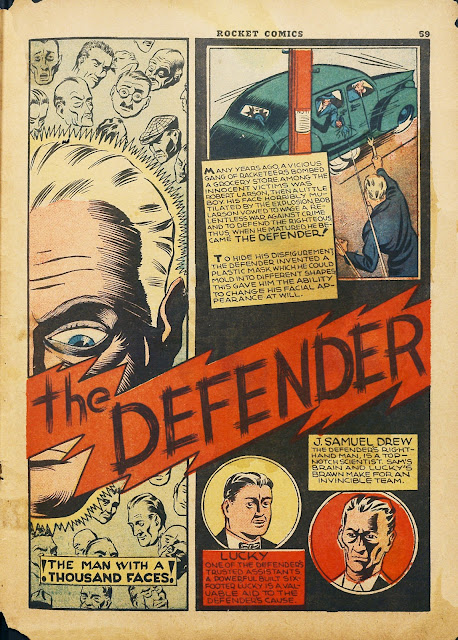
    Is the Defender (Robert Larson, who was scarred facially by criminals as a child and who now fights crime using a malleable rubberoid mask and two dedicated assistants) a take on pulp and comic character the Avenger (Richard Benson, whose face was rendered inhuman by the shock of losing his wife and child to criminals and who now fights crime using his own malleable face and 4-5 dedicated assistants)? I certainly think he is, but I don’t know if you could conclusively prove it. (Rocket Comics 002, 1940)

    Samson UPDATE:

    Samson being descended from the long-haired Biblical figure of the same name is not a new origin for the character, but once he had his own series it was time to explicitly lay it out in the form of his mother telling him in plain English that he is. Frankly, I’d much rather learn how he managed to get away with  having shoulder-length hair as a teenager in the early 1930s, but it’s just left as an exercise for the reader to figure out.

    No such luck for David, however. He remains an orphaned Boy Scout who Samson just found and adopted one day. David is not his actual name and we do not know his actual name. There is some early effort to play up his Boy Scout knowledge as valuable to the crimefighting enterprise but that soon falls by the wayside. (Samson 001, 1940)

  • MINOR SUPER-HERO ROUND-UP 037

    MINOR SUPER-HERO ROUND-UP 037

    More cream rises from the milky depths of the Golden Age!

    Red Roberts, the Electro Man:

    It’s unclear what Red Roberts’ actual job is, but he is a guy who Knows Too Much about the corruption in the unnamed city he lives in and so he is framed for murder and fast-tracked to the electric chair.

    Luckily for Roberts, this is a comic book universe and being an innocent person sentenced to be executed via the electric chair means that you get sick-ass electricity powers instead of dying like everyone else. Red Roberts quickly parleys these powers into revenge on the city’s crooked mayor and his cronies and then cleans up crime around town for a couple of issues more for good measure. He doesn’t bother with a secret identity because at least half a dozen people were there to witness his origin, which must feel quite freeing. (Rocket Comics 001, 1940)

    the Phantom Ranger:

    There’s not much to distinguish the Phantom Ranger from his contemporaries in the ranks of Mysterious Cowboys Who Stick Around Just Long Enough to Help Out, but here goes: his horse is named Demon and he likes to ride around with his sleeves rolled up, which gives him a business casual look that I appreciate. (Rocket Comics 001, 1940)

    the Defender:

    Is the Defender (Robert Larson, who was scarred facially by criminals as a child and who now fights crime using a malleable rubberoid mask and two dedicated assistants) a take on pulp and comic character the Avenger (Richard Benson, whose face was rendered inhuman by the shock of losing his wife and child to criminals and who now fights crime using his own malleable face and 4-5 dedicated assistants)? I certainly think he is, but I don’t know if you could conclusively prove it. (Rocket Comics 002, 1940)

    Samson UPDATE:

    Samson being descended from the long-haired Biblical figure of the same name is not a new origin for the character, but once he had his own series it was time to explicitly lay it out in the form of his mother telling him in plain English that he is. Frankly, I’d much rather learn how he managed to get away with  having shoulder-length hair as a teenager in the early 1930s, but it’s just left as an exercise for the reader to figure out.

    No such luck for David, however. He remains an orphaned Boy Scout who Samson just found and adopted one day. David is not his actual name and we do not know his actual name. There is some early effort to play up his Boy Scout knowledge as valuable to the crimefighting enterprise but that soon falls by the wayside. (Samson 001, 1940)

  • MINOR SUPER-HERO ROUND-UP 036

    Prize Comics time, bay-bee.

    Power Nelson:

    Power Nelson is from the far-off future year of 1982 CE, in which the world has been conquered by the Mongols, but the wink, wink, nudge, nudge kind of Mongols from 1940-1941 where they’re actually supposed to be the Japanese (and for some reason the nation of Mongolia is fair game as far as Explicit Villain Status goes while Japan is still off the table). He has been given super strength by some surprisingly beefy scientists so that he might save civilization from oppression. Three things about Power Nelson:

    1) I think that his first name might actually be Power. So futuristic!

    2) I kind of want to give this series credit for not being too racist but the truth is that it is fairly racist but my senses have been dulled by exposure to the excesses of post Pearl Harbor depictions of the Japanese. 

    3) Power Nelson is very bad at his job? Every issue sees him within striking distance of Emperor Seng I and while assassinating the top man isn’t a guaranteed way to end a regime, it absolutely cannot hurt. Just punch him, man! (Prize Comics 001, 1940)

    Jupiter:

    Jupiter represents two distinct super-hero archetypes: the alien lawman sent to Earth to dispense justice and the magic-user, and as those are two of the more omnipotent origins that a character can have he goes through crooks like a hot knife through butter. The most important question about Jupiter is: was he called Jupiter back on the planet Jupiter or is he adopting a cool new name like a kid at camp? (Prize Comics 001, 1940)

    K the Unknown:

    Douglas Danville, wealthy playboy, takes to the crime-ridden ski slopes as K the Unknown, feared and hunted by ski crooks and ski cops alike. And presumably regular cops and crooks too, but he only had one recorded outing and it took place entirely within the bounds of a ski resort.

    K the Unknown’s one adventure involves embezzlement and murder among the officers of a college alumni group, possibly the perfect case for a wealthy playboy type hero.

    K the Unknown is a great name but perhaps not a great super-hero name, so I can see why he only had on outing. Still, it must be handy to have a calling card that you can piss into the snow. (Prize Comics 001, 1940)

    the Black Owl: 

    It’s hardly unusual for a Golden Age character to make one appearance and then disappear forever, but much more unusually while K the Unknown never had a second adventure his alter ego Doug Danville just kept on trucking under another identity. It’s never explored in the text of the story, so any explanation for why he made the change is an equally valid bit of speculation, from “he wanted a less generic super-hero identity” to “it’s completely different guy named Doug Danville who hangs around with a completely different private eye named Terry Dane.” It turns out that I wrote that last bit prematurely, as in the Black Owl’s second outing his foe is Sigmund Rathko, the crook who was also behind the alumni association shenanigans in the K the Unknown story. I suppose that it could be three completely different people but no, at that point we’re getting silly.

    One thing that you can say for certain is that he didn’t change identities to get the cops off of his back, because they want to get the Black Owl just as much as they did K the Unknown. Moreso, honestly, because K the Unknown was safely carving powder and never even saw a cop. (Prize Comics 002, 1940)

  • MINOR SUPER-HERO ROUND-UP 036

    Prize Comics time, bay-bee.

    Power Nelson:

    Power Nelson is from the far-off future year of 1982 CE, in which the world has been conquered by the Mongols, but the wink, wink, nudge, nudge kind of Mongols from 1940-1941 where they’re actually supposed to be the Japanese (and for some reason the nation of Mongolia is fair game as far as Explicit Villain Status goes while Japan is still off the table). He has been given super strength by some surprisingly beefy scientists so that he might save civilization from oppression. Three things about Power Nelson:

    1) I think that his first name might actually be Power. So futuristic!

    2) I kind of want to give this series credit for not being too racist but the truth is that it is fairly racist but my senses have been dulled by exposure to the excesses of post Pearl Harbor depictions of the Japanese. 

    3) Power Nelson is very bad at his job? Every issue sees him within striking distance of Emperor Seng I and while assassinating the top man isn’t a guaranteed way to end a regime, it absolutely cannot hurt. Just punch him, man! (Prize Comics 001, 1940)

    Jupiter:

    Jupiter represents two distinct super-hero archetypes: the alien lawman sent to Earth to dispense justice and the magic-user, and as those are two of the more omnipotent origins that a character can have he goes through crooks like a hot knife through butter. The most important question about Jupiter is: was he called Jupiter back on the planet Jupiter or is he adopting a cool new name like a kid at camp? (Prize Comics 001, 1940)

    K the Unknown:

    Douglas Danville, wealthy playboy, takes to the crime-ridden ski slopes as K the Unknown, feared and hunted by ski crooks and ski cops alike. And presumably regular cops and crooks too, but he only had one recorded outing and it took place entirely within the bounds of a ski resort.

    K the Unknown’s one adventure involves embezzlement and murder among the officers of a college alumni group, possibly the perfect case for a wealthy playboy type hero.

    K the Unknown is a great name but perhaps not a great super-hero name, so I can see why he only had on outing. Still, it must be handy to have a calling card that you can piss into the snow. (Prize Comics 001, 1940)

    the Black Owl: 

    It’s hardly unusual for a Golden Age character to make one appearance and then disappear forever, but much more unusually while K the Unknown never had a second adventure his alter ego Doug Danville just kept on trucking under another identity. It’s never explored in the text of the story, so any explanation for why he made the change is an equally valid bit of speculation, from “he wanted a less generic super-hero identity” to “it’s completely different guy named Doug Danville who hangs around with a completely different private eye named Terry Dane.” It turns out that I wrote that last bit prematurely, as in the Black Owl’s second outing his foe is Sigmund Rathko, the crook who was also behind the alumni association shenanigans in the K the Unknown story. I suppose that it could be three completely different people but no, at that point we’re getting silly.

    One thing that you can say for certain is that he didn’t change identities to get the cops off of his back, because they want to get the Black Owl just as much as they did K the Unknown. Moreso, honestly, because K the Unknown was safely carving powder and never even saw a cop. (Prize Comics 002, 1940)

  • MINOR SUPER-HERO ROUND-UP 035

    MINOR SUPER-HERO ROUND-UP 035

    Planet Comics how I love you, cobbled-together pile of scraps that you are.

    Torro:

    In an adventure that I can only assume was concocted in order to use up some extraneous art, Captain Nelson Cole of the Solar Force travels to the distant planet Zog and ends up taking up the mantle (and magic whip) of the hero Torro in order to help recover the planet’s treasures from an evil giant.

    As befits a personality that is probably just, again, repurposed art from an unused fantasy comic, Cole adopts the Torro identity completely. Using his magic clothes, boots, belt and whip, he battles and ultimately kills the two-headed giant and his one-headed wife and then goes back to being a spaceman. (Planet Comics 002, 1940)

    Amazona the Mighty Woman:

    Amazona belongs to a pre-Ice Age civilization that is not advanced so much as stubborn in that as the ice advanced on them they just toughed it out until the only ones left were super strong and immune to cold.

    Amazona is understandably bored of the endless expanses of ice and snow afforded her and decides to tag along when reporter Blake Manners passes through following a shipwreck. In their one adventure together back in the US, Amazona gets to beat the tar out of a bunch of gangsters while wearing a party dress and I’m pretty sad that there wasn’t more of this. (Planet Comics 003, 1940)

    Jim Giant:

    Jim Giant, billed as both the Strongest Man in the Universe and the Mightiest Man on Earth (both can be correct, in the right order), is super strong and super tough and in his single recorded adventure he beats the stuffing out of an entire invasion force that sweeps down from the Arctic. (Planet Comics 004, 1940)

    Fero, Planet Detective:

    I’m going to call it: Fero, Planet Detective started life as an unused Zero, Ghost Detective story that found its way from Quality Comics to Fiction House and was altered just enough to be distinct. Scrub out the Z and add an F, swap “Ghost” for “Planet” and most importantly slap an extra line on the text box about how all the werewolves and vampires are actually from Pluto. It’s seamless!

    I actually unironically love the first Fero adventure. It’s a great example of how restriction and constraint can make for the most weird and creative choices. “Occult Detective” is after all an entertaining and rich subgenre, but “Occult Detective But All of the Monsters Are Also Space Aliens” is the sort of wild and wacky stuff you come up with while trying to pad out the pagecount of your science fiction comic book and all you have is a second-hand story about vampires and goblins. It’s great stuff!

    Sadly, though Fero continued to appear in Planet Comics for three more issues the occult aspects of his adventures fell by the wayside in favour of more traditional space detective cases – space theft, space kidnappings, etc. It’s a real blow for fans of occult sci fi.

    Fero’s remaining adventures are all right, but nothing to write home about. He does have a fun futuristic high-collared shirt, so that’s something, but the most interesting thing about his latter adventures is his selection of transformation pills that he uses to get out of  scrapes, including one that turns you into a toddler and the amazing one that he is taking above to turn into a rampaging anthropoid. (Planet Comics 005, 1940)