The Curse of Skeleton Munroe

Category: god

  • DIVINE ROUND-UP 030

    In today’s exploration of the divine, we delve into the extended lore of Sir Richard of Warwick, aka the Golden Knight, starting with his three magical brothers in-law.

    Mokon, King of the Moon:

    Mokon, King of the Moon, appears at Sir Richard’s window one night to claim the hand of his sister Marion in marriage, and though we the reader are hearing about this deal (and indeed about this or any of the Golden Knight’s sisters) for the first time, Sir Richard is well aware of whatever deal his father made to ally his kingdom with the Moon itself.

    Mokon gives Richard a silver rod as proof of his identity, and also possibly as some sort of dowry? This rod will come in quite useful later on, as it is magic and has the ill-defined ability to freeze things. 

    It seems that this is a true arranged marriage, as we get to see the first meeting between Marion and King Mokon just before he flies her away to the Moon. At this point we must ask: just what’s the deal with this guy? Is he a god? “King of the Moon” is certainly a deific title, and he has cool magical powers. Later issues will show that he actually lives on the Moon. There’s going to be a lot of back and forth about just what these guys are as we go forward in this entry but the format dictates that I state up front that I’m going with Some Sort of Godly Entity.

    God Style: Real Entity (Fantastic Comics 016, 1941)

    Sukon, King of the Sun: 

    Sukon, King of the Sun, shows up later in the same day to marry Richard’s second (heretofore unseen) sister, Elaine. Sukon is like a less cool version of his big brother Mokon – he even has a slightly less cool token, the golden rod, which paralyzes people. 

    God Style: Real Entity (Fantastic Comics 016, 1941)

    Winkon, King of the Winds: 

    After Sukon leaves, Lucifer himself (see the next Demonic Round-Up for him) wants to get in on the extended family action and shows up to marry Richard’s third sister, Jane. Richard has two problems with this: 1. Jane is too young and 2. it’s the freaking devil, man. Lucifer then makes off with Richard’s lover Alice instead. Shortly thereafter we learn a third reason: that Jane is already promised to Winkon, King of the Winds, youngest and weeniest brother of Mokon and Sukon. He doesn’t even have a token!

    Though Winkon doesn’t actually lift a hand to help out, he does tell Sir Richard how to get to Hell to rescue Alice. He also exits on a really unfortunately creepy line – just look at Alice’s face!

    God Style: Real Entity (Fantastic Comics 016, 1941)

    Further Adventures of the Golden Knight and his Magical Brothers In-Law:

    As is always the case when a wild new bit of lore is dropped into a comic I was initially afraid that we would see no more of the Golden Knight’s new extended family, but I need not have worried:

    Sir Richard and Alice take advantage of their new connections to visit Mokon and Marion on the Moon in the following issue. This does nothing to clear up the questions about the three brothers’ divine status, but does allow us to see a cool moon-bird.

    Bakalma:

    We are also introduced to Mokon’s rival for the throne of the Moon, Bakalma, who kidnaps Marion and Alice and holds them in his underwater palace – is Bakalma the god of the moon’s oceans? If so, he must have a pretty good chance of being the only on in fiction.

    In order to aid Richard in his pursuit of their loves, Mokon calls upon Xakolma, the Moon God, (God Style: Invoked (Real?)) to grant Richard the power to travel and breathe under water. Just what is the relationship between the humanoid entities like Mokon and Bakalma and the unseen Xakolma? We will receive no further clarification on that, so I’m going to consider them to be part of a godly continuum like the Greek pantheon, with Xakolma being further up the chain of divinity in a Uranus -> Cronus -> Zeus -> Herakles kind of situation.

    Bakalma has a very cool palace shaped like a melting monster head, but seemingly no idea what he’s doing. When Richard bursts in on him he’s trying to wrest Mokon’s secrets out of Marion, who has been on the Moon for like a month or two, tops.

    Bakalma perishes when the nearby volcano Venturious unexpectedly erupts. Is Venturious part of the extended Lunar pantheon as well or was this just a fun coincidence? (Fantastic Comics 017, 1941)

    Richard and Alice are on their way to visit Sukon and Elaine on the sun when they have the above exchange that doesn’t serve to resolve the issue of whether the brothers are gods or not (Sukon’s high technology allowing Elaine, a mortal woman, to live on the Sun, yes. Anything about Sukon being a mortal man, no). Sadly the rest of the issue is concerned with an unexpected detour to the planet Zutarn and nothing further is learned, and this is the final Golden Knight story so there will be no future revelations. We do however learn that the Sun is actually cold, and any heat that it emits is due to ultra-violet ultra-resonic rays being converted when they reach the atmosphere. You dolt. (Fantastic Comics 020, 1941)

  • DIVINE ROUND-UP 029

    Comic book religion. Tricky stuff.

    Hercules: 

    The thing that really jumps out at you when you first encounter this version of Hercules is that he goes to Valhalla when he dies, which is weird. The second thing is that he is appearing in a Golden Age Marvel comic and so there might be fun storytelling ramifications considering the fact that Hercules is a moderately popular (and alive) Marvel Comics character with appearances from the mid-60s to today. Perhaps the fact that this is a pretty Roman mythology (aside from the Valhalla thing) and Hercules from  the Champions is from a Greek one can play into it.

    The third thing that jumps out at you comes on maybe your third reading of the comic in question, when you pay a bit more attention to that first panel in which Hercules is dying and realize that he is not only meant to have survived until some time after the founding of the United States but that the heavy shadowing on the faces of the people in that panel kind of implies that he might have been one of the Founding Fathers? There just aren’t enough clues in the art to tell for sure but I know Simon and Kirby’s tricks and making George Washington Hercules is just their style.

    After spending a while in Valhalla, Herc gets worried about the rise of fascism and decides to reincarnate as a mortal in order to be there to lend a hand when the US needs him (a real snub to his former fave of Rome) so he heads on back to be reborn as Marvel Boy. 

    God Style: Real (Daring Mystery Comics 006, 1940)

    Jupiter:

    Like his son Hercules, this version of Jupiter is very concerned with personal freedom and the fate of the United States in particular. Or maybe he’s just a good father who wants to support his son’s little projects.

    Whatever the reason, he shows up on his reincarnated son’s fifteenth birthday to deliver a cool super-hero uniform before making a very cool exit via lightning storm. 

    God Style: Real (Daring Mystery Comics 006, 1940)

    Father Patriot:

    Father Patriot is the brand-new anthropomorphic personification of the spirit of America created by an unknown comics scribe for the origin story of Major Victory. As I have already speculated behind that link, my only real guess as to why they might have done this is to avoid stepping on Quality Comics’ toes by using Uncle Sam for the role. I was going to complain about them not replacing him with one the less-used personifications of America like Brother Jonathan or Columbia, but on reflection I can see why they might have wanted to go with an all-new character. If nothing else, this means that they had free reign to add as much patriotic nonsense to his design as they wanted to, like his retinue of patriotic angels or the fact that he can whale on the Liberty Bell to impart strength unto his champion. They also got to design a set of patriotic clothing for him, and while it doesn’t quite match up to the classic Uncle Sam look I do appreciate his big gaudy belt buckle.

    Speaking of those mysterious angelic servants: does this indicate that the glories of to American Heaven are not exclusive to the mythology of Captain Fearless?

    God Style: Real (Anthropomorphic Personification) (Dynamic Comics 001, 1941)

    Maloo:

    No non-white and non-monotheistic group is immune to the threat of Golden Age comics just making up some random god that they supposedly worship, and the Aboriginal Australians are no exception. Maloo is a giant, vicious kangaroo who the Face is nearly sacrificed to but who ends up dead instead. Sorry, Maloo. Sorry, Aboriginal Australians.

    God Style: Animist (The Face 001, 1941) 

  • DIVINE ROUND-UP 028

    Religions of the world: you are not being well-represented in fiction.

    the Dream Warner: 

    While they never actually say the words “Tibetan Buddhism” in either of Thun-Dohr’s two appearances, he was brought up in a lamasery in Tibet and is personally mentored by the Dalai Lama (though not the one you’re thinking of), so I think that we can extrapolate and assign the Dream Warner to that religious tradition. Though it does not actually appear on-panel, the Dream Warner does give the Dalai Lama an accurate heads-up on the machinations of the villainous Sin Khaii, so me must conclude that it actually exists. It also has a very fun if on-the-nose name.

    God Style: Real (Silver Streak Comics 014, 1941)

    Ratzinatzi: 

    In Cloud Curtis’ final adventure he sets out alone to solve the mystery of some mysterious disappearances and air raids across South America, and ends up crashing his plane in the middle of the jungle. There he stumbles upon an idol to “Ratzinatzi, the Demon-God of the Ancient Incas” and is seemingly about to enter a chamber that opens up underneath it when the story ends. Sadly for all the completionists out there the story never concludes and so we never learn what kind of pseudo-Nazi air base or whatever lies below, though I think that we can safely assume that it continues to be pretty disrespectful to the Incas.

    God Style: Idol (Silver Streak Comics 017, 1941)

    the Devil-Flower:

    Trojak the Tiger Man’s friend Edith’s brother is sick, and according to the nearest wise man the only thing that will aid him is the juice of the sacred Devil-Flower, as worshipped by the Gemba tribe.

    Trojak and Edith brave fanatical cultists and flower-charmed animals until they are able to harvest the sacred juice and seemingly kill the plant. One can only hope that the Devil-Flower, which not only has magical powers but also seemingly some degree of self-awareness, had the foresight to do a little precautionary propagation.

    God style: Animist (Real?) (Daring Mystery Comics 005, 1940)

    Mars:

    Seen overlooking the Axis war machine in an image I would say is meant to be purely allegorical if it wasn’t from the origin of Marvel Boy, a reincarnation of Hercules in whose story Jupiter figures prominently. Were the Marvel Boy stories to have continued I’m sure that this version of Mars would have gotten a sock on the jaw in due time.

    God style: Real (Daring Mystery Comics 006, 1940)

  • DIVINE ROUND-UP 027

    I wonder if we’ll ever synthesize a unified theory of comic book religion out of this stuff.

    Isis:

    While attempting to thwart the magical con man Ahman-Ka-Lukor, Doctor Miracle calls upon the power of the Egyptian goddess Isis, who aids him by summoning the shade of the man whose reincarnated soul is now Ka-Lukor’s, and all so that Doctor Miracle can compare the two and make sure that he has the right man – it’s the most elaborate alternative to acquiring a photograph of the guy that I can imagine.

    Isis is depicted with a horns/sun disc/vulture headdress that is reasonably accurate to at least one era’s iconography, which is impressive enough for a just-wing-it medium like comics, but even more impressively for 1941 she is also totally topless, though also completely nipple-less.

    It’s not really anything to do with Isis, but Ka-Lukor has a cat familiar named Oasi who can turn into a lady who looks weirdly like the depiction of Isis and who caused me some confusion when I skimmed the story. I think that sh might just have represented another chance to draw a topless woman. (Champ Comics 013, 1941)

    the God of Hate: 

    The God of Hate is worshipped by the Claw’s followers at his skull castle in Tibet, and might just have the biggest head to body ratio that we have seen thusfar.

    Given the way that the God of Hate descends into the fiery pit and is then replaced with the Claw, it is possible that they are seen as aspects of the same being, that the Claw is the Earthly representative of the GoH, or even that the God works for the Claw, given the fanatical devotion that he elicits from his minions.

    Also: check out these guys. I’m sure that they came straight out of a National Geographic photo shoot but they also look quite cool. (Silver Streak Comics 007, 1941)

    the Great One: 

    This happens all the time when you’re a jungle adventurer: you rock up to an ancient temple to a near-forgotten god that is still worshipped with grisly rites and human sacrifice, and it turns out that there’s a big snake or other monster in there, just living it up. In this case, god of death the Great One has been played by Kadu, the Man-Eating Rat, who adventurer Lance Hale has personal beef with from a prior encounter, it seems. 

    God Style: Animist (Silver Streak Comics 011 1941)

    Moko:

    Moko is the god of a group of Tibetan bandits referred to as the Hoods, who I initially thought just had that weird yellow skin tone that comics used to render Asians with, but are later revealed or revised to be wearing cape and cowl getups. The actual worship of Moko is not detailed but does involve human sacrifice via a pit-and-pendulum style swinging blade.

    God Style: Idol (Silver Streak Comics 012, 1941)

  • DIVINE ROUND-UP 027

    I wonder if we’ll ever synthesize a unified theory of comic book religion out of this stuff.

    Isis:

    While attempting to thwart the magical con man Ahman-Ka-Lukor, Doctor Miracle calls upon the power of the Egyptian goddess Isis, who aids him by summoning the shade of the man whose reincarnated soul is now Ka-Lukor’s, and all so that Doctor Miracle can compare the two and make sure that he has the right man – it’s the most elaborate alternative to acquiring a photograph of the guy that I can imagine.

    Isis is depicted with a horns/sun disc/vulture headdress that is reasonably accurate to at least one era’s iconography, which is impressive enough for a just-wing-it medium like comics, but even more impressively for 1941 she is also totally topless, though also completely nipple-less.

    It’s not really anything to do with Isis, but Ka-Lukor has a cat familiar named Oasi who can turn into a lady who looks weirdly like the depiction of Isis and who caused me some confusion when I skimmed the story. I think that sh might just have represented another chance to draw a topless woman. (Champ Comics 013, 1941)

    the God of Hate: 

    The God of Hate is worshipped by the Claw’s followers at his skull castle in Tibet, and might just have the biggest head to body ratio that we have seen thusfar.

    Given the way that the God of Hate descends into the fiery pit and is then replaced with the Claw, it is possible that they are seen as aspects of the same being, that the Claw is the Earthly representative of the GoH, or even that the God works for the Claw, given the fanatical devotion that he elicits from his minions.

    Also: check out these guys. I’m sure that they came straight out of a National Geographic photo shoot but they also look quite cool. (Silver Streak Comics 007, 1941)

    the Great One: 

    This happens all the time when you’re a jungle adventurer: you rock up to an ancient temple to a near-forgotten god that is still worshipped with grisly rites and human sacrifice, and it turns out that there’s a big snake or other monster in there, just living it up. In this case, god of death the Great One has been played by Kadu, the Man-Eating Rat, who adventurer Lance Hale has personal beef with from a prior encounter, it seems. 

    God Style: Animist (Silver Streak Comics 011 1941)

    Moko:

    Moko is the god of a group of Tibetan bandits referred to as the Hoods, who I initially thought just had that weird yellow skin tone that comics used to render Asians with, but are later revealed or revised to be wearing cape and cowl getups. The actual worship of Moko is not detailed but does involve human sacrifice via a pit-and-pendulum style swinging blade.

    God Style: Idol (Silver Streak Comics 012, 1941)

  • ALIENS AND SO FORTH ROUND-UP 025

    ALIENS AND SO FORTH ROUND-UP 025

    We got Fish-Men, we got Fishmen, we got other kinds of men.

    Fishmen:

    Adventurer Lance Rand has acquired a map showing the location of the sunken continent of Atlantis and so naturally he sets out to see if it’s accurate and more importantly to find out if there’s any ancient Atlantean treasure there for him to loot. Making his way to the ocean floor, Lance and his pal Tubby are almost immediately accosted by a Fishman riding on a sea monster. This is a good sign!

    The sunken city of Atlantis does indeed turn out to me right where the map said it was, complete with some monumental bare-assed statuary. Lance and Tubby are able to drive their submarine tractor right up to the base of what must have been an important Atlantean idol and pry the disco ball-sized diamond out of its forehead, upon which they have to deal with another squad of hostile Fishmen. Though the implication is of course that these fellows are the descendants of drowned Atlantis, the fact that they never say anything really makes it hard to confirm. Perhaps they are unrelated underwater humanoids who just disapprove of Lance and Tubby’s wanton looting. Whichever it is, I really dig the little wing-fins that grow out of their backs. (Cat-Man Comics 001, 1941)

    Fish-Men: 

    When oceanic adventurer Navy Jones’ submarine is lost at sea, he is rescued by an undersea race of aquatic humanoids who don’t really have an official name but who are more often than not called Fish-Men or something similar. Despite some early conflict engineered by the scheming Prime Minister, Jones soon becomes the Fish-Men’s champion.

    Fish-Men society is ruled over by a more humanoid nobility, represented here in the forms of their unnamed king and his daughter/ Navy Jones’ love interest, Princess Coral. As usual, the reasons for these morphological differences are not explained and likely boil down to “we didn’t want our hero to be romantically involved with a fish.”

    Like many Fiction House heroes, Navy Jones passed through a lot of hands over the course of his career, and the Fish-Men had a correspondingly large number of looks, each of them charming in its own way.(Science Comics 001, 1940)

    Fishmen:

    This Fishman is encountered by Tabu, Wizard of the Jungle in what is probably a prehistoric underground enclave that a group of explorers stumble across “far to the Southeast of the Congo”. I say probably because Tabu gasses on about how they have gone back in time, which might be meant literally and might just be a bit of excessively flowery exposition. 

    The above is virtually all of the on-panel time that the Fishmen get, as the narrative is much more focused on the drama of one of the explorers falling in love with a cave woman. (Jungle Comics 011, 1940) 

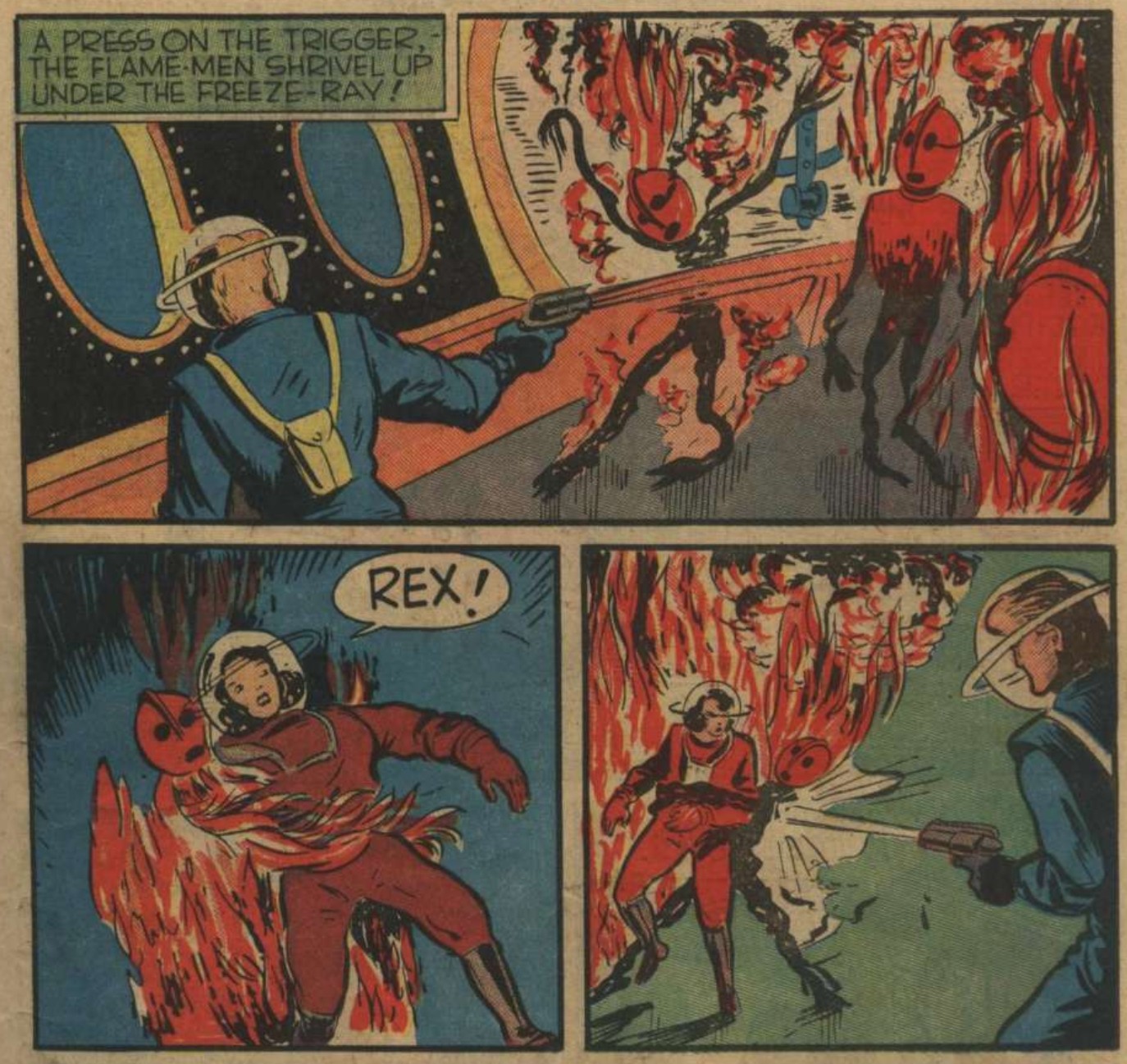
    Flame-Men: 

    Just as Rex Dexter of Mars and his companion Cynde are about to leave the planet Nexis and its friendly inhabitants, the Nexis as part of their never-ending attempt to reach Mars, the world is attacked by some sort of apocalyptic flame weapon.

    Rocketing into space to investigate, Rex and Cynde discover that the source of the attack is a fiery comet that is being directed by a massive spacecraft, by which they are swiftly captured. Inside they find the Flame-Men from Planet Emalf, who are attacking Nexis as the first move in their attempt to destroy the rest of the universe. Why are they doing this? No idea.

    The Flame-Men are unprepared for Rex’s freeze-ray gun, and shrivel up into little burnt matchstick men in a way that is as aesthetically pleasing as it is unsettling. (Mystery Men Comics 010, 1940) 

    Categorized under: Aliens, Animals (Fish), Elements (Fire), Generica (Men)

  • DIVINE ROUND-UP 026

    I’ve finally caught up on my god backlog so these are all piping fresh deities for you to peruse.

    Itzalotahui:

    On an expedition to Guatemala to locate their missing friend John Malcolm, Billy Batson and Whitey Murphy make camp in the lost temple of the monkey god Itzalotahui and are awoken from their slumber by the god himself, flaming and steaming and flailing about.

    After an initial panic and an in-retrospect-embarassing fistfight, Captain Marvel discovers the truth: Itzalotahui is not alive but is in fact a cunningly-designed ball and socket arrangement in which the lower torso/socket is connected to a natural gas source and periodically ignites and wiggles around thanks to gas pressure.

    This issue is real study in contrasts: though the name of the fictional god is literally It’s a Lot of Hooey (in keeping with 1940s contempt for non-Christian or Classical religion), Captain Marvel actually seems to respect the cultural value of the site rather than just smashing it up like so many characters might. Meanwhile, the presence of natural gas means the probability of oil as well, but both Malcolm and Marvel advocate for leaving the area free from the hell of oil extraction, even if they do so in the most patronizing/patriarchal language possible.

    God Style: Idol (Whiz Comics 022, 1941) 

    the Angry God: 

    The
    Angry God, aka the Dark Spirit, is a near-forgotten entity whose last
    remaining priest has thrown in with the villain Half-Man and his Hitler
    stand-in boss the War Lord to lend mystical power to the armies of the
    Axis forces. The Angry God requires not just human sacrifice but the
    sacrifice of “great men,” which might go some way toward explaining his
    low levels of worshipper-retention. Please also note the fun imp-swarm
    that seems to accompany the worship of this particular god – they must
    be very distracting. 

    The
    Angry God’s status as a real entity and current diminished circumstances are
    both illustrated in the fact that it animates its idol in an attempt Ibis the Invincible from killing its priest and then itself falls dead once it is deprived of that one last worshipper.

    God Style: Real (Whiz Comics 023, 1941)

    Balka: 

    Balka
    is the guardian tiger spirit of the ruling line of the Asian country of
    Balkania, and whether the country was named after the tiger or vice
    versa is left unexplored in-text. What is made clear is that the
    old legends about the statue of Balka coming to life to avenge the death
    of murdered Balkanian monarch are absolutely true, as experienced by regicidal
    dictator and fashion maven Carnov after he kills good King Banok.

    Alas,
    Carnov is not torn asunder by Balka but spared by rightful heir Kelo (aka the Jungle Prince) so
    that he can face more conventional justice. Balka then returns to statue form to await the next threat to Balkania. (The Arrow 003,
    1941) 

    Quetzalcoatl: 

    Jungleman
    and his lover Louise Carson stumble upon a hidden Aztec city while
    searching for Louise’s father. Jungleman is briefly worshipped as
    Quetzalcoatl as per the legend about Hernán Cortés, while Louise is slated for sacrifice by a jealous high
    priestess. They manage to extract themselves from this situation with minimal fuss, for a 1940s adventure comic, and even find Louise’s father just kind of hanging around the temple on their way out. (Champion Comics 012, 1941)

  • DIVINE ROUND-UP 025

    Gods gods gods. 

    Puni, God of Fire: 

    Sea-faring adventurer Lance O’Casey almost gets sacrificed to this fire god by the cannibalistic inhabitants of a tropical Antarctic island before escaping, entering the volcano in question and meeting the other Puni. Not sure how much the volcano-dwelling madman and the actual religion influenced each other, but it must have been at least a little. Also: cool idol.

    God Style: Idol (Whiz Comics 019, 1941) 

    the War God:

    This War God idol functions like one of those hollow dog statues you see at grocery stores, that you put your change in to help raise money for people to get seeing eye dogs (and if that’s not a thing where you live then sorry for the unrelatable analogy), only the money is meant to go to the defense of China against Japanese invasion, and instead of a dog it is a sick-ass god-monster. It’s never entirely clear if this is supposed to be a representation of an actual god or just a marketing gimmick.

    God Style: Idol (More Fun Comics 059, 1940)

     Wotan:

    As was established when he beat up Mars that one time, Merlin the Magician hates war, and seeing as he has a magic cloak and a can-do attitude he sets out to do something about it. His first step is to go back in time and save a couple of young Ancient Britons from being human sacrificed by some Druids. What does this have to do with ending war? No idea, but then again I don’t have a magic cloak so my perspective might just be too mundane to comprehend the intricacies.

    Having reviewed the plan, I must conclude that Merlin just needed a couple of people with no ties who would be grateful enough to him to do whatever he wanted and that Druidic sacrifices were his first thought. Specifically, he asks these young folk to act as peace ambassadors to an unnamed fascist nation in order to undermine the efforts of the war god Wotan, who has been roaming the Earth inciting men to war.

    (It would have been quite thematically satisfying if the two young people had been rescued from being sacrificed to Wotan, and while that might have implicitly been the intent, it’s just not there on the page) 

    The young people are somewhat successful, in that they are immediately killed by a similarly young and idealistic pair of enemy soldiers (and what a progressive fascist nation, to field female soldiers in 1941!) who then become overwhelmed with remorse and swear of war forever, at which point Merlin appears and restores his agents to life – an effective but painful strategy, it seems.

    All this talk of pacifism and understanding between nations draws the ire of Wotan himself, who shows up to kill Merlin and ends up on the end of a killing sword-blow from the magician, making the current score Gods: 0 Merlin the Magician: 4.

    God Style: Real (National Comics 011, 1941)

    Death: 

    This version of Death is bound to obey an artifact known as the Sceptre of Eternity, and as such has been commanded to replace the lost daughter of a guy called the Sheik of Kamroon in the 12th Century, and as such has made off with a present-day woman named Betty Jekil. I’m pretty sure that this was a calculated move, as Betty’s father turns to super-magician El Carim for help, which ultimately results in El Carim trading the Sceptre of Eternity for Betty’s life, which is a pretty good deal for Death.

    God Style: Anthropomorphic Personification (Master Comics 019, 1941)

  • DIVINE ROUND-UP 025

    Gods gods gods. 

    Puni, God of Fire: 

    Sea-faring adventurer Lance O’Casey almost gets sacrificed to this fire god by the cannibalistic inhabitants of a tropical Antarctic island before escaping, entering the volcano in question and meeting the other Puni. Not sure how much the volcano-dwelling madman and the actual religion influenced each other, but it must have been at least a little. Also: cool idol.

    God Style: Idol (Whiz Comics 019, 1941) 

    the War God:

    This War God idol functions like one of those hollow dog statues you see at grocery stores, that you put your change in to help raise money for people to get seeing eye dogs (and if that’s not a thing where you live then sorry for the unrelatable analogy), only the money is meant to go to the defense of China against Japanese invasion, and instead of a dog it is a sick-ass god-monster. It’s never entirely clear if this is supposed to be a representation of an actual god or just a marketing gimmick.

    God Style: Idol (More Fun Comics 059, 1940)

     Wotan:

    As was established when he beat up Mars that one time, Merlin the Magician hates war, and seeing as he has a magic cloak and a can-do attitude he sets out to do something about it. His first step is to go back in time and save a couple of young Ancient Britons from being human sacrificed by some Druids. What does this have to do with ending war? No idea, but then again I don’t have a magic cloak so my perspective might just be too mundane to comprehend the intricacies.

    Having reviewed the plan, I must conclude that Merlin just needed a couple of people with no ties who would be grateful enough to him to do whatever he wanted and that Druidic sacrifices were his first thought. Specifically, he asks these young folk to act as peace ambassadors to an unnamed fascist nation in order to undermine the efforts of the war god Wotan, who has been roaming the Earth inciting men to war.

    (It would have been quite thematically satisfying if the two young people had been rescued from being sacrificed to Wotan, and while that might have implicitly been the intent, it’s just not there on the page) 

    The young people are somewhat successful, in that they are immediately killed by a similarly young and idealistic pair of enemy soldiers (and what a progressive fascist nation, to field female soldiers in 1941!) who then become overwhelmed with remorse and swear of war forever, at which point Merlin appears and restores his agents to life – an effective but painful strategy, it seems.

    All this talk of pacifism and understanding between nations draws the ire of Wotan himself, who shows up to kill Merlin and ends up on the end of a killing sword-blow from the magician, making the current score Gods: 0 Merlin the Magician: 4.

    God Style: Real (National Comics 011, 1941)

    Death: 

    This version of Death is bound to obey an artifact known as the Sceptre of Eternity, and as such has been commanded to replace the lost daughter of a guy called the Sheik of Kamroon in the 12th Century, and as such has made off with a present-day woman named Betty Jekil. I’m pretty sure that this was a calculated move, as Betty’s father turns to super-magician El Carim for help, which ultimately results in El Carim trading the Sceptre of Eternity for Betty’s life, which is a pretty good deal for Death.

    God Style: Anthropomorphic Personification (Master Comics 019, 1941)

  • DIVINE ROUND-UP 024

    Not a lot of depth to this batch of gods.

    the Tiger God: 

    When the Tiger’s Eye Emerald, formerly installed as the eye in an idol of the Tiger God in India, is stolen, detective Dan Dare is brought in on the case and almost immediately captured by the tiger-worshippers who were responsible for the theft. As usual it is only the current and not historical owner of the stolen artifact who is considered legitimate and so after slaying the avatar of the Tiger-God pictured above, Dan returns the emerald.

    God Style: Idol (Whiz Comics 018, 1941)

    the Sun God:

    Samar of the Jungle gets into it with a local tribe and ends up captured and slated for sacrifice to their Sun God. Disappointingly, though this involves being burned, it is at a boring old stake rather than by the sun itself. Just as well that he manages to escape.

    God style: Animist (Feature Comics 049, 1941)

    Takal:

    The final adventure of the Bob Kane-created kid gang Rusty and His Pals concerns a hunt for lost treasure, specifically the Idol of Takal, stolen by a group of villainous ex-circus performers called the Unholy Four twenty years earlier. Takal doesn’t actually feature too prominently into Rusty and the Pals’ attempt to re-steal the idol for themselves, aside from being made to talk via ventriloquism to awe his worshippers. 

    God Style: Idol (Adventure Comics 049, 1940)

    Tanis: 

    In one of the two separate adventures in which the Three Aces find a remnant of lost Atlantis, they travel deep blow the Azores to settle a conflict over Atlantean succession caused by power-grasping courtiers. The ultimate solution: use surface world chemistry to simulate an intervention by the god Tanis by setting the throne room on fire. It’s unorthodox, but it works! 

    God Style: Invoked (Action Comics v1 038, 1941)