The Curse of Skeleton Munroe

Category: god

  • DIVINE ROUND-UP 023

    The gods they just keep on coming. 

    Osiris: 

    Ibis the Invincible’s power levels get a bit of a nerf in 1941 when the caveat that his Ibistick is ineffective, variously, against magic, evil magic and in areas of ambient magic (just which is the case depends on the dramatic needs of the story). This forces him to come up with creative solutions to his problems, such as during this attack by a storm demon summoned by his arch-foe Trug, in which he summons the Ancient Egyptian god Osiris to act as divine muscle.

    Osiris is one of the more humanoid of the Egyptian gods, so the only major critique to levy about his appearance (other than all of the stuff that any Egyptology nerds who read this are yelling about of course), aside from the fact that he’s supposed to be green. I’m not sure if Osiris is the go-to god for demon-battling either. Maybe Horus would be a better choice?

    Regardless, Osiris defeats the demon and then takes off. I’m sure that the above panel is meant to represent him returning to the land of the gods, but I get a real kick out of the image of him just wandering off into the California countryside, inspiring religious mania in the locals. 

    God Style: Real (Whiz Comics 016, 1941)

    Thoth: 

    After yet another magical attack by his enemy Trug, Ibis again turns to the gods of Egypt for aid, this time appropriately from the ibis-headed god of wisdom, Thoth.

    I appreciate that the artist made an effort, but while this version of Thoth looks reasonably cool that is absolutely not an ibis head. It’s more like an angry and disturbingly flesh-toned duck. Duck head or no, Thoth comes through and supplies Ibis with a divination spell capable of locating the magically-shielded Trug.

    God Style: Real (Whiz Comics 017, 1941)

    the Man of the Mountain:

    Once Ibis locates Trug he also has to contend with the Man of the Mountain, a guy with four arms who, appropriately, lives on a mountaine. 

    While Ibis calls the Man of the Mountain an evil spirit, Trug insists that he is a “Great God of Revenge.” The being in question remains silent, which is a shame because he really could have cleared up this taxonomic problem for us with a few words.

    Whatever the Man of the Mountain is, he is also unable to withstand the fall off of his home mountain after Ibis tabletops him. He shatters at the bottom, revealing (to me at least) that he is in fact made of stone. RIP, Man of the Mountain.

    God Style: Real (Whiz Comics 017, 1941)

    the Snake-God: 

    The subject of cult worship and human sacrifice in a cavern somewhere under NYC, this particular snake seemingly has a bit more of the divine about it than its fellow animal subjects of worship in comics. At the very least it is bulletproof, though this does not avail it against the raw might of Dr Occult’s mitts. And as a bonus, its entire cult is crushed in its death throes!

    God Style: Animist (Real?) (More Fun Comics 027, 1937)

  • DIVINE ROUND-UP 023

    The gods they just keep on coming. 

    Osiris: 

    Ibis the Invincible’s power levels get a bit of a nerf in 1941 when the caveat that his Ibistick is ineffective, variously, against magic, evil magic and in areas of ambient magic (just which is the case depends on the dramatic needs of the story). This forces him to come up with creative solutions to his problems, such as during this attack by a storm demon summoned by his arch-foe Trug, in which he summons the Ancient Egyptian god Osiris to act as divine muscle.

    Osiris is one of the more humanoid of the Egyptian gods, so the only major critique to levy about his appearance (other than all of the stuff that any Egyptology nerds who read this are yelling about of course), aside from the fact that he’s supposed to be green. I’m not sure if Osiris is the go-to god for demon-battling either. Maybe Horus would be a better choice?

    Regardless, Osiris defeats the demon and then takes off. I’m sure that the above panel is meant to represent him returning to the land of the gods, but I get a real kick out of the image of him just wandering off into the California countryside, inspiring religious mania in the locals. 

    God Style: Real (Whiz Comics 016, 1941)

    Thoth: 

    After yet another magical attack by his enemy Trug, Ibis again turns to the gods of Egypt for aid, this time appropriately from the ibis-headed god of wisdom, Thoth.

    I appreciate that the artist made an effort, but while this version of Thoth looks reasonably cool that is absolutely not an ibis head. It’s more like an angry and disturbingly flesh-toned duck. Duck head or no, Thoth comes through and supplies Ibis with a divination spell capable of locating the magically-shielded Trug.

    God Style: Real (Whiz Comics 017, 1941)

    the Man of the Mountain:

    Once Ibis locates Trug he also has to contend with the Man of the Mountain, a guy with four arms who, appropriately, lives on a mountaine. 

    While Ibis calls the Man of the Mountain an evil spirit, Trug insists that he is a “Great God of Revenge.” The being in question remains silent, which is a shame because he really could have cleared up this taxonomic problem for us with a few words.

    Whatever the Man of the Mountain is, he is also unable to withstand the fall off of his home mountain after Ibis tabletops him. He shatters at the bottom, revealing (to me at least) that he is in fact made of stone. RIP, Man of the Mountain.

    God Style: Real (Whiz Comics 017, 1941)

    the Snake-God: 

    The subject of cult worship and human sacrifice in a cavern somewhere under NYC, this particular snake seemingly has a bit more of the divine about it than its fellow animal subjects of worship in comics. At the very least it is bulletproof, though this does not avail it against the raw might of Dr Occult’s mitts. And as a bonus, its entire cult is crushed in its death throes!

    God Style: Animist (Real?) (More Fun Comics 027, 1937)
  • DIVINE ROUND-UP 022

    DIVINE ROUND-UP 022

    Oh my gosh this place has so many god options.

    the Sacred Leopard: 

    The animal-worshipping tribe who all dress like the animal in question is a regular trope in jungle comics so of course Kalthar, lord of the jungle eventually encounters some of them. In this case it’s Leopard Men from the Leopard Village, who dress in leopard skins and worship Karno, the leopard (Karno seems to be the collective singular noun for the leopard, a thing that happens a lot in jungle adventure books. I’m sure that it happens in real-world language as well, just as I’m sure that most of the examples in comics are just arbitrarily made up). The Leopard Men attack Kalthar and his people because they are being manipulated by a slaver who has a vendetta against them, and end up minus a lot of leopards for their trouble.

    God Style: Animist (Zip Comics 005, 1940)

    Roor the Octopus God: 

    After former Zatara foe Setap achieves her goal of regaining her youth, she reforms and starts looking to reconnect with her Atlantean roots by the simplest way possible: enlisting Zatara’s help in finding the sunken city of Atlantis.

    Everything is going great – Setap is welcomed with open arms, she and Zatara are learning why Atlantis sank (hit by a lost second moon, natch), etc – when one of the sailors they brought with them starts trouble while stealing everything not nailed down, as so often happens when an ancient civilization is discovered by sea. Specifically, the sailor enters the temple of Roor, the Octopus God, within which the giant and insatiable immortal octopoid was not so much worshipped as imprisoned.

    Roor is free to lay waste to Atlantis, and not even the power of Zatara can touch him. The Atlanteans are justifiably upset by this.

    Thankfully, the one magic that Zatara has that can affect Roor is that of illusion, by which means he fools the ancient/powerful/gullible god into eating a whole heap of sponge and salt and then exploding himself by drinking more water than he can contain. Atlantis is saved!

    God Style: Real (Action Comics v1 018, 1939) 

    the Sacred Oak: 

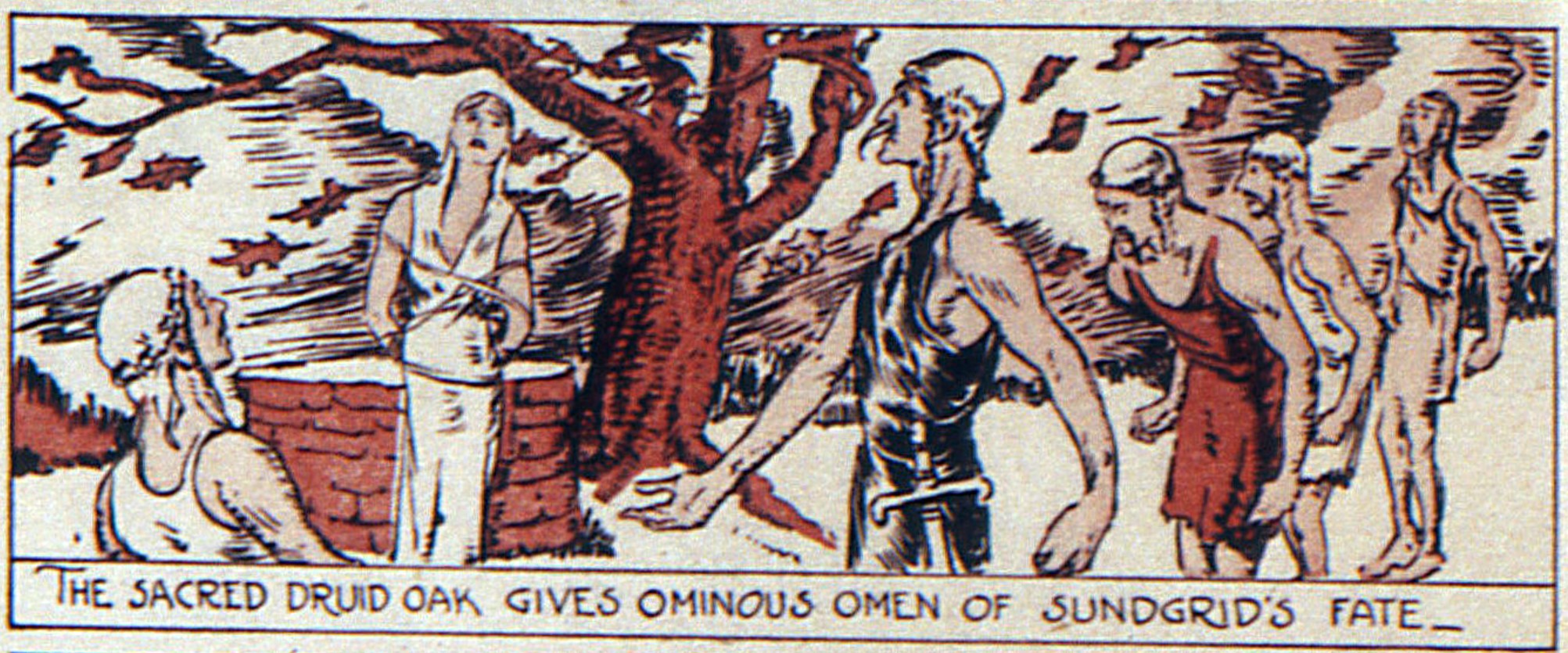
    One of the earliest DC books, New Comics (which eventually becomes New Adventure and then just Adventure Comics) had among its many features an adventure strip called ‘Vikings’ which was kind of slow and dour like a lot of early comics but did feature these doily-hatted Druids and their Sacred Oak that communicates to them via stiff breezes.

    God Style: Animist (New Comics v1 010, 1936) 

    Shin-Giva: 

    Shin-Giva is the god of the Dwarf People of Matto Grosso in Brazil, and his solid platinum idol is the focus of the attention of crooked explorer Frank Hart, who wants to steal it, and his former partner Henri Rinaldo along with Zatara, who want to return it to Shin-Giva’s worshippers and do so thanks to Zatrara’s mighty magicks (please note that the idol is not returned out of any sense that you shouldn’t just waltz in and take valuables from less technologically-advanced societies but rather out of a desire to not crash the world platinum market. So noble!).

    God Style: Idol (Action Comics v1 033, 1941) 

  • DIVINE ROUND-UP 021

    DIVINE ROUND-UP 021

    Just scads of gods.

    Yum Chac: 

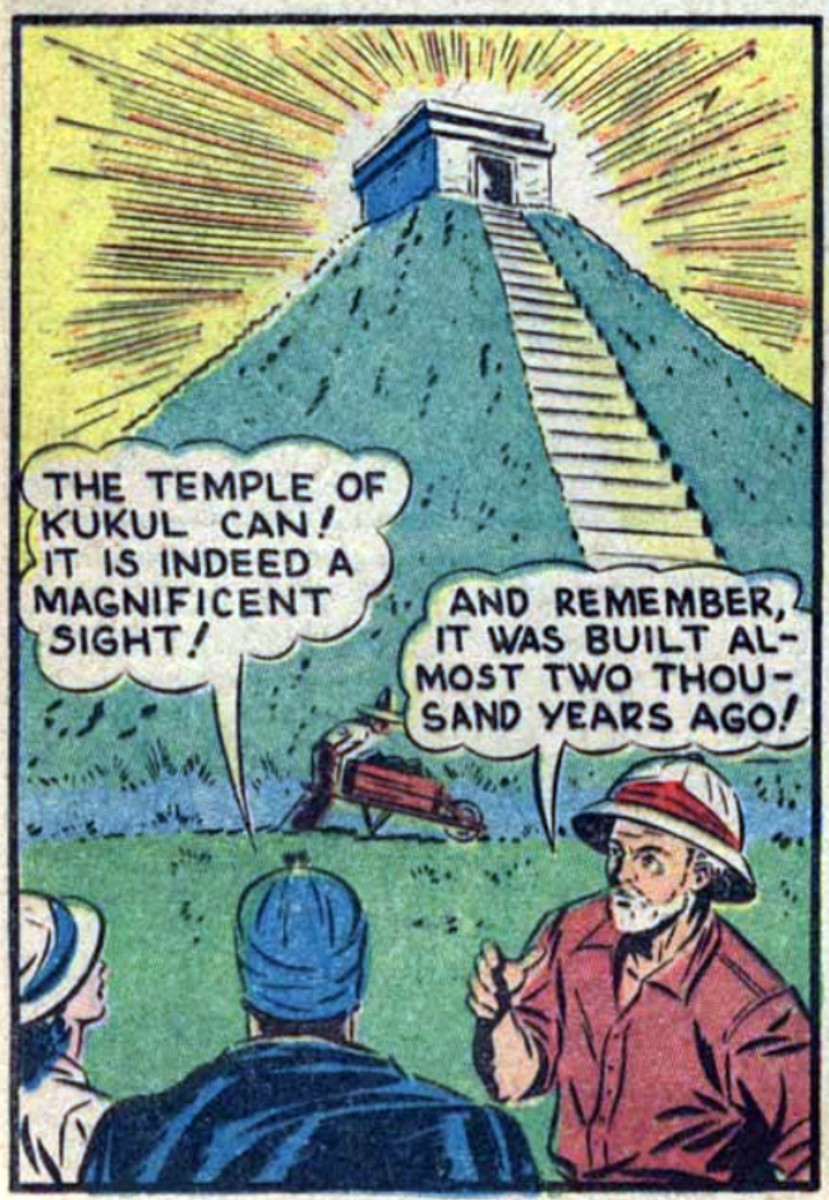
    These Mayan priests have tied a recent drought to some archaeological excavations in the Yucatan and have decided that the only thing for it is to revive the practice of human sacrifice to Yum Chac, aka just Chac, god of rain. They of course do this just in time for Zambini the Miracle Man to show up and wreck their whole operation.

    The really interesting thing about this whole episode is that it takes place at a site called “Hichen-Citza” and let me tell you that it’s this sort of thing that really shakes my confidence with regard to my knowledge of just when and why Golden Age comic book creators did these cute little place name substitutions. Surely there was no concern that an ancient or present-day Mayan might get upset by this depiction of their city but not, say their god? Or maybe I should just look back on the whole Egyptasia thing and conclude that “Zambini” scribe Joe Blair just really liked making up silly names for real places.

    (also the high priest is named “Macchu Pacchu,” which again seems to just be Blair having fun with names)

    El Castillo, the temple of Kukulcan also features, and evidently drawn from an old reference photo from back when the sides were still covered in vegetation. 

    God Style: Idol (Real Pantheon) (Zip Comics 008, 1940) 

    the Moon Orchid:

    I frequently like to point out when Golden Age explorers are just blithely waltzing into religious sites and stealing their sacred relics even in the face of stiff and reasonable resistance from the faithful, but this one is pretty beyond the pale. While most of the others at least attempt to adopt a pretense of respectability by claiming to be thieving for anthropological or other scientific reasons, Congo Bill and his pal Professor Kent are explicitly heading into the jungle to steal the Mesabi tribe’s sacred Moon Orchid so that they can sell it for big bucks.

    And steal it they do! And what’s worse: they blow up the entire Mesabi village in the process, so it’s not just sacrilege but mass murder. Worth it for that sweet orchid money, I guess.

    God Style: Animist (More Fun Comics 066, 1941) 

    Ozaz: 

    Adventurer Steve Conrad is on vacation in Egypt when he stumbles upon a weird cult looking to do a blood transfusion from a living woman into a mummy queen in order to bring her back to life and usher in a new age of the Pharaohs. Presumably this bunch worship all of your standard Ancient Egyptian gods, but they don’t name-drop any specific ones, until Steve fumbles his rescue attempt and is slated to be sacrificed to… 

    OZAZ THE FIRE GOD! Possessed of a pretty good name and nothing else, Ozaz is a made-up god who seems to have the head of a bird and whose statue is perfectly placed to topple over and kill the cultists when Steve’s assistant Chang opens the trap door underneath it. Too bad for Ozaz (no sacrifice today) and the Pharaoh cult (crushed to death).

    God Style: Idol (Real Pantheon) (Adventure Comics 063, 1941)

    Pyro:

    Worshipped by the Center People of Asteroid Djung, Pyro is a simple god: he hungers for sacrifice and he wants it via his sacred lava pit. 

    God Style: Invoked (Master Comics 019, 1941) 

  • DIVINE ROUND-UP 020

    Human sacrifice is the order of the day with this bunch of deific bad-boys. 

    Shem: 

    Shem, the Sun God, is worshipped in the Land of Shem by the Shemmites, aka the Men of Shem. It’s a very well-branded religion. 

    The Shemmites capture and attempt to sacrifice Kalthar, king of the jungle, but fail to reckon with his tendency to grow to fifteen feet tall and be invulnerable to harm, and are ultimately driven from their lands. 

    God Style: Invoked (Zip Comics 004, 1940) 

    Marro: 

    When the Three Aces set out into the Amazon jungle to investigate rumours of an ancient flying machine they end up discovering a lost colony of Atlantis for the second time in their careers – an astonishing hit rate (though their memories were wiped after leaving the first one and a language barrier probably prevented them from knowing about the Atlantis connection this time, if we’re going to be scrupulously accurate). Upon arriving, they are immediately captured and prepared for sacrifice to the Atlanteans’ god Marro. 

    Luckily for the three aviators, Marro turns out to be the very ancient aircraft they seek, sealed against the ravages of time in a glass dome. They manage to convince the Atlanteans to not sacrifice them if they can make the god fly again as it did in their legends, and being the expert fliers that they are, the Aces pull it off without a hitch. 

    God Style: Animist (Action Comics v1 043, 1941)

    Moloch: 

    The set up for this is a bit convoluted, but here goes: an anthropologist named Dr Chadwick is showing Zero, the Ghost Detective a weird skull that he dug up in Egypt one day when the ghost of the skull’s former owner shows up to take it back, and makes off with Chadwick’s daughter, to boot. Zero pursues the ghost back to Egypt and through a portal to Ancient Egypt, where he finds himself in a temple to Moloch and learns that the skull had been stuffed full of jewels sacred to the god. Zero manages to escape back to the 20th Century with the girl but wisely leaves the jewels behind.

    There is of course a lot of business involving human sacrifice to Moloch via the white hot hands of his idol, and while Moloch himself only shows up in the form of the idol the question remains: just who is raising all these ghosts and powering this time portal?

    God Style: Idol (Real?) (Feature Comics 041, 1941)

    the “Monster-God”: 

    The Monster-God is not this fellow’s name. We never learn what, in fact, it is, because the adventure he appears in is another boilerplate heroic-white-explorers-versus-evil-native-heathens adventure, handled with all of Fawcett Comics’ trademark cultural sensitivity. I include him only for completions’ sake and to point out that I like how gangly he is.

    God Style: Idol (Whiz Comics 006, 1940)

  • DIVINE ROUND-UP 019

    These pantheons are going to fill up if we’re not careful.

    Ammon-Ra:

    Worshipped by a secret sect in the hidden underground city-state of Ruxor in Egypt, Ammon-Ra, contrary to the above image, is probably just an idol that Yarko the Great is making speak so that he doesn’t have to keep magically duelling High Priest Ramma-Tep. 

    God style: Idol (Wonderworld Comics 018, 1940)

    Kila:

    Kila, the supposed Hindu God of Destruction, is represented here by a ruby idol. There’s not much else concrete to say about this particular god, because Sheldon Lenox, the fellow selling the idol, stages a series of crimes using a fake cult in order to get it back and that sort of thing really muddies the waters.

    God Style: Idol (Detective Comics v1 035, 1940)

    Kilu:

    In a classic set-up, a pirate captain and a wicked witch doctor have teamed up to control an island tribe using a hollow idol of the tribe’s god, Kilu. The whole operation is upended by the heroic Captain Fortune and the idol of Kilu is blasted by his ship’s cannon.

    God Style: Idol (Feature Comics 030, 1940)

    Koru: 

    Having heard about a fabulous fortune in rubies somewhere in the African jungle, adventure Tod Hunter and his monocled pal Tommy set out to steal them from their place on the idol of Koru, God of the Ruby Eye. Let me tell you, they are pretty put out when the worshippers of Koru very reasonably imprison them rather than allow them to waltz in and deface their sacred idol. 

    The duo (along with some other miscellaneous imprisoned treasure hunters) of course end up escaping and stealing all of the rubies, because they are the protagonists of an adventure story and thus are in the right, Along the way they discover that the idol of Koru is hollow and has a little guy living inside of it to speak in the god’s voice, just like every other giant idol in comics.

    God Style: Idol (New Adventure Comics 027, 1938) 

  • DIVINE ROUND-UP 018

    Idols, idols, idols! 

    the Great God Khwass: 

    Khwass, Great God of Vengeance, is a comparatively rare villain’s god who actually follows through on his promises. He is invoked vs Dr Fung by the daughter of a former foe and not only replies to her prayers but deploys sleeping gas and a weird monster to aid her in her quest for vengeance. 

    God Style: Real (Wonderworld Comics 016, 1940)

    Ice God Emul:

    Captain Venture and the Planet Princess Zyra’s great enemy, King Leon of Asteroid Djung, loves to subcontract out his villainy, and to that end he has engaged the services of Frigo, King of the Ice Planet. Frigo is to kill Captain Venture and deliver Zyra to King Leon for marriage but of course betrays him and slates all three for sacrifice to the Ice God Emul.

    The idol of Emul is destroyed in the subsequent battle and escape, and what’s interesting here is that Emul is explicitly just the idol. As Frigo states, “the god Emul is no more.” Wild.

    God Style: Idol (Master Comics 015, 1941)

    Bubastis & Isis:

    In an early adventure in Egypt, Zatara comes across a member of a lost archaeological expedition who is on the verge of death, and who is magically revealed to have found a lost temple to Bubastis. Travelling there in hopes of finding the rest of the expedition, Zatara encounters the ancient priest Amen-Hotep, who is part of one of those weird remnant Ancient Egyptian populations that exist under the sands of Egypt in adventure fiction, and whose priestly magics are comparable to Zatara’s own.

    The temple of Bubastis also turns out to be a temple to Isis, as Zatara discovers when he meets a less-powerful but still magically potent priestess of Isis and is almost sacrificed by her. Amen-Hotep seems to be an Isis worshipper as well, as he animates a statue of the goddess to smite Zatara with – it’s possible that the two goddesses are being conflated here.

    Zatara ends up melting the statue of Isis and disintegrating Amen-Hotep. The priestess is “sent away,” presumably with the rest of her people in tow, and the temple is turned over to the archaeologists to plunder.

    God Style: Real (Action Comics 005, 1938) 

    Khor: 

    Khor is known as the Blind God because the magical diamond that was the eye of his idol was stolen long ago, and since that diamond subsequently became the source of super-heroic adventurer Diamond Jack’s power, the priesthood of Khor is out for his blood.

    The high priest animates the idol of Khor and sends it to destroy Diamond Jack and recover the eye. This is impressive but not innovative – we just saw the Amen-Hotep do the same with a statue of Isis, after all – but what is is the custom roadster-cum-juggernaut that the thing rides around in. Was ever aan evil god so sporty?

    The whole thing ends back at the temple, as Diamond Jack disrupts the ritual that keeps Khor animated and the high priest ends up being crushed under the falling idol. So long, Khor. 

    God Style: Idol (Real?) (Slam-Bang Comics 004, 1940) 

  • DIVINE ROUND-UP 018

    Idols, idols, idols! 

    the Great God Khwass: 

    Khwass, Great God of Vengeance, is a comparatively rare villain’s god who actually follows through on his promises. He is invoked vs Dr Fung by the daughter of a former foe and not only replies to her prayers but deploys sleeping gas and a weird monster to aid her in her quest for vengeance. 

    God Style: Real (Wonderworld Comics 016, 1940)

    Ice God Emul:

    Captain Venture and the Planet Princess Zyra’s great enemy, King Leon of Asteroid Djung, loves to subcontract out his villainy, and to that end he has engaged the services of Frigo, King of the Ice Planet. Frigo is to kill Captain Venture and deliver Zyra to King Leon for marriage but of course betrays him and slates all three for sacrifice to the Ice God Emul.

    The idol of Emul is destroyed in the subsequent battle and escape, and what’s interesting here is that Emul is explicitly just the idol. As Frigo states, “the god Emul is no more.” Wild.

    God Style: Idol (Master Comics 015, 1941)

    Bubastis & Isis:

    In an early adventure in Egypt, Zatara comes across a member of a lost archaeological expedition who is on the verge of death, and who is magically revealed to have found a lost temple to Bubastis. Travelling there in hopes of finding the rest of the expedition, Zatara encounters the ancient priest Amen-Hotep, who is part of one of those weird remnant Ancient Egyptian populations that exist under the sands of Egypt in adventure fiction, and whose priestly magics are comparable to Zatara’s own.

    The temple of Bubastis also turns out to be a temple to Isis, as Zatara discovers when he meets a less-powerful but still magically potent priestess of Isis and is almost sacrificed by her. Amen-Hotep seems to be an Isis worshipper as well, as he animates a statue of the goddess to smite Zatara with – it’s possible that the two goddesses are being conflated here.

    Zatara ends up melting the statue of Isis and disintegrating Amen-Hotep. The priestess is “sent away,” presumably with the rest of her people in tow, and the temple is turned over to the archaeologists to plunder.

    God Style: Real (Action Comics 005, 1938) 

    Khor: 

    Khor is known as the Blind God because the magical diamond that was the eye of his idol was stolen long ago, and since that diamond subsequently became the source of super-heroic adventurer Diamond Jack’s power, the priesthood of Khor is out for his blood.

    The high priest animates the idol of Khor and sends it to destroy Diamond Jack and recover the eye. This is impressive but not innovative – we just saw the Amen-Hotep do the same with a statue of Isis, after all – but what is is the custom roadster-cum-juggernaut that the thing rides around in. Was ever aan evil god so sporty?

    The whole thing ends back at the temple, as Diamond Jack disrupts the ritual that keeps Khor animated and the high priest ends up being crushed under the falling idol. So long, Khor. 

    God Style: Idol (Real?) (Slam-Bang Comics 004, 1940) 

  • DIVINE ROUND-UP 017

    You’ll never believe it: more gods. 

    the Serpent Gods: 

    While pursuing crook Rango in the African jungle, Yarko the Great comes across a couple being sacrificed to the Serpent Gods by being flung into a pit of sacred serpents. But are the serpents the Serpent Gods themselves? There is no further context given, so we must assume that they are.

    God style: Animist (Wonderworld Comics 015, 1940) 

    Gorm: 

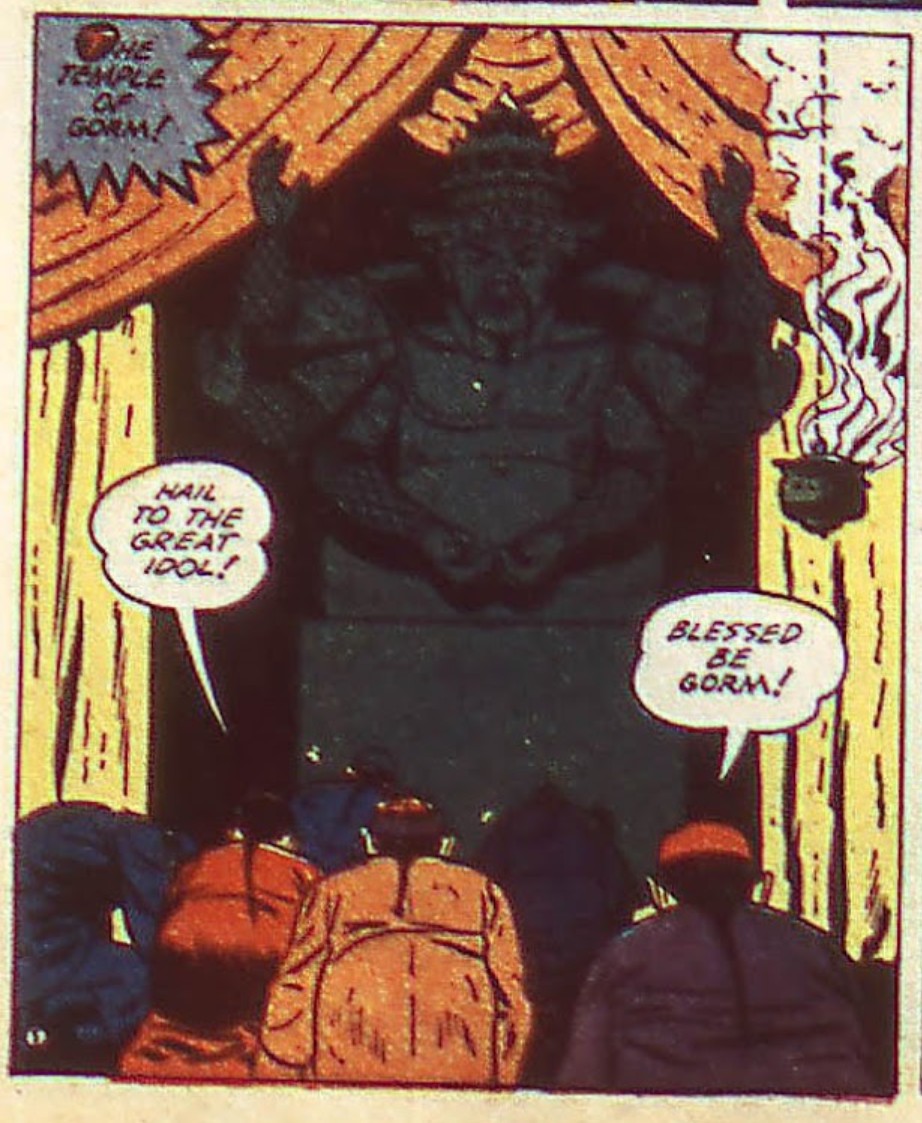
    Gorm is the god of the villainous Hatchet Cult, a gang that the Flash encounters early in his career, but since the Hatchet Cult is made up of white gangsters surgically made to look Chinese in order to throw the authorities off of their trail, one must assume that Gorm is just another part of the ruse (though for who’s benefit these guys are praying is a mystery to me).

    God Style: Idol (Flash Comics v1 022, 1941) 

    the Great God Orrab: 

    The Great God Orrab is yet another idol to which Our Heroes are almost sacrificed, ho hum. The interesting thing about this particular god, however, is that the hero in question is Blaze Barton, which placed Orrab in the year 50033 CE or thereabouts, and makes it very possible that his worshippers are in fact post-apocalyptic remnants worshipping the equivalent of a McDonaldland statue.

    God Style: Idol (Hit Comics 009, 1941)

    Hu, the Horse God: 

    Adventurer Lance Larkin and a lady named Marsha are looking for the “Land of the Flying Dragons” in Siberia, and wouldn’t you know it, they find it! And there are flying dragons (well, “pterodactyls”) there! There are also caveman-style Ape-Men riding the dragons, who swiftly capture Lance and Marsha and take them to be sacrificed at the altar of Hu, the Horse God. It is only the arrival of Lance’s loyal steed Satan, taken to be an earthly avatar of Hu, that saves the two.

    So just why do a bunch of cavemen who ride flying reptiles and have never seen a horse in their lives have a horse as their god? Because hundreds of thousands of years ago when they came to this prehistoric enclave they had horses and those horses saved them from disaster somehow. This inspired the reverence, but didn’t stop the horses from eventually dying out, which then inspired the taming of the “pterodactyls”.

    God-Style: Idol (More Fun Comics 067, 1941) 

  • DIVINE ROUND-UP 017

    DIVINE ROUND-UP 017

    You’ll never believe it: more gods. 

    the Serpent Gods: 

    While pursuing crook Rango in the African jungle, Yarko the Great comes across a couple being sacrificed to the Serpent Gods by being flung into a pit of sacred serpents. But are the serpents the Serpent Gods themselves? There is no further context given, so we must assume that they are.

    God style: Animist (Wonderworld Comics 015, 1940) 

    Gorm: 

    Gorm is the god of the villainous Hatchet Cult, a gang that the Flash encounters early in his career, but since the Hatchet Cult is made up of white gangsters surgically made to look Chinese in order to throw the authorities off of their trail, one must assume that Gorm is just another part of the ruse (though for who’s benefit these guys are praying is a mystery to me).

    God Style: Idol (Flash Comics v1 022, 1941) 

    the Great God Orrab: 

    The Great God Orrab is yet another idol to which Our Heroes are almost sacrificed, ho hum. The interesting thing about this particular god, however, is that the hero in question is Blaze Barton, which placed Orrab in the year 50033 CE or thereabouts, and makes it very possible that his worshippers are in fact post-apocalyptic remnants worshipping the equivalent of a McDonaldland statue.

    God Style: Idol (Hit Comics 009, 1941)

    Hu, the Horse God: 

    Adventurer Lance Larkin and a lady named Marsha are looking for the “Land of the Flying Dragons” in Siberia, and wouldn’t you know it, they find it! And there are flying dragons (well, “pterodactyls”) there! There are also caveman-style Ape-Men riding the dragons, who swiftly capture Lance and Marsha and take them to be sacrificed at the altar of Hu, the Horse God. It is only the arrival of Lance’s loyal steed Satan, taken to be an earthly avatar of Hu, that saves the two.

    So just why do a bunch of cavemen who ride flying reptiles and have never seen a horse in their lives have a horse as their god? Because hundreds of thousands of years ago when they came to this prehistoric enclave they had horses and those horses saved them from disaster somehow. This inspired the reverence, but didn’t stop the horses from eventually dying out, which then inspired the taming of the “pterodactyls”.

    God-Style: Idol (More Fun Comics 067, 1941)