The Curse of Skeleton Munroe

Category: god

  • DIVINE ROUND-UP 016

    Gods aplenty! 

    Tyalpo: 

    The god worshipped by Ibis the Invincible villain Piang the Terrible. Probably real, in that Piang has real magical power that he calls upon Tyalpo to activate, even if the god himself shows up only in idol form.

    God Style: Idol (Real?) (Whiz Comics 009, 1940) 

    Goddess of the Jungle: 

    Sandor is a jungle hero who doesn’t so much adventure as get into one long series of scrapes and situations in Northern India, the second most popular location to be a jungle hero by my reckoning. One of those scrapes involves him nearly getting sacrificed to the Goddess of the Jungle, about whom we never really learn more than her name. 

    God Style: Invoked (New Comics 006, 1936)

    the Golden Dragon: 

    “The Golden Dragon” is a serial that ran in Adventure Comics for around three years (and in fact started back when the book was called New Comics), about a group of adventurers and soldiers of fortune travelling from China to Mongolia in search of the fabled treasure of the Golden Dragon, while fending off attempts by the villainous Torgadoff to halt their journey, presumably so that he can seek the treasure himself. 

    Adventure Comics 034 finds de facto expedition leader Ian Murray at the end of the trail, which turns out to be a very much still in-use Temple of the Golden Dragon, with Torgadoff turning out to be one of the high priests. Does this dampen his desire to strip the place of its treasure? Absolutely not! This is a 1930s adventurer we’re talking about! The presence of a non-Christian religious practice only increases his lust for gold!

    Even the treasure-hungry Murray is taken aback, however, when the Golden Dragon shows up and turns out to be a real, living creature – presumably some sort of giant snake rather than a more traditional dragon based on how dumb it seems to be. 

    Murray’s reverence for this wonder of the natural world extends about as far as his respect for other cultures, and he ends up blasting the Golden Dragon at the first opportunity (but not before tossing Torgadoff into it’s crushing coils). The death of their god causes the worshippers to retreat, and the heroic adventurers are able to loot the temple and retire to lives of ease and luxury.

    God Style: Animist (Adventure Comics 034, 1939) 

    the Golden God: 

    The Golden God is one of the innumerable gods worshipped by the uncountable made-up Amazon tribes that comics are full of, and like so many of these gods, the Golden God is sought out by adventurers because it is represented by an idol of solid gold. Heroic adventurers the Companions Three seek out the idol after being hired by a woman named Cassie Bennett to find her father, Professor Bennett, who is supposedly after it on anthropological grounds 

    As usual, the anthropological value of an artifact outweighs the fact that the idol in question is still being used, but that turns out to matter a bit less than it normally does because the Golden God has in fact been discarded in favour of an unnamed new god, This new god in turn is revealed to be the Companions’ antagonist Hook Harroday, who is himself after the gold.

    Harroday’s plan to messily murder the Companions Three falls apart under a barrage of punches, and the group escapes with the idol of the Golden God, which Professor Bennett sells to a museum in a real triumph for selfless anthropology. 

    God Style: Idol (Master Comics 015, 1941) 

  • DIVINE ROUND-UP 016

    Gods aplenty! 

    Tyalpo: 

    The god worshipped by Ibis the Invincible villain Piang the Terrible. Probably real, in that Piang has real magical power that he calls upon Tyalpo to activate, even if the god himself shows up only in idol form.

    God Style: Idol (Real?) (Whiz Comics 009, 1940) 

    Goddess of the Jungle: 

    Sandor is a jungle hero who doesn’t so much adventure as get into one long series of scrapes and situations in Northern India, the second most popular location to be a jungle hero by my reckoning. One of those scrapes involves him nearly getting sacrificed to the Goddess of the Jungle, about whom we never really learn more than her name. 

    God Style: Invoked (New Comics 006, 1936)

    the Golden Dragon: 

    “The Golden Dragon” is a serial that ran in Adventure Comics for around three years (and in fact started back when the book was called New Comics), about a group of adventurers and soldiers of fortune travelling from China to Mongolia in search of the fabled treasure of the Golden Dragon, while fending off attempts by the villainous Torgadoff to halt their journey, presumably so that he can seek the treasure himself. 

    Adventure Comics 034 finds de facto expedition leader Ian Murray at the end of the trail, which turns out to be a very much still in-use Temple of the Golden Dragon, with Torgadoff turning out to be one of the high priests. Does this dampen his desire to strip the place of its treasure? Absolutely not! This is a 1930s adventurer we’re talking about! The presence of a non-Christian religious practice only increases his lust for gold!

    Even the treasure-hungry Murray is taken aback, however, when the Golden Dragon shows up and turns out to be a real, living creature – presumably some sort of giant snake rather than a more traditional dragon based on how dumb it seems to be. 

    Murray’s reverence for this wonder of the natural world extends about as far as his respect for other cultures, and he ends up blasting the Golden Dragon at the first opportunity (but not before tossing Torgadoff into it’s crushing coils). The death of their god causes the worshippers to retreat, and the heroic adventurers are able to loot the temple and retire to lives of ease and luxury.

    God Style: Animist (Adventure Comics 034, 1939) 

    the Golden God: 

    The Golden God is one of the innumerable gods worshipped by the uncountable made-up Amazon tribes that comics are full of, and like so many of these gods, the Golden God is sought out by adventurers because it is represented by an idol of solid gold. Heroic adventurers the Companions Three seek out the idol after being hired by a woman named Cassie Bennett to find her father, Professor Bennett, who is supposedly after it on anthropological grounds 

    As usual, the anthropological value of an artifact outweighs the fact that the idol in question is still being used, but that turns out to matter a bit less than it normally does because the Golden God has in fact been discarded in favour of an unnamed new god, This new god in turn is revealed to be the Companions’ antagonist Hook Harroday, who is himself after the gold.

    Harroday’s plan to messily murder the Companions Three falls apart under a barrage of punches, and the group escapes with the idol of the Golden God, which Professor Bennett sells to a museum in a real triumph for selfless anthropology. 

    God Style: Idol (Master Comics 015, 1941) 

  • DIVINE ROUND-UP 015

    Hate and deception abound in this batch of deities.

    Wangwa, God of Hate: 

    Wangwa, God of Hate is the personal god of Okoro, medicine man of the Blancas and enemy of Doctor Voodoo. I’ve never decided if the Evil Medicine Man trope is mere condescension toward native spiritual practices or a porting over of the Evil Vizier archetype to jungle comics, and in all honesty it’s probably both. Anyway, Okoro fits the mould to a T and he worships the god of hate. Sorry he’s so fuzzy.

    God Style: Idol (Whiz Comics 008, 1940) 

    Cheops:

    Adventurer Clip Carson and his archaeologist companion Jim Blake are searching for the fabled lost tomb of Cheops one day when they find themselves in the midst of an entire cult dedicated to the worship of what is apparently the resurrected Pharaoh himself. Carson and Blake are captured by the cult, upon which the supposed Cheops – with very little prompting, mind you – reveals himself to be Sergeant Beatty of the local colonial government, out to seize the treasures of Cheops for himself. Blake and Carson of course escape, and along the way Beatty is exposed as a fraud and torn apart by his former devotees. 

    The deep need for modern Egyptians in adventure fiction to turn to Ancient Egyptian religion, but only in the most secret, cultish, conspiratorial way is another one of those things that you end up wondering about once you read it enough times. Is it merely a fun and easy way to inject some mysterious action into your story? If so, why does it crop up instories set in Egypt so much more than ones set in Greece of Italy? Is it racism again? 

    God Style: Complicated – Cheops/Khufu could be considered to be a deified ruler of Egypt, even though the practice of doing so became common something like a thousand years after his time. Plus this is just some dude posing as him. (Action Comics v1 016, 1939)

    Doolong: 

    Remember Korieg the Sea Devil from a little while ago? Well, the same island people who hate that guy just love to worship Doolong, “god of [their] ancestors”. Not too much detail on Doolong, other than a) his idol is just a little face mounted on the wall and b) he slings a very accurate prophecy – he totally predicts the arrival of Tex Thomson and his party on the island, even if the small matter of Tex being the Princess’ destined mate is inaccurate. 

    God Style: Idol (Real?) (Action Comics v1 011, 1939)

    the Druid God: 

    This is possibly only obvious to someone who lives in the area, but the “group of islands” being indicated in the above image is clearly Cape Breton, Nova Scotia. Was Cape Breton seen as a place just far enough outside of the everyday for things like shipwrecks and secret cults to happen in, or did “Reynolds of the Mounted” scribe and lifelong resident of New York State Art Pinajian just trace a random bit of Canadian coastline and call it a day?

    Speaking of shipwrecks and secret cults, the first of those happens when Sergeant Reynolds heads toward the last known location of missing rich guy Johnny Westlake. Like Johnny, Reynolds washes up on the shore and is found and nursed back to health by local Pierre Dulac.

    Westlake has been on the island long enough to be able to relate the local legend of the Druid Cave, a spooky cave surrounded by spooky rock formations and regarded with fear by the superstitious islanders, who believe that though the cave is full of gold it is also cursed and that anyone venturing inside will die. Reynolds and Westlake venture inside after finding a local fisherman dying on the nearby beach and discover that the cave does in fact contain an ancient treasure and that the curse is probably just plain old asphyxiation thanks to some natural gas deposits.

    Here’s where the cult comes in: the islanders just kind of spontaneously develop it after finding Westlake emerging from the cave shortly before an explosion rocks the countryside. Never trust a group who turn to human sacrifice as a first option, is what I always say.

    In the end, the real culprit behind the murders and explosions turns out to be Pierre Dulac, who, far from being an altruistic soul, has been manipulating the situation to bring maximum chaos as a distraction while he sneaks off with the treasure. He didn’t reckon with Reynolds’ tenacity, of course, and ends up exploding along with the treasure and all evidence of whatever fantastic culture produced the Druid Cave. The islanders just kind of scatter, presumably to keep the worship of the Druid God alive in secret.

    God Style: Invoked (Feature Comics 045, 1941)

  • DIVINE ROUND-UP 014

    Once again I present to you some deities. 

    Pelenona: 

    South Pacific adventurer Lance O’Casey almost gets sacrificed to the volcano goddess Pelenona on the of the same name because a different, more evil adventurer had made off with the island’s sacred temple jewels.

    The people of the same island also worship a shipwrecked circus gorilla as god-monster the Eepa, 

    God Style: Animist (Whiz Comics 008, 1940)

    the Creeping Death:

    The Jungle Twins were a pair of brothers who were separated as infants when their parents’ jungle expedition was attacked by raiders. William Dale was taken back to New York by a loyal nursemaid to grow up in the lap of luxury, while his brother Steve was left behind in the jungle to – you guessed it – become the toughest, baddest dude and rule over all he surveyed.

    Years later, William made his way back to the jungle to find Steve, and along the way he and his servant Dagoo were captured by apemen and left as sacrifices for their god, the Creeping Death, which turns out to be a whole river full of giant crocodiles! Dagoo gets them out of this scrape using some magic pipes to put the crocs to sleep, despite William being a total asshole to him. 

    God Style: Animist (Nickel Comics 001, 1940)

    Dagan the Only: 

    Cotton Carver is your classic Golden Age comics adventurer, and in one of his first outings he stumbles into a classic Golden Age adventure setting: a vast network of temperate, well-lit caverns beneath Antarctica. From then on, his adventuring career involves getting into scrapes in underground nation after underground nation as he looks for a way back to the surface world. After making a particularly perilous transition from the Land of the White Witch to the kingdom of Thule (pre-WWII, so not a red flag), Carver and his companions encounter a group of archers who are making their yearly pilgrimage to the shrine of Dagan the Only. 

    The actual worship of Dagan the Only is a bit of a mystery – he requires travellers of the Path of Peril between the LotWW and Thule to delivered living unto him, which suggests human sacrifice and triggers a bloody battle between the archers and Carver’s people, but that turns out to be a ruse by the princess of Thule to acquire their help in defeating an enemy. Later on, however, Cotton and his pals make the transition to the next underground land by being tossed into Dagan’s sacrificial pit. All we can say for sure is that he has a great name.

    God Style: Idol (Adventure Comics 039, 1939)

    the Devil God: 

    A cool-ass idol that Zero the Ghost Detective smashes up in order to banish a ghost in the Guatemalan jungle. Though Zero asserts that the ghost is operating under the Devil God’s will, I would say that it’s equally likely that the idol is his anchor to the material world. Also, we only have Zero’s word for it that this guy is named the Devil God.

    God Style: Idol (Real?) (Feature Comics 049, 1941) 

  • DIVINE ROUND-UP 014

    Once again I present to you some deities. 

    Pelenona: 

    South Pacific adventurer Lance O’Casey almost gets sacrificed to the volcano goddess Pelenona on the of the same name because a different, more evil adventurer had made off with the island’s sacred temple jewels.

    The people of the same island also worship a shipwrecked circus gorilla as god-monster the Eepa, 

    God Style: Animist (Whiz Comics 008, 1940)

    the Creeping Death:

    The Jungle Twins were a pair of brothers who were separated as infants when their parents’ jungle expedition was attacked by raiders. William Dale was taken back to New York by a loyal nursemaid to grow up in the lap of luxury, while his brother Steve was left behind in the jungle to – you guessed it – become the toughest, baddest dude and rule over all he surveyed.

    Years later, William made his way back to the jungle to find Steve, and along the way he and his servant Dagoo were captured by apemen and left as sacrifices for their god, the Creeping Death, which turns out to be a whole river full of giant crocodiles! Dagoo gets them out of this scrape using some magic pipes to put the crocs to sleep, despite William being a total asshole to him. 

    God Style: Animist (Nickel Comics 001, 1940)

    Dagan the Only: 

    Cotton Carver is your classic Golden Age comics adventurer, and in one of his first outings he stumbles into a classic Golden Age adventure setting: a vast network of temperate, well-lit caverns beneath Antarctica. From then on, his adventuring career involves getting into scrapes in underground nation after underground nation as he looks for a way back to the surface world. After making a particularly perilous transition from the Land of the White Witch to the kingdom of Thule (pre-WWII, so not a red flag), Carver and his companions encounter a group of archers who are making their yearly pilgrimage to the shrine of Dagan the Only. 

    The actual worship of Dagan the Only is a bit of a mystery – he requires travellers of the Path of Peril between the LotWW and Thule to delivered living unto him, which suggests human sacrifice and triggers a bloody battle between the archers and Carver’s people, but that turns out to be a ruse by the princess of Thule to acquire their help in defeating an enemy. Later on, however, Cotton and his pals make the transition to the next underground land by being tossed into Dagan’s sacrificial pit. All we can say for sure is that he has a great name.

    God Style: Idol (Adventure Comics 039, 1939)

    the Devil God: 

    A cool-ass idol that Zero the Ghost Detective smashes up in order to banish a ghost in the Guatemalan jungle. Though Zero asserts that the ghost is operating under the Devil God’s will, I would say that it’s equally likely that the idol is his anchor to the material world. Also, we only have Zero’s word for it that this guy is named the Devil God.

    God Style: Idol (Real?) (Feature Comics 049, 1941) 

  • DIVINE ROUND-UP 013

    Piping hot deities for you this mornining.

    Sivu the Tiger God: 

    The worshippers of Sivu the Tiger God come to New York City to recover the jewelled eyes of their great idol, which are known as the Death Ruby and the Doom Ruby and held in the New York Museum and the collection of Beverly van Pell, respectively. Detective Dan Dare gets involved when he is hired by Mrs van Pell and the rubies ultimately stay right where they are. A shame, but at least we get to see that six-armed, four-legged, chubby, tiger-headed representation of Sivu, right?

    God Style: Idol. (Whiz Comics 003b, 1940) 

    Zeus: 

    The MLJ Hercules is the first super-hero of that name to actually be the demi-god in question, and he accordingly has a couple of meetings with his dad Zeus to discuss the state of the fight for truth and justice back on Earth. What I mostly want to point out about this version of the King of Olympus is that he’s probably the most flamboyantly dressed Zeus in comics before Jack Kirby illustrates him in Thor. 

    God style: Real (Blue Ribbon Comics 005, 1940)

    Charon: 

    A pretty by-the-numbers version of Charon who doesn’t deserve to be bullied by Dr Fate just because he needs to cross the Styx. He didn’t even try a bribe first!

    God Style: Real (More Fun Comics 056, 1940) 

    Wisdom: 

    The reason that Dr Fate is visiting the underworld is to check on whether his enemy Wotan is in fact dead, and to that end he is consulting with “Wisdom, who rules the world,” which I can only assume is another entry in the long tradition (that started four issues earlier with the origin of the Spectre) of alluding to the Abrahamic (or let’s face it: Christian) god via a combination of vague wording, blinding light and dialogue from an unseen source.

    God Style: Real (More Fun Comics 056, 1940) 

    (annoyingly, I can’t figure out where the bit about the seven gates to the underworld is from. It feels familiar and I wanted to see if it was from a non-Greek, non-Christian source because then this trip would be incorporating three whole mythologies, but there is simply too much “Gates of Hell” talk online to find it easily) 

  • DIVINE ROUND-UP 013

    Piping hot deities for you this mornining.

    Sivu the Tiger God: 

    The worshippers of Sivu the Tiger God come to New York City to recover the jewelled eyes of their great idol, which are known as the Death Ruby and the Doom Ruby and held in the New York Museum and the collection of Beverly van Pell, respectively. Detective Dan Dare gets involved when he is hired by Mrs van Pell and the rubies ultimately stay right where they are. A shame, but at least we get to see that six-armed, four-legged, chubby, tiger-headed representation of Sivu, right?

    God Style: Idol. (Whiz Comics 003b, 1940) 

    Zeus: 

    The MLJ Hercules is the first super-hero of that name to actually be the demi-god in question, and he accordingly has a couple of meetings with his dad Zeus to discuss the state of the fight for truth and justice back on Earth. What I mostly want to point out about this version of the King of Olympus is that he’s probably the most flamboyantly dressed Zeus in comics before Jack Kirby illustrates him in Thor. 

    God style: Real (Blue Ribbon Comics 005, 1940)

    Charon: 

    A pretty by-the-numbers version of Charon who doesn’t deserve to be bullied by Dr Fate just because he needs to cross the Styx. He didn’t even try a bribe first!

    God Style: Real (More Fun Comics 056, 1940) 

    Wisdom: 

    The reason that Dr Fate is visiting the underworld is to check on whether his enemy Wotan is in fact dead, and to that end he is consulting with “Wisdom, who rules the world,” which I can only assume is another entry in the long tradition (that started four issues earlier with the origin of the Spectre) of alluding to the Abrahamic (or let’s face it: Christian) god via a combination of vague wording, blinding light and dialogue from an unseen source.

    God Style: Real (More Fun Comics 056, 1940) 

    (annoyingly, I can’t figure out where the bit about the seven gates to the underworld is from. It feels familiar and I wanted to see if it was from a non-Greek, non-Christian source because then this trip would be incorporating three whole mythologies, but there is simply too much “Gates of Hell” talk online to find it easily) 

  • ALIENS AND SO FORTH ROUND-UP 019

    ALIENS AND SO FORTH ROUND-UP 019

    Today we have, per usual, something from the comic I’m currently reading followed by some stuff from the archives. It’s a good system!

    Glompers: 

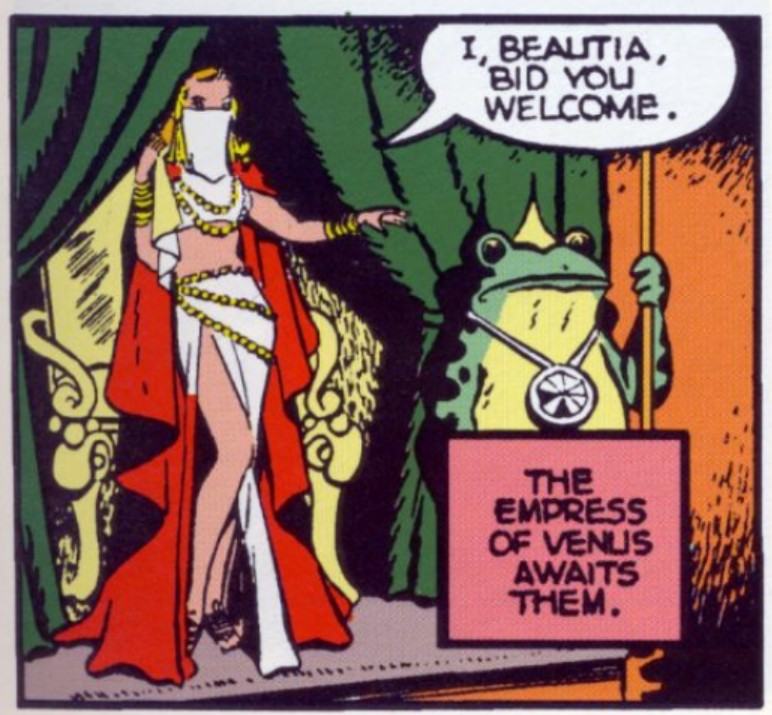
    We first meet the Glompers on the planet Venus after Dr Sivana has tricked Billy Batson and by extension Captain Marvel into joining him on an experimental rocket trip, with the intention of killing and/or stranding him there. They are immediately the most charming aliens I have ever seen, despite or perhaps because of the fact that they are just large frogs wearing trunks and little conical hats.

    The Glompers are ruled over by Beautia, Empress of Venus (later revealed to be Sivana’s daughter), and again I must emphasize just how friggin’ charming they are. Just look at his little spear! (Whiz Comics 003b, 1940)

    Sadly, as far as I can tell the Glompers only reappear one other time, as part of a plan by Dr Sivana to unleash them on Earth (Whiz Comics 015, 1941). The reformed-except-for-occasional-bursts-of-filial-duty Beautia expounds on the Glompers somewhat, revealing that they, like terrestrial frogs, are rapacious carnivores. Still charming! 

    In conclusion, since as far as I know the current DC Universe does not have a canonical native species on Venus and I have to say that I think that the Glompers should fill that roll. Make ’em big ol’ acid-spewing frog men!

    Alligator Men/Mermaids: 

    Rod Rian is an officer of Earth’s Sky Police in the year 2500 CE who finds himself on the planet Mephistos, having adventures among the various intelligent species that reside there. Perhaps the least explored of these are the friendly Alligator Men, who either coexist with a species of Mephistan mermaids or are yet another species with extreme sexual dimorphism. Either way: love a reptile man. (Flash Comics v1 011, 1940)

    Amazons of the Winged Death: 

    Don Drake, like Rod Rian, is an Earth man who finds himself on an alien world populated with all kinds of different species of intelligent life, in his case the planet Saro. Unlike Rod, Don’s adventures take place in the then-present day of 1935.

    The Amazons of the Winged Death are, as the name suggests, statuesque humanoid females. They ride horrible insects (the Winged Death of the name, natch) and are generally hostile, though Don does manage to ally with at least a few of them. (New Fun Comics 004, 1935)

    the Ape Men: 

    Brad Hardy, like Rod and Don, is an adventurer who finds himself in a world full of strange and often hostile creatures. Like Don, he is contemporary to the comic that he appears in, but unlike both of them, the world he finds himself in exists on Earth, in a cavernous realm below Mongolia. 

    The Ape Men (also Ape-Men and Apemen) are pretty typical: monkey faced humanoids with tails and a bad attitude. I do enjoy their Living Ape-God, who seems to just be the largest Ape Man. (More Fun Comics 009, 1936)

  • DIVINE ROUND-UP 012

    Craig Carter’s whole deal is summoning ancient gods out of his ring, and since he only had two issues in which to do so I am able to offer you a complete list of them here. With pictures!

    Zeus: 

    Zeus acts as the spokesgod of Craig Carter’s magic ring, and seems to be the one in charge of summoning forth the other deities. He’s called the “god of wisdom” here. I dig his little crown. (Wham Comics 001, 1940)

    Pegasus:

    Technically summoned by Zeus for Craig rather than directly from the ring, but who cares about technicalities: it’s a divine flying horse! (Wham Comics 001, 1940)

    Mercury: 

    Mercury serves Craig as a land-based equivalent to Pegasus after he discovers that his adversaries are holed up in a cave. His super speed really saves Carter’s hash on multiple occasions. (Wham Comics 001, 1940)

    Pluto:

    Pluto, styled as the “Master of Hades, Prince of All Black Magic”, is summoned to deal with a Hindu mystic that Carter’s second batch of foes has on call. He absolutely has the most personality of any of the gods summoned from the ring, and though the magic battle between the two suffers somewhat from Golden Age crudeness it does manage to look pretty intense and harrowing.

    Pluto wins the duel, of course, then decides to stay on Earth and get up to some mischief instead of returning to whatever world exists in the ring. He is pretty clearly intended to be an antagonist for Carter going forward, but since the feature never reappeared this was to be it for him. A true shame – just look at that cartoonishly evil face. I bet he’d have been brilliant. (Wham Comics 002, 1940)

    Thor:

    The only non Greco-Roman god summoned in the two Craig Carter adventures, so we can only speculate on the extent of its god-summoning powers. Could you get Mithras out of it? What about a god that is currently being worshipped? What about Catholic saints?

    Thor, like Pegasus and Mercury before him, is summoned as a mode of transport, via his goat cart, but sticks around to bust some heads. He also has a weird spiky halo that is never addressed.

    In a very frustrating development at the very end of the second and final Craig Carter adventure, Thor takes the antagonists back into the ring with him to “lead a better existence,” leaving us with even more questions about just what is going on with that thing than before. Is it simply a portal to the homes of the various gods, meaning that the thugs are now hanging out in Valhalla? Does it perhaps lead to some sort of amalgamated afterlife where all of the deprecated pantheons hang out together? We shall never know, alas. (Wham Comics 002 1940)

    The Also-Rans:

    The header of the first Craig Carter strip in Wham Comics 001 included three gods who never got to actually strut their stuff. It’s hard to say who the two in the back were supposed to be (I might guess Hades for the one on the far right if we didn’t get Pluto), but if that fellow with the club isn’t Hercules (or indeed Herakles), I’ll eat my hat. 

  • DIVINE ROUND-UP 011

    Lookit’m go!

    Thor: 

    This particular version of Thor, Norse God of Thunder invests mortal man Grant Farrel with his powers, but while most ancient gods who get up to that sort of thing in comics are looking for an agent to fight against or promote a cause or agenda, Thor seems to just seems to want to see his powers being used in adventures. It’s kind of wholesome!

    Please also note the weird discs on Thor’s helmet. What the heck is up with those? 

    God style: real (Weird Comics 001, 1940)

    the Slave Giants’ Goddess: 

    Space-time adventurer Flip Falcon (back when he was called Flick Falcon, before someone realized that “flick” in comic book block lettering is awful close to “fuck”) spent his first few escapades getting in the middle of a conflict between various Martian races and an invading three-armed species. As a part of this, Fli(ck/p) and his companion Adele come up with a scheme to substitute her for the idol that the Three-Arms had been using to control the credulous Martian Giants.

    This works well enough that it causes a minor holy war among the Giants, but I suppose that all’s fair in planetary defense. 

    God style: idol/ fake (Fantastic Comics 003, 1940) 

    the Sun God: 

    A big tree worshipped by a group of hominids known as “flat heads” via human hominid sacrifice. Fortunately for Og, Son of Fire and his companions, they represent a slightly more quick-witted type of hominid and manage to escape this grisly fate. 

    God style: animist (The Funnies 013, 1937)

    Zagu: 

    Source of conflict between a local tribe who insist that he lives in a mine site and the guy who really wants to mine there. Unsurprisingly, the Red Panther shows up to take the mine owner’s side.

    God style: invoked (Jungle Comics 003, 1940)