The Curse of Skeleton Munroe

Category: god

  • ALIENS AND SO FORTH ROUND-UP 011

    ALIENS AND SO FORTH ROUND-UP 011

    What ho! Aliens!

    Martians: 

    These Martians attack Earth for reasons that will remain unclear forever, because the story they appear in never actually gets an ending. In fact, they never even show their faces, instead attacking from their very cool-looking ships and sending their very cool-looking robots to act as ground troops. The initial invasion is driven off by superhuman scientist Greg Gilday and his associate Joan and then the Martians just never bother to return for another shot. (War Comics 002, 1940)

    Barrangees: 

    After their initial encounter with the giant insect life of Planet Barrang, Captain Tornado and his companions end up falling in with the Barrangees, a humanoid species who were forced underground when the insects began to increase in size and intelligence, and despite the common cause that they had made with the purple ant faction, the trio are far more comfortable around an non-insectoid race.

    (wildly, this extends to not even questioning the Barrangee caste system in which servants are surgically rendered mute as a symbol of their subservience and children are raised in total darkness to give them enhanced night vision)

    The Earth-people quickly resolve to help the Barrangees return to surface life using their knowledge of firearms and insecticides. Their main obstacle to this, other than the insects themselves, is the Barrangee High Priest, leader of a religion that worships the Sacred Centipede and by extension all of Barrang’s insect life. Captain Tornado eventually resolves this by shooting both the High Priest and the Sacred Centipede dead. (Popular Comics 048, 1940) 

    the Batmen:

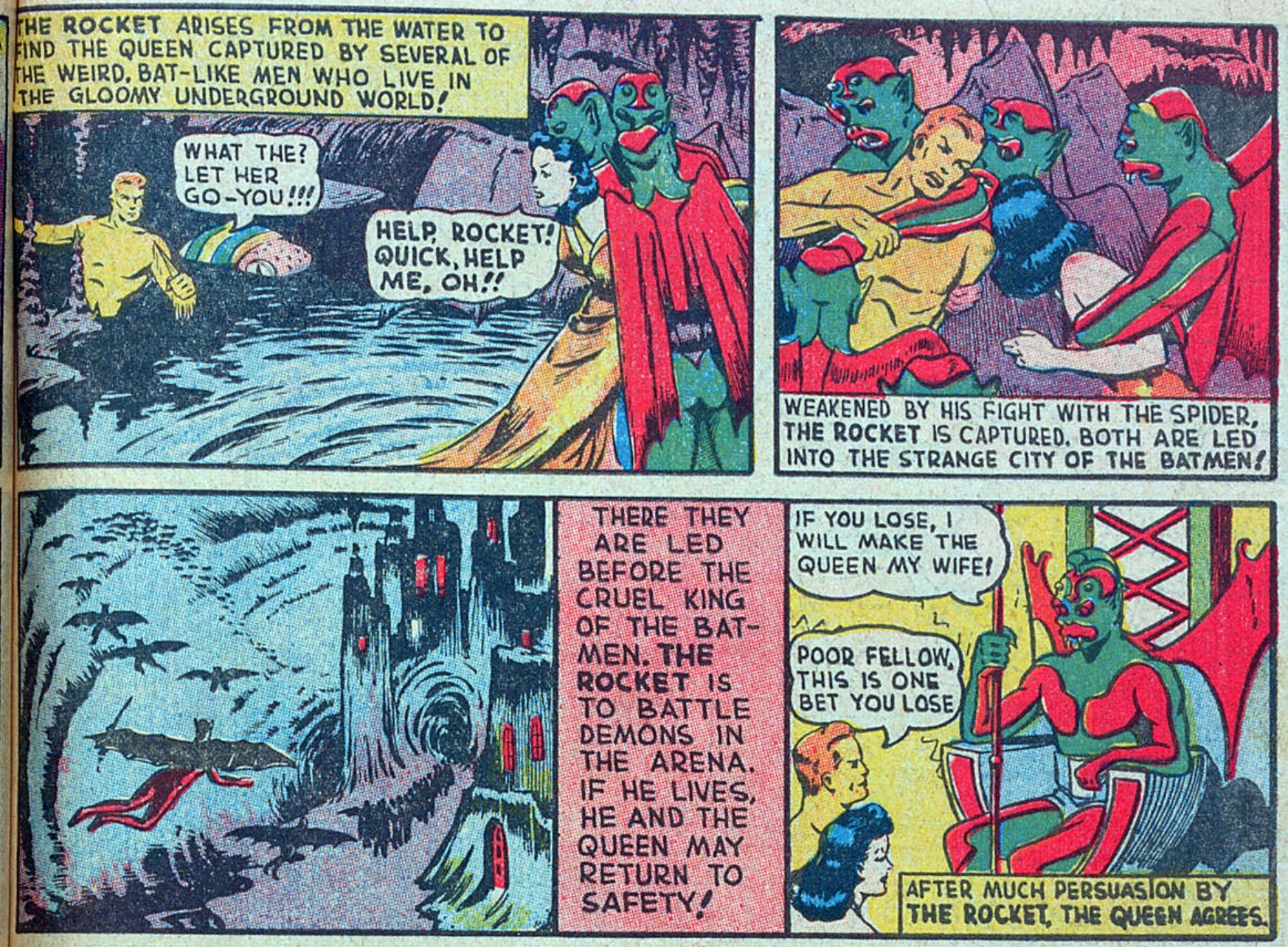
    The Rocket and the Queen of Diamonds seem to run into another hostile humanoid species every time they leave the walls of the hidden Diamond Empire, and the Batmen are yet another of these, which they end up in the clutches of after crashing the Rocket’s ship into an underground cavern. The king of the Batmen is of course a creep who lusts after the Queen and attempts to dispose of the Rocket via gladiatorial combat vs a giant turtle, but once the Rocket learns that the Batmen are mortally afraid of fire it’s all over. Quite literally, because he accidentally burns down their city. (Pep Comics 003, 1940)

    the Batmen of Kordano: 

    It’s been a while since I read “Air-Sub DX” and the world-building was never its main focus, so forgive me if I’m wrong, but as I recall it was set in an undefined future on a planet that I have written down as “Tago-Lor” but could have just as easily been a far-future Earth. The crew of the titular Air-Sub contend with the machinations of various bald guys, including Klawger here, who has assumed the identity of the administrator of some sort of mining colony. 

    All this is to say that I have no idea what the deal is with the Batmen of Kordano, aka the Living Dead Men, aside from the facts that a. they look cool, b. they have two great names, and c. they ride around in squat cylindrical vehicles called “mobile pillboxes,” which is fun. Aside from that, no idea. Why so aggro? Where or who or what is Kordano? No idea. (Amazing Mystery Funnies v2 005, 1939)

  • MINOR SUPER-HERO ROUND-UP 058

    A number of minor Fox Features characters for your perusal and delight.

    the Bird Man: 

    The Bird Man, descendant of “an ancient Indian god” (no further detail provided) uses his weird demigod wing-flaps to fly around the American Southwest and render aid to people. (Weird Comics 001, 1940)

    In Bird Man’s final appearance, in Weird Comics 004, he has conformed to the heroic norm a bit more by moving to a penthouse apartment in what might be NYC (please note that he keeps a little statue of his divine ancestor on top of his TV). He also has slightly more conventional wings in this appearance, but I have to say that I prefer the flaps.

    Typhon: 

    Typhon is a near-future undersea adventurer who not only has access to various super-submarines and ray guns and so forth but also sometimes has a magic ring that allows him to combat the various supernatural threats of the deep ocean. (Weird Comics 001, 1940)

    Thor, God of Thunder: 

    Thor, God of Thunder (the Norse god) gets restless one day in 1940 and decides to invest a mortal man with some of his power, making him Thor, God of Thunder (the super-hero). This is a not-uncommon origin story for a super-hero to have, but the really important thing to note is that the human, Grant Farrel, is not some paragon of virtue or descendant of Thor, and that he isn’t being sent out into the world to combat injustice on Thor’s behalf. No, he’s just kind of a sad sack who just got dumped and Thor hands him the power with a kind of “have fun with it” attitude. Grant seems like he might be the type to get into super-heroics of his own accord but he doesn’t really have any choice because Glenda, the girl who dumped him, is a real magnet for spy rings and secret invasions of France and so forth. They do eventually get back together, don’t worry.

    Like many of his contemporaries, Grant/Thor goes through a lot of different costume variants over the course of a short career, but the thing I really want to highlight is this very weird style of Viking helmet that both he and Original Thor wear in hist first three or four appearances. I mean, what’s with the discs? 

    Thor is of course wildly over-powered, as shown in this pretty awesome sequence in which he lassos an entire Luftwaffe attack on Paris and throws it at Berlin. He can also throw both his hammer and thunderbolts to devastating effect, and kind of alternates between flying under his own power and cartoonishly riding around on a big jagged bolt of lightning.

    In his final appearance, in Weird Comics 005, Thor is sans hammer for no particular reason. This doesn’t really slow him down but even so he gets a bit of divine aid via the gift of Thor’s strength-boosting gauntlet. (Weird Comics 001, 1940)

    Dynamite Thor:

    Dynamite Thor, the Explosion Man, is actually Peter Thor, wealthy mine owner and explosives expert. I was all ready to roast him for including his surname as part of his superhero identity, but on review of his five appearances it appears that the actual name he goes my is merely Dynamite. This also leaves me with no material with which to roast Thor’s fiance Glenda (same as our last Thor – what is it with Thors and Glendas?) for not realizing just who the mysterious man she so idolizes is.

    In his initial appearance, Dynamite Thor is merely a man with a belt-full of explosives and a pretty hammer-and nail approach to problem-solving. Crooks holed up in an old shack? Blow up the shack. Crooks getting away in a vehicle? A controlled explosion will bring a nearby object down and stop their flight. A big fire? Blow it up.

    By his second appearance in Weird Comics 007, someone had evidently decided that Dynamite Thor needed more of a hook or perhaps they just couldn’t figure out a good explosion-themed vehicle for him to fly around, because he gets his signature move which is absolutely the only reason that he is still talked about: he flies by the simple expedient of setting off a series of explosions under his ass. Finally, by his next appearance in Blue Beetle Comics 006, 1941, he is explicitly mentioned to be immune to these explosions, something that must have come as a great relief to him (edit to add: I was mistaken and they do make sure to mention that he is immune to explosions at the same time as he starts flying around on a column of them). (Weird Comics 006, 1940)

  • DIVINE ROUND-UP 010

    Pad out your pantheon with some of these:

    Death:

    This version of Death may lack the social graces necessary to welcome Kardak the Mystic and his pal Lorna rather than attempt to murder them for entering his domain, but he does have a very good version of the classic “robed skeleton” look. And his house is charmingly coffin-themed, to boot! 

    God Style: Anthropomorphic Personification (Top-Notch Comics 008, 1940)

    Ramu, God of Fire: 

    Ramu, God of Fire is another one of your deities created so that a group of “primitive savages” will have a reason to menace some “noble explorers” with the threat of being human sacrificed. Ramu at least is kind of fun because while he might have started out looking like the figure depicted on those red sacrificial poles, by the end of the comic this image has been supplanted by that of the miniature rocket ship that Minimidget and Ritty accidentally pilot into the middle of the ceremony.

    God Style: Idol  (Amazing-Man Comics 010, 1940)

    the Sacred Steam God:

    The Sacred Steam God is worshipped by the Quadropel Men, who themselves are notable for living beneath the land of Aquatania, which itself lies below the Marquesas Islands. Worship of the Sacred Steam God of course involves human sacrifice, but erstwhile victim Terry is saved when Chuck Hardy topples the inexplicably-full-of-scalding-water idol onto the crows of spectators. 

    God Style: Idol (Amazing-Man Comics 009, 1940)

    Sakka: 

    Sakka is, yes, another figure to whom some Noble White Explorers are almost sacrificed while making their way through the jungles of Matto Grosso in Brazil. Here’s the difference, though: Sakka isn’t just some idol, he’s an ancestor spirit, and his name and his ancient sword are all that the big-eyed Earth-Men need to keep their faith strong and bloodthirsty, at least until adventurer Rocky Ryan picks up the sword and is acclaimed the second coming of Sakka, that is. 

    God Style: Invoked (Big-Shot Comics 014, 1941) 

  • DIVINE ROUND-UP 009

    I came across Jumbo Comics 031 while filling in gods from my backlog in another Divine Round-Up entry and realized that the array of entities represented in the Stuart Taylor story in that issue should be presented as a block.

    Mercury: 

    This story begins as most Stuart Taylor stories do, with reckless use of time travel technology. Specifically, Taylor’s love interest Laura Hayward has travelled back to Ancient Greece to buy a new hat, because as we know: women be hat shopping. It’s practically all they think about!

    Laura’s Twentieth Century charms are apparently too much for the local deities to bear, because before Stuart can collect her and be condescending about headwear she is kidnapped by Mercury and spirited away to Olympus, which among other things places the gods of this issue in the hybrid Greco-Roman Pantheon.

    the Oracle of Delphi: 

    Stuart and Dr Hayward’s next move is to consult with the Oracle of Delphi to get a line on how exactly they might follow Mercury and recover Laura from him, and I must say that I really enjoy this weird wisp-of-air version of the Oracle, despite it being tremendously off-model. 

    Medusa: 

    The Oracle directs Our Heroes to seek information from Medusa, who turns out to be depicted in typical style, though somewhat more enormous than is generally the case. I do appreciate that this issue answers the age old question: “is Medusa vulnerable to ray gun blasts?” 

    the Evils Contained in Pandora’s Box: 

    The final stop on Stuart and Hayward’s quest is to retrieve a laurel wreath from inside of Pandora’s Box, which is just sitting in a field in the middle of nowhere. The comic kind of glosses over the fact that Stuart Taylor is responsible for unleashing the Evils of Mankind, but I am fully prepared to do so, as it might just be his worst snafu in a career full of the reckless and unthinking use of time travel. 

    The specific evils released from this version of Pandora’s Box are: 

    Disease – a classic for a reason. The generic ghost look suggests that the artist did not want to draw a lot of pustules.

    Greed – an evil little pig man. 

    Hunger – another one right out of the classic Four Horsemen of the Apocalypse set. Much more gruesome than Disease, when the opposite is usually the case.

    Intolerance – I was going to call this guy an unusual inclusion, but on reflection I’ll bet that most Pandora’s Box lineups include Hate, which isn’t far off. Definitely looks intolerant.

    and bringing up the rear… 

    War, aka Mars: 

    What is unusual inclusion is not War, who I reckon is there pretty often, but specifically Mars, God of War. Is the implication that this fairly major god was powerless until released by human hands? Is the War who is usually depicted in PB lineups some sort of aspect of war or a specific type of warfare? No clue. What is certain is that Stuart Taylor knocks this War’s block off.

    And speaking of block-knocking, that’s what also happens to Mercury once Taylor, Laurel wreath firmly on brow, makes his way to Olympus to finally rescue Laura. The story ends on a fairly limp callback joke about women and their genetic predilection for hat-shopping, one which I rolled my eyes at even before I realized that Laura wearing the divine laurel wreath as a regular hat at the end would be a much better bit. (Jumbo Comics 031, 1941)

  • DIVINE ROUND-UP 009

    I came across Jumbo Comics 031 while filling in gods from my backlog in another Divine Round-Up entry and realized that the array of entities represented in the Stuart Taylor story in that issue should be presented as a block.

    Mercury: 

    This story begins as most Stuart Taylor stories do, with reckless use of time travel technology. Specifically, Taylor’s love interest Laura Hayward has travelled back to Ancient Greece to buy a new hat, because as we know: women be hat shopping. It’s practically all they think about!

    Laura’s Twentieth Century charms are apparently too much for the local deities to bear, because before Stuart can collect her and be condescending about headwear she is kidnapped by Mercury and spirited away to Olympus, which among other things places the gods of this issue in the hybrid Greco-Roman Pantheon.

    the Oracle of Delphi: 

    Stuart and Dr Hayward’s next move is to consult with the Oracle of Delphi to get a line on how exactly they might follow Mercury and recover Laura from him, and I must say that I really enjoy this weird wisp-of-air version of the Oracle, despite it being tremendously off-model. 

    Medusa: 

    The Oracle directs Our Heroes to seek information from Medusa, who turns out to be depicted in typical style, though somewhat more enormous than is generally the case. I do appreciate that this issue answers the age old question: “is Medusa vulnerable to ray gun blasts?” 

    the Evils Contained in Pandora’s Box: 

    The final stop on Stuart and Hayward’s quest is to retrieve a laurel wreath from inside of Pandora’s Box, which is just sitting in a field in the middle of nowhere. The comic kind of glosses over the fact that Stuart Taylor is responsible for unleashing the Evils of Mankind, but I am fully prepared to do so, as it might just be his worst snafu in a career full of the reckless and unthinking use of time travel. 

    The specific evils released from this version of Pandora’s Box are: 

    Disease – a classic for a reason. The generic ghost look suggests that the artist did not want to draw a lot of pustules.

    Greed – an evil little pig man. 

    Hunger – another one right out of the classic Four Horsemen of the Apocalypse set. Much more gruesome than Disease, when the opposite is usually the case.

    Intolerance – I was going to call this guy an unusual inclusion, but on reflection I’ll bet that most Pandora’s Box lineups include Hate, which isn’t far off. Definitely looks intolerant.

    and bringing up the rear… 

    War, aka Mars: 

    What is unusual inclusion is not War, who I reckon is there pretty often, but specifically Mars, God of War. Is the implication that this fairly major god was powerless until released by human hands? Is the War who is usually depicted in PB lineups some sort of aspect of war or a specific type of warfare? No clue. What is certain is that Stuart Taylor knocks this War’s block off.

    And speaking of block-knocking, that’s what also happens to Mercury once Taylor, Laurel wreath firmly on brow, makes his way to Olympus to finally rescue Laura. The story ends on a fairly limp callback joke about women and their genetic predilection for hat-shopping, one which I rolled my eyes at even before I realized that Laura wearing the divine laurel wreath as a regular hat at the end would be a much better bit. (Jumbo Comics 031, 1941)

  • DIVINE ROUND-UP 008

    Some more dubious theology for you. 

    the Stone Tablet:

    The pompous jackasses at the British Archaeological Club really get Mr Mystic’s goat when they treat the theories of his friend Doctor Gadasky like trash, so he does the only sensible thing and uses his magic to travel back to 1 000 000 CE to see for himself. Gadasky claims that Cro-Magnons had a religion based around the worship of a stone tablet, and wouldn’t you know it, he’s right!

    Mr Mystic’s jaunt through time is about as well-considered as those things normally are, and he ends up causing the deaths of two Cro-Magnons, including the Stone Tablet’s keeper, plus the loss of the Tablet itself in a quicksand pit, which is a boon for Gadasky, as he is able to dig it up in the present and prove his theories. Take that, establishment jerks!

    Speaking of those theories, just where did they come from? Is the fact that Gada, the Stone Tablet’s guardian, is a dead ringer for Gadasky and that Gadasky carries an echo of the wound that killed Gada (reptile-bird beak to the skull) on his flesh an indication that the Tablet posesses some measure of actual power? Could be!

    God style: idol (the Spirit Section, 8 December, 1940)

    Oona, the Angry God: 

    Oona is the Angry God, a generically sinister Asian deity who requires the sacrifice of a good English girl now and then. Inspector Dayton is of course having none of that, particularly as the sacrifice happens to be his love interest Wini. Oona worship in England is ended at the barrel of a gun.

    God style: idol (Jumbo Comics 022, 1940) 

    Orga: 

    In a near-deserted lost city of gold, Sheena, Queen of the Jungle and her paramour Bob Reynolds come across an unnamed mad king and his court of trained gorillas. The King has been sacrificing travellers (and implicitly his own people, leading to the city’s depleted population) to his gods. I can only assume that the fantastic idol behind the king’s throne is a representation of Orga, the only god mentioned by name. 

    God style: idol (Jumbo Comics 009, 1939) 

    Orta the Sun-God: 

    Captured and sentenced to death by a Peruvian tribe, Marvelo, Monarch of Magicians pulls a variant on the old “we are divine beings, you primitives” gag by transforming his companion into a fireball. Is Orta the Sun-God something that Marvelo makes up on the spot or is he exploiting these (admittedly inhospitable) people’s extant beliefs? We shall never know.

    God style: fake (Big-Shot Comics 014, 1941) 

  • DIVINE ROUND-UP 008

    Some more dubious theology for you. 

    the Stone Tablet:

    The pompous jackasses at the British Archaeological Club really get Mr Mystic’s goat when they treat the theories of his friend Doctor Gadasky like trash, so he does the only sensible thing and uses his magic to travel back to 1 000 000 CE to see for himself. Gadasky claims that Cro-Magnons had a religion based around the worship of a stone tablet, and wouldn’t you know it, he’s right!

    Mr Mystic’s jaunt through time is about as well-considered as those things normally are, and he ends up causing the deaths of two Cro-Magnons, including the Stone Tablet’s keeper, plus the loss of the Tablet itself in a quicksand pit, which is a boon for Gadasky, as he is able to dig it up in the present and prove his theories. Take that, establishment jerks!

    Speaking of those theories, just where did they come from? Is the fact that Gada, the Stone Tablet’s guardian, is a dead ringer for Gadasky and that Gadasky carries an echo of the wound that killed Gada (reptile-bird beak to the skull) on his flesh an indication that the Tablet posesses some measure of actual power? Could be!

    God style: idol (the Spirit Section, 8 December, 1940)

    Oona, the Angry God: 

    Oona is the Angry God, a generically sinister Asian deity who requires the sacrifice of a good English girl now and then. Inspector Dayton is of course having none of that, particularly as the sacrifice happens to be his love interest Wini. Oona worship in England is ended at the barrel of a gun.

    God style: idol (Jumbo Comics 022, 1940) 

    Orga: 

    In a near-deserted lost city of gold, Sheena, Queen of the Jungle and her paramour Bob Reynolds come across an unnamed mad king and his court of trained gorillas. The King has been sacrificing travellers (and implicitly his own people, leading to the city’s depleted population) to his gods. I can only assume that the fantastic idol behind the king’s throne is a representation of Orga, the only god mentioned by name. 

    God style: idol (Jumbo Comics 009, 1939) 

    Orta the Sun-God: 

    Captured and sentenced to death by a Peruvian tribe, Marvelo, Monarch of Magicians pulls a variant on the old “we are divine beings, you primitives” gag by transforming his companion into a fireball. Is Orta the Sun-God something that Marvelo makes up on the spot or is he exploiting these (admittedly inhospitable) people’s extant beliefs? We shall never know.

    God style: fake (Big-Shot Comics 014, 1941) 

  • DIVINE ROUND-UP 007

    All of the following are from the “Mr Mystic” story in the Spirit Section for 17 November, 1940, in which Mr Mystic into the Land of Mythology to recover the Lost Ring of the Gods, an artifact that brings luck and happiness unless it is stolen by the one jealous god, upon which the bearer falls into eternal slumber. Since this has already happened to a young woman, Mystic is hoping that the recovery of the ring from the jealous god – see the Shadowman entry from a few Divine Round-Ups back – will help her out.

    All of these gods are part of the Greco-Roman Pantheon, which is what I call it when Greek and Roman gods are just kind of grouped together without rhyme or reason.

    the Goddess of the Gate: 

    Who knows what this god’s name really is. She welcomes Mr Mystic to the Land of the Gods and that’s about it. Even her name is based on Mr Mystic saying “she must have been the Goddess of the Gate” in the next panel. She is very helpful, which is something.

    Mars: 

    Mr Mystic’s first guide in the Land of Mythology is Mars, and an unusual version of him at that. Most 1940s depictions of Mars really lean in to his status as the god of war to depict him revelling in or even being the instigator of World War II, but this Mars is instead depressed by the indiscriminate slaughter of modern warfare. 

    “Susie”: 

    Who is “Susie” the Goddess of Knowledge? Athena or her mother Metis? Minerva? Is she from a third pantheon? Perhaps, but consulting a list of deities of knowledge really makes it clear that none of them naturally shorten to Susie. Is that the joke, like calling a fat guy Slim? Maddening stuff.

    Frustrating name aside, this Goddess of Knowledge is appropriately full of information, with some bonus sass and even a little horniness to round out her character.

    the Fates: 

    The concept of three goddesses weaving the thread of a man’s life crops up in Greek, Roman, and Norse mythology, and the question of where exactly these versions of them are from is neatly sidestepped by the fact that they call themselves Past, Present and Future in place of any of the names used in the original myths.

    You know, I just developed a theory: I think that when Bob Powell was writing this he just plain couldn’t find his dictionary or other reference book to look up the names of these gods and so he fudged it. Susie, sure. Past, Present and Future, sure. And it works! I’m sure that I’m the only person in history who tried to work out if Susie could plausibly be a nickname for an actual Goddess of Knowledge. Good job, Bob.

  • DIVINE ROUND-UP 006

    More gods means more options. 

    Katagwah, the Rain God: 

    An unseen Native American rain god whose most fanatical adherent is attempting to perform a human sacrifice to bring rain to the Mojave Desert when Mr Mystic steps in to help the intended victim’s brother put a stop to the ceremony. I felt certain that the story would end with a rainstorm brought on by Mystic chucking the aggressor into the sacrificial canyon, but no such luck.

    God style: invoked. (The Spirit Section, 18 August, 1940) 

    the Sacred Lion:

    Real-life big game trapper Clyde Beatty heads into the African jungle to prevent evil men from stealing the Sacred Lion God from the Ugandi Tribe who worship him. Not because it’s wrong to swan into someone else’s temple and steal their god, mind you, but rather because Beatty wants the Sacred Lion for his own circus.

    God style: animist (Crackajack Funnies 018, 1939) 

    the Living Tribe God: 

    Clyde Beatty is back again, in the Amazon jungle this time, and thanks to the machinations of his rival Bart Slay he almost gets eaten by/sacrificed to the Living Tribe God, an enormous tarantula. Strangely, even after clearing things up and avoiding death, Beatty doesn’t bother stealing this god to take home.

    God style: animist (Crackajack Funnies 037, 1941)

    Naga Goona: 

    Naga Goona, God of the Silvery Moon, is worshipped by the near-human Troglodytes of Matto Grosso. On the one hand, this is just another idol that a white explorer has to be saved from being sacrificed to, but on the other hand… just look at that face! Naga Goona might just be the most charmingly goofy-looking god on record, especially after his idol is animated by Marvelo, Monarch of Magicians and starts walking around and telling people off. 

    God style: idol (Big Shot Comics 010, 1941) 

  • DIVINE ROUND-UP 006

    More gods means more options. 

    Katagwah, the Rain God: 

    An unseen Native American rain god whose most fanatical adherent is attempting to perform a human sacrifice to bring rain to the Mojave Desert when Mr Mystic steps in to help the intended victim’s brother put a stop to the ceremony. I felt certain that the story would end with a rainstorm brought on by Mystic chucking the aggressor into the sacrificial canyon, but no such luck.

    God style: invoked. (The Spirit Section, 18 August, 1940) 

    the Sacred Lion:

    Real-life big game trapper Clyde Beatty heads into the African jungle to prevent evil men from stealing the Sacred Lion God from the Ugandi Tribe who worship him. Not because it’s wrong to swan into someone else’s temple and steal their god, mind you, but rather because Beatty wants the Sacred Lion for his own circus.

    God style: animist (Crackajack Funnies 018, 1939) 

    the Living Tribe God: 

    Clyde Beatty is back again, in the Amazon jungle this time, and thanks to the machinations of his rival Bart Slay he almost gets eaten by/sacrificed to the Living Tribe God, an enormous tarantula. Strangely, even after clearing things up and avoiding death, Beatty doesn’t bother stealing this god to take home.

    God style: animist (Crackajack Funnies 037, 1941)

    Naga Goona: 

    Naga Goona, God of the Silvery Moon, is worshipped by the near-human Troglodytes of Matto Grosso. On the one hand, this is just another idol that a white explorer has to be saved from being sacrificed to, but on the other hand… just look at that face! Naga Goona might just be the most charmingly goofy-looking god on record, especially after his idol is animated by Marvelo, Monarch of Magicians and starts walking around and telling people off. 

    God style: idol (Big Shot Comics 010, 1941)