The Curse of Skeleton Munroe

Category: god

  • DIVINE ROUND-UP 005

    Once again we add to the scriptures. 

    the Shadowman: 


    Like his predecessor/inspiration Yarko the Great, Mr Mystic also has a semi-friendly/ semi-adversarial relationship with the personification of death. In this case, Death is a guy in a cool suit with a half-cape, and he is called the Shadowman, presumably because of his perpetually-in shadow face.

    The Shadowman’s first couple of appearances cast him as a mysterious stranger who helps Mr Mystic in his battle against various evils (including scientist Ghantse, who the Shadowman seems to work for in his initial appearance). At this point the Shadowman is merely a mysterious man who has a miraculous ability to survive the most deadly of situations.

    In the 17 November 1940 Spirit Section, Mr Mystic ventures into the Land of Mythology on a quest for the Ring of the Gods, which turns out to be held by Death. This version of Death is a traditional Grim Reaper style skeleton in a robe, and he swears vengeance on Mr Mystic for the theft of the ring. 

    The Grim Reaper version of Death is never explicitly tied to the Shadowman, and it’s possible that they were intended to be different in some fundamental way – different aspects of death, perhaps. The Whole Ring of the Gods incident is not brought up by the Shadowman the next time he meets Mr Mystic (1 December 1940), so Mystic might be off the hook for that. It’s a bit of a moot point, however, as this installment of “Mr Mystic” is all about him saving the life of a little girl named Joan Barton, and it allows us to get more of a grip on the Shadowman’s code: he objects to bot murder and life-saving interventions as equally disruptive to the natural order. Mr Mystic now has two threats from Death hanging over him. 

    (this episode also establishes the deal with the Shadowman’s shadowy face: if you look at it sans shadow, you die) 

    The second-to-final Mr Mystic comic of the year (22 December 1940) features the Shadowman’s revenge on Mystic: he is going to seduce/kill his fiance Elena.

    While the Shadowman seems to have access to some sort of primordial seductive power relating to the inevitable entropic march toward the grave, he is not above employing cheap romantic comedy plot devices to drive a wedge between the lovers.

    Death is the inevitable winner of the contest, of course, and Elena goes off with him to… the afterlife? His home? Are they married now or is she just dead? We shall never know, alas, though we will see the Shadowman again.

    God Style: real anthropomorphic personification (The Spirit Section, 22 September, 1940)

    Jwang Tyoy:

    We don’t get a lot of the teachings of Jwang Tyoy beyond the fact that he is the god of a South American “anti-civilization” cult. The focus of the comic is much more focused on the very off-model pterodactyls that the cult leader uses to do he bidding, and for good reason!

    God Style: idol (Shadow Comics v1 004, 1940) 

    Kutu: 

    Kutu, aka Tuku, is possibly a moon god, definitely South American, and has the traditional jewel socketed into his idol for adventurers to steal and get into Big Trouble. 

    God Style: idol (Comics Magazine 002, 1936)  

    Nahapatan: 

    Nahapatan, the Golden Idol, is housed in a hidden Aztec city, where it is the subject of active worship. Does this stop Professor Roberts, his nephew Tim and adventurer Ken Masters from barging in and stealing it to put in Robert’s museum? It does not.

    God Style: idol (Masked Marvel 001, 1940)

  • DIVINE ROUND-UP 005

    Once again we add to the scriptures. 

    the Shadowman: 


    Like his predecessor/inspiration Yarko the Great, Mr Mystic also has a semi-friendly/ semi-adversarial relationship with the personification of death. In this case, Death is a guy in a cool suit with a half-cape, and he is called the Shadowman, presumably because of his perpetually-in shadow face.

    The Shadowman’s first couple of appearances cast him as a mysterious stranger who helps Mr Mystic in his battle against various evils (including scientist Ghantse, who the Shadowman seems to work for in his initial appearance). At this point the Shadowman is merely a mysterious man who has a miraculous ability to survive the most deadly of situations.

    In the 17 November 1940 Spirit Section, Mr Mystic ventures into the Land of Mythology on a quest for the Ring of the Gods, which turns out to be held by Death. This version of Death is a traditional Grim Reaper style skeleton in a robe, and he swears vengeance on Mr Mystic for the theft of the ring. 

    The Grim Reaper version of Death is never explicitly tied to the Shadowman, and it’s possible that they were intended to be different in some fundamental way – different aspects of death, perhaps. The Whole Ring of the Gods incident is not brought up by the Shadowman the next time he meets Mr Mystic (1 December 1940), so Mystic might be off the hook for that. It’s a bit of a moot point, however, as this installment of “Mr Mystic” is all about him saving the life of a little girl named Joan Barton, and it allows us to get more of a grip on the Shadowman’s code: he objects to bot murder and life-saving interventions as equally disruptive to the natural order. Mr Mystic now has two threats from Death hanging over him. 

    (this episode also establishes the deal with the Shadowman’s shadowy face: if you look at it sans shadow, you die) 

    The second-to-final Mr Mystic comic of the year (22 December 1940) features the Shadowman’s revenge on Mystic: he is going to seduce/kill his fiance Elena.

    While the Shadowman seems to have access to some sort of primordial seductive power relating to the inevitable entropic march toward the grave, he is not above employing cheap romantic comedy plot devices to drive a wedge between the lovers.

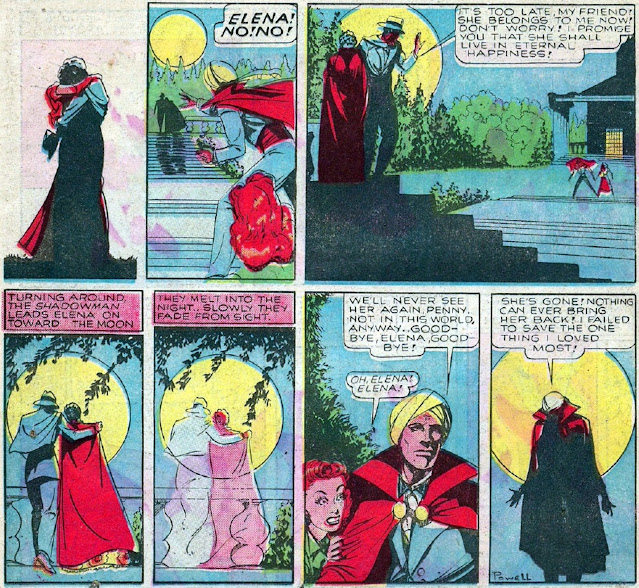
    Death is the inevitable winner of the contest, of course, and Elena goes off with him to… the afterlife? His home? Are they married now or is she just dead? We shall never know, alas, though we will see the Shadowman again.

    God Style: real anthropomorphic personification (The Spirit Section, 22 September, 1940)

    Jwang Tyoy:

    We don’t get a lot of the teachings of Jwang Tyoy beyond the fact that he is the god of a South American “anti-civilization” cult. The focus of the comic is much more focused on the very off-model pterodactyls that the cult leader uses to do he bidding, and for good reason!

    God Style: idol (Shadow Comics v1 004, 1940) 

    Kutu: 

    Kutu, aka Tuku, is possibly a moon god, definitely South American, and has the traditional jewel socketed into his idol for adventurers to steal and get into Big Trouble. 

    God Style: idol (Comics Magazine 002, 1936)  

    Nahapatan: 

    Nahapatan, the Golden Idol, is housed in a hidden Aztec city, where it is the subject of active worship. Does this stop Professor Roberts, his nephew Tim and adventurer Ken Masters from barging in and stealing it to put in Robert’s museum? It does not.

    God Style: idol (Masked Marvel 001, 1940)

  • DIVINE ROUND-UP 004

    Can you ever have enough made-up gods? 

    the Goddess of Fire: 

    Crooks Raoul and Victor Ladron hatch a scheme while hiding out on the South Pacific island of Kumoni: since the idol of the local Goddess of Fire looks identical to former super-villain Elena they will engineer her kidnapping, hypnotize her into impersonating the goddess and then kill her to prove that they are more powerful than her and thus deserve to make off with the temple gold. This plan is of course complicated by the fact that Elena is engaged to the nigh-omnipotent super-hero Mr Mystic, and the Ladrons meet a fiery end. 

    God style: idol only (The Spirit Section, 3 November, 1940)

    the Gansha:

    Adam Starr of the Space Legion is on the hunt for space pirate extraordinaire Black Michael, and no mealy-mouthed warning about a “water-god” who has “destroyed all who ventured near his cursed waters” for “untold ages” is going to stop him from searching the Martian canals.

    Starr’s manly skepticism doesn’t pay off this time, as Gansha the Water-God turns out not only to be real but to be a monstrous carnivorous fish that almost devours both him and his submersible without even needing to chew.

    Sadly for monster fans and fish fans alike, Gansha is unceremoniously blown to smithereens when Black Michael attempts to use it as a deathtrap to get rid of Starr without checking to see if he might have a ludicrously overpowered atomic sidearm on his person. Presumably the Martians are happy – the ones who like boat rides and don’t belong to any kind of Gansha-worshipping sect, at least.

    God style: animist (Crash Comics Adventures 003, 1940) 

    Golo:

    We get little in the way of detail on Golo, save that they are worshipped “from Ubangi to the Sudan” and that displaying a Golo fetish can grant safe passage in those areas. And that adventurer Ted Crane thinks it’s all poppycock, of course.

    God style: idol only (Exciting Comics 005, 1940) 

    the Ice Gods: 

    Stuart Taylor and his pals have been time travelling again, and this time they’ve ended up in the clutches of a prehistoric trip at the surprisingly rapid dawn of the last Ice Age, the environmental effects of which have been personified as the malevolent Ice 

    God style: animist (Jumbo Comics 028, 1941)

  • DIVINE ROUND-UP 003

    More gods for you to worship.

    Goddess of the Jungle: 

    The Goddess of the Jungle is an idol stolen by an adventurer named Stero while he was roving around Africa. Returning to America with it, he attains some fame and success as a film director, which he attributes to the influence of the Goddess on his life. Is the Goddess of the Jungle really real, or can the whole affair be blamed on the fact that Stero has apparently spent the decade or so that he’s had her whacked out of his gourd on jungle potions courtesy of his servant and Kailo, an acolyte of the Goddess?

    Stero attempts to bring the idol back to where he got it and assume the role of high priest or possibly king, but ultimately he ends up as sacrifice for his sacrilege.

    God style: idol, possible real powers. (The Arrow 001, 1940)

    Dong, God of War:

    Science adventurer Stuart Taylor spent the bulk of his early career being flung back in time by the mad scientist Ali Pasha, and on this particular jaunt he ends up in ~50 BCE helping to defend the Tibetan city of Manchung from invaders, and the key to his eventual success is that the people of Manchung (including Manchung, King of Manchung, natch) have seemingly accidentally invented gunpowder for use as a part of the ritual prayers to Dong, God of War. Thanks, Dong!

    God style: idol (Jumbo Comics 009, 1939)

    Eterno: 

    The comic series “Shangra”, in brief, is about a pair of newspaper correspondents, Joan Joyce and Jack Flynn, who crash their plane in the remote Tibet-adjacent country of Shangraland and get mixed up in the affairs of Shangraland ruler Shangra and his great-great-great granddaughter Lonna. Specifically, the super-powered, 200-year-old Shangra wants Jack to take his place and Lonna wants to marry Jack and murder Joan.

    Eterno here is the fun-looking and very specialized God of Eternal Life who bestows such on the rulers of Shangraland. Like I said, very specialized. 

    God style: idol, some real power (Crash Comics Adventures 003, 1940) 

    The Fire Monster: 

    Just some cavemen fearfully trying to appease a volcano, as you do.

    God style: animist (The Funnies 004, 1937) 

  • DIVINE ROUND-UP 002

    Oh so spiritual, we are.

    Koli Tow: 

    Hal Hazard and his brother Hoagy are adventuring in the South Seas when they get shipwrecked, which is not really an excuse for just wandering into a local temple to eat the food offerings but I guess when you’re hungry a little sacrilege is easy to justify. Even so, the local worshippers of Koli Tow aren’t particularly understanding about it, and given the nature of the comic there’s a human sacrifice in the offing until Hal and Hoagy escape to take their brand of cultural sensitivity to another island. 

    God Style: idol (Circus, the Comic Riot 001, 1938)

    the Canal God: 

    An adventure on Mars brings the Space Rovers to the temple of the Canal God, who basically just looks like a dude because this is a Mars populated by basic-ass humanoids. Just what persentage of Martian gods are going to turn out to be canal-related, anyway? 

    God style: idol (Exciting Comics 004, 1940)

    Death: 

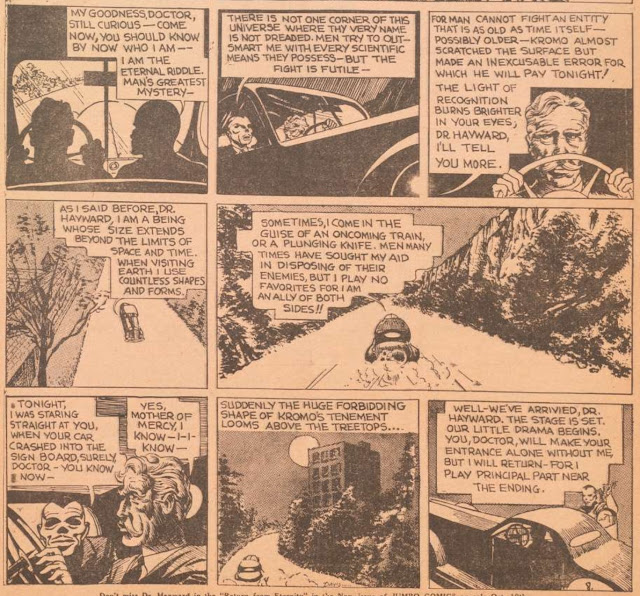
    There are a few ways that the anthropomorphic personification of death is commonly written -compassionate, dispassionate, cruel, goofy – but this particular one crops up in genre fiction a fair amount: personally offended by people attempting to extend their lifespan. This particular version of Death is both pissy about the scientist Kromo’s attempt to live forever via soul transfer and willing to take a hand in preventing him from doing so. He also seems to really enjoy freaking people out, as seen in his car ride with heroic scientist Dr Hayward. 

    God style: real, anthropomorphic personification. (Jumbo Comics 002-004, 1938) 

    Deli-Deli: 

    As is often the case I am torn between finding Malaysian idol-god Deli-Deli charmingly goofy looking and knowing that the goofiness is part of the sneering “these primitive people will worship anything at the heart of many this kind of jungle adventure.

    God-style: idol (Big Shot Comics 013, 1941) 

  • DIVINE ROUND-UP 002

    Oh so spiritual, we are.

    Koli Tow: 

    Hal Hazard and his brother Hoagy are adventuring in the South Seas when they get shipwrecked, which is not really an excuse for just wandering into a local temple to eat the food offerings but I guess when you’re hungry a little sacrilege is easy to justify. Even so, the local worshippers of Koli Tow aren’t particularly understanding about it, and given the nature of the comic there’s a human sacrifice in the offing until Hal and Hoagy escape to take their brand of cultural sensitivity to another island. 

    God Style: idol (Circus, the Comic Riot 001, 1938)

    the Canal God: 

    An adventure on Mars brings the Space Rovers to the temple of the Canal God, who basically just looks like a dude because this is a Mars populated by basic-ass humanoids. Just what persentage of Martian gods are going to turn out to be canal-related, anyway? 

    God style: idol (Exciting Comics 004, 1940)

    Death: 

    There are a few ways that the anthropomorphic personification of death is commonly written -compassionate, dispassionate, cruel, goofy – but this particular one crops up in genre fiction a fair amount: personally offended by people attempting to extend their lifespan. This particular version of Death is both pissy about the scientist Kromo’s attempt to live forever via soul transfer and willing to take a hand in preventing him from doing so. He also seems to really enjoy freaking people out, as seen in his car ride with heroic scientist Dr Hayward. 

    God style: real, anthropomorphic personification. (Jumbo Comics 002-004, 1938) 

    Deli-Deli: 

    As is often the case I am torn between finding Malaysian idol-god Deli-Deli charmingly goofy looking and knowing that the goofiness is part of the sneering “these primitive people will worship anything at the heart of many this kind of jungle adventure.

    God-style: idol (Big Shot Comics 013, 1941) 

  • DIVINE ROUND-UP 001

    As long as we’re dipping into the aliens of comics, we might as well go all the way and dig out all the various gods etc that people have made up too. Comic book divinities fall into a few broad styles:

    -real objects or creatures worshipped animistically but which do not display any real divine power

    -idols, verbal invocations or other trappings of religious worship without any indication that the being being represented is really real

    -actual supernatural beings, including:

    –versions of actual deities

    –new additions to real-world pantheons 

    –gods made up out of whole cloth

    Obviously there is some overlap between these categories. The idol that bestows curses or good luck, the invocation that does the same. Is a sacred tree an idol or animism or both? What if it delivers blessings on the faithful? 

    The other thing to mention about comic book representations or religion is that huge swathes of them are being presented through the triple lenses of Smug 40s Rationalism, Default Christianity and White Supremacy in a real racist trifecta. Barring the odd exception we’re going to see a lot of It’s Silly to Believe in a Non-Christian God and All Non-Christian Religions are Actually Long Cons by Priestly Classes along with some If There is a Real Entity Behind This Then They are Actually a Horrible Evil. Plus a lot of elder god-monsters and culturally safe classical deities and so forth.

    So: on we go! 

    the Guardian of the Grotto of Jewels: 

    Though the Red Mask is the leader of some or all of the peoples of the island of Kakura, he doesn’t seem to have much regard for their culture (as befits a proper 1940s rationalist hero, I suppose), as in quick succession he a) brings a girl to the sacred Grotto of Jewels, b) gives her some of the eponymous jewels and c) kills the grotto’s guardian god-monster with a boat. 

    God-style: animistic worship of a real beast (Best Comics 001, 1939)

    Akrifa: 

    Akrifa here is the god worshipped by the evil King Tongo. He’s some sort of fire god who Tongo does human sacrifice to, but before he really gets a chance after building Akrifa a shiny new temple, Kaänga ends up smashing the idol to flinders and Tongo is killed by an elephant. 

    God-style: idol only (Jungle Comics 009, 1940)

    Ailus the Flamingo God: 

    He may just be another idol that a hapless white lady almost gets sacrificed to to you, but Ailus the Flamingo God has a certain whimsy that is lacking in most of his ilk. 

    God-style: idol (Jungle Comics 011, 1940)

    Baako: 

    There’s not a lot of detail given here but who cares. Baako is a Martian god, and you know I’m going to be into something like that. And just in case you need a bit more sauce to get excited about a Martian deity, this one was created by Jack Kirby!

    God-style: invoked (Crash Comics Adventures 003, 1940)

  • MINOR SUPER-VILLAIN 665: THE WIND GOD

    (Jungle Comics 007, 1940)

    Not quite a normal super-hero/ super-villain interaction, this. Tabu, Wizard of the Jungle intervenes to stop the wind elemental Sirocco from wreaking havoc and in so doing incurs the wrath of the unspecified but very Norse-looking Wind God. At this point we have a simple misunderstanding over a poorly-trained pet.

    Everyone involved now escalates things simultaneously. The Wind God unleashes lightning, storms and tornadoes on the valley and Tabu counters using both his own power and that of Sirocco, who he has… tamed? Brainwashed? The fact that it has a baby’s face really obfuscates just how intelligent it is.

    Eventually, Tabu has the common decency to recognize that even though he has the magical might to have a long-form duel with a deity, that doesn’t mean that he should do so, especially in a populated area. As such, he is forced to be the bigger man being and return Sirocco to the loving arms of his… owner? father? coworker? and hopefully learns a valuable lesson about wizard/god relations in the process.

  • MINOR SUPER-VILLAIN 665: THE WIND GOD

    (Jungle Comics 007, 1940)

    Not quite a normal super-hero/ super-villain interaction, this. Tabu, Wizard of the Jungle intervenes to stop the wind elemental Sirocco from wreaking havoc and in so doing incurs the wrath of the unspecified but very Norse-looking Wind God. At this point we have a simple misunderstanding over a poorly-trained pet.

    Everyone involved now escalates things simultaneously. The Wind God unleashes lightning, storms and tornadoes on the valley and Tabu counters using both his own power and that of Sirocco, who he has… tamed? Brainwashed? The fact that it has a baby’s face really obfuscates just how intelligent it is.

    Eventually, Tabu has the common decency to recognize that even though he has the magical might to have a long-form duel with a deity, that doesn’t mean that he should do so, especially in a populated area. As such, he is forced to be the bigger man being and return Sirocco to the loving arms of his… owner? father? coworker? and hopefully learns a valuable lesson about wizard/god relations in the process.