The Curse of Skeleton Munroe

Category: anthropomorphic personification

  • MINOR SUPER-VILLAIN 677: MARS

    (National Comics 001, 1940) 

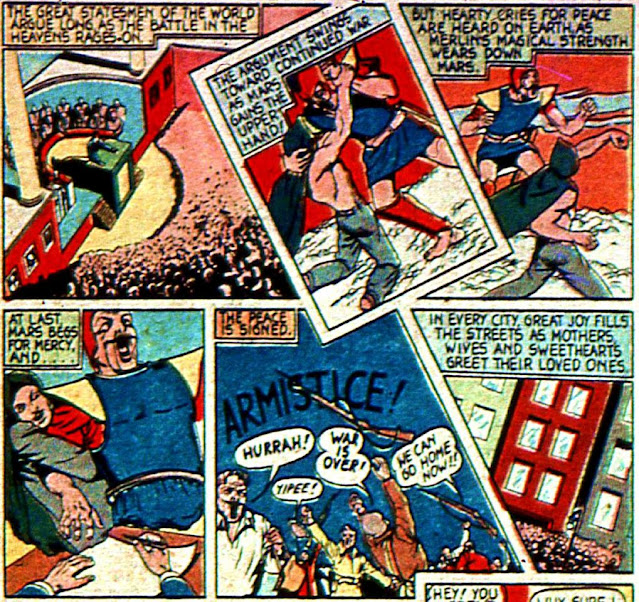
    Once Jock Kellog decides to turn his back on his playboy ways and put his inherited magic cloak to use as Merlin the Magician, he really goes for it. He hits the battlefields of WWII to aid the beleaguered soldiers of the front and ultimately rises into the realm of the gods to confront Mars, God of War and Destruction himself. 

    Mars turns out to be a huge jerk bully who is inciting nations to fight for his own amusement – a bit more Ares than Mars to be honest but I’ll let it go.

    Eventually, Merlin and Mars engage in Thrilling Hand to Hand Combat with the continuation of the war as the stakes, and after some back and forth that is cleverly mirrored in the progress of some armistice talks, Merlin wins! World War Two is over! As usual, this kind of “war can and will be avoided” story is very depressing in hindsight.

    But wait, there’s more! As in any story involving gods, demons and so forth, there is a high chance of some of my favourites the anthropomorphic personifications showing up, and show up they do! First off, Merlin encounters the embodiment of Peace chained to a bunch of weaponry like something out of a political cartoon and pledges to free her.

    Merlin also has to battle Mars’ henchmen Hunger and Poverty before he can get to the main event, and while there is a certain logic to the two of them making a person more susceptible to being either the perpetrator or victim of war I am sad that they don’t have a bit more allegorical oomph. Why couldn’t Hunger use those big fangs of his to sap Merlin’s life force or something? Still, even a bargain basement anthropomorphic personification is an anthropomorphic personification and I love me some anthropomorphic personifications. Hunger and Poverty can stay. The guys, not the things that they stand for. Those suck.

  • MINOR SUPER-HERO ROUND-UP 031

    MINOR SUPER-HERO ROUND-UP 031

    Great guns! More of them?

    the Masked Angel:

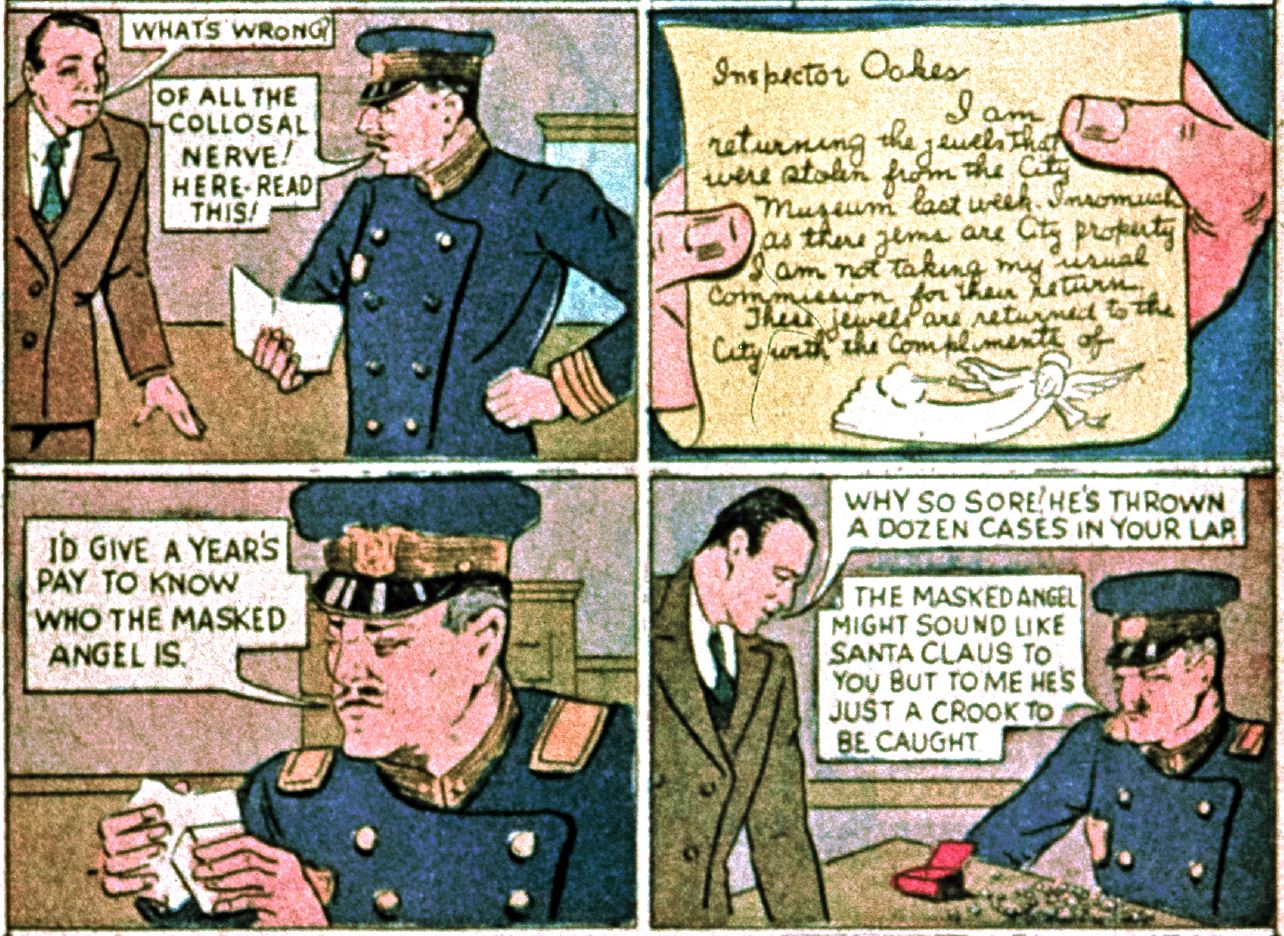
    Steve Oakes, wealthy playboy just so happens to also be the Masked Angel, vigilante feared by the underworld and wanted by the police.

    Steve’s father Detective Inspector John Oakes was murdered by crooks, so the Masked Angel act is his way of getting back at the criminal fraternity. It also seems to be a way to troll his brother, Detective Inspector John Oakes II, who is an asshole and who hates the Masked Angel in your classic way that a police officer does when they’re part of a vigilante’s supporting cast. Also please note the fun “angel shooting a gun” signature on the Masked Angel’s taunting note. (Miracle Comics 001 1940)

    Uncle Sam:

    We’re skirting the edge of what might be considered “minor” here, at least to DC Comics fans, but I have no Median Super-Hero category and however you slice it your parents almost certainly have not heard of him so here goes:

    Uncle Sam is the physical embodiment of the patriotic ideal of the United States: good, kind, powerful and just. He emerges to lend a physical hand in times of turmoil by inhabiting of reshaping the body of a recently slain patriot.

    This time around, Uncle Sam is (implicitly, all of this isn’t really spelled out until later) reborn from the death of Ezra Smith, who stands up to fascist agitators the Purple Shirts and gets a bullet in the back for his trouble. He sticks around to beat Axis ass for the duration of the war and then is not seen again until DC integrates the Quality characters into Earth-2 continuity in the 1970s. (National Comics 001, 1940)

    National Comics 005 expands the Uncle Sam lore slightly, firstly by making it a bit more explicit that he incorporates the spirits of dying patriots into himself with what is perhaps the initial time he did so, when a man named Sam sacrifices his own life to advance the cause during the American Revolution.

    Secondly, Sam is seen merging with a living patriot named Samuel in order to help drive the fascist Black Legion out of Glen Valley. Is this a common event? Does Uncle Sam roam the land absorbing patriots? Who can say, but it certainly would put a new spin on the character.

    Buddy Smith:

    When Ezra Smith is murdered by the Purple Shirts, his grandson Buddy is left alone, presumably some sort of double-orphan. He is almost immediately found, shamed for crying, and adopted by Uncle Sam (and hopefully the near immediate recovery Buddy has from the grief of seeing his grandfather gunned down in front of his eyes is a function of Uncle Sam being partially Ezra Smith and not some sort of deep traumatic repression left to fester in his soul).

    Buddy fills a pretty standard kid sidekick role: getting into trouble, getting Uncle Sam out of trouble, inventing things, befriending people, spotting clues, etc. He is unusual in that he is one of the few kid sidekicks who is a proper kid as opposed to being a young teenager (I know the common wisdom is that Dick Grayson was eight when he became Robin but that’s mostly because Golden Age artists – and particularly Bob Kane – were mostly very bad at drawing kids. Robin was absolutely supposed to be somewhere in the 12-15 range when he debuted). He’s also notable for – as far as I know – never ever showing up again post-Quality, not even in that event earlier this year that was specifically focused on bringing back all the old (and new) Golden Age kid sidekicks. Maybe Uncle Sam ate absorbed him once he got old/patriotic enough. (National Comics 001, 1940)

    Merlin the Magician:

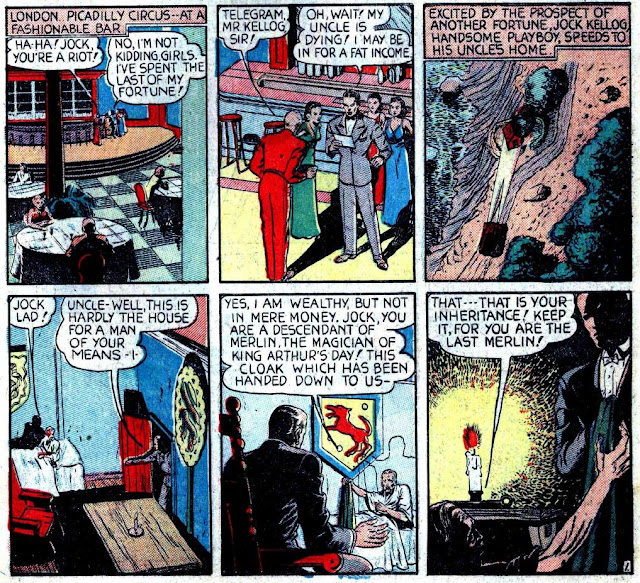
    Jock Kellog, a wealthy playboy in the classic mold, spends the last of his family fortune on the same day he is summoned to the bedside of his sole relative, an unnamed uncle. Instead of the fat stacks of cash that he is hoping for, Kellog comes away with a cloak and the knowledge that he is supposedly the last descendant of Merlin of Arthuriana fame.

    It turns out that he is in fact the last descendant of Merlin, of course, and that the cloak is a source of unlimited magical power in the grand tradition of mystic super-heroes like Zatara. Lucky for the world at large, the application of vast power has the opposite of its usual effect on the young wastrel and Jock devotes his newfound power to the defense and betterment of humanity. (National Comics 001, 1940)

  • MINOR SUPER-VILLAIN 664: THE DEVIL

    (Jungle Comics 007, 1940)

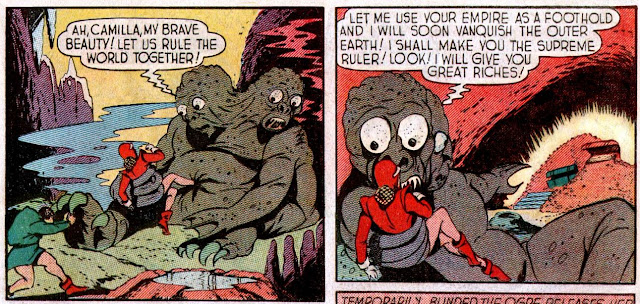
    Camilla, Queen of the Lost Empire, having made the transition from capricious villain to noble hero and staved off a couple of attempts on her throne and her life, is getting ambitious. She is determined to descend into the Cave of Sighs, a local portal to Hell, and banish the Devil from her lands.

    Together with the reformed assassin Caredodo, Camilla passes the Copper Gates of Hell after a brief encounter with one of my favourite things: an anthropomorphic personification! Specifically, they encounter Temptation, who almost ensnares poor Caredodo with her wiles and mug of delicious-looking potion before Camilla sends her packing.

    Also there to greet them is Mephistopheles of Faust fame in a much more charming turn than comic book demons usually get to be, probably as a deliberate contrast to the main attraction, the Devil himself, in a wildly more grotesque form than one usually sees in comics before the late Sixties. Ordinarily, your Devils and Satans are a lot closer to Mephistopheles there than this soggy lump of flesh and even the more monstrous of the bunch are still red humanoids along the lines of MLJ’s Devil.

    The Devil wants Camilla’s help to escape into the world of man and take over the place. Ambitious, sure, but a bit pedestrian for Satan himself. What use is temporal power to the Lord of Hell?

    In a slightly odd turn of events, Camilla defeats the Devil by hewing a cross out of stone and holding him at bay with it. Since Camilla originally worshipped Thor and the other Norse gods and later restored her empire with the aid of the pantheon-unspecified god Bal, I had assumed that the Lost Empire was established some time before the conversion of the Norse to Christianity. I’d be tempted to blame that pill Jon Dale for converting her but she has engaged in some paganism since his departure from the strip, so I am forced to conclude that Camila subscribes to some sort of syncretic faith that incorporates elements of many religions. Fun!

    (This is also the mission that ends with the Angel of Faith rewarding Camilla by transforming Caredodo from a Nottie to the Hottie Sir Champion, in case you were curious about when that happened)

  • MINOR SUPER-VILLAIN 562: THE HARBINGERS OF DEATH

    (Wonderworld Comics 008, 1939)

    As part of Yarko the Great’s second encounter with Death, he and the hapless Madame Punai journeyed to a sort of pastiche underworld (e.g., their journey took them through the Biblical Valley of Death but also involved this unnamed boatman ferrying them across the River Styx). And as with any good underworld pastiche there are some allegorical foes to get past before their goal is reached – the Harbingers of Death!

    Like I said, these guys are allegorical demon guardians, so there isn’t much more to them than the expression of their allegory. First Pain, aka Burning Pain, appears to crush Yarko to his burning body. Good allegory! Pain can overwhelm you – though in a more in-depth work perhaps Yarko would be left with a burn or other lingering reminder of this battle rather than walking away unscathed after hurling pain into the abyss.

    Fear appears next, and I really appreciate that he himself is a fearful creature rather than the more common monstrous fear-beasts that inflict fear by being big and spiky. Like Pain, Fear cannot stand up to Yarko’s overwhelming machismo and slinks back into the shadows from whence it came.

    Finally, Horror is a master of the jump scare and as someone who is particularly vulnerable to that tool of the filmmaker’s art I really appreciate seeing him (them?) be flung off a cliff, probably not to their doom due to being a demon but at the very least to their major inconvenience.

    And there you have it: three lil’ henchmen, three anthropomorphic personifications, three notches in Yarko the Great’s belt.

  • MINOR SUPER-VILLAIN 557: DEATH

    (Wonderworld Comics 003, 1939)

    Like I said in the Devil’s entry yesterday: Death and the Devil have teamed up as a sort of Yarko the Great Revenge Squad because Yarko saves so many live and souls, respectively. I also mentioned that Death did all of the legwork toward getting Yarko just where they wanted him, and here that is: Death kills a seemingly random London man then delivers him to the police, leaving only a calling card behind.

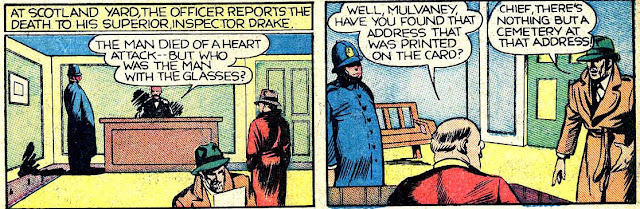
    The discovery that the calling card’s address was that of a cemetery is enough to convince Inspector Drake of Scotland Yard that this is a case for Yarko the Great, and… obviously Drake is right because even the most well-trained officer is going to have a hard time dealing with Death himself, but have some gumption, man. Try to track down where the card was printed or something before abdicating all responsibility.

    Yarko makes his way to Death and the Devil’s Limehouse lair, where he is promptly captured, put in a deathtrap, escapes and banishes the Devil back to the netherworld. Death takes more of a background role in this latter part of the adventure, but that’s okay because he looks great – mostly quite cool but a bit sleazy too, because this ain’t your regular Death, this is Bad Boy Death.

    In the end, the Devil having been vanquished, Death just leaves. Yarko can’t actually affect him, and there’s even some hinting that the man in the car was not killed so much as dies naturally and was just used as bait, which implies that Death has no way of affecting someone who isn’t about to die anyway. He does kill a reluctant henchman who refuses to go up against Yarko, but maybe he was about to die too – working for the Devil has to be a dangerous profession, right?

    Death returns in Wonderworld Comics 008 after a Madame Punjai finds the creatively-named Golden Amulet, which compels his service. Punjai is obsessed with her lost youth and beauty and because of this commands Death to kill the young and beautiful Carla Dennis, a former passing acquaintance. This is done seemingly on a whim? There’s no real exploration of Madame Punjai’s plans, whether toward regaining her lost youth or revenging herself on the beautiful women of the world.

    Yarko the Great of course becomes involved in these shenanigans and the more-hapless-than-evil Madame Punjai is tricked into trading her life for that of Carla’s. Death is again cheesed off about this. BUT WHY IS HE? He’s going to get basically everyone eventually, even in a comic book world with immortals and so forth. Why care? Is this a Discworld style Death who gets into human roles like hobbies? Maybe.

  • MINOR SUPER-VILLAIN 557: DEATH

    (Wonderworld Comics 003, 1939)

    Like I said in the Devil’s entry yesterday: Death and the Devil have teamed up as a sort of Yarko the Great Revenge Squad because Yarko saves so many live and souls, respectively. I also mentioned that Death did all of the legwork toward getting Yarko just where they wanted him, and here that is: Death kills a seemingly random London man then delivers him to the police, leaving only a calling card behind.

    The discovery that the calling card’s address was that of a cemetery is enough to convince Inspector Drake of Scotland Yard that this is a case for Yarko the Great, and… obviously Drake is right because even the most well-trained officer is going to have a hard time dealing with Death himself, but have some gumption, man. Try to track down where the card was printed or something before abdicating all responsibility.

    Yarko makes his way to Death and the Devil’s Limehouse lair, where he is promptly captured, put in a deathtrap, escapes and banishes the Devil back to the netherworld. Death takes more of a background role in this latter part of the adventure, but that’s okay because he looks great – mostly quite cool but a bit sleazy too, because this ain’t your regular Death, this is Bad Boy Death.

    In the end, the Devil having been vanquished, Death just leaves. Yarko can’t actually affect him, and there’s even some hinting that the man in the car was not killed so much as dies naturally and was just used as bait, which implies that Death has no way of affecting someone who isn’t about to die anyway. He does kill a reluctant henchman who refuses to go up against Yarko, but maybe he was about to die too – working for the Devil has to be a dangerous profession, right?

    Death returns in Wonderworld Comics 008 after a Madame Punjai finds the creatively-named Golden Amulet, which compels his service. Punjai is obsessed with her lost youth and beauty and because of this commands Death to kill the young and beautiful Carla Dennis, a former passing acquaintance. This is done seemingly on a whim? There’s no real exploration of Madame Punjai’s plans, whether toward regaining her lost youth or revenging herself on the beautiful women of the world.

    Yarko the Great of course becomes involved in these shenanigans and the more-hapless-than-evil Madame Punjai is tricked into trading her life for that of Carla’s. Death is again cheesed off about this. BUT WHY IS HE? He’s going to get basically everyone eventually, even in a comic book world with immortals and so forth. Why care? Is this a Discworld style Death who gets into human roles like hobbies? Maybe.