The Curse of Skeleton Munroe

Category: sidekick

  • MINOR SUPER-HERO ROUND-UP 074

    Some more of those “minor super-heroes” you like so much. 

    the Cat-Man **Update**:

    Hey, it’s the Cat-Man! As you may or may not recall, the Cat Man (sans hyphen) debuted in Crash Comics Adventures in 1940 and was the only survivor of that comics short run. The most obvious change to his character is his costume, which goes from its former jungle chic look through a blue-and-orange phase  before settling on the orange-and-darker orange look that he will stick with for the rest of his career.

    In addition to the costumes and the hyphen, Cat-Man got a slight tweak to his origin: rather than being orphaned by a hostile tribe in India, David Merrywether’s parents are now said to have been killed by bandits in Burma. David also has a job now: he’s a private detective for the first four issues of Cat-Man Comics, after which he enlists and becomes a lieutenant in the US Army.

    The Cat-Man also gets a couple of new powers in 1941: he is able to see otherwise-invisible radiation and displays some degree of super strength.

    Finally: his nine lives. Though he still has this power, David manages to only die once during the whole of 1941, bringing his total remaining lives down to six.

    the Kitten: 

    Actually, not quite finally, as this is also the year that the Cat-Man gets a sidekick. While en route to investigate a series of train explosions, Lt David “the Cat-Man” Merrywether picks up a hitchhiking man and his niece. The man turns out to be a real scumbag, but the girl, named Katie Conn, turns on her uncle rather than see him rob and possibly murder Merrywether. Once the uncle is tossed in the hoosegow it’s a classic case of a child just entering a super-hero’s orbit and getting auto-adopted.

    Katie turns out to be the orphaned child of a pair of circus acrobats, which as we know is a perfect background for a potential super-hero’s sidekick to have. She also appears to be a few years younger than your typical kid sidekick – if they average in at about 13-15 I’d call her 11 or 12, though as usual the limitations of Golden Age art make estimating the age of kids difficult at best.

    Merrywether does his best to conceal his dual identity from his new ward but doesn’t quite manage it, and her self-assigned new role as the Cat-Man’s sidekick is announced in the final panel of the last Cat-Man story of 1941. More specifics on her in action as a sidekick in 1942. I will say that it’s nice to see a kid sidekick with both a costume and a code name. (Cat-Man Comics 005, 1941)

    Blaze Baylor: 

    Blaze Baylor is the son of the famous fire chief Smoky Baylor, who was killed by arsonists, and who is now a very specific anti-arson crimefighter. Though the name of the strip is “‘Blaze’ Baylor and the Arson Ring,” there is no indication in any of his adventures that the arsonists he battles are connected to one another in any way. (Cat-Man Comics 001 1941)

    Dr Diamond: 

    Dr Drake Gorden is bound for the South Seas when the freighter he is travelling on is sunk by a waterspout. He passes out after washing up on a beach at the base of an unscaleable cliff and is carried off by an eagle that takes him to the home of a frankly weird guy who has dressed him in a generic super-hero costume.

    This never-named man explains that thirty years prior he had come into possession of a legendary black diamond that conferred great physical power to its wielder, and that he had retired to the island to await the arrival of someone worthy enough to receive it. Dr Gorden, a man who he just met and who has spoken all of thirty-three words to him, several of which were to refer to a pair of brown pants as his “American clothes,” is his pick.

    Whatever the opposite of the Refusal of the Call part of the Hero’s Journey is, that’s what Dr Gorden has. He immediately renames himself Dr Diamond and launches into a monologue about just how hard he’s going to bust up crime that is so over the top that it would make me personally reconsider giving him any sort of power whatsoever. Despite my misgivings, Dr Diamond does an adequate job of using the powers conferred by the gem (super strength, enhanced speed, some degree of invincibility) to battle crime for four issues before fading into the mists of obscurity. (Cat-Man Comics 001, 1941) 

  • MINOR SUPER-HERO ROUND-UP 067

    Something for everyone* in this one.

    *not really. 

    Zambini the Miracle Man: 

    Zambini the Miracle Man, aka Zambini the Great, is your fairly typical comic book magic man, albeit a bit more flamboyantly dressed than even that crowd normally are.

    Though Zambini has a lot of the regular magic abilities of his peer group his signature trick involves his magical Boomerang Amulet, which causes evil to rebound on its sender. This takes forms as diverse as a cobra returning to the one who released it to bombs flying back up to the plane that dropped them to magic spells rebounding on their casters. 

    (please also note the final panel above, in which Zambini is being made a Knight of Ritania, which I here recognize as an honour)

    Finally, while I generally do enjoy when a magic user has a weakness to counter their nigh-omnipotence, Zambini might just have the worst one in comics: the touch of a human hand renders him completely powerless and unable to resist, to the point that this Hundanian spy is able to gently lead him to their headquarters and he is only saved when her boss gets jealous – thank heavens that Hundania doesn’t have a robust anti-workplace romance policy. This weakness kind of falls by the roadside as time goes on but does occasionally crop up now and then in horrible ways. (Zip Comics 001, 1940)

    Perhaps the most interesting thing about Zambini is his magical system: for his first two appearances he casts spells by spouting nonsense words (as far as I can tell), but from Zip Comics 003 onward, he uses a version of Ubbi Dubbi that involves inserting the syllable “ab” instead of “ub”. I don’t know if it’s strictly better than speaking backward, Zatara style, but it certainly is unique.

    Atom Blake, Boy Wizard **UPDATE**:

    I had read the 1940-1941 issues of Wow Comics before embarking on my great comics-reading project, so I already knew going in that Atom Blake would essentially speed-run the process of getting tired of living among mere mortals and heading off into space, Dr Manhattan style, but I had forgotten that he is doing so in order to look for his long-lost father. Also, while I did remember that Blake duplicated himself before setting out I had misremembered it as him leaving behind a non-super version of himself on Earth while the superhuman part set off for adventure. What I’m saying here is that the version of Atom Blake that I had remembered is way more interesting than the actual character. (Wow Comics 002, 1941) 

    the Hunchback: 

    The Hunchback is in actuality wealthy playboy Allan Lanier, who became obsessed with the figure of Quasimodo after seeing the 1939 film version of the Hunchback of Notre Dame (or possibly a literal picture of the character – the text box isn’t 100% clear) and combined that with his interest in wiping out crime to become a weird spectre of the night, Batman-style.

    Lanier is refreshingly up-front about his interest in criminology, to the extent that he is seen droning on and on about it before a date with his fiance Betty Brenton. I don’t know if I’d like every fellow with a secret identity to abandon the “disaffected socialite” act, but it is nice to see the odd one do without it and just be a weird eccentric.

    The Hunchback really leans into two specific aspects of his inspiration: he is absurdly acrobatic, and he metes out insane and terrifying violence to his foes. The latter has git to be one of the better justifications for the dread a masked figure of the night inspires among the criminal fraternity.

    We’re on a bit of a run of characters who share their secret identity with their love interest and Alan Lanier is one of them: his fiance Betty has to be told before she will let the Hunchback help her (this might be the downside of the whole “reputation for insane violence” thing). (Wow Comics 002, 1941)

    In the Hunchback’s second adventure, in Wow Comics 003, Lanier switches to a slightly more conventional super-hero outfit. It’s a generic but not terrible design, and I always appreciate a character making a bold hat choice, but I think that it is perhaps a bit too twee for a character who is supposed to be some sort of rampaging engine of madness and destruction. The old uniform came back out of the closet for the Hunchback’s remaining appearances.

    Pinky the Whiz Kid: 

    Pinky the future Whiz Kid (not technically called that until 1942, but whatever, we’re loose and goosey around here) is already a fan of Mr Scarlet before he is rendered a crime orphan by the villainous Mr Hyde (upcoming), who seemingly randomly murders his mother.

    Pinky ends up at Oaklawn Orphanage, which just so happens to be run by Mr Hyde’s alter ego, Dr Jelke. When Hyde/Jelke and Mr Scarlet inevitably clash, Pinky is right there in his homemade sidekick costume to help out.

    Pinky is adopted by District Attorney Brian Butler, ostensibly to keep him out of trouble, but since Pinky has worked out that Brian is secretly Mr Scarlet he is able to blackmail him into becoming his sidekick. It sounds more sinister than it reads, honestly.

    The real downside to Mr Scarlet getting a sidekick is that Miss Wade, formerly a romantic sparring partner for Brian and occasional daring assistant in her own right, is relegated to the role of scolding caretaker as she sensibly attempts to prevent a teenager from flinging himself into danger. It’s a real loss to the comic.(Wow Comics 004, 1941)

  • MINOR SUPER-HERO ROUND-UP 056

    Some hot Archie/MLJ super-hero action. 

    **Hero Update** Bob Phantom:

    Perhaps in honour of his making the jump from Blue Ribbon Comics to Top-Notch Comics, Bob Phantom gets two hitherto-unseen powers: super-breath powerful enough to turn aside oncoming bullets and the ability to summon cyclones by flapping his cape. (Top-Notch Comics 003, 1940) 

    Bob Phantom also demonstrates super strength sufficient to tear an airplane to pieces in mid air. (Top-Notch Comics 004, 1940)

    And not content with three new super powers, in Top-Notch 010, Bob is shown to be completely bulletproof.

    Bob Phantom’s modus operandi, to reveal crimes and taunt both police and criminals in his gossip column as Walt Whitman and then bust things up as Bob Phantom, has never been particularly kind to the police of his corner of MLJ New York, and at this point they openly hate him in both of his identities. (Top-Notch Comics 009, 1940) 

    **Hero Update** the Wizard: 

    The Wizard’s powers also get expanded once 1940 rolls around: not only can he now hypnotically mind control people with a mere glance but he can mentally contact his thralls across distances of at least 500 miles (the above message was broadcast from somewhere in the vicinity of Dallas to somewhere in Mexico). 

    1940 is also the year that the Wizard’s already-formidible strength was rounded up to full-on super, seen here as he is bodily heaving an entire u-boat Bundonian submarine out of the water with only the power of his little kicking feet to hold him up.

    The Wizard’s arsenal of weapons and gadgets also gets a fair few additions this year, including:

    – more rays guns than one would assume could fit in a suit with such clean lines: death rays, two different engine-killing rays (the vibra-ray gun and the neutronic ray gun), an explosive ray (the destructo-ray), a metal-melting ray (the VB-ray gun), a paralysis ray (the electrolysis ray), a rainmaking ray (the H2-VX-0 ray), fire-extinguishing ray (the Hydra Gun), and the dynamagno saw ray projector, a cutting ray which can be tuned to selectively destroy mechanical parts such as the wires that hold a plane together.

    – secret chemicals including: Secret Chemical L-77 (solidifies liquids), Ethyl Formula 2X-Y-BZ (superfuel additive) and Super-Caloric Capsules and Secret Formula Ho Mg 4, which put pep back in a weary Wizard’s step.

    – special vehicles, the greatest of which is the Contra-Gravity Flask, pictured above, which allows the Wizard to float harmlessly to the ground from a height or run through the air, merely by virtue of being in his pocket.

    (Top-Notch Comics 002, 1940) 

    I somehow also failed to note in the original Wizard entry that he is not only a calling card guy but an obnoxiously patriotic one. (Top-Notch Comics 001, 1939) 

    After being blinded by his enemies the Mosconians, the Wizard changes out his tuxedo costume for a more super-heroic one with even less room for ray guns. This is supposedly to protect him from getting acid splashed in his eyes again, but since the Mosconians don’t actually get a chance for a second try the actual mechanism by which the same mask but a different shirt might help in that situation is not explored. (Top-Notch Comics 007, 1940)

    Finally, Blane Whitney abandons the life of the wealthy playboy to become a crusading newspaper publisher with ex-fiance Jane Barlowe as his star reporter, though he of course does not get a break for this. (Top-Notch Comics 008, 1940)

    Roy the Super-Boy: 

    He’s not quite the Sensational Character Find of 1940, but Roy the Super-Boy is the Marvel of 1940 and that has to count for something. He’s also our first Archie/MLJ sidekick (yes, yes, Tommy the Super-Boy, but he was a reference to Roy and we only covered him first because of the alphabet and its tricks). Does he suffer the “just running around without a mask calling yourself by your own name” problem common to a lot of Golden Age sidekicks? Sure he does, but at least he has a partial code name. And I was wrong: he totally wears a mask most of the time! 

    As is often the case, Roy is just a scrappy young orphan making his way in the world as a bootblack, when he ends up in a fight with some grown-ass men and impresses the Wizard with his sweet moves and devotion to justice. He soon finds himself with an invite to a rich man’s private gymnasium!

    Thanks to an intensive training regimen, Roy is quickly developed into an impressive physical specimen. The Wizard claims that they are equivalent barring the Wizard’s mind-powers, but I haven’t seen Roy bench-press a submarine yet. (Top-Notch Comics 008, 1940) 

    Kardak the Mystic: 

    There is a general consensus online that Kardak the Mystic is the same character as the Mystic, who appeared in Top-Notch Comics 001 and 002, but I ain’t buying it. For one, where the Mystic was an ordinary stage magician who used his skills at slight-of-hand to battle crime, Kardak has actual magical power. For another, where the Mystic was already engaged to an unnamed woman in his first adventure, Kardak’s adventures are all set in motion when a girl he just met on a cruise to India is kidnapped by undersea creatures. Certainly, relationships break up all the time, but not the Mystic and Unnamed Woman! Their love is forever!

    Kardak’s adventures take him and his gal-pal Lorna from the bottom of the Indian Ocean to Louisiana, where they enter a series of extra-dimensional lands populated by hostile weirdos. It’s a pretty good setup to showcase the power of a magical hero without having story after story of him just destroying regular gangsters.

    Kardak also acquires the services of Balthar, a huge dude with a magic turban, and he’s just as annoying as Tong and the other members of the Shirtless Broken English Magicians’ Assistants Collective. (Top-Notch Comics 004, 1940) 

  • MINOR SUPER-HERO ROUND-UP 050

    Novelty Press character round-up, more like.

    the Chameleon:

    An unnamed master of disguise (throughout his 1940 appearances, at least) who dispenses vigilante justice on an ad hoc basis, the Chameleon’s major distinction is that his name is always written in cursive. Other than that: he’s got a chauffeur/sidekick (Slim) and a bumbling police nemesis (Inspector Parks) and somehow manages to simultaneously be one of those heroes who is wanted by the law and whose identity and address are just kind of common knowledge. (Target Comics v1 006, 1940)

    the Blue Zombie:

    “Fantastic Feature Films” was a strip that ran in the first couple of years of Target Comics, with the same conceit as Ed Wheelan’s Minute Movies: that the stories being presented were films in which the were being portrayed by a pool of fictional actors – the titular Blue Zombie of this feature, for instance, was played by Orson Black, a Boris Karloff-style Man of a Thousand Faces. This is a fantastic fictional conceit and I am surprised that it hasn’t cropped up more over the years.

    In the fictional movie The Blue Zombie, Bolshemanian scientist Igor Zamoisky rebels against his country’s warmongering dictator and heads to the neighbouring country of Coreland in order to put his scientific discoveries to use in thwarting a Bolshemanian invasion. Discovering a lost Bolshemanian battalion that succumbed to the harsh Corelian winter, he attempts to restore one of them, his old friend Nicholas Samousk, to life. Instead of a restored Samousk, his experiment produces a bright blue zombie version of his friend who responds to his mental commands but cannot think for itself. Zamoisky restores the rest of the battalion in a similar fashion and uses them to crush the Bolshemanian invasion of Coreland, then sets off with his zombie army to free his homeland. 

    Obviously describing a one-off like the Blue Zombie as a super-hero is a bit of a stretch, but a) he’s not that far off of the Purple Zombie in his origin and general deal, b) I wanted an excuse to talk about the fictional-actors-in-fictional-film conceit and c) the Blue Zombie is a really good name. (Target Comics v1 006, 1940)

    the Target: 

    It’s always fun when an old-school anthology comic book gets a character to match its name fairly late in the game and to prove my point here’s the Target, showing up in the tenth issue of Target Comics.

    The Target makes his debut with a big advertising push to really get the word out that he is out to crush crime in his version of NYC: full page newspaper ads, messages on the radio, threatening telegrams sent directly to crooks… at one point a lady calls that number that used to tell you the correct time and a recording of the Target tells her to keep her nose clean. It’s really the opposite of the modern Batman as Urban Legend school of superhero mystique.

    The Target’s gimmick is also Batman adjacent: like 50s 60s 70s whichever era’s Batman first justified the yellow circle on his chest as a bulletproof target for crooks to aim at, the Target is running around with a literal target painted on his chest (and back) because he has a bulletproof leotard on underneath. Just why the fact that his legs are unprotected is a) necessary and b) emphasized is never really addressed.

    Finally, the Target has a thematically appropriate calling card, a dart. We’ll see how long he keeps using it for. (Target Comics v1 010, 1940)

    the Targeteers:

    The more astute readers among you might have noticed that I didn’t really go into the actual origin of the Target in his own entry, and that’s because it’s tied in with that of his sidekicks the Targeteers and so we’re covering them all at once.

    So: Niles Reed is a brilliant but aimless metallurgist whose only relative, brother and New York City District Attorney Bill Reed, is framed for murder and scheduled to be executed at Sing Sing.

    Niles dons a domino mask and attempts to bust Bill out during his final prison transfer but the guards manage to hit Bill during their escape. After a heartfelt “why me?” Bill dies and Niles buries him in an unmarked grave, which means that he’s still considered to be at large, an evocative detail that I had hoped would lead to something like Niles hinting that the Target is actually Bill to throw suspicion off of himself and flush out the crooks who framed him, it never really seems to come up again.

    This would ordinarily be the point in an origin story in which the costume would come into play, there’s one more step to the Target’s origin and that’s the Targeteers.

    See, Niles is wandering the streets at night, trying to figure out just what he can do in the face of an uncaring world in which innocent district attorneys are gunned down in the street for merely trying to break jail, when he runs off some thugs who are attempting to kill or at least maim two teenage boys, Dave and Tommy. It turns out that the kids are both orphans who also hate crime because the crooks had already killed their father (well, one father and one unofficial adopted father, but why get technical).

    Having two young wards who love to talk about getting real beefy and wiping out crime is the final catalyst for Niles, who remembers that he has some superscientific bulletproof material and three super-hero costumes just lying around, and since the three were playing darts when they came up with the idea the whole endeavour ends up being dart and target themed (and as this is possibly my favourite style of generic supersuit it’s nice to see three people running around in it at once).

    The two lads collectively go by the Targeteers, which is a nice change of pace from teen sidekicks who just go by their own names. Finally, according to some dialogue later in the comic the jailbreak, ad hoc funeral, befriending of the boys, making costumes and the initial Target adventure in the previous issue (including the entire publicity blitz) all take place in about a week, which is very efficient. (Target Comics v1 011, 1940)

  • MINOR SUPER-HERO ROUND-UP 046

    Enjoy these ancient delights!

    the Black Spider:

    Mild-mannered district attorney Ralph Nelson, like many comic book lawmen, sallies forth at night in order to deal with criminals that the law can’t touch. Nelson is despised by his colleague Police Inspector Stern for being too soft on crime/ dedicated to the letter of the law to allow the cops to torture confessions out of people, while the Black Spider is hated by Stern for showing up the police by being so good at torturing confessions out of people. It’s a real dichotomy!

    Nelson’s secretary Peggy Dodge has a classic “love one identity and hate the other” relationship with the Black Spider and her boss that gets resolved when she learns his secret during the first Black Spider adventure. It’s a nice change of pace from your standard Lois/Clark arrangement, plus Peggy has the distinction of being one of the few noncostumed super-heroic aides to remember to wear a mask while on crime-fighting duty! (Super-Mystery Comics 003, 1940)

    Davey: 

    One day while fighting crime, Magno rescues Carole Landis and her kid brother Davey from a bombed-out building and learns about the crime that they were investigating and also that Davey is such a big Magno fan that he has his own Magno costume and also would Magno like to see it? Magno of course gives the kid the old brush-off.

    Seeing as he first met this kid after he had tagged along with his sister on a dangerous assignment, it should not have surprised Magno to find Davey chasing him down the street in full Magno cosplay. The two get mixed up in various life-or-death situations before Magno can get rid of Davey and by the time things calm down they have formed a battle-bond or something. Magno figures out how to temporarily give Davey a portion of his powers for about an hour (the time limit gets dropped eventually, presumably because bookkeeping isn’t very fun) and becomes the latest in a long line of super-heroes to have a sidekick with no code name. (Super-Mystery Comics v1 004, 1940)

    the Sparkler: 

    Red Morgan’s father has invented an invisibility suit, but what he should have been working on was a don’t-blab-your-secrets-all-over-town suit, because the local gang boss Baldy Spade has heard that there’s some big scientific discovery in the works and has sent a guy to kill Morgan Senior and steal it. A vengeance-minded Red dons the suit and exacts justice on Baldy before going on to have a handful of adventures as the Sparkler, so named because the suit flashes and sparks as it returns to its user to visibility. (Super Spy 001, 1940)

    the Night Hawk: 

    Horse Rancher John Rogers was murdered some time ago, and his unnamed son has seemingly wandered the West ever since, doing vigilante justice while looking for murderer Baldy Crane. In his one recorded adventure he finally locates and guns him down before riding into the sunset. (Super Spy 002, 1940)

  • MINOR SUPER-HERO ROUND-UP 046

    Enjoy these ancient delights!

    the Black Spider:

    Mild-mannered district attorney Ralph Nelson, like many comic book lawmen, sallies forth at night in order to deal with criminals that the law can’t touch. Nelson is despised by his colleague Police Inspector Stern for being too soft on crime/ dedicated to the letter of the law to allow the cops to torture confessions out of people, while the Black Spider is hated by Stern for showing up the police by being so good at torturing confessions out of people. It’s a real dichotomy!

    Nelson’s secretary Peggy Dodge has a classic “love one identity and hate the other” relationship with the Black Spider and her boss that gets resolved when she learns his secret during the first Black Spider adventure. It’s a nice change of pace from your standard Lois/Clark arrangement, plus Peggy has the distinction of being one of the few noncostumed super-heroic aides to remember to wear a mask while on crime-fighting duty! (Super-Mystery Comics 003, 1940)

    Davey: 

    One day while fighting crime, Magno rescues Carole Landis and her kid brother Davey from a bombed-out building and learns about the crime that they were investigating and also that Davey is such a big Magno fan that he has his own Magno costume and also would Magno like to see it? Magno of course gives the kid the old brush-off.

    Seeing as he first met this kid after he had tagged along with his sister on a dangerous assignment, it should not have surprised Magno to find Davey chasing him down the street in full Magno cosplay. The two get mixed up in various life-or-death situations before Magno can get rid of Davey and by the time things calm down they have formed a battle-bond or something. Magno figures out how to temporarily give Davey a portion of his powers for about an hour (the time limit gets dropped eventually, presumably because bookkeeping isn’t very fun) and becomes the latest in a long line of super-heroes to have a sidekick with no code name. (Super-Mystery Comics v1 004, 1940)

    the Sparkler: 

    Red Morgan’s father has invented an invisibility suit, but what he should have been working on was a don’t-blab-your-secrets-all-over-town suit, because the local gang boss Baldy Spade has heard that there’s some big scientific discovery in the works and has sent a guy to kill Morgan Senior and steal it. A vengeance-minded Red dons the suit and exacts justice on Baldy before going on to have a handful of adventures as the Sparkler, so named because the suit flashes and sparks as it returns to its user to visibility. (Super Spy 001, 1940)

    the Night Hawk: 

    Horse Rancher John Rogers was murdered some time ago, and his unnamed son has seemingly wandered the West ever since, doing vigilante justice while looking for murderer Baldy Crane. In his one recorded adventure he finally locates and guns him down before riding into the sunset. (Super Spy 002, 1940)

  • MINOR SUPER-HERO ROUND-UP 041

    Another assortment of guys for your delectation.

    the Sky Wolf:

    Just another masked pilot in a souped-up named plane (originally the Silver Bullet, followed by the Golden Bullet), the Sky Wolf loses both his place in Silver Streak Comics and his plane’s name to fellow pilot Cloud Curtis once 1941 rolls around, and to add insult to injury, in 1942 the far more successful character of Skywolf debuts over at Hillman, ensuring that he doesn’t even have good SEO. (Silver Streak Comics 004, 1940)

    Whiz, King of Falcons:

    The Silver Streak is not immune to the sting of pride, so when aviator Sir Cedric Baldwin challenges him to a race around the world to prove who is the fastest man on Earth, he accepts, and is of course fast enough that he not only wins but is able to have a very culturally-sensitive adventure in Saudi Arabia along the way. Silver Streak is knocked out and captured at one point, and the falconry-obsessed villain takes advantage of this to inject his favourite bird with some super-fast blood. 

    Astonishingly, this works, despite our only account of the Silver Streak’s origin being as a result of hypnotic conditioning coupled with a near-death experience – perhaps the hypnosis was so deep that it mesmerized his very blood? That would explain the falcon’s immediate shift in loyalty from its owner to its super-heroic blood doner, at least.

    “Whiz, King of Falcons” is technically not this guy’s name until Silver Streak Comics 007, which was published in 1941, but I reckon that calling him “Unnamed Falcon Companion” here and then correcting it in six months’ time would be extremely wilfully obtuse of me. (Silver Streak Comics 006, 1940)

    UPDATE 1941 

    the Daredevil:

    The Daredevil is Bart Hill, a vigilante in the Batman mould, having lost his parents to a gang of crooks and subsequently vowed to revenge himself on crime. Further, those same crooks tortured Bart himself, rendering him mute in the process, and due to a boomerang-shaped brand they left on his chest he devoted himself to the study of the weapon, adopting it as one of his heroic signatures. The Daredevil is one of the longer-running non-Marvel or DC/Fawcett/Quality characters of the Golden Age so he will be making a few appearances here going forward, but there are a few notable things about him:

    – his origin will undergo some revision between his first and second appearances, most notably the fact that his muteness is discarded – presumably to enable for easier storytelling

    – his costume is also somewhat revised, which is fun particularly because, like his Silver Age namesake, he switches from a yellow to a red colour scheme

    – this Daredevil’s Golden Age popularity, combined with his public domain status, means that he’s a popular choice for modern revivals, but the fact that there is a currently-published character with the same name (and owned by Disney, to boot) means that nobody dares to actually call him Daredevil in their stories and so the more recent versions of him have a wide range of variably terrible alternate names including the Death Defying ‘Devil, the Daring Devil and Doubledare. (Silver Streak Comics 006, 1940)

    UPDATE 1941 

    Iron Vic:

    Iron Vic is a frustrating beast. He first appears as a mostly-dead body washing up near the island laboratory of Professor Carvel, who applies a “certain rare serum” to the task of saving his life before dropping dead from the strain. Vic, as the man comes to be known, is rendered both amnesiac and superhuman by the process. He has one proper super-heroic adventure against Carvel’s old colleague Dr Spagna before the strip transitions into one primarily about baseball (and in case you’re wondering there is no mention of the ethical quandary that a superhuman participating in regular human sports would cause). The really frustrating part is that Dr Spagna implies that he knows something about Iron Vic, but the Spagna story is never actually resolved anywhere. Vic is merely an amnesiac baseball player until I think he enters the Army at some point? WHERE OH WHERE IS MY RESOLUTION (Single Series 022, 1940)

  • MINOR SUPER-HERO ROUND-UP 031

    MINOR SUPER-HERO ROUND-UP 031

    Great guns! More of them?

    the Masked Angel:

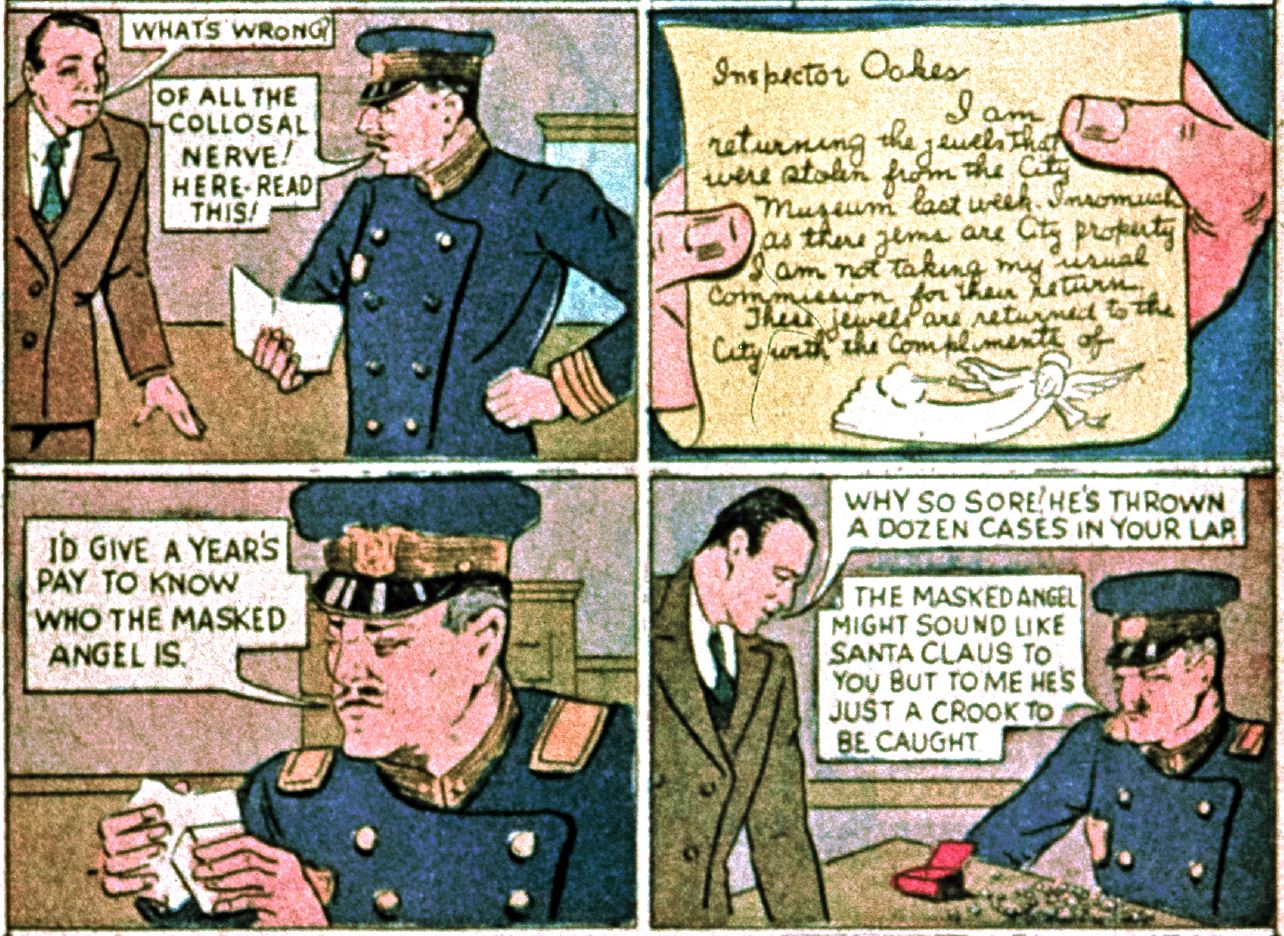
    Steve Oakes, wealthy playboy just so happens to also be the Masked Angel, vigilante feared by the underworld and wanted by the police.

    Steve’s father Detective Inspector John Oakes was murdered by crooks, so the Masked Angel act is his way of getting back at the criminal fraternity. It also seems to be a way to troll his brother, Detective Inspector John Oakes II, who is an asshole and who hates the Masked Angel in your classic way that a police officer does when they’re part of a vigilante’s supporting cast. Also please note the fun “angel shooting a gun” signature on the Masked Angel’s taunting note. (Miracle Comics 001 1940)

    Uncle Sam:

    We’re skirting the edge of what might be considered “minor” here, at least to DC Comics fans, but I have no Median Super-Hero category and however you slice it your parents almost certainly have not heard of him so here goes:

    Uncle Sam is the physical embodiment of the patriotic ideal of the United States: good, kind, powerful and just. He emerges to lend a physical hand in times of turmoil by inhabiting of reshaping the body of a recently slain patriot.

    This time around, Uncle Sam is (implicitly, all of this isn’t really spelled out until later) reborn from the death of Ezra Smith, who stands up to fascist agitators the Purple Shirts and gets a bullet in the back for his trouble. He sticks around to beat Axis ass for the duration of the war and then is not seen again until DC integrates the Quality characters into Earth-2 continuity in the 1970s. (National Comics 001, 1940)

    National Comics 005 expands the Uncle Sam lore slightly, firstly by making it a bit more explicit that he incorporates the spirits of dying patriots into himself with what is perhaps the initial time he did so, when a man named Sam sacrifices his own life to advance the cause during the American Revolution.

    Secondly, Sam is seen merging with a living patriot named Samuel in order to help drive the fascist Black Legion out of Glen Valley. Is this a common event? Does Uncle Sam roam the land absorbing patriots? Who can say, but it certainly would put a new spin on the character.

    Buddy Smith:

    When Ezra Smith is murdered by the Purple Shirts, his grandson Buddy is left alone, presumably some sort of double-orphan. He is almost immediately found, shamed for crying, and adopted by Uncle Sam (and hopefully the near immediate recovery Buddy has from the grief of seeing his grandfather gunned down in front of his eyes is a function of Uncle Sam being partially Ezra Smith and not some sort of deep traumatic repression left to fester in his soul).

    Buddy fills a pretty standard kid sidekick role: getting into trouble, getting Uncle Sam out of trouble, inventing things, befriending people, spotting clues, etc. He is unusual in that he is one of the few kid sidekicks who is a proper kid as opposed to being a young teenager (I know the common wisdom is that Dick Grayson was eight when he became Robin but that’s mostly because Golden Age artists – and particularly Bob Kane – were mostly very bad at drawing kids. Robin was absolutely supposed to be somewhere in the 12-15 range when he debuted). He’s also notable for – as far as I know – never ever showing up again post-Quality, not even in that event earlier this year that was specifically focused on bringing back all the old (and new) Golden Age kid sidekicks. Maybe Uncle Sam ate absorbed him once he got old/patriotic enough. (National Comics 001, 1940)

    Merlin the Magician:

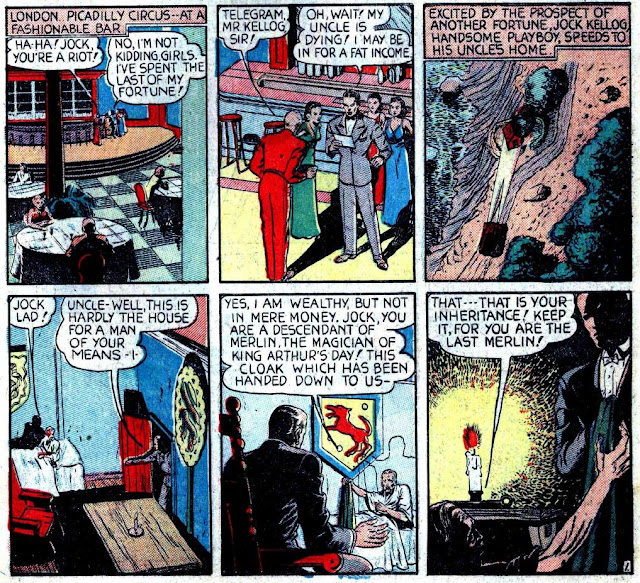
    Jock Kellog, a wealthy playboy in the classic mold, spends the last of his family fortune on the same day he is summoned to the bedside of his sole relative, an unnamed uncle. Instead of the fat stacks of cash that he is hoping for, Kellog comes away with a cloak and the knowledge that he is supposedly the last descendant of Merlin of Arthuriana fame.

    It turns out that he is in fact the last descendant of Merlin, of course, and that the cloak is a source of unlimited magical power in the grand tradition of mystic super-heroes like Zatara. Lucky for the world at large, the application of vast power has the opposite of its usual effect on the young wastrel and Jock devotes his newfound power to the defense and betterment of humanity. (National Comics 001, 1940)

  • MINOR SUPER-HERO ROUND-UP 025

    Just a great bunch of guys.

    David:

    I read the Samson stories in Big 3 before those in his home comic Fantastic, so while I knew about his sidekick David I didn’t really know what his whole deal was. I had read that Samson just found him sitting around somewhere and assumed that that was hyperbole but no, it’s not: Samson is investigating some mysterious plane crashes in the Rockies when he just finds a kid, who turns out to be the only survivor of the latest crash, and just… brings him along. There’s no real attempt to address the fact that he must be an orphan now (or if not and he was travelling alone for some reason, that his family now thinks he is dead) or to find him a familial guardian – heck, his name isn’t even David. It’s low-key one of the weirdest sidekick origins in comics and that’s before he gets his own pair of fur briefs. (Fantastic Comics 010, 1940)

    UPDATES: Even in the updated Samson origin, David is still a hanger-on (Samson 001, 1940)

    UPDATE – the Fantom of the Fair:

    The Fantom of the Fair gets his own short-lived book that sees him spending more and more time fighting crime outside the New York World’s Fair, if you can believe it. To that end he adopts the more generic name of the Fantoman. The costume changes (blue instead of black, uncovered lower face) happened at the end of 1939 and technically I’ve read more Fantom stories in which he had the new one than the old but it never feels right to me. At least you can still see his hair through the cowl.

    Though he has a new name and a not-so-new look, Fantoman retains one of his most iconic properties: every time you start thinking of him as just another masked adventurer he busts out another heretofore-unseen superpower or bit of lore suggesting he is a thousand year old demigod or something. See above as he either teleports or passes through matter for the first and last time. (Fantoman 003, 1940)

    the Spy Fighter:

    It kind of says something about the mood of America in 1940 that there are multiple comic book series that take place in the 1990s after what we know as World War II has stretched on for fifty years (Marvel’s Breeze Barton is the other one that I can recall off the top of my head, while MLJ’s Doc Strong is from a future ravaged by a whole century of WWII). In this version of that, the war has resulted in an amalgamation of the world into three rival nations: Russmany (Europe and Africa), Mongo (Asia) and Greater America (the Americas), and in this world of super nations, a super spy is required to ensure the sanctity of the Greater American way of life.

    That man is Saber, the Spy Fighter! Who does eventually put on a shirt. Saber starts out as physically gifted telepath who roots out enemy agents by reading their ill intent in their own minds and then beats them up for it. Over time, the challenges he faces get larger and less specifically espionage related, and he develops new abilities to meet them, including that of changing his own size at will, to the point that he is eventually able to travel through space on his own power to fight planet-sized enemies. And what can Mongo do to challenge that? (Fight Comics 001, 1940)

    Update 1941

    the Skull Squadron:

    Chip Collins’ Skull Squadron is extremely unremarkable but at this point I have to make note of every skull-adjacent comic book thing. They operate somewhere in between a commando group and the Suicide Squad and barely even have skulls painted on their planes. SKULL SCORE: 1/2 and only for the name. (Fight Comics 001, 1940)

  • MINOR SUPER-HERO ROUND-UP 008

    MINOR SUPER-HERO ROUND-UP 008

    Some real highs and lows in this one.

    the Twister: 

    The Twister is a quite minor Golden Age super-hero – he managed more than one appearance but not more than seven – who has the distinction of having one of the most well-designed costumes of the era. Not my favourite costume, mind you, but boy oh boy, you can really tell that his creators (Ray Gill and Paul Gustavson as it happens) really sat down for a good think about how to evoke “tornado” via the medium of clothing.

    The Twister turns out to be Bob Sanders, and he turns out to be a descendant of perennial fave Greek hero Odysseus. It turns out that the story of Aeolus gifting Odysseus two bags of wind and his men opening the bag of storm winds thinking that it was full of treasure was more than just another delay in Odysseus’ Bad Voyage, it was akin to the opening of Pandora’s Box and Aeolus had charged Odysseus or his descendants to round up all of the evil violent winds and return the to captivity. 

    Evidently over the years the charge to gather up evil winds has expanded to fighting all evil, and the Twister’s power set allows him to run roughshod over just about anyone using wind control, a tornado form and invulnerability to anything that couldn’t harm actual wind. There is some attempt to establish that he is vulnerable to being locked up somewhere with no airflow but that proves even easier to defeat than all the times that Silver Age Aquaman is locked up and forced to source water from unexpected places.

    The Twister’s other claim to fame is that he was introduced as a mysterious tornado that appeared in the Blue Bolt, Sub-Zero and Dick Cole stories in the issue he first appears in, which is enough to be counted as a rare Golden Age crossover even though none of them shared words. (Blue Bolt v2 001, 1941)

    Freezum:

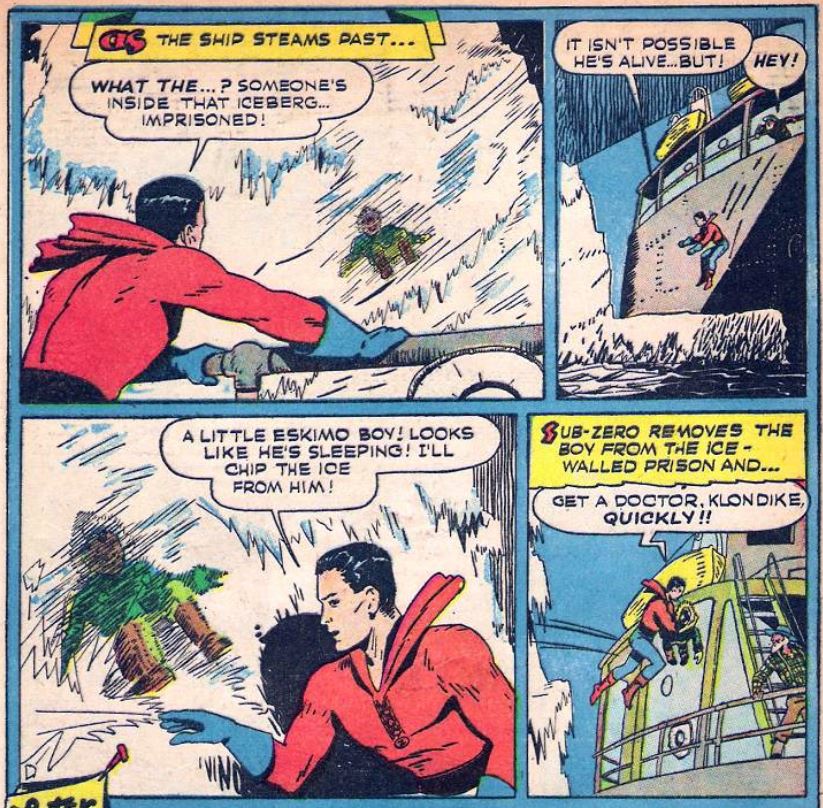
    On an adventure that takes him to Alaska, Sub-Zero happens upon a little Inuit or Aleut boy frozen in a glacier.

    Thawing the kid out and finding him to miraculously be alive, Sub-Zero (as well as an unfortunate doctor) is further astounded to discover that they share the same sort of cold-based powers due to their similar near-death freezing experiences. The kid names himself Freezum, and that’s just the first salvo of a barrage of tired comic relief sidekick shenanigans. Yes, we’ll be sighing and rolling our eyes for the remainder of Sub-Zero’s run – the joys of the Golden Age, friends! (Blue Bolt v2 005, 1941)

    Lois Blake:

    Lois Blake is a woman who Blue Bolt meets while attempting to take down a gang that was swindling immigrants using fake citizenship papers and decides to team up with. At some point when the gang is being particularly elusive he remembers that his pal Dr Bertoff down in the underground Kirby world has a viewscreen that can see virtually any location and so they head down there to use it. Bertoff then very helpfully offers to transfer some of Blue Bolt’s power to Lois and a new crimefighting team is born! (small aside: Golden Age comics don’t get a lot of praise for their art but I really enjoy both the small detail of Lois gripping Blue Bolt’s arm for comfort in the first panel above and her delighted expression in the third).

    Lois never gets a super-hero name and only really makes a handful of appearances before Blue Bolt ditches his costume and powers to become a regular if oddly-named soldier, but he’s such a nonentity post Simon and Kirby that I can’t help but love her for adding some life to the strip.(Blue Bolt v2 007, 1941)

    the Marvel:

    The Marvel is your classic mask-and-tuxedo vigilante, who specializes in showing up to bail reporter Scoop Cody out of the kind of jams you can get in when you’ve cracked a juicy crime story but not accounted for the possibility that the criminals involved might want to stop you from reporting on it.

    Three things about the Marvel: 

    1. The nose cutout never looks as cool as the full-face cowl does but I reckon it’s a heck of a lot more comfortable, so you have to give him some credit for choosing function over form.

    2. Scoop Cody and thus the Marvel only had two appearances and both of them had a teaser at the end promising that the Marvel’s identity would be revealed in the next issue. It’s always possible that they were planning on making the Marvel a completely new, never-before-seen guy but if they weren’t then literally the only suspect is this guy, Scoop Cody’s crusty old unnamed editor.

    3. Love a super-hero calling card, even in the rare cases when it’s a literal calling card.

    Also here is the Marvel’s second appearance in its entirety. (Blue Ribbon Coimcs 002, 1939)