The Curse of Skeleton Munroe

Category: 1942

  • MINOR SUPER-VILLAIN 922: GENGHIS KHAN

    (Champ Comics 015, 1941)

    Okay, Genghis Khan. A lot of guys in comics like to call themselves Genghis Khan or claim to be his successor etc, and importantly they all seem to be into all the old Genghis Khan stuff like horse archers. Absolutely 100% stuff that Genghis was into at the time he was around of course, but I personally think that he would enjoy a machine gun if he had the chance. 

    Duke “the Human Meteor” O’Dowd is getting up to his usual day of driving cabs and palling around with his shoeshine boy pal Toby when suddenly the city is attacked by a mass of cavalry led by a shirtless giant wielding a flaming sword. This is Genghis Khan (a Genghis Khan, at least), and he is probably the Human Meteor’s only recurring foe, appearing in 3 (possibly 4, but Champ Comics 018 is currently AWOL) whole issues.

    A conquering giant cuts an intriguing figure, but the unfortunate thing about Genghis Khan is that the stories he appears in are pretty incoherent. There’s a plot, but everything other than the plot is just shiny bits glued on like sparkles. That said, here are the most interesting and intriguing things about him:

    1. Size and Origins

    Genghis Khan’s size remains fairly consistently enormous during his first two appearances – if anything, he might just be a bit bigger in the second one. His third appearance, however, shows him at a considerably reduced stature, from the third set of panel above in which he’s maybe ten feet tall to perhaps fifteen feet at maximum. Is this an indication that he can control his size or just a general disregard for continuity?

    The unanswered question of just what is up with this guy’s size is a symptom of the fact that he has no real origin. He just shows up one day, stomping around Manhattan. Is he even Mongolian? Not to put too fine a point on it, but I’ve read a lot of 1940s comics and I think that they would have drawn him differently if he was. 

    2. Technology

    The other major unanswered question about Genghis Khan is: just where did he get those wonderful toys? Such as… 

    His giant flaming sword that can also change its atomic structure on the fly, seemingly specifically so that the Human Meteor can’t pick it up.

    His cool dirigible base and its defensive screen of flamethrowers.

    The “sky road,” a transparent walkway that both men and horses can travel to and from the dirigible on, which need no support and must have some sort of crazy friction going on considering the angles that people are climbing it at.

    3. Goals

    Unsurprisingly, the self-declared successor of Genghis Khan, this fellow’s main goal is conquest. The attack on New York in his initial appearance is the first part of an attempted takeover of the US, for example.

    In Genghis Khan’s second appearance (Champ Comics 016, 1941), he is laying siege to the hidden, high-tech city of Bayakura, the place that Duke O’Dowd became the Human Meteor. 

    Though the Human Meteor drops a mountain on him at the end of that second appearance, Genghis Khan survives somehow (perhaps by shedding mass to allow himself to escape his mountain tomb? That’d be an interesting aspect of the character if it ever came up) and allies with the Japanese to harry the US fleet off China. The Human Meteor sinks the Khan’s entire fleet, and since he (probably) never appears again, drowning does what being crushed under a mountain failed to.

    Categorized in: Famous Figures (Genghis Khan), Real Folk (Genghis Khan), Supercrime (Attempted Conquest)

  • ALIENS AND SO FORTH ROUND-UP 026

    There is a never-ending supply of aliens (and so forth) in comics, and here are some of them. 

    Giants: 

    When Doctor Voodoo is flung into the past by an old wizard, his only instruction is to find something called the Golden Flask, located somewhere called the Valley of Giants. Astonishingly, it only takes him about two issues worth of privation to get there, whereupon he and his pal Nero are immediately taken captive and frogmarched to the castle of the Queen of the Giants.

    As can be seen in the above panel, these are the less extreme kind of giant, being only ten or so feet tall (based on their sizes compared to Doctor Voodoo – probably a standard length of hero at six feet – and Nero – extra big and tall so at least seven). Hardly as dramatic as a forty-foot titan might be but at least you don’t spend the whole time wondering how their bodies hold together under the strain.

    The Queen of the Giants (Anita to her friends), by contrast, is a regular-sized lady who comes across as quite nice until Doctor Voodoo rejects her romantic advances and she has him thrown to Achilles, who turns out to be a giant python. Despite this, when the Valley of the Giants is depopulated by pirate raids, Docotr Voodoo rescues her and takes her along on the remainder of his adventures in the past. And since he never actually makes it back to the present on-panel, perhaps romance does eventually blossom, who knows? (Whiz Comics 020, 1941)

    Camurians: 

    Space hero Captain Venture and his companion Zyra, aka the Planet Princess, spend a lot of their early adventures just wandering around space and seeing what the cosmos has to offer. On one of these jaunts, they land on Planet Camur, where they find the native Camurians enslaved by another species called the Valhoes, and being righteous hero types they resolve to liberate them from bondage. 

    After being captured and enslaved themselves, Venture and Zyra lead an uprising and free the Camurians from the tyranny of the Valhoes, who were unprepared to face any resistance from their seemingly cowed slaves.

    Just where the Valhoes come from is not expanded upon in the story but just by looking at them we must reasonably assume that they also come from Camur, right? Millions of years ago some sleepy-eyed alien ape species’ population split along nerd/jock lines and the Camuriand and Valhoes were the end results. Nature is grand, really. (Nickel Comics 006, 1940)

    Catskill Dwarfs: 

    Thanks to a plane crash in the Catskill Mountains, super magician El Carim and his assistant/ love interest Gladys find themselves in the underground realm of the Catskill Dwarfs, aka the Little Men of the Mountain of Rip van Winkle fame.  

    It’s all pretty goofy until Galdys swats the Dwarfs’ Scared Flea, at which point the Little Men of the Mountain try to murder both her and El Carim in a fit of righteous ire. All is forgiven, however, by the time they return to the comic two issues later – I suppose sacred fleas are easy to come by. (Master Comics 020, 1941)

    Djungas: 

    Captain Venture and the Planet Princess’ wandering ways come to an end eventually when they crash on the far-off Asteroid Djung and are captured by the local Djunga people on behalf of their tyrannical leader King Leon. 

    The Djungas are that ever-popular combination of a high-tech society with medieval trappings, and Leon is very much a medieval tyrant figure who spends much of his time attempting to wed Zyra against her will while pitting Venture and his Djunga companion Tazon up against a series of deadly situations. These often involve the wide array of other intelligent species endemic to Asteroid Djung and its local system, so more on them later.

    The series eventually had to end, and King Leon with it, with the flick of a giant’s finger. Tazon is installed as the new King of Djung, and peace presumably reigns among the Djungas. (Master Comics 009, 1940)

  • MINOR SUPER-VILLAIN 528: THE BLACK HAND

    (Blue Ribbon Comics 016, 1941) 

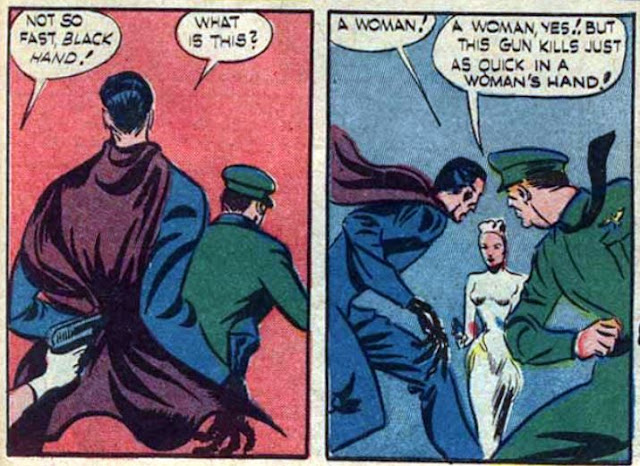
    There’s a quality that some comic book characters have and some do not and I never knew about it until I started writing this blog. That quality is called Standing in Clear View So That I Can Get a Screengrab of Them, and buddy, the Black Hand does not have it. This is about as good of a full look as you get of the guy in his first appearance.

    Enough complaining! The Black Hand is a spy of the Unaffiliated Freelancer subtype, which since he operates out of the US means that he steals US secrets for sale to the Nazis. Is a character who does business with Nazis better than one who is a Nazi? Marginally. The Black Hand is also the recurring villain of Captain Flag, who he is also responsible for becoming a super-hero due to his murder of Flag’s father and failure to proof his lair against narratively significant eagles.

    The Black Hand is called the Black Hand because of his black hand, which he usually conceals beneath a black glove and which is riddled with a deadly disease that the Black hand can transfer to a victim via a simple scratch of his horrible fingernails. It’s definitely a useful power (affliction?) for a villain to have but not one that has a chance of coming up in anyone’s super-power wishlist.

    Throughout his five appearances the Black Hand sports three distinct looks: the initial iteration (either afflicted with a deathly pallor or just overenthusiastic when applying foundation), a sort of suave mustachioed cat-burglar getup with no hint of the grave and then back to the deathly complexion with an added skull-like quality to the face. Realistically this can be put down to Captain Flag being a secondary character without a dedicated artist, but if that was the point of this blog then it would swiftly cease to be much fun.

    Notably, the suave version of the Black Hand wears his glove on the opposite side – could this indicate that he and the corpselike Black Hand are different characters? Perhaps the disease that gives them their name is also slowly killing them, which could account for the more ghoulish appearance of the original Hand over time?

    These questions will never be answered, sadly, as in-universe the Black Hand made a transition from spy the thief to pirate and Captain Flag was quick to invoke the Law of the Sea to hang him from the nearest yardarm. Out of universe, Captain Flag’s feature didn’t survive the cancellation of Blue Ribbon Comics and so the Black Hand had nobody to come back from the dead to torment.

  • MINOR SUPER-HERO ROUND-UP 005

    All Columbia Comic Corporation edition!

    Skyman: 

    Skyman (properly the Skyman but it just doesn’t scan for me) is a pilot hero, normally a ho-hum sort of character for me. But between his sci-fi super plane (the Wing), his blood-freezing stun ray (the Stasimatic) and his cool on-the-edge-of-being-too-busy costume there’s just enough super-hero peanut butter mixed in with the pilot chocolate to make it appealing (bonus running list of Skyman’s super science: atomic explosives, invisible glass phonograph, disitegrator ray, explosives-detonating ray and a ray that fuses gun barrels shut)

    After a few issues we learn that the Skyman is actually Allan Turner, wealthy good-for-nothing playboy who lost his parents to a plane crash when he was a child. If the Bruce Wayne parallel was 1:1 he would have grown up to become a noted slayer of planes, but that’s a villain’s origin. Instead, Allan Turner dresses up as a plane to fight criminals. It doesn’t make quite as much narrative sense as Batman does but it’s probably more fun to read than the other way around.

    Early Skyman also might just hold the record for the most overinflated torso in comics outside of parody characters. He gets a bit more proportional eventually but for a while there you’re concerned for his ability to live a normal life.

    the Face:

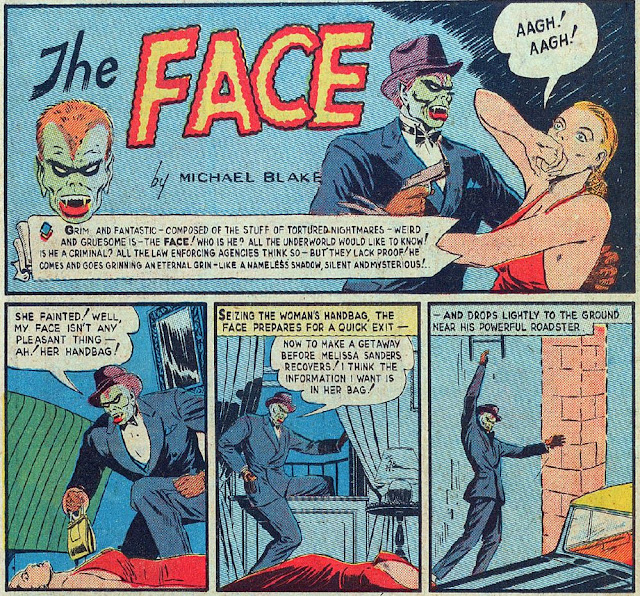
    The Face, like a lot of early comics heroes, draws a lot of elements from the pulps: a tuxedo-clad hero drives around in a souped up roadster fighting crime with his fists and an automatic – a pretty regular early super-guy. Even his secret identity of Tony Trent, radio station owner/ radio announcer is in the pulp-adjacent character wheelhouse.

    It was very exciting to me when I realized that the Face’s face is frequently referred to as a rubberoid mask, my favourite term for the kind of masks that only exist in comic books – perfectly realistic and naturalistic but also very easy to don and doff. This particular mask was made specially for Tony Trent by someone whose other major characteristic is being dead, which is apparently a combination that makes Trent feel quite jolly.

    Weirdly, in Big Shot Comics 006, the Face has a new, slightly less grotesque mask. No word on where he got this one but he goes back to the original pretty quickly.

    Marvelo, Monarch of Magicians:

    Created by Fred Guardineer, who also created Zatara over at DC Comics, Marvelo is… extremely similar to Zatara. Aside from their different approaches to dressing like a stage magician, I’d say that there are two slight differences between the characters: 

    1. Rather than speaking backward to cast spells, Marvelo shouts “Kalora!” as an all-purpose magic word.

    2. Marvelo’s manservant Zee is just a hair more racist than Zatara’s manservant Tong. It’s pretty close but I reckon Zee takes it.

    Big Shot Comics 017 reveals that Marvelo is the son of the ruler of the generically foreign South Pacific island of Brahama (hell on autocorrect). This doesn’t seem to have anything to do with him being a magic man but it’s nice to know. (Big Shot Comics 001, 1940)

    the Cloak:

    Jeff Cardiff, Spy Chief was a feature in Big Shot Comics from issue 1 (well, it was Jeff Cardiff, Spy-Master for the first issue or two but the point stands) with all kinds of foiled plots and plans and spies of both the vaguely fascist and vaguely communist varieties. In Issue 15, however, the spies adopt the reasonable policy of attempting to shoot on sight the man who has foiled so many of their plans and a wounded Jeff Cardiff goes to recuperate at his brother’s house.

    Long story short, Jed Cardiff is a coal magnate with a collection of “adventure curios”, including the namesake cloak of Revolutionary War-era costumed spy the Cloak and it being 1941 and a comic book, Jeff immediately adopts the Cloak identity as his own. It’s a fairly basic costumed hero shtick but I appreciate the effort and it’s always nice to see a more elaborate cape and cowl getup now and then. (Big Shot Comics 015, 1941)

    The original Cloak eventually shows up in a flashback and it turns out that his impact on the history of the American Revolution is only slightly less impactful than Superboy’s in the 1949 story in which he goes back in time and takes part in about half the major events of the war. I must say that I do love a retcon of a historical event. (Big Shot Comics 021, 1942)

  • MINOR SUPER-HERO ROUND-UP 005

    All Columbia Comic Corporation edition!

    Skyman: 

    Skyman (properly the Skyman but it just doesn’t scan for me) is a pilot hero, normally a ho-hum sort of character for me. But between his sci-fi super plane (the Wing), his blood-freezing stun ray (the Stasimatic) and his cool on-the-edge-of-being-too-busy costume there’s just enough super-hero peanut butter mixed in with the pilot chocolate to make it appealing (bonus running list of Skyman’s super science: atomic explosives, invisible glass phonograph, disitegrator ray, explosives-detonating ray and a ray that fuses gun barrels shut)

    After a few issues we learn that the Skyman is actually Allan Turner, wealthy good-for-nothing playboy who lost his parents to a plane crash when he was a child. If the Bruce Wayne parallel was 1:1 he would have grown up to become a noted slayer of planes, but that’s a villain’s origin. Instead, Allan Turner dresses up as a plane to fight criminals. It doesn’t make quite as much narrative sense as Batman does but it’s probably more fun to read than the other way around.

    Early Skyman also might just hold the record for the most overinflated torso in comics outside of parody characters. He gets a bit more proportional eventually but for a while there you’re concerned for his ability to live a normal life.

    the Face:

    The Face, like a lot of early comics heroes, draws a lot of elements from the pulps: a tuxedo-clad hero drives around in a souped up roadster fighting crime with his fists and an automatic – a pretty regular early super-guy. Even his secret identity of Tony Trent, radio station owner/ radio announcer is in the pulp-adjacent character wheelhouse.

    It was very exciting to me when I realized that the Face’s face is frequently referred to as a rubberoid mask, my favourite term for the kind of masks that only exist in comic books – perfectly realistic and naturalistic but also very easy to don and doff. This particular mask was made specially for Tony Trent by someone whose other major characteristic is being dead, which is apparently a combination that makes Trent feel quite jolly.

    Weirdly, in Big Shot Comics 006, the Face has a new, slightly less grotesque mask. No word on where he got this one but he goes back to the original pretty quickly.

    Marvelo, Monarch of Magicians:

    Created by Fred Guardineer, who also created Zatara over at DC Comics, Marvelo is… extremely similar to Zatara. Aside from their different approaches to dressing like a stage magician, I’d say that there are two slight differences between the characters: 

    1. Rather than speaking backward to cast spells, Marvelo shouts “Kalora!” as an all-purpose magic word.

    2. Marvelo’s manservant Zee is just a hair more racist than Zatara’s manservant Tong. It’s pretty close but I reckon Zee takes it.

    Big Shot Comics 017 reveals that Marvelo is the son of the ruler of the generically foreign South Pacific island of Brahama (hell on autocorrect). This doesn’t seem to have anything to do with him being a magic man but it’s nice to know. (Big Shot Comics 001, 1940)

    the Cloak:

    Jeff Cardiff, Spy Chief was a feature in Big Shot Comics from issue 1 (well, it was Jeff Cardiff, Spy-Master for the first issue or two but the point stands) with all kinds of foiled plots and plans and spies of both the vaguely fascist and vaguely communist varieties. In Issue 15, however, the spies adopt the reasonable policy of attempting to shoot on sight the man who has foiled so many of their plans and a wounded Jeff Cardiff goes to recuperate at his brother’s house.

    Long story short, Jed Cardiff is a coal magnate with a collection of “adventure curios”, including the namesake cloak of Revolutionary War-era costumed spy the Cloak and it being 1941 and a comic book, Jeff immediately adopts the Cloak identity as his own. It’s a fairly basic costumed hero shtick but I appreciate the effort and it’s always nice to see a more elaborate cape and cowl getup now and then. (Big Shot Comics 015, 1941)

    The original Cloak eventually shows up in a flashback and it turns out that his impact on the history of the American Revolution is only slightly less impactful than Superboy’s in the 1949 story in which he goes back in time and takes part in about half the major events of the war. I must say that I do love a retcon of a historical event. (Big Shot Comics 021, 1942)

  • MAD AND CRIMINAL SCIENTIST ROUND-UP 003

    They may not be the top of the class, but they did their time in the evil sciences!

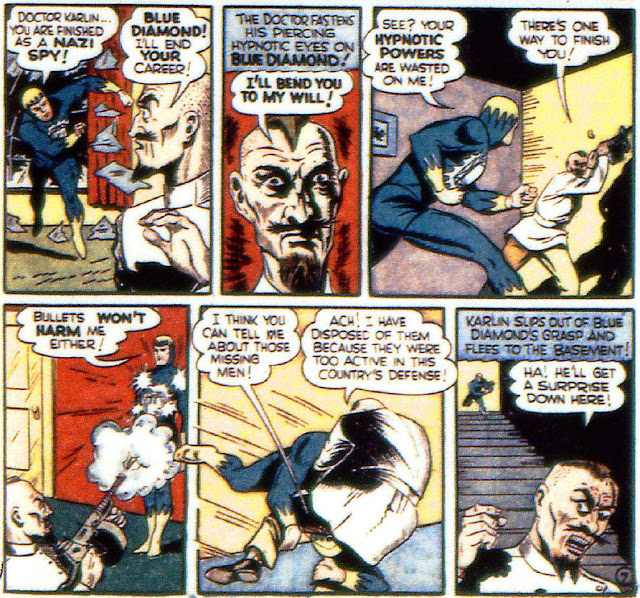
    Dr Eric Karlin has a lot of moxie on paper: a Nazi psychologist with a sideline in Egyptology, he dissolves the enemies of the Reich in acid and keeps their jellied remains in a series of jars in his basement. He also employs mind controlled pseudo-zombies in a scheme to recover frozen Nazi assets from a bank vault. The problem is that while all of this makes for a dynamite summary, the Blue Diamond story that he appears in is… not very good. (Daring Mystery Comics 008, 1942)

    DeVaux here had a plan to grow regular guys into huge guys and use them to take over the world but made the elementary mistake of trying to kill a friend of super-magician El Carim as his literal first step toward that end – it didn’t go well. (Master Comics 011, 1941)

    I’m not sure if this guy is even a scientist, but if you’re “the worst foreign spy living” and your name is Dr Evil and your cover as you plan to blow up a NYC analog is to call yourself “Dr Live” well then I can’t help but love you, even if you do get electrocuted by extremely generic Golden Age hero Lightning. (Jumbo Comics 015, 1940)

    And speaking of Lightning, he also battled Dr Tol, who used remote stone-crumbling technology to open up banks for his gang to loot. He also had very cool goggles. (Jumbo Comics 020, 1940)

  • MINOR SUPER-VILLAIN 324: HITLER

    (Daring Mystery Comics 008, 1942)

    Hitler is going to show up more than a few times as you go through the history of comics, even if you set aside all the times he or a pastiche of him show up as the antagonist of a WWII comic you have reams of They Saved Hitler’s Brain or I Recruited the Worst Men of History stories. This here is possibly the first of those and there’s not a lot to it.

    So: Hitler, Goering, Goebbels and a scientist named von Schalz, seeing the writing on the wall circa 1942, escaped by cryogenically freezing themselves until 3050 AD. Hitler being Hitler, he decides to make another attempt at world conquest. The story ends with von Schalz having hypnotized 3050’s protector Captain Daring into leading their armies – presumably the comeuppance would have taken place in the next ish, but this was hampered somewhat by there being none. Hitler’s destruction by Captain Daring has existed in potentia for 82 years and counting. Our only consolation must be that this Hitler’s defeat in 1942 means that some of the excesses of the Holocaust must have been avoided. 

    (and of course Hitler is only a minor super-villain in the context of being in the future fighting space men)

  • MINOR SUPER-VILLAIN 323: GORE

    (Daring Mystery Comics 008, 1942)

    Like he says in his dying moments above, Gore is a weird-looking guy who lashes out at society via a series of radio-themed deathtraps, always preceded by a broadcast of the letter D in Morse Code. As a villain he’s all right – he gives the Thunderer a run for his money at least. My major gripe with him is that there was ample opportunity for him to be called the D Killer or the Radio Killer or just D but no, he has to go by his stupid actual name. Bah.

    This radio skeleton is partial compensation, at least.

  • MINOR SUPER-VILLAIN 322: THE BARRACUDA

    (Daring Mystery Comics 008, 1942)

    A certain number of uboat captains are going to be written villainously enough to meet all of my criteria and Captain Erich von Wolff, AKA the Barracuda, is one such.

    Like seriously a real stinker of the highest order. It’s a good thing that the Fin is on the case to beat the tar out of him and deliver him to the British. I was going to say that hopefully he was tried and executed after the war but some cursory research suggests that u-boat commanders who weren’t killed in battle largely weren’t. I’m sure he had a long career as an investment banker or something.

  • MINOR SUPER-VILLAIN 314: THE RED TERROR

    (Tough Kid Squad 001, 1942)

    A fairly undistinguished costumed gang boss, the Red Terror has three things going for him:

    1. he gets around in a very cool rocket-powered dirigible

    2. he is the only super-villain to face Golden Age underachiever the Human Top

    3. he really goes above and beyond in his attempt to rid himself of the Top, hitting him with, in quick succession: mountain lions, flame throwers, an avalanche and a bursting dam. That’s the kind of thoroughness that more villains should aspire to, although of course if it’s not enough to do the job you risk getting thrown from your own rocket-zep in retaliation.