The Curse of Skeleton Munroe

Category: Prize

  • MINOR SUPER-VILLAIN 711: MAYTUS, KING OF THE BEASTS

    (Prize Comics 005, 1940)

    Late in his first incarnation, Power Nelson makes the acquaintance of Zora Doone, agent of the Interplanetary Red Cross, and the two form a very horny-but-chaste relationship. At her behest, Nelson takes a break from not freeing the people of Earth from the tyrannical rule of Seng I to investigate conditions on planet Ato, where humans are ruled… BY APES!
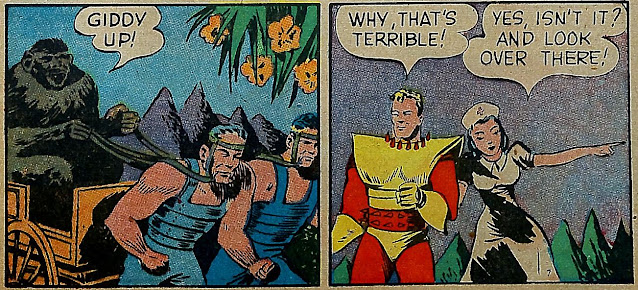
    Yes, it’s a good old fashioned Planet of the Apes situation on Ato. Humans are treated as animals, act as beast of burden, are fed on garbage, etc, while apes get to be cops and wagon-drivers. It just ain’t fair!

    There isn’t really any exploration of why or how exactly the apes are in charge on Ato – the humans seem to be intelligent and verbal and the apes know it… Is this a race thing? It probably is, isn’t it – whether the writer consciously wrote it that way or not it’s got a lot in common with fantasies of white oppression under the heels of the “lesser” races (oh wait, I forgot that this is a comic set in a future in which the West has been conquered by the evil Mongol, isn’t it) . It’s also an interesting bit of commentary on the treatment of animals – that panel of the ape zookeeper feeding its charges garbage straight out of the can speaks of someone who has felt a pang of empathy for a creature in their time.

    King Maytus isn’t really your typical villain, just the head of an oppressive society, but I like his bluster. I also like seeing Power Nelson get mashed up by an elephant for a few panels before he inevitably comes out on top.

    For all my talk of racist allegories above, the situation on Ato is actually resolved far more peacefully than a similar one on a comic set on a Pacific Island would be. Sure Maytus is beaten up and threatened with death, but the story doesn’t end with, say, all of the apes being killed and/or reduced to servitude and/or stripped of their intelligence. In Golden Age comics terms it’s a triumph of diplomacy!

  • MINOR SUPER-VILLAIN 710: BLOOR

    (Prize Comics 004, 1940)

    The year is 1982! The world languishes under the heel of a global dictatorship, and the economy is tanking – presumably the Mongols were running a war economy that failed to stand up to the post-world-conquering peace.

    Emperor Seng I offers nothing but empty promises to his subjects, until Power Nelson, as committed as ever to working within the system, bursts in and strongarms him into making… real promises? Frankly, this is Power Nelson at his worst. He was created to remove the dictator’s yoke from around the neck of the people and he consistently works to make the absolute dictator a better leader rather than, say, destroying him utterly. Like, I know that conflict is the essence of storytelling and if Nelson had just broken Seng I’s neck in Prize Comics 001 there would be less of that but… come on, man. Forcing the Emperor to say he’ll make some jobs isn’t going to do anything.

    In fact, Nelson’s threats probably make Seng I more amenable to the offer he receives when he is visited by Bloor, dictator of Uranus. After all, how can Power Nelson complain after thousands of men are given jobs? And how could the Emperor know that they were actually being sold into slavery, wink, wink?

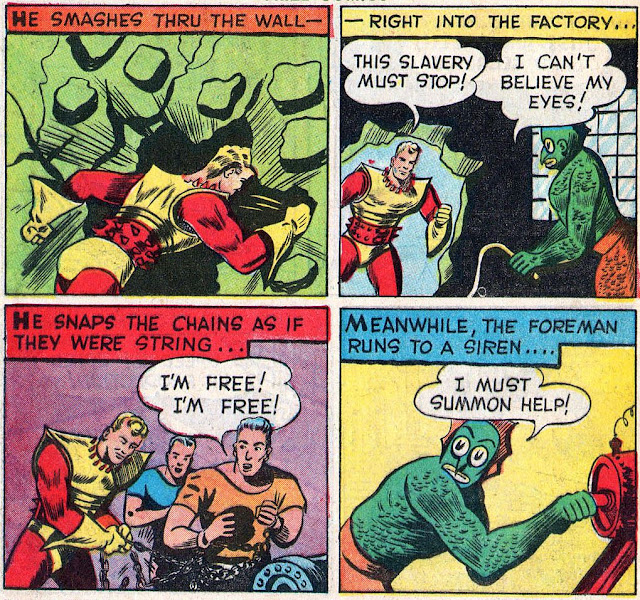
    The men are of course disappointed to learn that they are effectively slaves, to the extent that none of them seem to notice the high-fashion look that their captor is sporting and how much is contrasts with the simple purple pants of the planet’s leader. A bit self-involved, but who am I to judge?

    Power Nelson of course does not abide this, and busts everyone free at the first opportunity. Note also the factory foreman’s look – orange sunburst bonnets must be “in” on Uranus in 1982.

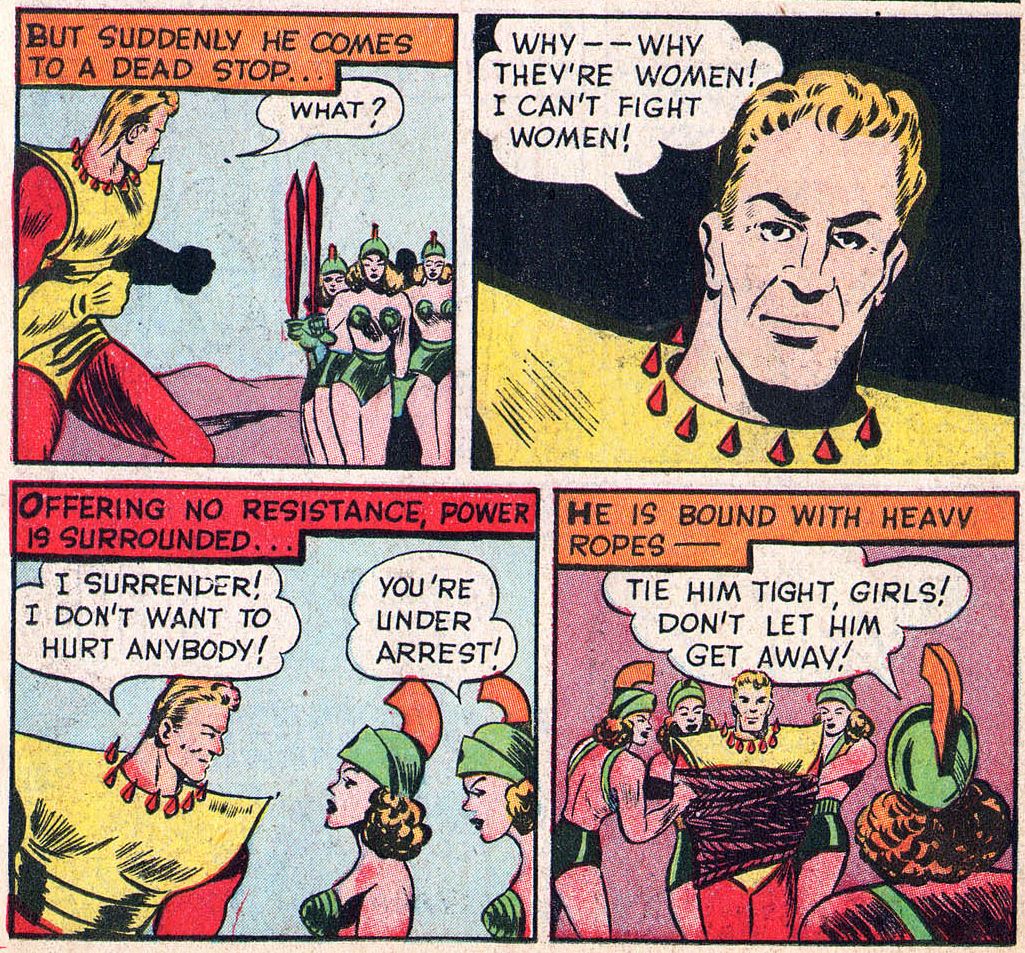
    Power Nelson does not fight women and so Bloor’s strategy to send his Amazon Regiment to capture him really pays off. But who are these Amazons? Is this what female Uranians look like or are they mercenaries from some other planet? Is this a sex thing for Bloor?

    Power Neslon is of course held in place not by ropes but by the power of his own antiquated ideas about gender and he frees himself just in time to get attacked by some really excellent cylindrical robots that, alas, have no visible gender signifiers and are rendered into so much scrap.

    Bloor is forced to release and pay the men, but in keeping with Nelson’s dedication to preserving existing power structures suffers no further consequences. I do really appreciate how committed he is to his role as a manager of Uranus rather than a traditional dictator – he might just be our first villain who operates almost completely from a desk. 

    The men all head home with a week’s wages and I guess that that solves the financial crisis. Everyone is happy under the boot of Seng I. Thanks, Power Nelson!

  • MINOR SUPER-VILLAIN 710: BLOOR

    MINOR SUPER-VILLAIN 710: BLOOR

    (Prize Comics 004, 1940)

    The year is 1982! The world languishes under the heel of a global dictatorship, and the economy is tanking – presumably the Mongols were running a war economy that failed to stand up to the post-world-conquering peace.

    Emperor Seng I offers nothing but empty promises to his subjects, until Power Nelson, as committed as ever to working within the system, bursts in and strongarms him into making… real promises? Frankly, this is Power Nelson at his worst. He was created to remove the dictator’s yoke from around the neck of the people and he consistently works to make the absolute dictator a better leader rather than, say, destroying him utterly. Like, I know that conflict is the essence of storytelling and if Nelson had just broken Seng I’s neck in Prize Comics 001 there would be less of that but… come on, man. Forcing the Emperor to say he’ll make some jobs isn’t going to do anything.

    In fact, Nelson’s threats probably make Seng I more amenable to the offer he receives when he is visited by Bloor, dictator of Uranus. After all, how can Power Nelson complain after thousands of men are given jobs? And how could the Emperor know that they were actually being sold into slavery, wink, wink?

    The men are of course disappointed to learn that they are effectively slaves, to the extent that none of them seem to notice the high-fashion look that their captor is sporting and how much is contrasts with the simple purple pants of the planet’s leader. A bit self-involved, but who am I to judge?

    Power Nelson of course does not abide this, and busts everyone free at the first opportunity. Note also the factory foreman’s look – orange sunburst bonnets must be “in” on Uranus in 1982.

    Power Nelson does not fight women and so Bloor’s strategy to send his Amazon Regiment to capture him really pays off. But who are these Amazons? Is this what female Uranians look like or are they mercenaries from some other planet? Is this a sex thing for Bloor?

    Power Neslon is of course held in place not by ropes but by the power of his own antiquated ideas about gender and he frees himself just in time to get attacked by some really excellent cylindrical robots that, alas, have no visible gender signifiers and are rendered into so much scrap.

    Bloor is forced to release and pay the men, but in keeping with Nelson’s dedication to preserving existing power structures suffers no further consequences. I do really appreciate how committed he is to his role as a manager of Uranus rather than a traditional dictator – he might just be our first villain who operates almost completely from a desk. 

    The men all head home with a week’s wages and I guess that that solves the financial crisis. Everyone is happy under the boot of Seng I. Thanks, Power Nelson!

  • MINOR SUPER-VILLAIN 709: RACKO

    (Prize Comics 002, 1940)

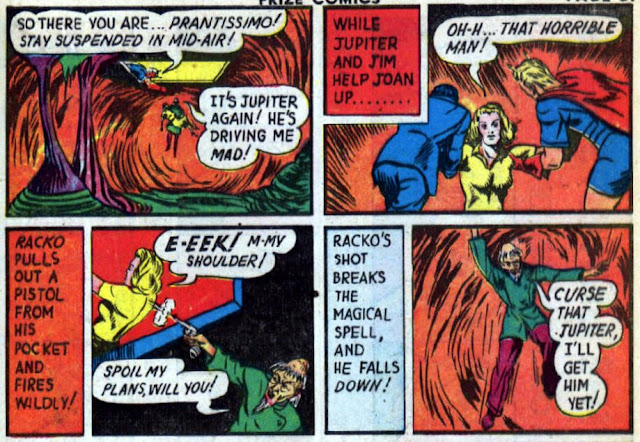
    Though he went unnamed in his first appearance, this tonsured fellow is Racko, alien magic man Jupiter’s most enduring foe at a whopping three encounters. Racko’s first outing involved a classic pyramid scheme structure as he sent mutated green humans with horn noses out into the New York streets to kidnap more humans to turn into more minions, and so on until he controlled the world. Ironically, this might be a slightly more ethical version of the typical pyramid scheme, as his minions were under no illusions that they might eventually become wealthy if they sold enough tights or what have you.

    A bunch of what turns out to be fairly dim-witted minions is just not enough to contend with a magic-using alien super-hero, even when bolstered by a paralysis ray cannon, and Racko is forced to restore his henchmen to human form before seemingly taking his own life via some handily exposed wires.

    Racko fans need not despair, as it turns out that he survived! His new plan: drain all of the reservoirs that supply NYC until the Governor of New York is forced to bow to his demands for some ray gun plans and the Governor’s daughter Joan.

    (just why the Governor has these plans is not explored in the text, so we must assume that they are associated with the office. A gubernatorial death ray, as it were)

    Perhaps in an overreaction to the poor showing that his monsterized henchmen put on in his last scheme, Racko uses the death ray on his own men after they secure it for him. They probably wouldn’t have offered much assistance when Jupiter and his pal Jim Johnson show up at the volcano base immediately afterward, but even a useless henchman can serve as a distraction. As it stands, Racko ends up falling to his death in the depth of a volcano that is subsequently blown up by Jupiter. Gone for good, I’d say.

    racko

    I have called it too soon, as Racko is in fact not dead yet again and is taking another pass at world conquest, this time by launching “boulder storms” from his hideout at the South Pole, and here I think that I have some constructive criticism for him: mad science or no, attempt to conquer the world or no… stop attacking New York City first. You’re sitting at the South Pole, man – chuck a few boulders at Australia to test out your equipment before you do the thing that you know will attract Jupiter’s attention because he live in New York.

    Jupiter sails through Racko’s defenses as easily as ever, despite the best efforts of some unaligned ice dragons, and the third time proves to be the charm as far as blowing him and his entire operations to smithereens with alien magic goes. Good by Racko;

  • MINOR SUPER-VILLAIN 709: RACKO

    (Prize Comics 002, 1940)

    Though he went unnamed in his first appearance, this tonsured fellow is Racko, alien magic man Jupiter’s most enduring foe at a whopping three encounters. Racko’s first outing involved a classic pyramid scheme structure as he sent mutated green humans with horn noses out into the New York streets to kidnap more humans to turn into more minions, and so on until he controlled the world. Ironically, this might be a slightly more ethical version of the typical pyramid scheme, as his minions were under no illusions that they might eventually become wealthy if they sold enough tights or what have you.

    A bunch of what turns out to be fairly dim-witted minions is just not enough to contend with a magic-using alien super-hero, even when bolstered by a paralysis ray cannon, and Racko is forced to restore his henchmen to human form before seemingly taking his own life via some handily exposed wires.

    Racko fans need not despair, as it turns out that he survived! His new plan: drain all of the reservoirs that supply NYC until the Governor of New York is forced to bow to his demands for some ray gun plans and the Governor’s daughter Joan.

    (just why the Governor has these plans is not explored in the text, so we must assume that they are associated with the office. A gubernatorial death ray, as it were)

    Perhaps in an overreaction to the poor showing that his monsterized henchmen put on in his last scheme, Racko uses the death ray on his own men after they secure it for him. They probably wouldn’t have offered much assistance when Jupiter and his pal Jim Johnson show up at the volcano base immediately afterward, but even a useless henchman can serve as a distraction. As it stands, Racko ends up falling to his death in the depth of a volcano that is subsequently blown up by Jupiter. Gone for good, I’d say.

    racko

    I have called it too soon, as Racko is in fact not dead yet again and is taking another pass at world conquest, this time by launching “boulder storms” from his hideout at the South Pole, and here I think that I have some constructive criticism for him: mad science or no, attempt to conquer the world or no… stop attacking New York City first. You’re sitting at the South Pole, man – chuck a few boulders at Australia to test out your equipment before you do the thing that you know will attract Jupiter’s attention because he live in New York.

    Jupiter sails through Racko’s defenses as easily as ever, despite the best efforts of some unaligned ice dragons, and the third time proves to be the charm as far as blowing him and his entire operations to smithereens with alien magic goes. Good by Racko;

  • MINOR SUPER-HERO ROUND-UP 036

    Prize Comics time, bay-bee.

    Power Nelson:

    Power Nelson is from the far-off future year of 1982 CE, in which the world has been conquered by the Mongols, but the wink, wink, nudge, nudge kind of Mongols from 1940-1941 where they’re actually supposed to be the Japanese (and for some reason the nation of Mongolia is fair game as far as Explicit Villain Status goes while Japan is still off the table). He has been given super strength by some surprisingly beefy scientists so that he might save civilization from oppression. Three things about Power Nelson:

    1) I think that his first name might actually be Power. So futuristic!

    2) I kind of want to give this series credit for not being too racist but the truth is that it is fairly racist but my senses have been dulled by exposure to the excesses of post Pearl Harbor depictions of the Japanese. 

    3) Power Nelson is very bad at his job? Every issue sees him within striking distance of Emperor Seng I and while assassinating the top man isn’t a guaranteed way to end a regime, it absolutely cannot hurt. Just punch him, man! (Prize Comics 001, 1940)

    Jupiter:

    Jupiter represents two distinct super-hero archetypes: the alien lawman sent to Earth to dispense justice and the magic-user, and as those are two of the more omnipotent origins that a character can have he goes through crooks like a hot knife through butter. The most important question about Jupiter is: was he called Jupiter back on the planet Jupiter or is he adopting a cool new name like a kid at camp? (Prize Comics 001, 1940)

    K the Unknown:

    Douglas Danville, wealthy playboy, takes to the crime-ridden ski slopes as K the Unknown, feared and hunted by ski crooks and ski cops alike. And presumably regular cops and crooks too, but he only had one recorded outing and it took place entirely within the bounds of a ski resort.

    K the Unknown’s one adventure involves embezzlement and murder among the officers of a college alumni group, possibly the perfect case for a wealthy playboy type hero.

    K the Unknown is a great name but perhaps not a great super-hero name, so I can see why he only had on outing. Still, it must be handy to have a calling card that you can piss into the snow. (Prize Comics 001, 1940)

    the Black Owl: 

    It’s hardly unusual for a Golden Age character to make one appearance and then disappear forever, but much more unusually while K the Unknown never had a second adventure his alter ego Doug Danville just kept on trucking under another identity. It’s never explored in the text of the story, so any explanation for why he made the change is an equally valid bit of speculation, from “he wanted a less generic super-hero identity” to “it’s completely different guy named Doug Danville who hangs around with a completely different private eye named Terry Dane.” It turns out that I wrote that last bit prematurely, as in the Black Owl’s second outing his foe is Sigmund Rathko, the crook who was also behind the alumni association shenanigans in the K the Unknown story. I suppose that it could be three completely different people but no, at that point we’re getting silly.

    One thing that you can say for certain is that he didn’t change identities to get the cops off of his back, because they want to get the Black Owl just as much as they did K the Unknown. Moreso, honestly, because K the Unknown was safely carving powder and never even saw a cop. (Prize Comics 002, 1940)

  • MINOR SUPER-HERO ROUND-UP 036

    Prize Comics time, bay-bee.

    Power Nelson:

    Power Nelson is from the far-off future year of 1982 CE, in which the world has been conquered by the Mongols, but the wink, wink, nudge, nudge kind of Mongols from 1940-1941 where they’re actually supposed to be the Japanese (and for some reason the nation of Mongolia is fair game as far as Explicit Villain Status goes while Japan is still off the table). He has been given super strength by some surprisingly beefy scientists so that he might save civilization from oppression. Three things about Power Nelson:

    1) I think that his first name might actually be Power. So futuristic!

    2) I kind of want to give this series credit for not being too racist but the truth is that it is fairly racist but my senses have been dulled by exposure to the excesses of post Pearl Harbor depictions of the Japanese. 

    3) Power Nelson is very bad at his job? Every issue sees him within striking distance of Emperor Seng I and while assassinating the top man isn’t a guaranteed way to end a regime, it absolutely cannot hurt. Just punch him, man! (Prize Comics 001, 1940)

    Jupiter:

    Jupiter represents two distinct super-hero archetypes: the alien lawman sent to Earth to dispense justice and the magic-user, and as those are two of the more omnipotent origins that a character can have he goes through crooks like a hot knife through butter. The most important question about Jupiter is: was he called Jupiter back on the planet Jupiter or is he adopting a cool new name like a kid at camp? (Prize Comics 001, 1940)

    K the Unknown:

    Douglas Danville, wealthy playboy, takes to the crime-ridden ski slopes as K the Unknown, feared and hunted by ski crooks and ski cops alike. And presumably regular cops and crooks too, but he only had one recorded outing and it took place entirely within the bounds of a ski resort.

    K the Unknown’s one adventure involves embezzlement and murder among the officers of a college alumni group, possibly the perfect case for a wealthy playboy type hero.

    K the Unknown is a great name but perhaps not a great super-hero name, so I can see why he only had on outing. Still, it must be handy to have a calling card that you can piss into the snow. (Prize Comics 001, 1940)

    the Black Owl: 

    It’s hardly unusual for a Golden Age character to make one appearance and then disappear forever, but much more unusually while K the Unknown never had a second adventure his alter ego Doug Danville just kept on trucking under another identity. It’s never explored in the text of the story, so any explanation for why he made the change is an equally valid bit of speculation, from “he wanted a less generic super-hero identity” to “it’s completely different guy named Doug Danville who hangs around with a completely different private eye named Terry Dane.” It turns out that I wrote that last bit prematurely, as in the Black Owl’s second outing his foe is Sigmund Rathko, the crook who was also behind the alumni association shenanigans in the K the Unknown story. I suppose that it could be three completely different people but no, at that point we’re getting silly.

    One thing that you can say for certain is that he didn’t change identities to get the cops off of his back, because they want to get the Black Owl just as much as they did K the Unknown. Moreso, honestly, because K the Unknown was safely carving powder and never even saw a cop. (Prize Comics 002, 1940)

  • NOTES – JANUARY 2025

    Heaven help me, I looked forward to the 1950s issues of Planet Comics to see what the Gale Allen feature ended up like and boy oh boy do I regret it. It’s one thing to only read comics from 1940, but seeing the improvements to the form after a decade or so makes it hard to go back. But I must soldier on!

    Happy New Year!

    Infographics:

    A conceptual drawing of a spaceship and some speculative facts about space travel c.1940 (Planet Comics 009, 1940)

    Ephemera:

    This is a bit out of order seeing as I have a two week or so buffer of posts most of the time and I write the Notes bits as they occur to me, but a real theme that has emerged as I’ve read the 1940 issues of Planet Comics has been that Fiction house was just repurposing whole stories left and right, including ones that were written and drawn for characters from other comic book companies. To be clear, I don’t think that this was a shady business practice or anything, just that the industry was still new and that almost every book was an anthology title that features were being shuffled in and out of constantly – it’s no wonder that artists were left with finished stories that were no longer wanted from time to time – why not just slap a new name on the hero and publish it?

    With that in mind, I am 100% confident in saying that this first Crash Parker story started life as a Cyclone story over at Quality Comics – the setup of colonizing a new planet after a space race and even the look of the evil Martian king are dead giveaways. Good news for fans of Cyclone, the character who appeared in 4 comics in 1940, I guess. (Planet Comics 009, 1940)

    Honours:

    American pilot Ted O’Neil is given an unspecified medal for bringing down an Axis superweapon. (Prize Comics 004, 1940)

    Names:

    The third case tackled by Fox Features mid tier hero the Eagle is catching a gang of pickpockets, and that gang’s lead is named Ben Dread, which I think is unnecessarily cool. Save the good names for more interesting criminals, I say. (Science Comics 003, 1940) 

    Drawn Without Reference:

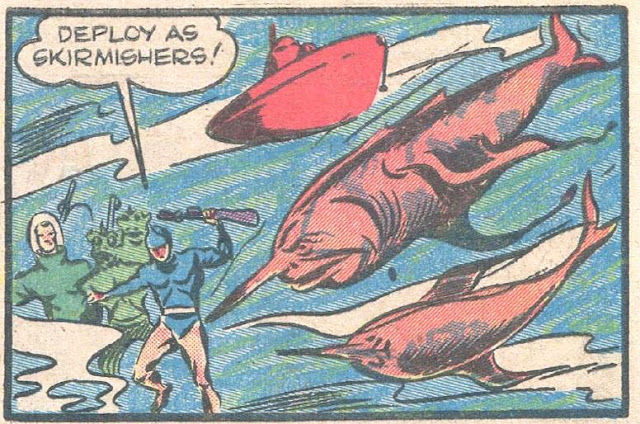
    This might just be the bold new look the narwhal have been looking for. (Science Comics 008, 1940)

  • NOTES – JANUARY 2025

    Heaven help me, I looked forward to the 1950s issues of Planet Comics to see what the Gale Allen feature ended up like and boy oh boy do I regret it. It’s one thing to only read comics from 1940, but seeing the improvements to the form after a decade or so makes it hard to go back. But I must soldier on!

    Happy New Year!

    Infographics:

    A conceptual drawing of a spaceship and some speculative facts about space travel c.1940 (Planet Comics 009, 1940)

    Ephemera:

    This is a bit out of order seeing as I have a two week or so buffer of posts most of the time and I write the Notes bits as they occur to me, but a real theme that has emerged as I’ve read the 1940 issues of Planet Comics has been that Fiction house was just repurposing whole stories left and right, including ones that were written and drawn for characters from other comic book companies. To be clear, I don’t think that this was a shady business practice or anything, just that the industry was still new and that almost every book was an anthology title that features were being shuffled in and out of constantly – it’s no wonder that artists were left with finished stories that were no longer wanted from time to time – why not just slap a new name on the hero and publish it?

    With that in mind, I am 100% confident in saying that this first Crash Parker story started life as a Cyclone story over at Quality Comics – the setup of colonizing a new planet after a space race and even the look of the evil Martian king are dead giveaways. Good news for fans of Cyclone, the character who appeared in 4 comics in 1940, I guess. (Planet Comics 009, 1940)

    Honours:

    American pilot Ted O’Neil is given an unspecified medal for bringing down an Axis superweapon. (Prize Comics 004, 1940)

    Names:

    The third case tackled by Fox Features mid tier hero the Eagle is catching a gang of pickpockets, and that gang’s lead is named Ben Dread, which I think is unnecessarily cool. Save the good names for more interesting criminals, I say. (Science Comics 003, 1940) 

    Drawn Without Reference:

    This might just be the bold new look the narwhal have been looking for. (Science Comics 008, 1940)