The Curse of Skeleton Munroe

Category: extortionist

  • MINOR SUPER-VILLAIN 868: THE HOOD

    (Wonderworld Comics 019, 1940)

    The Hood, a mysterious figure (who leaves a note with an unfortunately cut-off symbol that I can only assume/hope is a hood-and-crossbones) is terrorizing an unnamed city with a series of murders – eight in one week! 

    Going by the old wisdom that the murderer always returns to the scene of the crime, the Flame waits at the site of the latest murder and is rewarded when the Hood does just that. He is however unsuccessful in capturing the fiend due to the twin facts that a) the Hood thought to bring some guys along with him and b) an unfortunate woman happens by just in time to be taken hostage. 

    The Flame and the never-named woman are taken prisoner and spend some time escaping while the Hood lines up his next victim, a store owner who lives near the Sea Clock mentioned in his taunting note. This is when we finally get some inkling of the Hood’s motivations: far from being an ordinary homicidal maniac, he is instead forcing his victims to sign over their property to him before murdering them.

    (I would just like to take a second here to roast the Unnamed City authorities for the sheer amount of consternation they evince at the notion of a “sea clock” when they live in a town that has such a large clock tower located on its waterfront)

    The Hood is finally unmasked and turns out to be the Unnamed City Mayor’s personal secretary, Jenkins, who the Flame had held in deep suspicion for the entire issue for using the word “extraordinary” to describe the killer. This sort of thing is always highlighted when it pays off, but how many times does a crime go unsolved because of such unwarranted suspicion of a person with a weird vocabulary or a tendency for malapropisms, hmm?

  • GENERIC COSTUMED VILLAIN ROUND-UP 029

    You’ll never believe how close these guys get to being name-brand super-villains! 

    The Great-Great-Grandson of Lafitte is a flamboyant character who runs a protection racket on coconut plantations on the US Virgin Islands. Is he really a descendant of the great pirate captain? Who can say, but what is certain is that he puts on a good show before getting his block absolutely knocked off by US Navy goofs Spark Stevens and Chuck Lawson. (Wonderworld Comics 009, 1940)

    Some classic fake haunting shenanigans by a group of spies assigned to disrupt the work of US government scientist Dr Sloan. Punched and apprehended by K-51. (Wonderworld Comics 013, 1940)

    The Killer is head of a gang of extortionists and kidnappers who target rich men around an indeterminate US metropolis. True to his name, the Killer murders his targets whether they pay up or not, which I personally think might be a poor long-term strategy. We shall never know, because in the short term the Flame gets involved and roasts the entire gang before delivering the Killer to the authorities. (Wonderworld Comics 014, 1940)

    Professor Z has so many villainous accessories – an eye patch, a castle, a tiger, terrible hair, henchmen dressed in colour-coded, vaguely sci-fi uniforms – that it may surprise you to learn that his entire operation is set up so that he can commit insurance fraud. Perhaps the out-of scale trappings are what attracts the attention of the Phantom Rider.

    This adventure is personally annoying to me because while the Phantom Rider was previously absolutely set in the Old West, at the end of this one he calls for the authorities and two regular cops rock up. It’s yet another time that the line between the past and present in a Western comic is so blurry that you could ride a horse through it and I will never stop grumbling about this when it happens. (Wonderworld Comics 015, 1940)

  • MINOR SUPER-VILLAIN 839: THE DOCTOR

    (Top-Notch Comics 010, 1940) 

    The Doctor operates a simple but brutal extortion racket: a network of crooked doctors refer workplace compensation cases to him at his fake hospital and he then charges them as much as they are being paid in compensation, and if anyone dares to complain, they suddenly require urgent surgery and die on the operating table.  

    For the second time in two days I must note: surgical scrubs are such a good super-villain costume.

    This is exactly the sort of thing that the Wizard hates, and you just know that Roy the Super-Boy has to get in on Beating Up an Entire Hospital. Roy almost gets murdered for his trouble, but the Wizard shows up in the nick of time, and the Doctor’s entire network gets handed over to the authorities.

  • MINOR SUPER-VILLAIN 787: THE TERROR TRUST

    (Sure-Fire Comics 002, 1940)

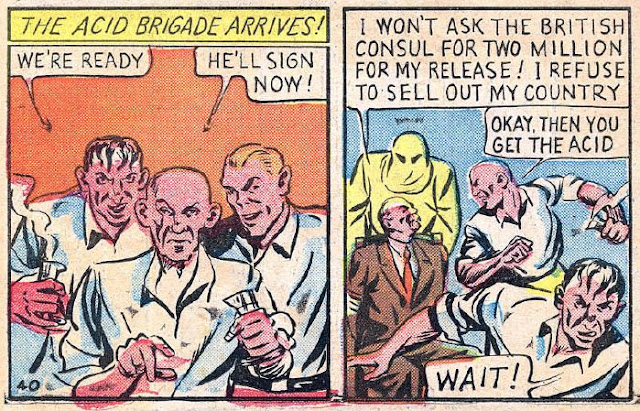
    The Terror Trust is a group with a very simple money-making scheme: demand money from millionaires and then throw acid in the faces of the one who refuse to pay up. X, the Phantom Fed infiltrates this group by breaking captured member Horton out of prison and then impersonating him.

     
    X’s scheme falls apart when the Trust’s members realize that Horton was simply not clever enough to effect his own escape, leading him to capture one of the ringleaders, prominent psychologist Professor Parks, and extract the names of the remaining two from him using some legally suspect truth serum.

    Does X then complete the roundup of the Terror Trust in disguise as Parks? Nothing so simple for the Phantom Fed. First off, he disguises himself as the local Police Commissioner, then enlists the aid of the Trust’s next victim, Sir Anthony, and then poses as Parks. Or rather as the Commissioner posing as Parks. Does he do this as a way to gain Sir Anthony’s trust, perhaps? A good guess, but no, he immediately tells Sir Anthony that he is actually X in disguise. It might be in an effort to make the local police look good but honestly I reckon that it’s merely for the challenge of the thing, that by his second appearance X is getting a bit tired of the regular master of disguise schtick and looking to up the difficulty a bit. Real adrenaline junkie stuff.

    As is customary we must take a moment to recognize the little people who make the true super-villainy happen, and this time our focus is on this bunch of absolute creeps, the Acid Brigade. Just something to keep in mind when you create a business that revolves around the act of throwing acid in people’s faces: you’re going to have to work with people willing to do that. It’s an HR nightmare, I can only assume.

  • GENERIC COSTUMED VILLAIN ROUND-UP 020

    We’re stretching the definition of the term “generic” this week, folks.

    Carr, the self-styled Planetary Potentate, is released from the insane asylum that he is imprisoned in when a resurrected sub-sea dinosaur called the Amphisaur crashes into it. He sets out to claim his rightful place at the head of society, along with his friend/ companion/ army, the wild man Simeo.

    While murdering and robbing a gas station attendant, Carr learns of the Amphisaur and its role in their escape and vows to aid his newfound ally against the forces of the enemy as represented by former mummy/current magical super-hero Mystico.

    At this point in the story I am fully expecting the pair to have a meaningful interaction with the Amphisaur, something along the lines of them interfering with Mystico’s second attempt to kill it and then either riding it around as a war-beast or getting eaten by an uncaring monster. Instead, they are unceremoniously knocked out by the Amphisaur’s death-throes. Mystico doesn’t even know that they’re there! (Startling Comics 004, 1940)

    Boris Ivanoff is not a particularly remarkable freelance spy in most respects, but he really does have a flair for the theatrical. I really like the flashlight bit above, but I really really like the fact that he wears that sheet ghost outfit for the entire adventure for no stated reason. The authorities already know his name, where he is and enough about his plans to substitute secret agent Q-13 for his new recruit, for heavens sake. They don’t even bother to dramatically unmask Ivanoff at the end, because the sheet is apparently just an affectation! (Super-Mystery Comics v1 003, 1940)

    This fellow is really Jay Jackson, publisher of newspaper the Morning Star, who extorts money out of people by threatening to print scandalous articles about them and then murders the ones who refuse to pay. He is very frustrating to me because I find his weird Halloween mask disguise very charming, except that I have read this story and know that it is a racist Chinese caricature, which is the opposite of charming. Annoying!

    Jackson is also the subject of what is possibly the most extreme version of the bit where a super-hero scares a confession out of someone I have ever read, in which Magno collapses an entire skyscraper on top of him, seemingly with no guarantee that he will survive the process. Plus, there are like half a dozen other crooks in the building when it comes down and none of them are extracted from the wreckage in time to confess their wrongdoings. (Super-Mystery Comics v1, 1940)

    Adopting the role of the high priest of the local Tiger-God might have seemed like a good way to take control of a region that contained a rich gold mine, but all too predictably it ended up with this fellow being thrown into his own tiger pit once he is revealed as a fraud by adventurer Scotty of the Skyways. (Super Spy 001, 1940)

  • MINOR SUPER-VILLAIN 776: THE BLUE SPARK

    (Super-Mystery Comics v1 002, 1940)

    In terms of crime, the Blue Spark is ambitious but not extraordinary: a little corporate extortion, some bank robbery, a few kidnappings. Nothing we haven’t seen a few hundred times by now.  When it comes to the trappings of super-villainy, however, the Blue Spark is on the cutting edge.

    Just look at that costume – it’s not quite the standardized super-villain getup we will eventually see on so many one-shot Batman villains but it’s pretty damn close, and particularly in an era in which most villains are still pairing a mask with a suit and tie or a robe. Even more impressive and ahead of its time is the Blue Spark’s choice to dress his henchmen in a simplified version of his own uniform. Just really impressive stuff.

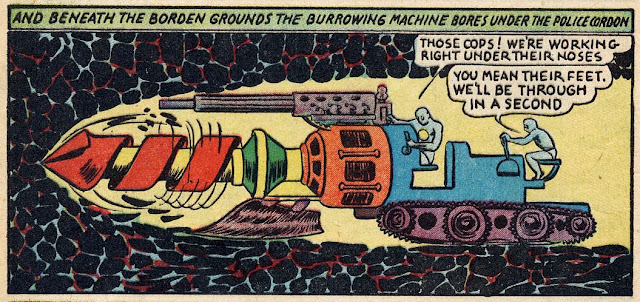
    The Blue Spark’s main gimmick, a heat ray cannon mounted on a truck, isn’t quite as remarkable but it is a pretty sweet bit of gear. Plus he has another one mounted on a cool-ass drilling machine!

    (it is somewhat unclear if the Blue Spark has a second ray that allows him to mind control people or if his heat ray doubles as a mind control ray, and determining this is not helped by the fact that he clearly has an aesthetic fondness for that particular style of scientific greebling on the outside of the rays. It’s a good clean visual on the mind control ray, I will say that)

    The Blue Spark’s henchmen (called the Blue Rubber Men at one point, btw) are not just well-dressed:  their costumes have  little nozzles in the chest that lets them be inflated like a balloon to render them immune to fisticuffs  – another idea that sounds like something out of a Silver Age comic, twenty years early.

    Technology or no, inflation fetish suits or no, the Blue Spark vs Magno is your classic case of a villain who is so little of an even match for the hero that the plotter’s concern must lie in keeping them apart for as long as possible because the instant they meet up, something like the above happens. Magno didn’t even give him a chance to blow up his suit, the poor guy.

  • MINOR SUPER-VILLAIN 776: THE BLUE SPARK

    (Super-Mystery Comics v1 002, 1940)

    In terms of crime, the Blue Spark is ambitious but not extraordinary: a little corporate extortion, some bank robbery, a few kidnappings. Nothing we haven’t seen a few hundred times by now.  When it comes to the trappings of super-villainy, however, the Blue Spark is on the cutting edge.

    Just look at that costume – it’s not quite the standardized super-villain getup we will eventually see on so many one-shot Batman villains but it’s pretty damn close, and particularly in an era in which most villains are still pairing a mask with a suit and tie or a robe. Even more impressive and ahead of its time is the Blue Spark’s choice to dress his henchmen in a simplified version of his own uniform. Just really impressive stuff.

    The Blue Spark’s main gimmick, a heat ray cannon mounted on a truck, isn’t quite as remarkable but it is a pretty sweet bit of gear. Plus he has another one mounted on a cool-ass drilling machine!

    (it is somewhat unclear if the Blue Spark has a second ray that allows him to mind control people or if his heat ray doubles as a mind control ray, and determining this is not helped by the fact that he clearly has an aesthetic fondness for that particular style of scientific greebling on the outside of the rays. It’s a good clean visual on the mind control ray, I will say that)

    The Blue Spark’s henchmen (called the Blue Rubber Men at one point, btw) are not just well-dressed:  their costumes have  little nozzles in the chest that lets them be inflated like a balloon to render them immune to fisticuffs  – another idea that sounds like something out of a Silver Age comic, twenty years early.

    Technology or no, inflation fetish suits or no, the Blue Spark vs Magno is your classic case of a villain who is so little of an even match for the hero that the plotter’s concern must lie in keeping them apart for as long as possible because the instant they meet up, something like the above happens. Magno didn’t even give him a chance to blow up his suit, the poor guy.

  • MINOR SUPER-VILLAIN 761: THE HOODED RIDERS

    (Speed Comics 007, 1940)

    Despite their KKK-adjacent looks and tactics, the Hooded Riders are nothing more than a gang of rural protection racketeers. Over the course of the adventure the riders keep rolling out more elaborate equipment and plans to deal with both their targets and the interference of Shock Gibson and I kept thinking that their deep well of resources was going to turn out to be due to some sort of secret funding from a hostile country but no, they’re just unusually well-prepared gangsters. 

  • MINOR SUPER-VILLAIN 751: THE MUMMY

    MINOR SUPER-VILLAIN 751: THE MUMMY

    (Smash Comics 015, 1940) 

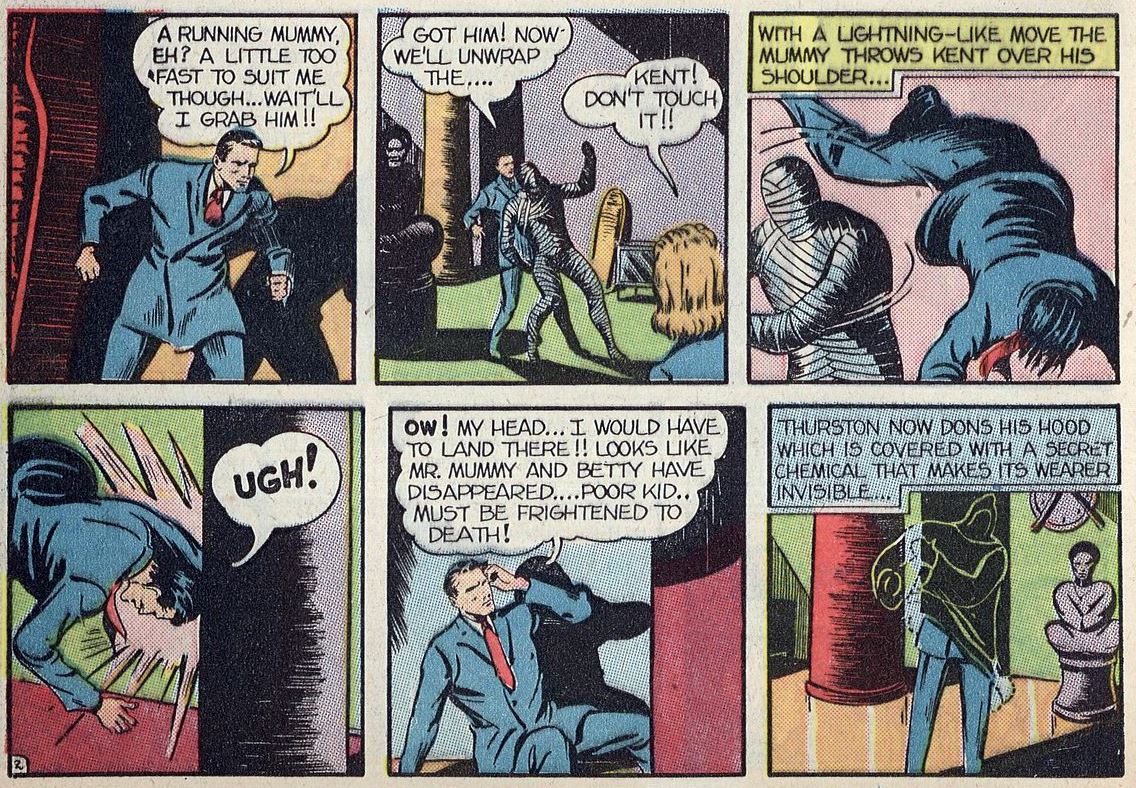
    Strange things are happening at the museum: knives are flying through the air, suits of armour are wandering around in a menacing fashion and things are getting pretty spooky. Head Curator Robbins asks his pal Kent Thurston (aka the Invisible Hood) to check things out, at which point the Mummy enters the picture, knocks out Thurston and kidnaps Robbins’ plucky daughter Betty.

    After grabbing Robins as well, the Mummy reveals his devious plan: Robbins must resign as curator. And that’s it. Unsurprisingly, the Mummy turns out to be Nolan, the Assistant Curator, who has admittedly hacked the whole promotion process with this bold scheme but who also has not done a particularly great job of deflecting suspicion from himself as the only person who is going to benefit from the scheme.

    As usual, the Invisible Hood’s power of invisibility is a real asset and he cleans up the gang with relative ease. He even does a bit of a challenge run by initially approaching dressed up as a second mummy, with a spooky twist once he removes his wrappings to reveal the nothingness within.

    Not the greatest fake mummy in comics history, but I’m happy to get any fake mummies.

  • MINOR SUPER-VILLAIN 729: THE WRECKER

    (Science Comics 008, 1940) 

    The Wrecker is a very good example of how a good name can elevate a project out from the ordinary. Comics books are full of corporate extortion schemes – it’s one of the classic scheme types for a reason. You can ramp the threat to life up or down with ease depending on just what is being sabotaged and likewise there are opportunities for big action setpieces as buildings or other corporate infrastructure are targeted. But while I would be hard pressed to find something to write about every time some gang of miscreants shakes down a construction company, once one of them starts calling themself “the Wrecker” well then my interest is piqued.

    The Wrecker himself is nothing special, even if he has a very good thick gangster accent. Somewhat charmingly, though, the Wrecker’s gang are also occasionally referred to as the Wreckers. Wrecker and the Wreckers! Gang name, band name, bowling team name, pub quiz name.

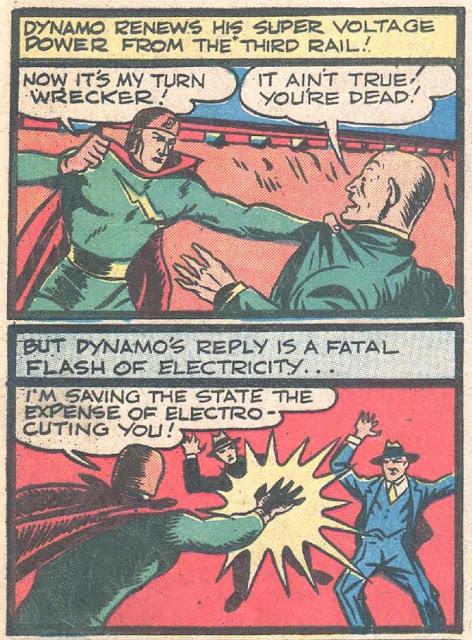
    Dynamo runs out of juice and gets captured during his initial battle with the gang (evidently trading pot-shots with some low-level goons is as energy-intensive as travelling to Betelgeuse) but as with most of his foes, the Wrecker is… a great believer in ironic deaths or something, I don’t know. They all try to electrocute him for some reason is all I can say, and maybe it’s just down to it being 1940 and all of the villains just aren’t genre-savvy enough to know the basics of comic book pseudo-elementalism. Regardless, the Wreacker electrocutes Dynamo and then Dynamo returns the favour – so long Wrecker.