The Curse of Skeleton Munroe

Category: extortionist

  • MINOR SUPER-VILLAIN 729: THE WRECKER

    (Science Comics 008, 1940) 

    The Wrecker is a very good example of how a good name can elevate a project out from the ordinary. Comics books are full of corporate extortion schemes – it’s one of the classic scheme types for a reason. You can ramp the threat to life up or down with ease depending on just what is being sabotaged and likewise there are opportunities for big action setpieces as buildings or other corporate infrastructure are targeted. But while I would be hard pressed to find something to write about every time some gang of miscreants shakes down a construction company, once one of them starts calling themself “the Wrecker” well then my interest is piqued.

    The Wrecker himself is nothing special, even if he has a very good thick gangster accent. Somewhat charmingly, though, the Wrecker’s gang are also occasionally referred to as the Wreckers. Wrecker and the Wreckers! Gang name, band name, bowling team name, pub quiz name.

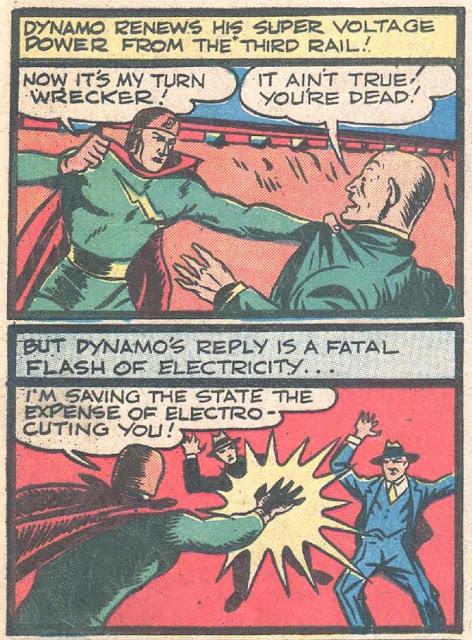
    Dynamo runs out of juice and gets captured during his initial battle with the gang (evidently trading pot-shots with some low-level goons is as energy-intensive as travelling to Betelgeuse) but as with most of his foes, the Wrecker is… a great believer in ironic deaths or something, I don’t know. They all try to electrocute him for some reason is all I can say, and maybe it’s just down to it being 1940 and all of the villains just aren’t genre-savvy enough to know the basics of comic book pseudo-elementalism. Regardless, the Wreacker electrocutes Dynamo and then Dynamo returns the favour – so long Wrecker.

  • GENERIC COSTUMED VILLAIN ROUND-UP 018

    The hits flops just keep coming.

    This gang doesn’t bother to give themself a proper name even though their scheme is extremely big and loud: they have access to a magnetic ray device and have employed it to pull down multiple large buildings in scenic Midtown City, thus killing between one and four thousand people (a printing error obscures the exact number), all so that their demands for protection money from the owners of other buildings will be paid without question. It’s just as well that the Comet eye-beams them all.

    I really am stuck on the fact that they haven’t bothered to give themselves a name, when they have such attention to detail that the hostages they grabbed in order to stymie the Comet were literally Mr & Mrs John Q. Public Priorities differ, I suppose. (Pep Comics 009, 1940)

    Buck Brady of the FBI is investigating a gang that is smuggling Malaysians across the Canada/ US border (because nobody would expect them to, that’s why) and the ringleader, when he shows up, is dressed fantastically. I cannot believe that more super-villains aren’t wearing big fur coats when they look so great when paired with a cowl mask. Anyway, he turns out to be Lieutenant Thomas of the US Border Patrol. (Prize Comics 003, 1940)

    Move over pre-2000s Wolverine, because this guy right here is possibly the most mysterious figure in comics. Samson and David track him to the hidden City of Erde after he initiates a series of attacks against the US, presumably with an eye on conquering it. But who is he? How did he become king of Erde and its population of cavemen? Where did he get the weaponry his cavemen are using in their attacks? Just how the heck did a whole city full of cavemen go unnoticed smack in the middle of the US, secret valley or no? (Samson 002, 1940)

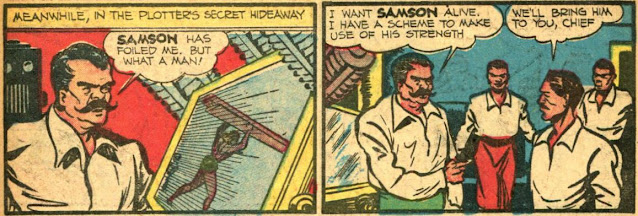
    This unnamed mustachioed man is remarkable mostly for the number of pivots that he manages to pull off over the course of a 13-page story. He first attracts Samsons’s attention with a scheme to pit the presumably South American country of Ecuazil against its neighbour (sadly unnamed but probably something like Perile or Aregentuay) and then conquer both once they were both sufficiently weakened by the fighting. Once Samson and David put an end to that he hypnotically enslaved Samson for a while, then launched into a full-fledged invasion of the US. Pretty good range, I’d say.

    The US invasion plan also featured this amazing spindly-legged flamethrower tank. Bask in its pleasing aesthetics and questionable strategic value! Please also note David in these panels as this is a good representation of his role in the comic: all enthusiasm, willing to lasso absolutely anything, very low actual impact on events as they unfold but clearly Samson enjoys having him around.

    Finally, I don’t quite know why but I feel that I must highlight this sequence in which Samson hurls a man into a pit and then his lifeless body is just there for the next two panels. I want to frame this and hang it on my wall. (Samson 002, 1940)

  • MINOR SUPER-VILLAIN 717: THE MASKED TERROR

    MINOR SUPER-VILLAIN 717: THE MASKED TERROR

    (Rocket Comics 003, 1940)

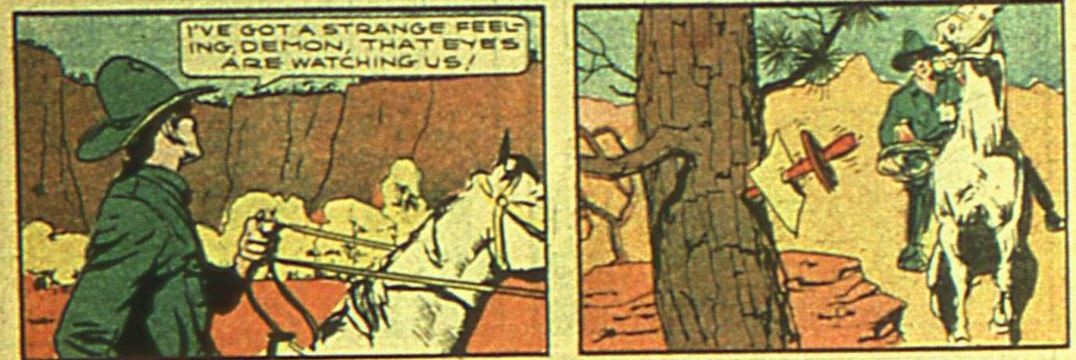
    The Phantom Ranger is just minding his business one day when he receives a sternly-worded letter via throwing knife, warning him to “steer clear of the red-headed girl.” This is of course your classic case of warning the hero off before he has a dang clue what’s going on.

    Everything is okay though, because the young woman who shortly rides up and requests the Ranger’s help has blonde hair. The “red-headed girl” must be seeking aid elsewhere. Or the colourist and the letterer had some sort of miscommunication. One of the two.

    The girl, whatever her hair colour, is named Lindy Davis, and the Masked Terror has kidnapped her father for ransom, a crime you don’t see as much in a lot of Western comics but I am certain is an authentic Old West crime.

    The Phantom Ranger accompanies Lindy to the handoff, where we learn that a) the Masked Terror is one homely cuss and eventually b) that he has already killed Mr Davis. The Phantom Ranger sets off in hot pursuit.

    And of course the Masked Terror turns out to be Ansom, the Davis’ neighbour and, crucially, the only one Lindy told about her plan to contact the Phantom Ranger. Plus I assume that he is the only nearby man ugly enough to be a suspect. The Terror chooses to go for his gun and meets a swift end.

  • MINOR SUPER-VILLAIN 717: THE MASKED TERROR

    MINOR SUPER-VILLAIN 717: THE MASKED TERROR

    (Rocket Comics 003, 1940)

    The Phantom Ranger is just minding his business one day when he receives a sternly-worded letter via throwing knife, warning him to “steer clear of the red-headed girl.” This is of course your classic case of warning the hero off before he has a dang clue what’s going on.

    Everything is okay though, because the young woman who shortly rides up and requests the Ranger’s help has blonde hair. The “red-headed girl” must be seeking aid elsewhere. Or the colourist and the letterer had some sort of miscommunication. One of the two.

    The girl, whatever her hair colour, is named Lindy Davis, and the Masked Terror has kidnapped her father for ransom, a crime you don’t see as much in a lot of Western comics but I am certain is an authentic Old West crime.

    The Phantom Ranger accompanies Lindy to the handoff, where we learn that a) the Masked Terror is one homely cuss and eventually b) that he has already killed Mr Davis. The Phantom Ranger sets off in hot pursuit.

    And of course the Masked Terror turns out to be Ansom, the Davis’ neighbour and, crucially, the only one Lindy told about her plan to contact the Phantom Ranger. Plus I assume that he is the only nearby man ugly enough to be a suspect. The Terror chooses to go for his gun and meets a swift end.

  • MINOR SUPER-VILLAIN 693: THE TARANTULA

    (Pep Comics 010, 1940)

    A vile villain known as the Tarantula is extorting the young wealthy women of London and then murdering the ones who don’t pay up, and Inspector Bentley is on the case after two significant pieces of evidence fall into his lap: the latest body is left on the steps of Scotland Yard and then the latest extortion attempt is made against Deborah Morgan, whose father went to school with Bentley’s boss and you can’t beat the old boys’ club when it comes to swinging the forces of law into action.

    The usual parade of suspects that fills the pages of an Inspector Bentley story is a bit thin on the ground in this one. Don’t get me wrong, the numbers are there, but at least two of them are clearly padding – they don’t even say anything. The only credible suspects are BJ Morgan, his daughter Deborah (assuming some real 4D chess moves on her part), her fiance Bill Barnes and, in a big reach that the comic is not afraid to make, Bentley’s boss. I’ll say right now that the boss is a complete red herring set up by a walking stick.

    (please take note of the Tarantula’s little spider signature, which I love)

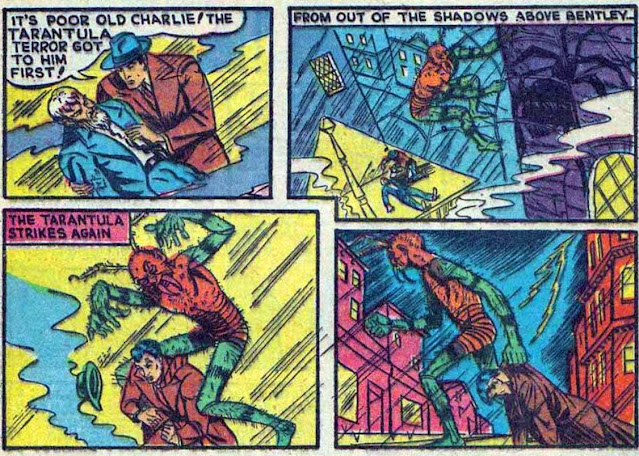
    Bentley goes to meet a potential witness, at which point w get the most important revelation of the episode: the Tarantula is not just some murderer but a proper super-villain, with a proper costume and everything! Sure, some spider fans might quibble about the inclusion of antennae (not to mention the use of fairly mild tarantula venom as the murder vehicle) but it’s been so long since I’ve seen a villain who wasn’t just wearing a mask that I literally cheered when I saw this dude.

    The Tarantula turns out to have about the right constitution for a basement dwelling spider breeder and goes down under the attacks of a heavily tied up Bentley. He’s smashed into his case of tarantula containment orbs in a way that would usually signal a villain’s ironic end via their own murder method, but I’ve reread the ending of this story a couple of times now and I have no clue whether the Tarantula is dead or alive at the end.

    The Tarantula turns out to be Deborah’s fiance Bill Barnes, who did it all because he was insecure about marrying a wealthy woman while not having much money himself. Moderately sweet, until you remember that he expressed this insecurity by extorting and murdering other young women. Wotta creep, am I right?

    More importantly is the question of exactly why Bentley was suspicious of Deborah’s circle: because when he went to interview his acquaintance Charlie about a possible Tarantula sighting he found him murdered and the only ones who knew about the potential witness were Deborah and her intimates. But did Bentley set a trap using the life of an innocent beggar or is he just so bad at infosec that he got a man murdered by accident?

  • MINOR SUPER-VILLAIN 628: PROFESSOR DONALDSON

    (Fantastic Comics 011, 1940)

    Sometimes it’s nice to read a story about a straightforwardly criminal scientist, and that’s just what Professor Donaldson is. He’s invented an “electronic exploder” which can turn steel to dust and by gar if he isn’t going to use that to extort some money out of people with steel things that they would like to stay intact, such as the superstructure of a skyscraper.

    Donaldson is also prepared to pivot: when his original attempt to set up a protection racket fails he attempts to extort NYC itself. This also fails, because Samson is in the city and the Generic New York Mayor has a guy on staff who knows how super-heroes work. Why, they often don’t even ask to be paid!

    But Professor Donaldson just won’t stop pivoting! If extortion isn’t going to pay off then a steel-dissolving ray is the perfect thing for bank robbery!

    The bank robbery is, alas, Donaldson’s last pivot before Samson and David catch up to him. He puts up a very brave front but ultimately a pasty-faced lab rat, even armed with a fire axe, is no match for David, let alone Samson.

    At least Donaldson’s death is somewhat poetic, as he is run down, or “wrecked” by a train, just as he himself had wrecked a train in his earlier campaign to extort the city.

    Shout out also Professor Donaldson’s unusually large number of named henchmen. Good luck looking for new employment Buck, Butch, Silky, Mike, Slinky and Bill. Except not Buck because Samson killed him. Rest in peace, Buck.

  • MINOR SUPER-VILLAIN 628: PROFESSOR DONALDSON

    (Fantastic Comics 011, 1940)

    Sometimes it’s nice to read a story about a straightforwardly criminal scientist, and that’s just what Professor Donaldson is. He’s invented an “electronic exploder” which can turn steel to dust and by gar if he isn’t going to use that to extort some money out of people with steel things that they would like to stay intact, such as the superstructure of a skyscraper.

    Donaldson is also prepared to pivot: when his original attempt to set up a protection racket fails he attempts to extort NYC itself. This also fails, because Samson is in the city and the Generic New York Mayor has a guy on staff who knows how super-heroes work. Why, they often don’t even ask to be paid!

    But Professor Donaldson just won’t stop pivoting! If extortion isn’t going to pay off then a steel-dissolving ray is the perfect thing for bank robbery!

    The bank robbery is, alas, Donaldson’s last pivot before Samson and David catch up to him. He puts up a very brave front but ultimately a pasty-faced lab rat, even armed with a fire axe, is no match for David, let alone Samson.

    At least Donaldson’s death is somewhat poetic, as he is run down, or “wrecked” by a train, just as he himself had wrecked a train in his earlier campaign to extort the city.

    Shout out also Professor Donaldson’s unusually large number of named henchmen. Good luck looking for new employment Buck, Butch, Silky, Mike, Slinky and Bill. Except not Buck because Samson killed him. Rest in peace, Buck.

  • MINOR SUPER-VILLAIN 624: MOLOKA

    (Fantastic Comics 009, 1940)

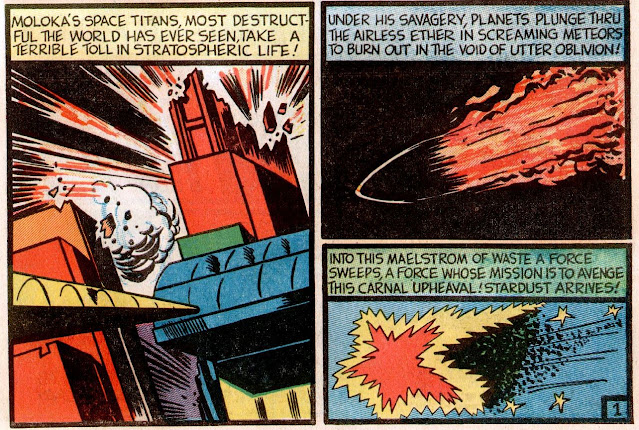
    Moloka is our second Stardust the Super Wizard foe from a story not penned by Fletcher Hanks and I’d say that our unknown scribe gets things mostly right: there’s certainly enough wanton destruction for this to be a Hanks comic. Moloka is a humanoid alien who has developed world-wrecking super weapons and as the comic opens is using them to blast away at various inhabited planets.

    Where exactly this is happening is a little unclear. If Fletcher Hanks’ idea of how outer space is structured is a little fuzzy then his stand-in is even more vague on the particulars. It’s equally possible that Moloka is based in another star system and using weapons with an interstellar range as it is that he’s in our own Solar System and there are just a heap of extra planets to blow up.

    Moloka’s goal is also a bit unclear. I think that he’s looking to become some sort of Galactic or Solar Dictator but he spends an awful lot of time just blasting away at inhabited planets without really asking to be put in charge. It’s possible that the power is an excuse and the blasting is the point.

    Moloka is based on Pluton, which is either an alternate spelling of Pluto (that I have seen before to be honest) or as mentioned above a completely extrasolar one. There’s no way of working out which it is though I will say that none of Pluto’s satellites were discovered before 1978 so I have no idea where Nemus is supposed to be.

    Moloka does give some hints as to his mental state when he mistakes a vengeful Stardust for some sort of elemental being created by the hellish energies at his command. It’s kind of charming! It’s also wildly out of character for Stardust “the shortest distance between two lines is a punch” the Super Wizard. Stardust’s goal with this little ruse is to goad Moloka into firing his weapon at Earth, then using his own patented ray-reversal technology to redirect it back to its source.

    As to whyhe bothers to do this when he’s perfectly capable of blowing the whole of Pluton to hell and gone? I guess it’s a bit more of an ironic punishment to leave a warmonger stranded on a planet that they themself have devastated? Sure, we’ll go with that.

  • MINOR SUPER-VILLAIN 622: PROFESSOR SIMM

    MINOR SUPER-VILLAIN 622: PROFESSOR SIMM

    (Fantastic Comics 009, 1940)

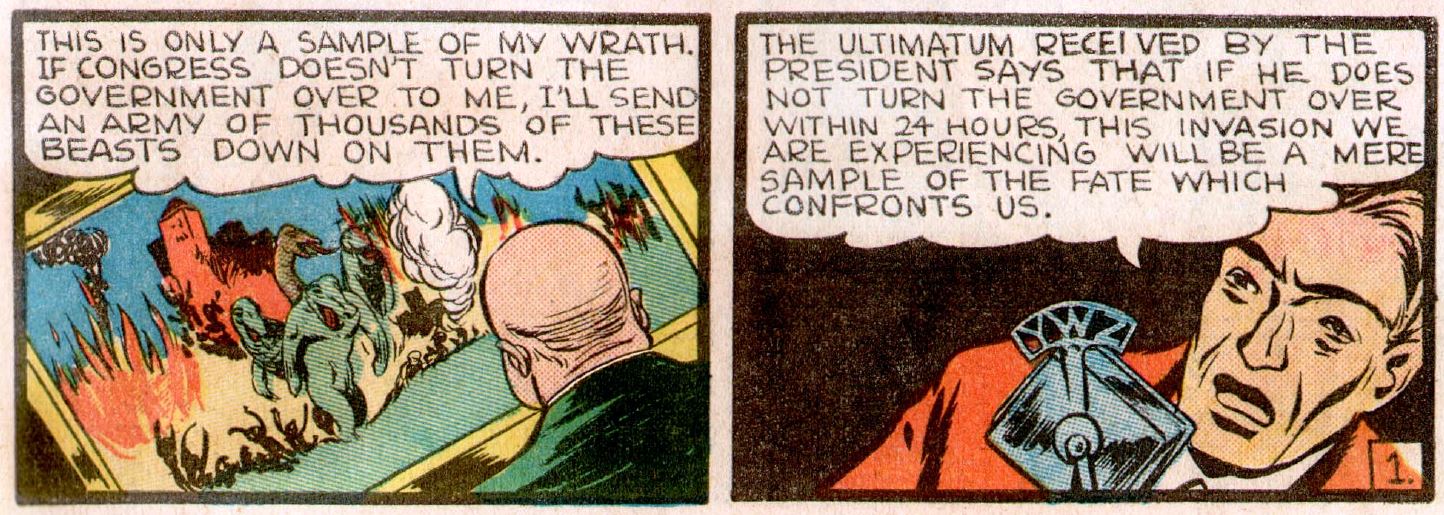
    We open on a very exciting scene! Professor Simm has unleashed giant monsters on an unnamed US city! Chaos reigns!

    I unironically love these monsters. They have that half-baked quality that you get in generic kids toys – the kind of thing you got as a cheap way for your parents to occupy you on a trip and because they have no built-in lore you end up inventing a whole backstory for them. That picture of the humanoid reptile standing next to the giant anthropoid would be on the packaging.

    Having front-loaded a lot of positivity (one last dollop: look at the cavemen riding away on the creatures! It’s very cute!) I must now reveal that this is a pretty bad comic book adventure. I don’t know what was going on at Fox Features in mid-to-late 1940 but they were wildly swapping writer/artists in and out of serials – this very issue features both a Stardust the Super Wizard and a Space Smith story drawn by someone other than Fletcher Hanks!

    While this is a minor problem in terms of narrative consistency – this is as far as I know the only time that Samson it depicted as being three times taller than an average human, for example – it also feels like the story was put together in haste or as the third or fourth thing on someone’s mind. Nothing quite hangs together – Professor Simm starts out demanding control over the US government and later is purely interested in money, for example.

    Once Samson makes his way to Simm’s island castle the story becomes a series of loosely connected vignettes: Samson finds a cage full of cavemen and gets inside, only to immediately leave again. Samson finds a room full of prisoners and skeletons and frees the prisoners. Samson confronts Simm, who escapes. Samson frees more prisoners. Samson kills Simm. It could all be assembled into a coherent plot but very much is not.

    That said, it certainly is a comic full of incident, such as this scene in which Samson sets off a volcano to destroy all the monsters (and hopefully not the prisoners. Hopefully they escaped off-panel) and flies away on a giant bird.It just doesn’t all hold together as a narrative. Things can only get more coherent as we make our way through the Golden Age, right? (SPOILER: not necessarily)

  • MINOR SUPER-VILLAIN 622: PROFESSOR SIMM

    MINOR SUPER-VILLAIN 622: PROFESSOR SIMM

    (Fantastic Comics 009, 1940)

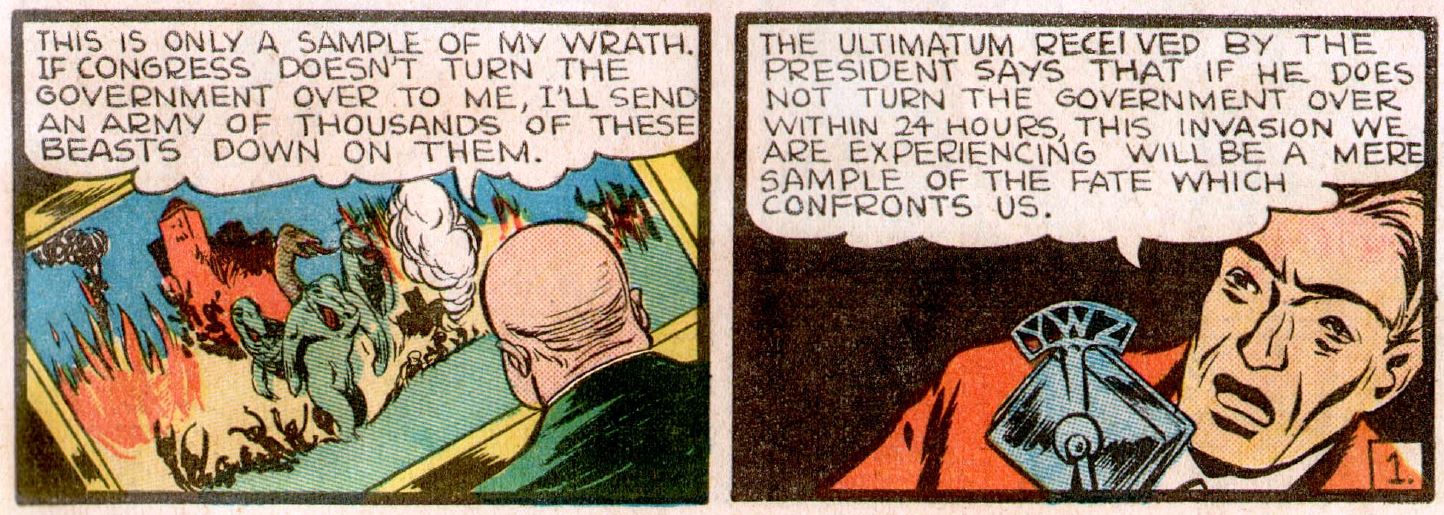
    We open on a very exciting scene! Professor Simm has unleashed giant monsters on an unnamed US city! Chaos reigns!

    I unironically love these monsters. They have that half-baked quality that you get in generic kids toys – the kind of thing you got as a cheap way for your parents to occupy you on a trip and because they have no built-in lore you end up inventing a whole backstory for them. That picture of the humanoid reptile standing next to the giant anthropoid would be on the packaging.

    Having front-loaded a lot of positivity (one last dollop: look at the cavemen riding away on the creatures! It’s very cute!) I must now reveal that this is a pretty bad comic book adventure. I don’t know what was going on at Fox Features in mid-to-late 1940 but they were wildly swapping writer/artists in and out of serials – this very issue features both a Stardust the Super Wizard and a Space Smith story drawn by someone other than Fletcher Hanks!

    While this is a minor problem in terms of narrative consistency – this is as far as I know the only time that Samson it depicted as being three times taller than an average human, for example – it also feels like the story was put together in haste or as the third or fourth thing on someone’s mind. Nothing quite hangs together – Professor Simm starts out demanding control over the US government and later is purely interested in money, for example.

    Once Samson makes his way to Simm’s island castle the story becomes a series of loosely connected vignettes: Samson finds a cage full of cavemen and gets inside, only to immediately leave again. Samson finds a room full of prisoners and skeletons and frees the prisoners. Samson confronts Simm, who escapes. Samson frees more prisoners. Samson kills Simm. It could all be assembled into a coherent plot but very much is not.

    That said, it certainly is a comic full of incident, such as this scene in which Samson sets off a volcano to destroy all the monsters (and hopefully not the prisoners. Hopefully they escaped off-panel) and flies away on a giant bird.It just doesn’t all hold together as a narrative. Things can only get more coherent as we make our way through the Golden Age, right? (SPOILER: not necessarily)