The Curse of Skeleton Munroe

Category: extortionist

  • MINOR SUPER-VILLAIN 245: SATANA

    (Flash Comics v1 013, 1941)

     I am torn on Satana! Torn verily in twain!

    My standard critique of a comic book scientist-villain is that they would have been better off using their tech in a non-crime endeavor, but Satana is a brilliant and pioneering young surgeon living in 1941 and given what I know about the history of women in science I think it’s fair to say that if she had decided to make a go of it in academia then there’s a decent chance that all her research would have been stolen by some dude and she might have gotten credit years after her death, if ever. Also, her signature breakthrough involves transplanting human brains (and eyes!) into tigers, which while groundbreaking might be a hard sell to the ethics committee.

    On the other hand, her crime scheme is very bad. In short: she extorts rich men with threats of harm, then gets work as an entertainer called Satana the Tiger Girl at rich guy parties and has her tigers kill the ones that don’t pay up. She only does it once before getting caught by Hawkman, that we know of, but even if she varied the method by which the tiger was introduced to the rich guy, it’s not a sustainable business model. Stylish, yes, but not sustainable.

    Perhaps the best part of the story is when Hawkman comes across a couple of tigers engaging in humanlike behaviors and it nearly drives him insane, like he’s an HP Lovecraft character. Human habits like… sitting near a newspaper and holding a pipe in their mouth. 

    They kinda hint at a return appearance for Satana at the end of the story but she doesn’t actually come back until 2004, in the same Hawkman story that brought back the Thought Terror. She’s a substantially different character by that point, with ties to the Ultra-Humanite and a focus on making humanoid animals via genetic modification. I’ll revisit her when and if I manage to keep doing this long enough to get to that era. It’s good that they brought her back! She’s a fun character!
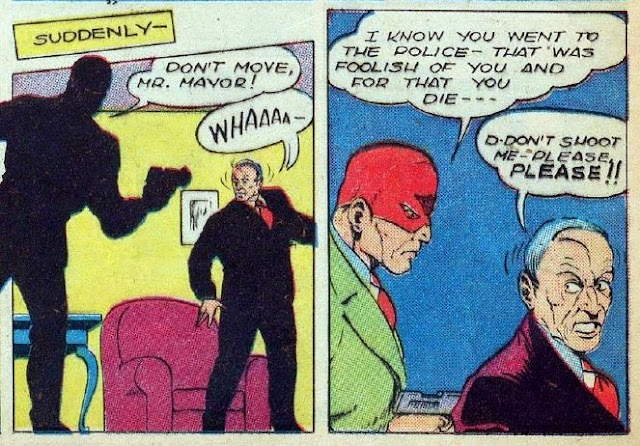
  • MINOR SUPER-VILLAIN 208: THE TERROR

    (Crack Comics 018, 1941)

    Not too much to distinguish this guy: he’s Bumps Bale, a former pinball racketeer (you’re just as likely to see Batman smashing up a bunch of pinball machines as an underground casino or a slot machine in the 40s. Gambling is Bad and Pinball is Gambling, was the attitude) who had hit hard times and decided to go into extorting mayors as a second career. Accordingly, he poisoned city comptroller Ezra Daves and promised Unnamed Mayor here some of the same if one million dollars in small bills was not produced post haste. Sadly for the Terror, the Clock got involved.

    I do have to say that I appreciate the cowl-style mask that the Terror is sporting. Personally I find it far more aesthetically pleasing than the executioner’s hoods and cloth draperies that have been more the norm thusfar.

    (also for those keeping track this is presumably the mayor who took over after the Big Shot was ousted, placing him somewhere on a very spicy alternate Wikipedia page for List of Mayors of New York City)

  • MINOR SUPER-VILLAIN 200: THE CRIMSON VULTURE

    (Crack Comics 015, 1941)

    The Crimson Vulture is a prime example of a character who could be so much better with just a little more oomph put behind him. His real name is Sarada, and he is a genius mechanical engineer who is back for revenge after being sent to prison. All well and good, but his actions – attempting to extort money from a series of rich men via mechanical vultures and then blowing them up when they refuse – have no in-story link to his motivation. They easily could, if, say, they were responsible for his incarceration or had profited from his genius while he was away, but no dice. Even if it was made clear that he was striking out at society in general, that would be more of a satisfying motivation.

    He gets blown up by Madam Fatal, a suitably ignominious end for our less-than-satisfying 200th minor super-villain.

  • MINOR SUPER-VILLAIN 199: THE CRAB

    (Crack Comics 013, 1941)

    The Crab here is a prime example of the gang boss who goes just over the top enough – and has a good enough moniker – to make the jump to full super-villain.

    His plan – hold the city to ransom for 5 million bucks, then blow up the first ambush the cops set for him to show he means business – is sufficiently out there, and he adds some flourishes like taunting the police via skywriting, but the thing that really does it is his signature: 

    It’s a little crab, oh my god

  • MINOR SUPER-VILLAIN 178: THE ARSON FIEND

    (Captain Marvel Adventures 002, 1941)

    The Arson Fiend! A simple villain conceptually: fire insurance salesman George D. Tweedle just can’t sell any fire insurance and so he starts what is nominally a protection racket but really seems to be an excuse for wholesale arson.

    The twist in this particular tale is that Tweedle has somehow developed or otherwise gotten his hands on a formula that transforms him into the fire-spewing and fireproof Arson Fiend. Legitimately super-powered crooks being a bit underrepresented at this point, I am delighted by this development! I had honestly expected the Fiend to be an asbestos outfit with a flamethrower concealed in each sleeve. The secondary twist is that Tweedle finds out that Billy is Captain Marvel seemingly without effort, which I love. Finally a comic book character is being held accountable for their poor infosec.

    Sadly, such a being cannot be long for a comics world. The Arson Fiend and Captain Marvel battle atop a large oil tank and it eventually turns out that however immune to fire you are, you still have to look out for the concussive force element of, say, an oil tank explosion if you want a long career in arson.

  • MINOR SUPER-VILLAIN 165: THE EEL

    (Blue Beetle v1 006, 1941)


    What makes them a super-villain? I’ll be honest. The Eel’s initial plot – take over 
    NYC York City ‘s shipping industry in order to starve and thereby ransom the city – was, while ambitious, a bit old hat and I was going to write him off as another jagoff gang boss with a decent moniker. But then! He reveals his Room of Horrors(!) where he pickles his enemies alive(!!), and, well, how could I not?

  • MINOR SUPER-VILLAIN 107: MANGO THE MIGHTY

    (More Fun Comics 057, 1940)

    Mango is a magician who fancies himself tough enough to go up against Dr Fate and quickly finds out that even though he can summon globes of flame and the undead legions of the Styx he is no match for the big man. This sort of thing happens to magical Golden Age characters pretty often – penny ante magical shitheels seem to have this urge to Peter Principle themselves against all comers, but whereas in an office setting rising to one’s level of incompetence leaves you with poor job satisfaction doing so in the cutthroat world of magic crime gets you dead or sealed un a magic boulder.

    But what’s with the name? I checked and they definitely knew what mangoes were in 1940. Why is it a villain’s name? Look: 

    Look at this, USA Comics 003, 1941 – the Defender fights a beast-guy named Mango.

    Adventure Comics 058, 1941 – villainous Pacific Islander named Mango,

    Blood of Dracula’s Castle, 1969 – evil hunchback… NAMED MANGO.


    WHAT’s WITH ALL THE MANGOS
  • MINOR SUPER-VILLAIN 089: SCRAG

    (Blue Beetle Comics 005, 1940)

    Scrag attempts to extort (New) York City using remote controlled bombers – not a terrifically unique plan but he’s just so gleeful about his evil that I love him. Blown up while battling the Blue Beetle.

  • MINOR SUPER-VILLAIN 089: SCRAG

    (Blue Beetle Comics 005, 1940)

    Scrag attempts to extort (New) York City using remote controlled bombers – not a terrifically unique plan but he’s just so gleeful about his evil that I love him. Blown up while battling the Blue Beetle.

  • MINOR SUPER-VILLAIN 078: MR GLIB

    (All American Comics 011 & 013, 1940)

    What makes them a super-villain? He’s a guy who kind of looks like Satan (named I.M. Glib, natch) who uses such as invisibility fields and food spoiling chemicals to ransom cities and US Senators. A slam dunk, definitional villain.

    What about them is interesting? He’s a Golden Age scientific villain who made two appearances and used the same technology in both of them. This is almost unprecedented, I assure you – ordinarily someone who made their first foray into crime with invisibility tech would be sporting a time machine or an army of robots in their second.