The Curse of Skeleton Munroe

Category: Street & Smith

  • ALIENS AND SO FORTH ROUND-UP 042

    ALIENS AND SO FORTH ROUND-UP 042

    I hope you like aliens, because I just can’t stop finding new ones. 

    Kobolians:

    The Kobolians are from the underwater city of Kobol in the year 10 000 CE, and while we don’t learn too much about how their society functions we can intuit a certain amount of civic pride, given that their leader is named Lobok – did he rise to power on the strength of that name? Did he adopt it? Is the city named after him? Whichever it is, Lobok commands enough loyalty that the Kobolians go along with him when he decides to acquire a human wife via extortion. And not just any human either, but the daughter of Biran, leader of the Army of New America!

    Though the Kobolians live in an underwater city, it is not flooded, indicating that they are amphibious rather than fully water-breathing. They might even be that most rare of things: the underwater species that is fully air-breathing!

    Anyway, Sub Saunders blows the place up after rescuing Ms Nirab. (Fantastic Comics 014, 1941)

    Magyans:

    Space adventurer Iron Munro (born on Jupiter in the 22nd Century and thus very physically mighty. If his name seems familiar it’s because it was swiped by Roy Thomas and used as the name of the post-Crisis Superman replacement) and his companions, after being blasted into a “new universe” (contextually, a new solar system) by a rogue asteroid, find themselves in the middle of a conflict between two groups called the Magyans and the Tefflans. 

    As explained by the Magyan leader, the roots of this conflict stem from a war between their ancestors and the underground-dwelling Tefflans on another planet, tens of thousands of years earlier, a conflict that resulted in the destruction of their mutual home continent as the remnants of both populations fled into outer space. Iron Munro takes an immediate wild swing and identifies this continent as Mu (why no Atlantis? Is Iron Munro a hipster?). 

    If the Magyans are the lost inhabitants of Mu, then what does that make the Tefflans? Why, they are weird evil goat-men, and thus the basis for all of humanity’s legends about demons and devils!

    Munro and his pals side with the humans, of course, and over the next six issues there is an escalating back-and-forth war between the Magyans and the more technologically-advanced Tefflans that culminates in a devastating final attack in which the Magyans launch their twin moons Ma-Ran and Ma-Kanee at the Tefflan planet of Teff-El. It’s a horrifying way to end a war! (Shadow Comics v1 002, 1940)

    Man-Apes:

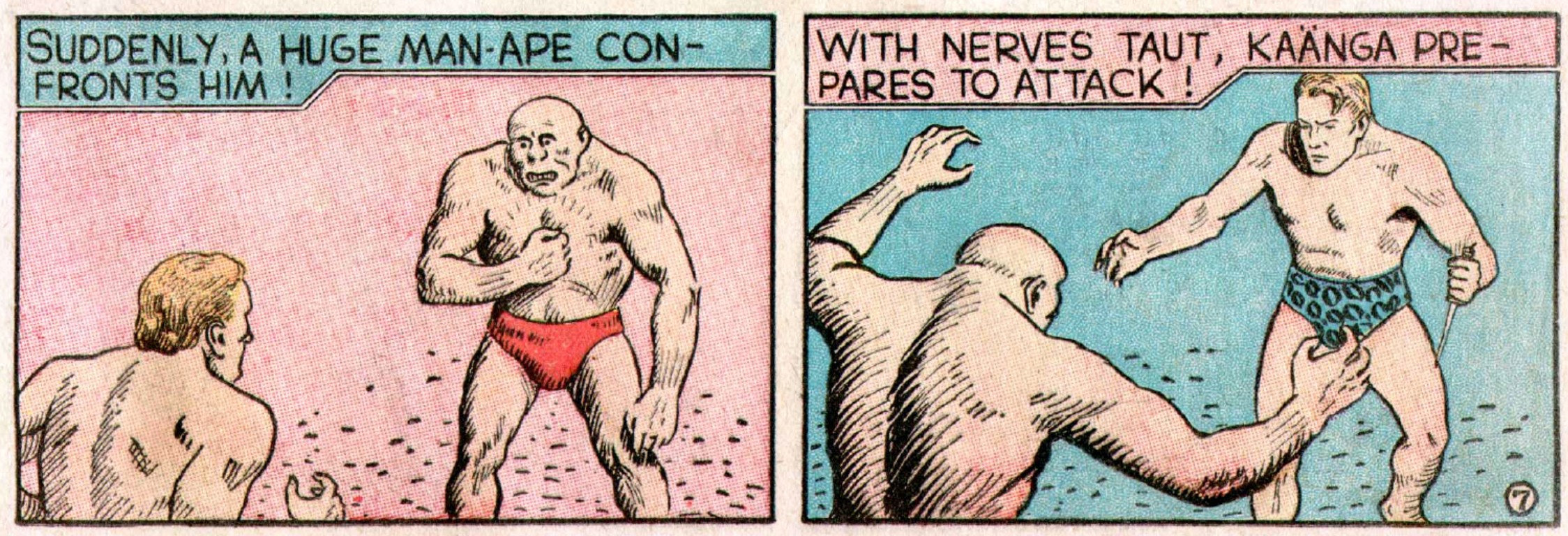
    These Man-Apes serve megacreep Dr Wratt as muscle. They hold the particular distinction of being the least apelike ape-men that I have ever seen. (Jungle Comics 002, 1940)
  • CATALOGUE OF WOUNDS 005

    CATALOGUE OF WOUNDS 005

    More wounds for the Catalogue of Wounds!

    Ace of Space:

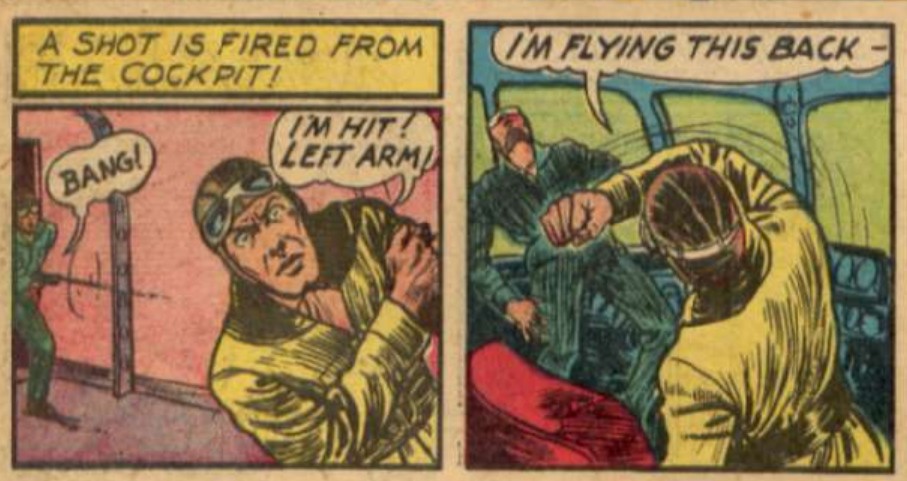
    Shot in the left arm during an attempted skyjacking. (Feature Comics 041, 1941)

    the Black Hood:

    As part of Kip Burland’s journey to masked vigilantism he gets shot all to hell and back by the Skull’s minions. The shots we can see happening are all hitting him in the torso, and according to his hermit mentor there were at least eight of them. Sheesh. (Top-Notch Comics 009, 1940)

    Chic Carter:

    Chic takes a bullet to his right arm while contending with the Phantom’s very satanic boss. (Smash Comics 015, 1941)

    the Comet:

    Shot in the left shoulder by a gun-wielding member of an angry mob that is after him. (Pep Comics 004, 1940)

    the Fox:

    Severely whipped and beaten by the Night Riders during his origin. (Blue Ribbon Comics 004, 1940)

    Galahad: 

    Takes a sword blow meant for King Arthur, and while all these bullet wounds and so forth can get a little abstracted, this is a real overhand chop that has to be threatening to hit his lung. Galahad only survives due to Merlin’s magical intervention. (Top-Notch Comics 008, 1940)

    the Green Falcon:

    Takes an arrow to the left shoulder. (Blue Ribbon Comics 013, 1941)

    the Shadow:

    Shot in the left arm by Zevox, aka the Head. (Shadow Comics v1 004, 1940)

    The Shadow’s left arm can’t get a break, as a few issues later it gets a throwing knife to the shoulder. (Shadow Comics v1 007, 1940)

    the Spider:

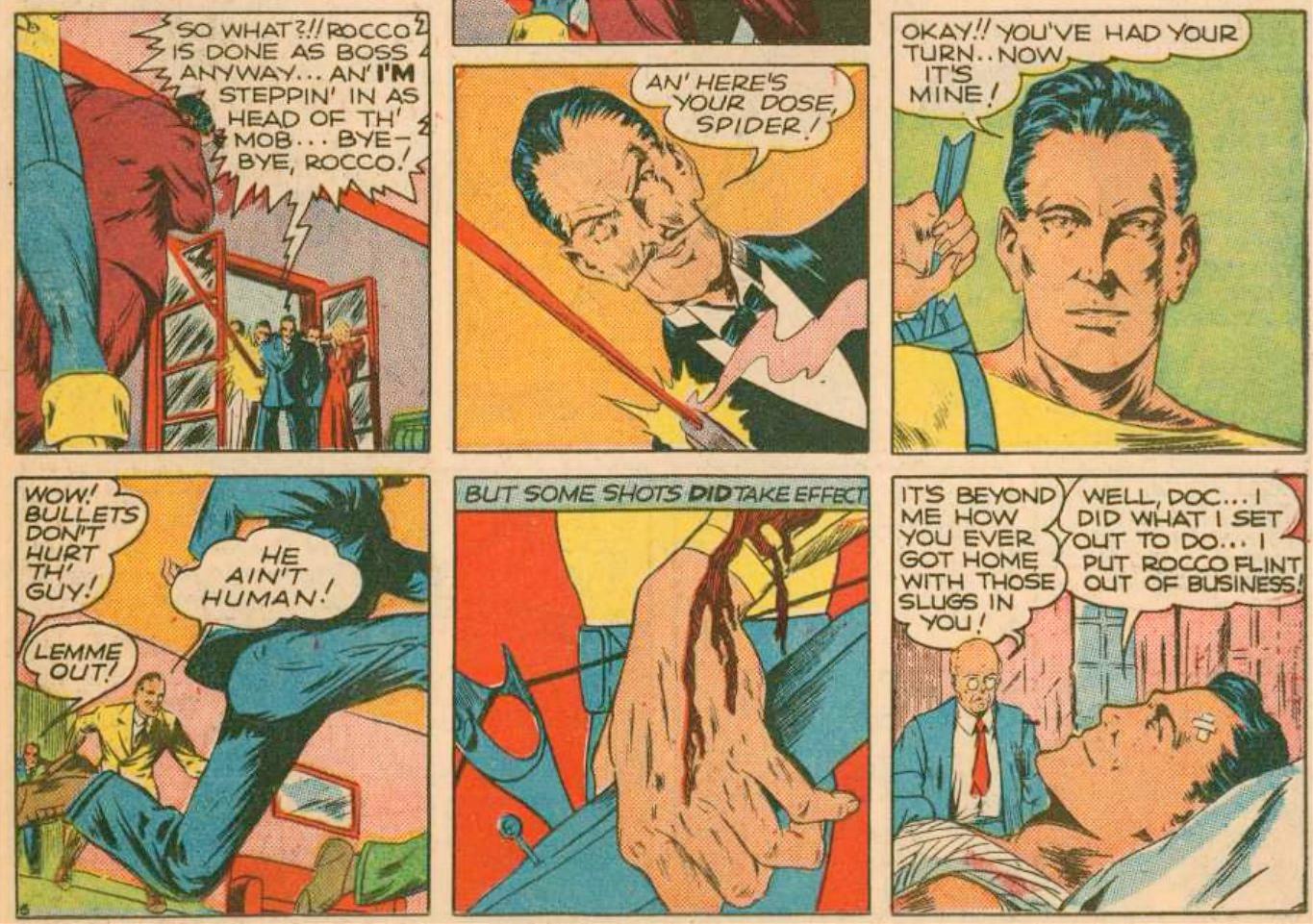
    I don’t know the precise number of times the Spider is shot here while tanking bullets to scare a gang but it sure is enough to impress his doctor. (Crack Comics 007, 1940)

    A year later, the Spider gets near-fatally shot in the chest by the Crow. (Crack Comics 018, 1941)

    Whiz, King of Falcons: 

    Silver Streak’s animal companion Whiz is struck in the bird-shoulder by a machine gun round. (Silver Streak Comics 010, 1941)

  • CATALOGUE OF WOUNDS 005

    CATALOGUE OF WOUNDS 005

    More wounds for the Catalogue of Wounds!

    Ace of Space:

    Shot in the left arm during an attempted skyjacking. (Feature Comics 041, 1941)

    the Black Hood:

    As part of Kip Burland’s journey to masked vigilantism he gets shot all to hell and back by the Skull’s minions. The shots we can see happening are all hitting him in the torso, and according to his hermit mentor there were at least eight of them. Sheesh. (Top-Notch Comics 009, 1940)

    Chic Carter:

    Chic takes a bullet to his right arm while contending with the Phantom’s very satanic boss. (Smash Comics 015, 1941)

    the Comet:

    Shot in the left shoulder by a gun-wielding member of an angry mob that is after him. (Pep Comics 004, 1940)

    the Fox:

    Severely whipped and beaten by the Night Riders during his origin. (Blue Ribbon Comics 004, 1940)

    Galahad: 

    Takes a sword blow meant for King Arthur, and while all these bullet wounds and so forth can get a little abstracted, this is a real overhand chop that has to be threatening to hit his lung. Galahad only survives due to Merlin’s magical intervention. (Top-Notch Comics 008, 1940)

    the Green Falcon:

    Takes an arrow to the left shoulder. (Blue Ribbon Comics 013, 1941)

    the Shadow:

    Shot in the left arm by Zevox, aka the Head. (Shadow Comics v1 004, 1940)

    The Shadow’s left arm can’t get a break, as a few issues later it gets a throwing knife to the shoulder. (Shadow Comics v1 007, 1940)

    the Spider:

    I don’t know the precise number of times the Spider is shot here while tanking bullets to scare a gang but it sure is enough to impress his doctor. (Crack Comics 007, 1940)

    A year later, the Spider gets near-fatally shot in the chest by the Crow. (Crack Comics 018, 1941)

    Whiz, King of Falcons: 

    Silver Streak’s animal companion Whiz is struck in the bird-shoulder by a machine gun round. (Silver Streak Comics 010, 1941)

  • ALIENS AND SO FORTH ROUND-UP 015

    ALIENS AND SO FORTH ROUND-UP 015

    A veritable bounty of aliens for your perusal.

    People of Venus, the Jibbering Giant of Jupiter, Weird Inhabitants of the Strange Planet: 

    Blast Bennett has lost his little pal Red, and his solution is to just kind of bop around from planet to planet, asking random aliens if they have seen a red-headed guy. I’ve grouped these alien together because they all represent a very boring alien design trend of the 40s and 50s (and beyond!): the alien as just some guy. The Venusians are short, bald guys; the Jovian is a really big guy and the weird inhabitants of the strange planet are guys who could use a shower. (Weird Comics 004, 1940)

    Ceresians:

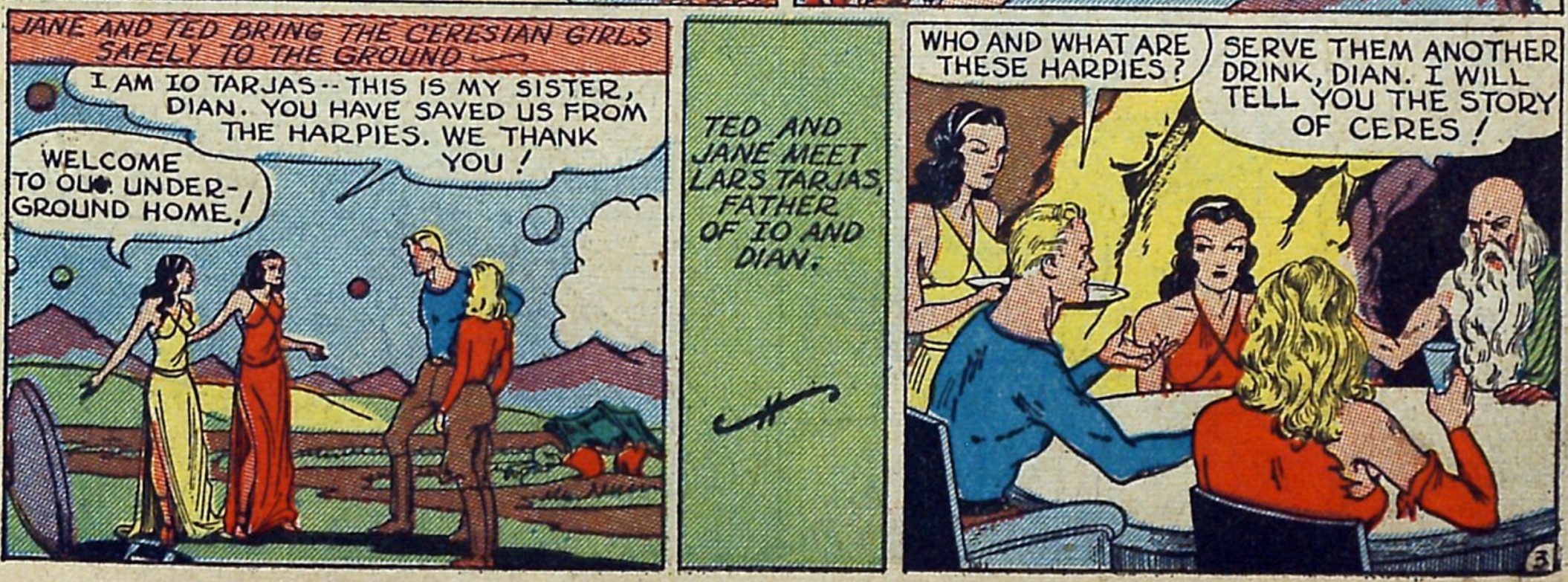
    During an unscheduled stop on then-asteroid/now-dwarf planet Ceres for water, Ted Hunt and Jane Martin, aka the Star Rovers, stumble into a conflict between the underground-dwelling native Ceresians and gargoyle-like invaders known as the Harpies.

    This is a pretty classic setup! The planet full of generic white guys vs some horrible space monsters scenario is a surefire way to engender sympathy in an early 20th Century American audience! It does however leave you with some fairly uninteresting humanoid aliens – I do appreciate the seeming shift in Ceresian society from a Medieval to more of a Roman aesthetic as they are forced to abandon their castles for retrofuturistic bunkers, but that’s about it. (Exciting Comics 005, 1940)

    Harpies: 

    The Space Rovers make their way to the Harpy home on Asteroid Nunda and are almost immediately captured after being incapacitated by the thin Nundan atmosphere. They find that rather than being simple predators, the Harpies have an advanced society that places great value in both science and the democratic process. They are, sadly, complete Harpy chauvinists who don’t recognize the humanity harpianity shared intelligent experience of other species, which is why they’re so happy to raid Ceres for fun and food.

    Ted and Jane escape this fate due to the Harpies’ scientific curiosity about them, and manage to parley that into a successful escape attempt. Once back in their ship and armed with superior firepower, perhaps they will be able to force the Harpies to stop their vicious ways at the barrel of a gun!

    Just kidding! As a nonhuman species who pose a threat to a world of white guys, the Harpies are of course fair game for utter and total annihilation – I’m talking blow up their cities and hunt down all of the survivors. But don’t feel bad, because as Jane says, “they’re nothing but enormous, blood-thirsty bats!” Now the Ceresians are free to go back to inventing feudalism or whatever. (Exciting Comics 005, 1940) 

    Lunaris:

    The way I do these Alien Round-Ups is that the first entry is from whatever comic I’m reading at the moment and then I pluck the rest from a big ol’ spreadsheet that I’ve been maintaining for years, which is why it’s a pretty fun coincidence that the the next aliens on my list after the Ceresians were the Cold Men, who rule the surface of an unnamed icy moon while a race of white guys called the Lunaris hide in tunnels below. Once Ray Darrow, aka the Star Rover (another little coincidence there) stumbles into this conflict he of course sides with the noble Lunaris against the horrible Cold Men, and it doesn’t hurt that the Lunaris Queen is somehow descended from Earth humans, so that Darrow can feel okay with being attracted to her, I guess. (Doc Savage Comics v1 003, 1941)

    Cold Men: 

    Cold Man society isn’t quite as fleshed out as the Harpies’ was, but Darrow’s conclusion is the same: to ensure the continued safety of the much more familiar-looking Lunaris, the Cold Men must be utterly annihilated – sure hope that the newly surface-dwelling Lunaris don’t find the headquarters of some sort of Cold Man organization dedicated to fostering peace between the species or they might end up feeling guilty about their role in this genocide some day. 

    … I do like that the Cold Men seem to actually be made of snow or ice. (Doc Savage Comics v1 003, 1941) 

  • ALIENS AND SO FORTH ROUND-UP 015

    A veritable bounty of aliens for your perusal.

    People of Venus, the Jibbering Giant of Jupiter, Weird Inhabitants of the Strange Planet: 

    Blast Bennett has lost his little pal Red, and his solution is to just kind of bop around from planet to planet, asking random aliens if they have seen a red-headed guy. I’ve grouped these alien together because they all represent a very boring alien design trend of the 40s and 50s (and beyond!): the alien as just some guy. The Venusians are short, bald guys; the Jovian is a really big guy and the weird inhabitants of the strange planet are guys who could use a shower. (Weird Comics 004, 1940)

    Ceresians:

    During an unscheduled stop on then-asteroid/now-dwarf planet Ceres for water, Ted Hunt and Jane Martin, aka the Star Rovers, stumble into a conflict between the underground-dwelling native Ceresians and gargoyle-like invaders known as the Harpies.

    This is a pretty classic setup! The planet full of generic white guys vs some horrible space monsters scenario is a surefire way to engender sympathy in an early 20th Century American audience! It does however leave you with some fairly uninteresting humanoid aliens – I do appreciate the seeming shift in Ceresian society from a Medieval to more of a Roman aesthetic as they are forced to abandon their castles for retrofuturistic bunkers, but that’s about it. (Exciting Comics 005, 1940)

    Harpies: 

    The Space Rovers make their way to the Harpy home on Asteroid Nunda and are almost immediately captured after being incapacitated by the thin Nundan atmosphere. They find that rather than being simple predators, the Harpies have an advanced society that places great value in both science and the democratic process. They are, sadly, complete Harpy chauvinists who don’t recognize the humanity harpianity shared intelligent experience of other species, which is why they’re so happy to raid Ceres for fun and food.

    Ted and Jane escape this fate due to the Harpies’ scientific curiosity about them, and manage to parley that into a successful escape attempt. Once back in their ship and armed with superior firepower, perhaps they will be able to force the Harpies to stop their vicious ways at the barrel of a gun!

    Just kidding! As a nonhuman species who pose a threat to a world of white guys, the Harpies are of course fair game for utter and total annihilation – I’m talking blow up their cities and hunt down all of the survivors. But don’t feel bad, because as Jane says, “they’re nothing but enormous, blood-thirsty bats!” Now the Ceresians are free to go back to inventing feudalism or whatever. (Exciting Comics 005, 1940) 

    Lunaris:

    The way I do these Alien Round-Ups is that the first entry is from whatever comic I’m reading at the moment and then I pluck the rest from a big ol’ spreadsheet that I’ve been maintaining for years, which is why it’s a pretty fun coincidence that the the next aliens on my list after the Ceresians were the Cold Men, who rule the surface of an unnamed icy moon while a race of white guys called the Lunaris hide in tunnels below. Once Ray Darrow, aka the Star Rover (another little coincidence there) stumbles into this conflict he of course sides with the noble Lunaris against the horrible Cold Men, and it doesn’t hurt that the Lunaris Queen is somehow descended from Earth humans, so that Darrow can feel okay with being attracted to her, I guess. (Doc Savage Comics v1 003, 1941)

    Cold Men: 

    Cold Man society isn’t quite as fleshed out as the Harpies’ was, but Darrow’s conclusion is the same: to ensure the continued safety of the much more familiar-looking Lunaris, the Cold Men must be utterly annihilated – sure hope that the newly surface-dwelling Lunaris don’t find the headquarters of some sort of Cold Man organization dedicated to fostering peace between the species or they might end up feeling guilty about their role in this genocide some day. 

    … I do like that the Cold Men seem to actually be made of snow or ice. (Doc Savage Comics v1 003, 1941) 

  • DIVINE ROUND-UP 005

    Once again we add to the scriptures. 

    the Shadowman: 


    Like his predecessor/inspiration Yarko the Great, Mr Mystic also has a semi-friendly/ semi-adversarial relationship with the personification of death. In this case, Death is a guy in a cool suit with a half-cape, and he is called the Shadowman, presumably because of his perpetually-in shadow face.

    The Shadowman’s first couple of appearances cast him as a mysterious stranger who helps Mr Mystic in his battle against various evils (including scientist Ghantse, who the Shadowman seems to work for in his initial appearance). At this point the Shadowman is merely a mysterious man who has a miraculous ability to survive the most deadly of situations.

    In the 17 November 1940 Spirit Section, Mr Mystic ventures into the Land of Mythology on a quest for the Ring of the Gods, which turns out to be held by Death. This version of Death is a traditional Grim Reaper style skeleton in a robe, and he swears vengeance on Mr Mystic for the theft of the ring. 

    The Grim Reaper version of Death is never explicitly tied to the Shadowman, and it’s possible that they were intended to be different in some fundamental way – different aspects of death, perhaps. The Whole Ring of the Gods incident is not brought up by the Shadowman the next time he meets Mr Mystic (1 December 1940), so Mystic might be off the hook for that. It’s a bit of a moot point, however, as this installment of “Mr Mystic” is all about him saving the life of a little girl named Joan Barton, and it allows us to get more of a grip on the Shadowman’s code: he objects to bot murder and life-saving interventions as equally disruptive to the natural order. Mr Mystic now has two threats from Death hanging over him. 

    (this episode also establishes the deal with the Shadowman’s shadowy face: if you look at it sans shadow, you die) 

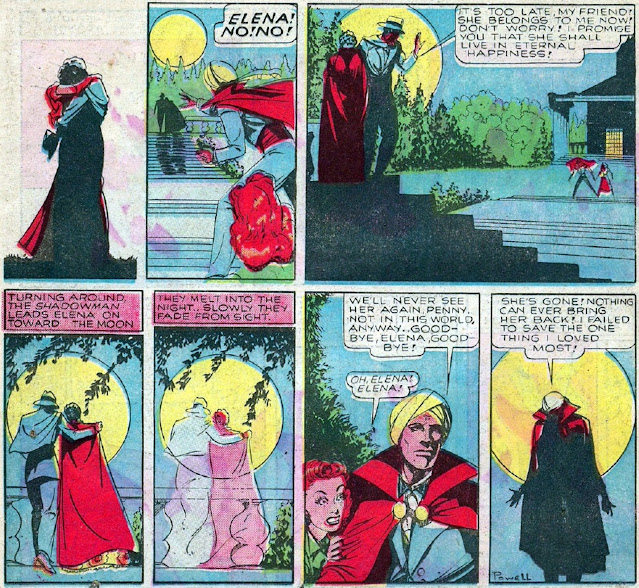
    The second-to-final Mr Mystic comic of the year (22 December 1940) features the Shadowman’s revenge on Mystic: he is going to seduce/kill his fiance Elena.

    While the Shadowman seems to have access to some sort of primordial seductive power relating to the inevitable entropic march toward the grave, he is not above employing cheap romantic comedy plot devices to drive a wedge between the lovers.

    Death is the inevitable winner of the contest, of course, and Elena goes off with him to… the afterlife? His home? Are they married now or is she just dead? We shall never know, alas, though we will see the Shadowman again.

    God Style: real anthropomorphic personification (The Spirit Section, 22 September, 1940)

    Jwang Tyoy:

    We don’t get a lot of the teachings of Jwang Tyoy beyond the fact that he is the god of a South American “anti-civilization” cult. The focus of the comic is much more focused on the very off-model pterodactyls that the cult leader uses to do he bidding, and for good reason!

    God Style: idol (Shadow Comics v1 004, 1940) 

    Kutu: 

    Kutu, aka Tuku, is possibly a moon god, definitely South American, and has the traditional jewel socketed into his idol for adventurers to steal and get into Big Trouble. 

    God Style: idol (Comics Magazine 002, 1936)  

    Nahapatan: 

    Nahapatan, the Golden Idol, is housed in a hidden Aztec city, where it is the subject of active worship. Does this stop Professor Roberts, his nephew Tim and adventurer Ken Masters from barging in and stealing it to put in Robert’s museum? It does not.

    God Style: idol (Masked Marvel 001, 1940)

  • DIVINE ROUND-UP 005

    Once again we add to the scriptures. 

    the Shadowman: 


    Like his predecessor/inspiration Yarko the Great, Mr Mystic also has a semi-friendly/ semi-adversarial relationship with the personification of death. In this case, Death is a guy in a cool suit with a half-cape, and he is called the Shadowman, presumably because of his perpetually-in shadow face.

    The Shadowman’s first couple of appearances cast him as a mysterious stranger who helps Mr Mystic in his battle against various evils (including scientist Ghantse, who the Shadowman seems to work for in his initial appearance). At this point the Shadowman is merely a mysterious man who has a miraculous ability to survive the most deadly of situations.

    In the 17 November 1940 Spirit Section, Mr Mystic ventures into the Land of Mythology on a quest for the Ring of the Gods, which turns out to be held by Death. This version of Death is a traditional Grim Reaper style skeleton in a robe, and he swears vengeance on Mr Mystic for the theft of the ring. 

    The Grim Reaper version of Death is never explicitly tied to the Shadowman, and it’s possible that they were intended to be different in some fundamental way – different aspects of death, perhaps. The Whole Ring of the Gods incident is not brought up by the Shadowman the next time he meets Mr Mystic (1 December 1940), so Mystic might be off the hook for that. It’s a bit of a moot point, however, as this installment of “Mr Mystic” is all about him saving the life of a little girl named Joan Barton, and it allows us to get more of a grip on the Shadowman’s code: he objects to bot murder and life-saving interventions as equally disruptive to the natural order. Mr Mystic now has two threats from Death hanging over him. 

    (this episode also establishes the deal with the Shadowman’s shadowy face: if you look at it sans shadow, you die) 

    The second-to-final Mr Mystic comic of the year (22 December 1940) features the Shadowman’s revenge on Mystic: he is going to seduce/kill his fiance Elena.

    While the Shadowman seems to have access to some sort of primordial seductive power relating to the inevitable entropic march toward the grave, he is not above employing cheap romantic comedy plot devices to drive a wedge between the lovers.

    Death is the inevitable winner of the contest, of course, and Elena goes off with him to… the afterlife? His home? Are they married now or is she just dead? We shall never know, alas, though we will see the Shadowman again.

    God Style: real anthropomorphic personification (The Spirit Section, 22 September, 1940)

    Jwang Tyoy:

    We don’t get a lot of the teachings of Jwang Tyoy beyond the fact that he is the god of a South American “anti-civilization” cult. The focus of the comic is much more focused on the very off-model pterodactyls that the cult leader uses to do he bidding, and for good reason!

    God Style: idol (Shadow Comics v1 004, 1940) 

    Kutu: 

    Kutu, aka Tuku, is possibly a moon god, definitely South American, and has the traditional jewel socketed into his idol for adventurers to steal and get into Big Trouble. 

    God Style: idol (Comics Magazine 002, 1936)  

    Nahapatan: 

    Nahapatan, the Golden Idol, is housed in a hidden Aztec city, where it is the subject of active worship. Does this stop Professor Roberts, his nephew Tim and adventurer Ken Masters from barging in and stealing it to put in Robert’s museum? It does not.

    God Style: idol (Masked Marvel 001, 1940)

  • MAD AND CRIMINAL SCIENTIST ROUND-UP 009

    You know how it is with these guys. Their science is mad and/or criminal!

    Felix Zurich, lab assistant to Professor Trent, has hidden the professor away in a castle improbably located in the middle of the jungle in Africa, all so that Zurich can force him to perfect his invention of the ever-popular engine-killing ray. This is a Blackstone the Magician story so of course Zurich is also an accomplished stage magician and there is a pivotal duel of illusions. Ultimately, a high-speed canoe chase ends with Zurich going over Victoria Falls while Blackstone and his companions serenely float down on parachutes. (Super-Magician v1 002, 1941)  

    This here scientist and his brother are for some reason trying to turn young women into statues. They don’t get very far before being beat up by Ted Parrish, the Man With 1000 Faces (Speed Comics 001, 1939)

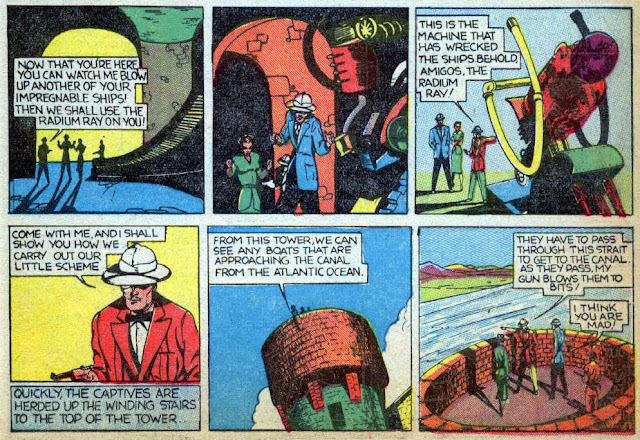
    Senor Anza here is one of your scientists with mysterious motivations: he’s been blowing up passing ships on their way to or from the Panama Canal using his very cool Radium Ray, but just why he’s doing it is not elaborated on. Top possibilities are “as a weapons test prior to some other scheme” and “on behalf of the Axis forces” with a possibility of “straightforward homicidal madness” but as Anza ends up stone dead at the hands of super-spy K-51 and his colleague/ fiance/ fellow super-spy Z-19 all speculation is purely academic. (Wonderworld Comics 004, 1939)

    The Professor Maxon mentioned above never appears in person in the story but does carry a scientific rivalry far enough that he completes the extinction of the dodo rather than allow his rival Professor Stone get credit for his discovery of a remnant population. (Champion Comics 006, 1940)

  • PROBLEMATIC ROUND-UP 001

    The kinds of character that are a part of comics history so it would be wrong to ignore them but are also pretty racist (usually – I’m sure that eventually I’ll find something else distasteful enough to put here) and unpleasant to dedicate a whole lot of time to. We’re going with a round-up!

    Our first culprit is George Harvard AKA Big Sun, a guy with a way too complicated plan to sell oil to the Axis out of the Florida Everglades under the cover of being a geological surveyor or prospector or something. He comes to the attention of adventurer Clip Carson due to not accounting for his partner maybe poking around looking for samples like their job is supposed to be? It’s a bad plan.

    I’m mad at myself for finding Big Sun’s mask so cool looking, but it’s mitigated by how dumb his gimmick is: he has a shiny breastplate on under his robe and he reveals it flasher-style to blind his foes. Hence the name, I guess. (More Fun Comics 069, 1941) 

    I didn’t even know that Zingaro was an Italian slur for people of Romani descent until I looked up this guy – just why it was used as the name of a fellow trying to take over Mexico I will never know. On the one hand he is stopped by weirdo character the Voice so that’s good. On the other, he gets away so there’s a chance he could appear again, which is bad. It’s okay though: the Voice only ever had two adventures and this is the second one.

    Thankfully there aren’t too many characters whose names are racial slurs. (Amazing-Man Comics 022, 1941)

    I don’t know if you could call it lucky, per se, but it is kind of fortunate for the purposes of this round-up that I’m hitting a lot of the major categories of racist super-villains all in one go. We’ll see if this questionable luck holds for the fourth entry.

    So: Banga the Elephant God is predicated on the old trope that indigenous peoples are so credulous and superstitious that they will believe that anything (eg, a big mean elephant with a guy in a skull mask on it) is a god or other supernatural occurrence – in this case the people of the hidden jungle civilization of Yenya are helped along by the fact that the human part of the Banga gestalt is actually their witch doctor (called a “wizard doctor” in this case, which is kind of a neat linguistic variation if nothing else). Banga is eventually unmasked by jungle hero Morak the Mighty and meets his dual ends.

    As with so many racist characters it is very unfortunate that Banga the Elephant God looks sick as hell. (Super-Magic Comics 001, 1941)

    The very next issue we have more of the same: a bunch of white guys dress up like the very cool looking Lizard-Lion Men of local legend and fleece ivory out of villagers in… Malaysia? If Rex King aka Black Fury stayed put between issues then it’s Malaysia.

    There’s not too much to these guys: one of them hides inside the statue of the Lizard-Lion in the local temple and says for the locals to bring all of their ivory hence and then costumed goons go beat up anyone who refuses. And then Black Fury beats them up. (Super-Magician v1 002, 1941)

    We didn’t hit all the greats in one go – there’s a lot of untapped racism coming up once we hit the comics of 1942 after all – but it’s a good – bad? – sample.

  • PROBLEMATIC ROUND-UP 001

    The kinds of character that are a part of comics history so it would be wrong to ignore them but are also pretty racist (usually – I’m sure that eventually I’ll find something else distasteful enough to put here) and unpleasant to dedicate a whole lot of time to. We’re going with a round-up!

    Our first culprit is George Harvard AKA Big Sun, a guy with a way too complicated plan to sell oil to the Axis out of the Florida Everglades under the cover of being a geological surveyor or prospector or something. He comes to the attention of adventurer Clip Carson due to not accounting for his partner maybe poking around looking for samples like their job is supposed to be? It’s a bad plan.

    I’m mad at myself for finding Big Sun’s mask so cool looking, but it’s mitigated by how dumb his gimmick is: he has a shiny breastplate on under his robe and he reveals it flasher-style to blind his foes. Hence the name, I guess. (More Fun Comics 069, 1941) 

    I didn’t even know that Zingaro was an Italian slur for people of Romani descent until I looked up this guy – just why it was used as the name of a fellow trying to take over Mexico I will never know. On the one hand he is stopped by weirdo character the Voice so that’s good. On the other, he gets away so there’s a chance he could appear again, which is bad. It’s okay though: the Voice only ever had two adventures and this is the second one.

    Thankfully there aren’t too many characters whose names are racial slurs. (Amazing-Man Comics 022, 1941)

    I don’t know if you could call it lucky, per se, but it is kind of fortunate for the purposes of this round-up that I’m hitting a lot of the major categories of racist super-villains all in one go. We’ll see if this questionable luck holds for the fourth entry.

    So: Banga the Elephant God is predicated on the old trope that indigenous peoples are so credulous and superstitious that they will believe that anything (eg, a big mean elephant with a guy in a skull mask on it) is a god or other supernatural occurrence – in this case the people of the hidden jungle civilization of Yenya are helped along by the fact that the human part of the Banga gestalt is actually their witch doctor (called a “wizard doctor” in this case, which is kind of a neat linguistic variation if nothing else). Banga is eventually unmasked by jungle hero Morak the Mighty and meets his dual ends.

    As with so many racist characters it is very unfortunate that Banga the Elephant God looks sick as hell. (Super-Magic Comics 001, 1941)

    The very next issue we have more of the same: a bunch of white guys dress up like the very cool looking Lizard-Lion Men of local legend and fleece ivory out of villagers in… Malaysia? If Rex King aka Black Fury stayed put between issues then it’s Malaysia.

    There’s not too much to these guys: one of them hides inside the statue of the Lizard-Lion in the local temple and says for the locals to bring all of their ivory hence and then costumed goons go beat up anyone who refuses. And then Black Fury beats them up. (Super-Magician v1 002, 1941)

    We didn’t hit all the greats in one go – there’s a lot of untapped racism coming up once we hit the comics of 1942 after all – but it’s a good – bad? – sample.