The Curse of Skeleton Munroe

Category: kidnapper

  • MAD AND CRIMINAL SCIENTIST ROUND-UP 018

    I’m not sure that these guys all have degrees. 

    This fellow is known only as the Professor, and he conducts experiments in long- and short-range mind control on Lost Hope Island until Secret Naval Agent Spike Marlin shows up in search of a missing ship’s crew. (Speed Comics 009, 1940) 

    This unnamed scientist has developed a drug that puts people into indefinite comas and has used it to kidnap and store ten millionaires, presumably with the intent of ransoming them back to their families. Before he actually gets to the point of sending the ransom notes, however, he makes the mistake of allowing his gangster hirelings go out and use the drug to mug people on the street, thus leaving a trail of mysterious coma victims that the indomitable Detective Crane follows all the way to the scientist’s secret penthouse. (Superworld Comics 002, 1940)

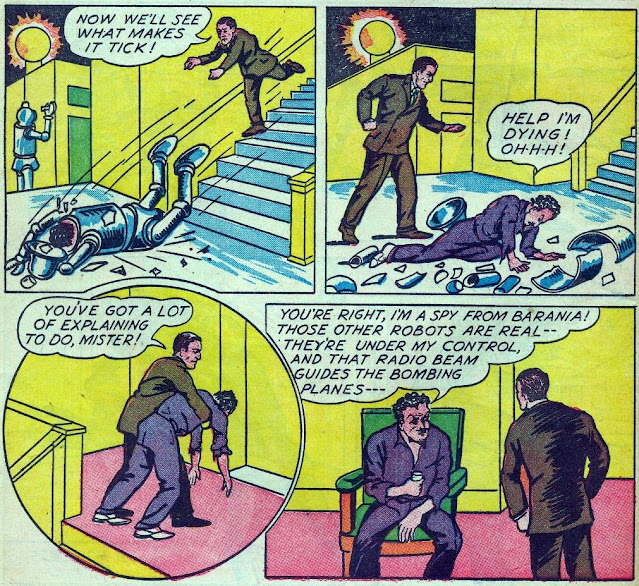
    Detective Crane is back to investigate the destruction of several West Virginian steel mills. It turns out that remote controlled drone bombers are responsible for the attacks, and he trails them back to a base near Pittsburgh filled with awesome robots, plus one Baranian spy who is merely dressed like a robot, presumably in case someone like Crane were to show up. The whole place gets absolutely annihilated.(Superworld Comics 003, 1940)

    Overworked and underappreciated Department Public Sanitation scientist Dr Sheldon might be justified in his workplace dissatisfaction but he expresses his negative emotions in an unproductive manner, by poisoning the city reservoir and killing thousands of people. It must be cathartic though, because the Arrow has to shoot him with one of his trademark arrows in order to prevent him from poisoning the reservoir even more than it was before. (The Arrow 002, 1940)

  • MAD AND CRIMINAL SCIENTIST ROUND-UP 018

    I’m not sure that these guys all have degrees. 

    This fellow is known only as the Professor, and he conducts experiments in long- and short-range mind control on Lost Hope Island until Secret Naval Agent Spike Marlin shows up in search of a missing ship’s crew. (Speed Comics 009, 1940) 

    This unnamed scientist has developed a drug that puts people into indefinite comas and has used it to kidnap and store ten millionaires, presumably with the intent of ransoming them back to their families. Before he actually gets to the point of sending the ransom notes, however, he makes the mistake of allowing his gangster hirelings go out and use the drug to mug people on the street, thus leaving a trail of mysterious coma victims that the indomitable Detective Crane follows all the way to the scientist’s secret penthouse. (Superworld Comics 002, 1940)

    Detective Crane is back to investigate the destruction of several West Virginian steel mills. It turns out that remote controlled drone bombers are responsible for the attacks, and he trails them back to a base near Pittsburgh filled with awesome robots, plus one Baranian spy who is merely dressed like a robot, presumably in case someone like Crane were to show up. The whole place gets absolutely annihilated.(Superworld Comics 003, 1940)

    Overworked and underappreciated Department Public Sanitation scientist Dr Sheldon might be justified in his workplace dissatisfaction but he expresses his negative emotions in an unproductive manner, by poisoning the city reservoir and killing thousands of people. It must be cathartic though, because the Arrow has to shoot him with one of his trademark arrows in order to prevent him from poisoning the reservoir even more than it was before. (The Arrow 002, 1940)

  • MINOR SUPER-VILLAIN 792: THE OCTOPUS

    (Target Comics v1 003, 1940)

    I’m going to start out by saying that I have no idea why this story is called “Return of the Octopus!” as this is as far as I can tell both the first and last appearance of the character. Both the title and the Octopus’ costume seem to be dramatic flourishes that don’t really play out in the text of the story.

    I do really like the Octopus’ costume, though. It’s got a lot of low-effort charm, though now that I think of it I have no idea how easy it would be to source a green sweater with a large octopus decal on it c. 1940.

    Sadly, the Octopus shucks his disguise after one panel when he has to answer an inquiry from Treasury Agent Chick Farrell at his funeral home front, and this is where the other part of his character design comes into play, as physically he embodies a whole set of characteristics that were associated with undertakers in the early 20th Century and beyond: cadaverous face, unnerving stare, unnatural posture, old-fashioned clothing – general creep vibes. This is of course a slander against the hard-working undertakers of the world, but what can you do?

    The extant copy of this comic is unfortunately missing the one or two pages that close this story. At the end of the part that is available, the Octopus has just murdered his accomplice (his kidnap victim’s crooked uncle) and is about to get away on a boat, so based on my long experience in reading comic books I’d say that there’s a 70/30 split on the odds of whether he eventually drowns or is arrested.

  • MINOR SUPER-VILLAIN 792: THE OCTOPUS

    (Target Comics v1 003, 1940)

    I’m going to start out by saying that I have no idea why this story is called “Return of the Octopus!” as this is as far as I can tell both the first and last appearance of the character. Both the title and the Octopus’ costume seem to be dramatic flourishes that don’t really play out in the text of the story.

    I do really like the Octopus’ costume, though. It’s got a lot of low-effort charm, though now that I think of it I have no idea how easy it would be to source a green sweater with a large octopus decal on it c. 1940.

    Sadly, the Octopus shucks his disguise after one panel when he has to answer an inquiry from Treasury Agent Chick Farrell at his funeral home front, and this is where the other part of his character design comes into play, as physically he embodies a whole set of characteristics that were associated with undertakers in the early 20th Century and beyond: cadaverous face, unnerving stare, unnatural posture, old-fashioned clothing – general creep vibes. This is of course a slander against the hard-working undertakers of the world, but what can you do?

    The extant copy of this comic is unfortunately missing the one or two pages that close this story. At the end of the part that is available, the Octopus has just murdered his accomplice (his kidnap victim’s crooked uncle) and is about to get away on a boat, so based on my long experience in reading comic books I’d say that there’s a 70/30 split on the odds of whether he eventually drowns or is arrested.

  • MINOR SUPER-VILLAIN 776: THE BLUE SPARK

    (Super-Mystery Comics v1 002, 1940)

    In terms of crime, the Blue Spark is ambitious but not extraordinary: a little corporate extortion, some bank robbery, a few kidnappings. Nothing we haven’t seen a few hundred times by now.  When it comes to the trappings of super-villainy, however, the Blue Spark is on the cutting edge.

    Just look at that costume – it’s not quite the standardized super-villain getup we will eventually see on so many one-shot Batman villains but it’s pretty damn close, and particularly in an era in which most villains are still pairing a mask with a suit and tie or a robe. Even more impressive and ahead of its time is the Blue Spark’s choice to dress his henchmen in a simplified version of his own uniform. Just really impressive stuff.

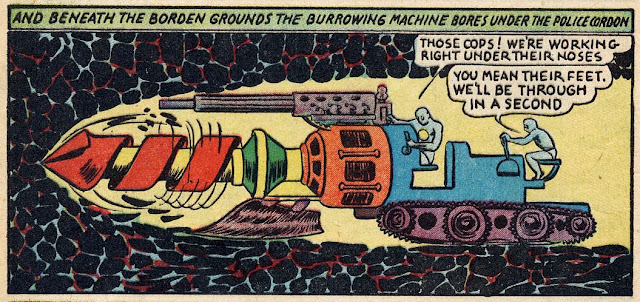
    The Blue Spark’s main gimmick, a heat ray cannon mounted on a truck, isn’t quite as remarkable but it is a pretty sweet bit of gear. Plus he has another one mounted on a cool-ass drilling machine!

    (it is somewhat unclear if the Blue Spark has a second ray that allows him to mind control people or if his heat ray doubles as a mind control ray, and determining this is not helped by the fact that he clearly has an aesthetic fondness for that particular style of scientific greebling on the outside of the rays. It’s a good clean visual on the mind control ray, I will say that)

    The Blue Spark’s henchmen (called the Blue Rubber Men at one point, btw) are not just well-dressed:  their costumes have  little nozzles in the chest that lets them be inflated like a balloon to render them immune to fisticuffs  – another idea that sounds like something out of a Silver Age comic, twenty years early.

    Technology or no, inflation fetish suits or no, the Blue Spark vs Magno is your classic case of a villain who is so little of an even match for the hero that the plotter’s concern must lie in keeping them apart for as long as possible because the instant they meet up, something like the above happens. Magno didn’t even give him a chance to blow up his suit, the poor guy.

  • MINOR SUPER-VILLAIN 776: THE BLUE SPARK

    (Super-Mystery Comics v1 002, 1940)

    In terms of crime, the Blue Spark is ambitious but not extraordinary: a little corporate extortion, some bank robbery, a few kidnappings. Nothing we haven’t seen a few hundred times by now.  When it comes to the trappings of super-villainy, however, the Blue Spark is on the cutting edge.

    Just look at that costume – it’s not quite the standardized super-villain getup we will eventually see on so many one-shot Batman villains but it’s pretty damn close, and particularly in an era in which most villains are still pairing a mask with a suit and tie or a robe. Even more impressive and ahead of its time is the Blue Spark’s choice to dress his henchmen in a simplified version of his own uniform. Just really impressive stuff.

    The Blue Spark’s main gimmick, a heat ray cannon mounted on a truck, isn’t quite as remarkable but it is a pretty sweet bit of gear. Plus he has another one mounted on a cool-ass drilling machine!

    (it is somewhat unclear if the Blue Spark has a second ray that allows him to mind control people or if his heat ray doubles as a mind control ray, and determining this is not helped by the fact that he clearly has an aesthetic fondness for that particular style of scientific greebling on the outside of the rays. It’s a good clean visual on the mind control ray, I will say that)

    The Blue Spark’s henchmen (called the Blue Rubber Men at one point, btw) are not just well-dressed:  their costumes have  little nozzles in the chest that lets them be inflated like a balloon to render them immune to fisticuffs  – another idea that sounds like something out of a Silver Age comic, twenty years early.

    Technology or no, inflation fetish suits or no, the Blue Spark vs Magno is your classic case of a villain who is so little of an even match for the hero that the plotter’s concern must lie in keeping them apart for as long as possible because the instant they meet up, something like the above happens. Magno didn’t even give him a chance to blow up his suit, the poor guy.

  • MINOR SUPER-VILLAIN 767: THE COUNT

    (Speed Comics 009, 1940)

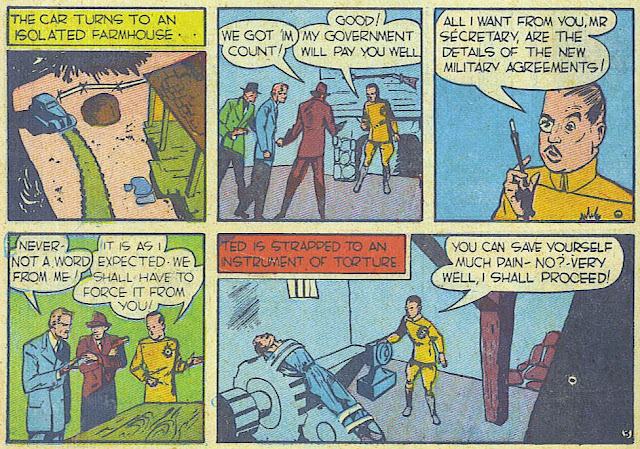
    The Count is a fairly by-the-book pseudo-Nazi spy with a very audacious plan for acquiring US military secrets: kidnap the US Secretary of State (a moderately off-model Cordell Hull) and extract them from him via gear-based torture.

    Unfortunately for the Count his plans were anticipated by the US Secret Service, who proactively substituted Ted Parrish, aka the Man With 1000 Faces, for Hull. Led to the spies’ farmhouse hideout by a special radium tracking device, the agents gun down the Count and his hirelings with some degree of prejudice, while Parrish just kind of looks on from his torture machine. An unusually passive role for a super-hero but I suppose here he is about three to five identity levels deep, so perhaps he ‘s just confused.

  • MINOR SUPER-VILLAIN 767: THE COUNT

    (Speed Comics 009, 1940)

    The Count is a fairly by-the-book pseudo-Nazi spy with a very audacious plan for acquiring US military secrets: kidnap the US Secretary of State (a moderately off-model Cordell Hull) and extract them from him via gear-based torture.

    Unfortunately for the Count his plans were anticipated by the US Secret Service, who proactively substituted Ted Parrish, aka the Man With 1000 Faces, for Hull. Led to the spies’ farmhouse hideout by a special radium tracking device, the agents gun down the Count and his hirelings with some degree of prejudice, while Parrish just kind of looks on from his torture machine. An unusually passive role for a super-hero but I suppose here he is about three to five identity levels deep, so perhaps he ‘s just confused.

  • MINOR SUPER-VILLAIN 764: THE BLACK KNIGHTS

    (Speed Comics 008, 1940)

    Like I said in the Queen Sheba entry, her brand of evil was a bit too depressing and I almost skipped making an entry for her in favour of doing this one but it ended up being mostly about her and her unpunished slaving ways anyway, and that wasn’t fair.

    The Black Knights are just what it says on the tin: a bunch of knights who dress in black. Presumably they are descended from the same group of crusaders as Sheba’s loyal followers, only instead of passively propping up a corrupt monarchy the Black Knights are out there busting heads and doing crimes. At least, I assume that’s their deal – the only actual crime that they are shown to have committed is kidnapping Sheba’s son, and I suppose that that could be the action of a group of slavery abolitionists who believe in direct action.

    Whatever their place on the alignment chart, the Black Knights try and fail to prevent Shock Gibson from rescuing the prince. Some days it just doesn’t pay to sally forth.

  • MINOR SUPER-VILLAIN 553 UPDATE: LANDOR, MAKER OF MONSTERS (1940)

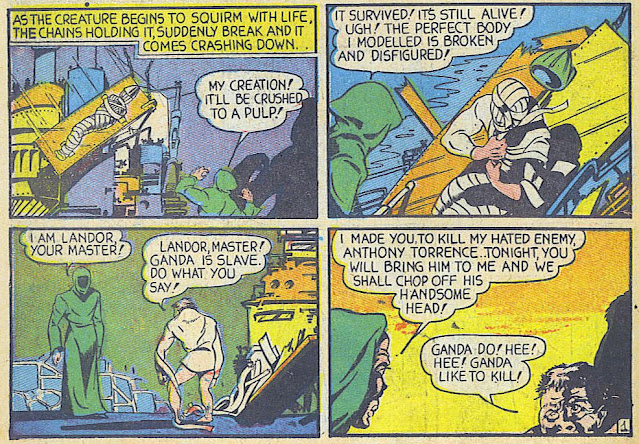
    When last we saw Landor, Maker of Monsters, he had just been exploded along with his castle and giant mosquito minions. But did you honestly expect a simple thing like a huge explosion to stop a villain of Landor’s calibre? No! He merely becomes more burned up and crusty and bitter! Landor has not shifted his goals since 1939 and is consumed with the twin urges to 1) make monsters and 2) get revenge on Tony Torrence and Marcia Merrill.

    Landor makes his dramatic return at the perfect time: US officials, including Landor’s old foe Anthony “Tony” Torrence, are completely unable to deal with the menace of the Fire-Men. This gives Landor the perfect opportunity to get Torrence under his thumb, using the power of patriotism!


    As usual, Landor has not rested on his laurels. Rather than trot out a version of one of his prior creations, such as a frankenstein or a giant insect or a surprisingly flammable woman, he has dipped his toe into the twin fields of robotics and cybernetics to produce a giant robot powered by a human brain! A fireproof one!

     
    The brain-bot disposes of the Fire-Men without a problem. Well, I say without a problem, but in fact there is one tiny hiccup in Landor’s plan: the cyborg is not strictly 100% fireproof after all, and the Fire-Men’s last desperate flamethrower attacks end up driving it berserk and it makes a murderous beeline for Landor and Tony Torrence. Torrence manages to destroy it by luring it into an electrical substation, and since he has saved Landor’s life he is forced to relinquish his claim over Torrence’s. Foiled by his own sense of honour!

    In Speed Comics 005, Landor accepts a commission to help a couple of foreign agents rob the US Treasury. Being the Maker of Monsters that he is, Landor proceeds to create a giant mole to aid in the tunnelling process. This escapade ends with Tony Torrence gunning down the agents and collapsing the tunnel on top of Landor, but the “IS LANDOR DEAD?” cliffhanger lacks a bit of oomph as he is in fact standing next to the giant mole when last seen.

    If Landor had given up his quest for revenge following the giant cyborg incident then the tunnel collapse brought it back in force, and so in Speed Comics 006 he puts a very strange revenge scheme into motion: he creates the Cat-Girl, a two-foot-tall human woman with the head of a cat, and uses her to kidnap Tony Torrence’s niece Gloria as a test subject in an experiment to see if he can turn a human being into solid diamond. I’m a bit winded just typing all that out.

    Tony Torrence of course rushes Landor’s castle just in time to rescue Gloria and deal with both the Cat-Girl and Landor using his new fighting technique: throw your opponent at the nearest solid object. Landor of course survives though the Cat-Girl is not so lucky.

    Speed Comics 007 introduces eminent biologist Dr Sina Zurat, who has long admired Landor’s work and wishes to join him in it.

    Together, Landor and Zurat create the bestial woman Creeta, and at some point along the way the two fall in love! Could a stable home life and a loving partner who gets all of his jokes about gene-splicing finally cure Landor of his antisocial ways? We will never know, as poor Creeta was seemingly born already in love with him and only gets about an hour to grapple with having feelings at all, let alone powerful ones. Consumed with jealousy, Creeta attacks Dr Zurat.

    Tony Torrence of course shows up in time to stop Creeta (by turning a screw on the side of her neck that is attached to her steel wire nervous system – a particularly grisly failsafe!), but too late to save Zurat. And here is the point, I reckon, where the Landor/Torrence relationship could turn around. A little compassion from Tony could show Landor that there is a better way to live than in a constant cycle of revenge and biological constructs. Instead, Tony is a huge jerk about the whole thing, ensuring that the cycle continues.

    Landor’s final four appearances are exclusively revenge-oriented: in Speed 008, he goes with what he knows best and makes a humanoid monster, but unfortunately for him, he drops the dang thing before it’s finished… cooking?… and so ends up as a classic Igor rather than the Adonis that Landor had intended. Still, any creature in a storm, and so Ganda, as this particular creation is known, is sent to capture Tony.

    Ganda goofs and brings back Torrence’s house guest, criminologist Kung Fu Tse (sadly just a name in the “mash together a lot of vaguely Chinese-sounding syllables” mode and not a 70s style martial arts master), but that turns out to be okay, as it turns out that Landor, Tse and Torrence all went to the same college and that the beefs between them began back then.

    As usual, Tony shows up in the nick of time, and while Landor escapes unscathed poor Ganda is not so fortunate.

    Landor’s revenge plot in Speed 009 involves kidnapping Marcia Merrill and injecting her with a chemical to make her blind. It’s not a particularly great plan, and Landor absolutely should have seen the end result coming: Tony beats him up until he gives up the antidote to the blindness serum. There are however two points of interest in the story:

    1) Landor’s chosen henchman for this one is the fantastically-named Stumbi the Fish-Man. It’s like I always say: if you’re going to be a biological construct created specifically to kidnap people off of boats then you might as well get a great name out of it. 

    2) From this issue onward Tony Torrence is instead called Jack Torrence, for no clear reason. Is it simple loose Golden Age continuity standards? Burgeoning anti-Italian sentiment relating to WWII? Something else? No idea, but what it certainly is is annoying, though mitigated slightly by the fact that it’s almost the name of the guy from The Shining.

    Landor’s lowest moment comes in Speed Comics 010, as this is the issue in which he doesn’t make a monster at all. At least unless you stretch the definition of “monster” to include a prominent criminologist who has been kidnapped and mind-controlled into a willing participant in a plot to frame Tony “Jack” Torrence as a jewel thief. And I do not do so.

    Tony ends up spending most of this issue in jail, so Kung Fu Tse is the one who hurls Landor into the nearest hard surface before freeing criminologist John Powers from the mind control.

    Speed Comics 011 marks Landor’s final appearance and fortunately for his reputation he does in fact make a monster in this one. Specifically, he tricks fugitive Spike Hart into accepting a job and some free plastic surgery and then proceeds to turn him into the Tiger-Man, i.e., Spike Hart with claws, oversized fangs and little stripes on his face.

    Sent to bring back Torrence alive or dead, the Tiger-Man comes closer to actually doing so than any creature since the Brute, way back in Speed Comics 001. It is not to be, however, as he ultimately meets his end at the hands of Torrence’s butler, a truly ignominious fate.

    As often happens in stories with recurring villains, Landor’s final appearance was not written as a final appearance. Tony/Jack socks him out the window and he scurries away into the night to get ready for their next encounter, which will never happen. 

    ADDENDUM: As I was about to publish this it occurred to me that Landor is of course a revenge killer, albeit one with a terrible score. Counting up all of the various attempts on Tony, Marcia and Kung Fu’s lives over the course of his career, he ends up with an abysmal final score of 0/9.