The Curse of Skeleton Munroe

Category: crime orphan

  • MINOR SUPER-HERO ROUND-UP 062

    We’re awash in minor super-heroes! 

    Golden Arrow: 

    Golden Arrow has a more convoluted origin than an Western hero has any right to, but I’ll do my best to summarize it without one million images. He is Roger Parsons, whose father, Professor Paul Parsons, develops advanced ballooning technology just before WWI breaks out and determines to test it out before donating it to the US government. To that end, he bundles his wife and infant son into a balloon and sets out on a cross-country voyage that turns out to have been a bit too well-publicized, because he is shot down by the villainous Brand Braddock while passing over the Western deserts. While Brand squirrels away Parsons’ technology until the day he can safely sell it on, the infant Roger is found by a prospector named Nugget Ned, who raises him as his own son.

    Life in the West suits Roger, and he grows up to be a physical paragon, a crack shot with the bow and arrow (with which he uses impractical but iconic golden-headed arrows, and yes, I do believe there is a story in which a crook goes around committing minor crimes in order to profit from gathering them up afterward) and a superb horseman on his faithful steed White Wind. Nugget Ned eventually dies of being Old, but passes on the truth of Roger’s parentage before he goes. Roger then takes back the ballooning technology from Brand (plus his twin sons Bronk and Brute) and donates it to the US Government. Along the way, he kind of falls into being a Western vigilante.

    Golden Arrow is also one of my classic examples of a character egregiously transitioning from the Modern to the Old West, since he is so firmly established as being in the present from the start. As usual, it’s not easy to pin down exactly when it happens, but it does. (Whiz Comics 002, 1940)

    UPDATE 1941 

    Spy Smasher:

    Spy Smasher is Alan Armstrong, a wealthy Virginia playboy who battles espionage threats to American democracy. He uses both his geographic proximity to Washington DC (via his Virginia estate) and his engagement to Eve Corby (daughter of Naval intelligence officer and eventual Chief of the US Secret Service Admiral Corby) to keep abreast of just what those threats might be and then sally forth to punch them in the face – smashing them, if you will.

    Though this setup might at first seem to be a recipe for a comic about a hero battling an endless series of nondescript men in suits, it is in fact the complete opposite, as Spy Smasher only smashes the most eccentric and flamboyant of spies, starting with the Mask, who does, yes, wear a suit most of the time, but trust me on this. He’s nutty.

    Something that I had forgotten about Spy Smasher is that they were extremely coy about his identity for the first year or so. It’s not a particularly mysterious mystery, as Armstrong is literally the only suspect and there is some allusion to the reader being able to figure it out.. They do make an attempt to imply that Armstrong could be the Mask, but there’s a period where Eve Corby knows the secret while the reader theoretically does not at I gotta assume that she would put 2 and 2 together if Spy Smasher was not Armstrong but Armstrong was still mysteriously sneaking off just before Spy Smasher and the Mask had a scrap. Basically what I’m saying is that this comic needed more white guys.

    Spy Smasher’s main bit of crime espionage-fighting technology is the Gyrosub (also Gyro-sub, Gyro Sub), a compact vehicle that combines the functions of a car, an airplane, a boat and a submarine and has a wide array of deployable weapons and technology as the story demands them. (Whiz Comics 002, 1940)

    UPDATES: 

    Smasher Spy 

    Doctor Voodoo: 

    Jungle heroes are all kind of samey: they fall into a few broad archetypes and have variably racist adventures in an abstract Jungle that frequently feels simultaneously Asian, African and South American (and indeed one of Doctor Voodoo’s own adventures involves Arab slavers raiding the Amazon from a very Sahara-like desert*). What is remarkable about Hal “Doctor Voodoo” Carey here is how he is both a white child who grew up in the jungle and excelled at jungle skills beyond his native peers and also simultaneously a magic white man from far away who brings modern science and medicine to the wilderness. How is this? Why, it is because the comic treats being a white guy as a kind of magical property that Hal has, and so even though he has never left the Amazon and learned all of his medicine from observing his father and reading his old textbooks, Hal identifies as and acts as an American doctor throughout the series.

    Hal practices his medicine among the Blanca, a tribe of “White Indians”, which is a term that I think originated in the pulps and is basically meaningless except to signal to the reader that the Blancas can be viewed as fully human. They are also the ones who give him the name “Doctor Voodoo” after deciding that his medical knowledge is magical in nature. Which I guess that it kind of is, given my earlier assertions. Annoying! (Whiz Comics 007, 1940)

    *this happens in Whiz Comics 017 if you’re interested 

    Maxinya the Heaven-Woman: 

    Doctor Voodoo’s companion/ love interest is Maxinya, the Heaven Woman, who is yet another kind of jungle hero in that she was abandoned when her explorer parents were seemingly killed in the collapse of an ancient temple and subsequently raised by jaguars. She can talk the language of jaguars and has jungle life down but ends up not having a lot to due because the focus is on Hal and he is the kind of misogynistic 40s hero who inists that adventure is no place for a lady.

    Not enough time is spent on the fact that Maxinya’s companion Jappa is a jaguar who is large enough to carry two adult humans on his back, who communicates with Maxinya and later Doctor Voodoo in an actual spoken language, with words. I feel like there’s a story there. (Whiz Comics 007, 1940)

    (it only comes up once, so I wouldn’t necessarily call it an essential part of his character, but here’s Doctor Voodoo engaging in Blanca Death Combat against his arch-foe Okoro)

    UPDATE 1941 – Dr Voodoo is flung back in time. 

  • MINOR SUPER-HERO ROUND-UP 059

    You thought that I couldn’t keep doing it but I can. MORE SUPER-HEROES 

    the Dart: 

    On the one hand, the Dart is just another guy with cape and a mask who fights crime alongside his kid sidekick, but on the other, he has a few interesting twists on what is already a tried-and-true formula:

    In the first place, the Dart was originally an Ancient Roman named Caius Martius who was magically sealed in a block of stone by his enemies, only to reemerge in the 20th Century. While this is only a moderately unusual origin for a super-hero, what is neat is that Caius Martius was effectively already a super-hero before he got cursed: he had his signature super-power of flight (referred to a “darting through the air,” hence the name) and was using it to fight “Roman racketeers.”

    Basically the first thing that Caius sees when he leaves the museum is a drive-by shooting, as the Ricarno Gang wipes out the Mariotti Gang, and more pertinently to his origin the parents of…

    Ace Barlow, the Amazing Boy: 

    Ace’s tragic orphaning at the hands of the Ricarno Gang leave him free to join up with Caius Martius as a crime-fighting team. Caius teaches Ace how to scrap, Roman-Style, and even more impressively goes to the trouble to teach him to fly rather than simply having an unpowered teenaged boy tagging along on all of his adventures like so many of his peers. (Weird Comics 005, 1940) 

    The Dart later gets a job as a teacher of Ancient Roman history at the school that Ace attends, and while this may seem like a good idea on the face of it, we must keep in mind that he slightly predates Julius Caesar, and so every time a kid asks a question about the Roman Empire, Caius is going to bug out his eyes and say “the Roman WHAT?”

    Also please note that while Caius Martius had the forethought to change his weird Roman name to something more modern to fit in, the change he made was to add “Wheeler” to the end, like having the last name “Martius” was the problem. (Weird Comics 006, 1940) 

    After their initial appearance, the Dart and Ace spend the rest of their 1940 appearances as nonsuper, nonflying vigilantes, but someone must have realized that that was the more boring option because the Dart was back to darting through the air in 1941.

    Finally, the creators of the Dart either vastly over-estimated the cutting power of a Roman short sword or intend for the Dart’s signature weapon to be magical in some way, because he sure does spend a lot of time carving through things that would stymie the vast majority of handheld tools.

    Dynamo **UPDATE**:

    I don’t know if it’s a new power per se, but in his first appearance in Weird Comics Dynamo continues his long habit of really expanding the limits of what you can do via control over electricity by employing it as a long-range listening device. (Weird Comics 008, 1940)

    Similar but unrelated: he can also hear radio broadcasts through his fingertips. (Weird Comics 009, 1940) 

    the Eagle **Update**: 

    The Eagle just can’t resist the lure of a new costume. Or Perhaps it’s the Eagle’s colourist, since as with several of his previous changes in outfit this one could just be some whimsical palette swap action. (Weird Comics 009, 1940)

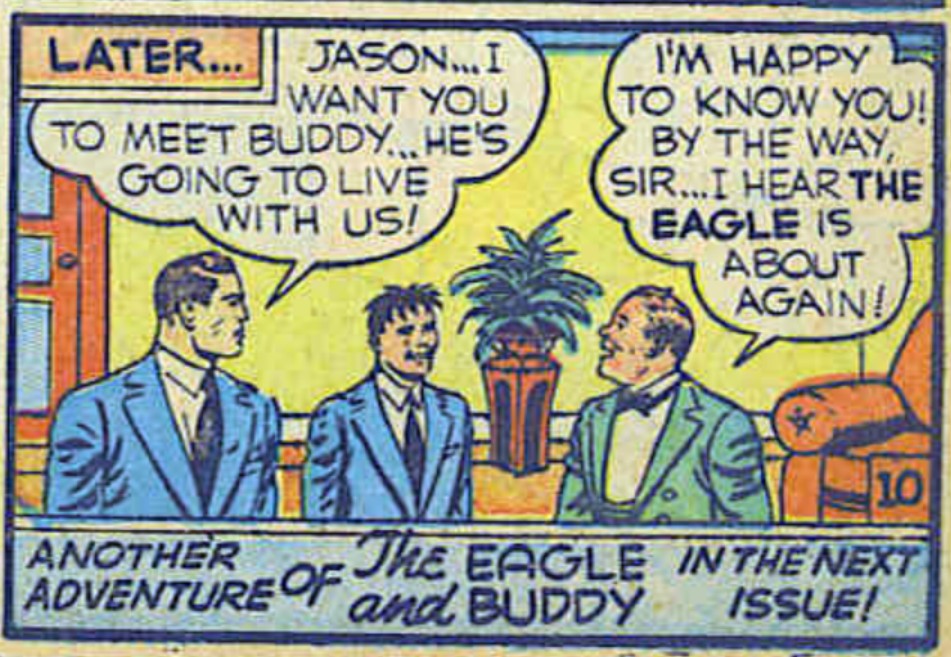
    More importantly, that kid up there is the Eagle’s new sidekick:

    Buddy, the Daredevil Boy: 

    Buddy is a kid who was presumably doing a little track-and-field when he saw the Eagle’s archfoe the Beast about to murder him with a poisoned dart and jumped in to save the day. The Eagle proceeds to adopt Buddy in such an abbreviated and perfunctory fashion that it almost serves as a parody of the idea of the kid sidekick – he doesn’t even bother to establish that he’s an orphan first.

    Buddy might just be the most hard-done-by sidekick in Golden Age comics, at least as far as costumes go, as he’s stuck in that track suit until Weird Comics 017, while the Eagle just keeps on trying new outfits the whole time. I can only imagine how galling that must have been for him. (Weird Comics 009, 1940) 

  • MINOR SUPER-HERO ROUND-UP 059

    MINOR SUPER-HERO ROUND-UP 059

    You thought that I couldn’t keep doing it but I can. MORE SUPER-HEROES 

    the Dart: 

    On the one hand, the Dart is just another guy with cape and a mask who fights crime alongside his kid sidekick, but on the other, he has a few interesting twists on what is already a tried-and-true formula:

    In the first place, the Dart was originally an Ancient Roman named Caius Martius who was magically sealed in a block of stone by his enemies, only to reemerge in the 20th Century. While this is only a moderately unusual origin for a super-hero, what is neat is that Caius Martius was effectively already a super-hero before he got cursed: he had his signature super-power of flight (referred to a “darting through the air,” hence the name) and was using it to fight “Roman racketeers.”

    Basically the first thing that Caius sees when he leaves the museum is a drive-by shooting, as the Ricarno Gang wipes out the Mariotti Gang, and more pertinently to his origin the parents of…

    Ace Barlow, the Amazing Boy: 

    Ace’s tragic orphaning at the hands of the Ricarno Gang leave him free to join up with Caius Martius as a crime-fighting team. Caius teaches Ace how to scrap, Roman-Style, and even more impressively goes to the trouble to teach him to fly rather than simply having an unpowered teenaged boy tagging along on all of his adventures like so many of his peers. (Weird Comics 005, 1940) 

    The Dart later gets a job as a teacher of Ancient Roman history at the school that Ace attends, and while this may seem like a good idea on the face of it, we must keep in mind that he slightly predates Julius Caesar, and so every time a kid asks a question about the Roman Empire, Caius is going to bug out his eyes and say “the Roman WHAT?”

    Also please note that while Caius Martius had the forethought to change his weird Roman name to something more modern to fit in, the change he made was to add “Wheeler” to the end, like having the last name “Martius” was the problem. (Weird Comics 006, 1940) 

    After their initial appearance, the Dart and Ace spend the rest of their 1940 appearances as nonsuper, nonflying vigilantes, but someone must have realized that that was the more boring option because the Dart was back to darting through the air in 1941.

    Finally, the creators of the Dart either vastly over-estimated the cutting power of a Roman short sword or intend for the Dart’s signature weapon to be magical in some way, because he sure does spend a lot of time carving through things that would stymie the vast majority of handheld tools.

    Dynamo **UPDATE**:

    I don’t know if it’s a new power per se, but in his first appearance in Weird Comics Dynamo continues his long habit of really expanding the limits of what you can do via control over electricity by employing it as a long-range listening device. (Weird Comics 008, 1940)

    Similar but unrelated: he can also hear radio broadcasts through his fingertips. (Weird Comics 009, 1940) 

    the Eagle **Update**: 

    The Eagle just can’t resist the lure of a new costume. Or Perhaps it’s the Eagle’s colourist, since as with several of his previous changes in outfit this one could just be some whimsical palette swap action. (Weird Comics 009, 1940)

    More importantly, that kid up there is the Eagle’s new sidekick:

    Buddy, the Daredevil Boy: 

    Buddy is a kid who was presumably doing a little track-and-field when he saw the Eagle’s archfoe the Beast about to murder him with a poisoned dart and jumped in to save the day. The Eagle proceeds to adopt Buddy in such an abbreviated and perfunctory fashion that it almost serves as a parody of the idea of the kid sidekick – he doesn’t even bother to establish that he’s an orphan first.

    Buddy might just be the most hard-done-by sidekick in Golden Age comics, at least as far as costumes go, as he’s stuck in that track suit until Weird Comics 017, while the Eagle just keeps on trying new outfits the whole time. I can only imagine how galling that must have been for him. (Weird Comics 009, 1940) 

  • MINOR SUPER-HERO ROUND-UP 050

    Novelty Press character round-up, more like.

    the Chameleon:

    An unnamed master of disguise (throughout his 1940 appearances, at least) who dispenses vigilante justice on an ad hoc basis, the Chameleon’s major distinction is that his name is always written in cursive. Other than that: he’s got a chauffeur/sidekick (Slim) and a bumbling police nemesis (Inspector Parks) and somehow manages to simultaneously be one of those heroes who is wanted by the law and whose identity and address are just kind of common knowledge. (Target Comics v1 006, 1940)

    the Blue Zombie:

    “Fantastic Feature Films” was a strip that ran in the first couple of years of Target Comics, with the same conceit as Ed Wheelan’s Minute Movies: that the stories being presented were films in which the were being portrayed by a pool of fictional actors – the titular Blue Zombie of this feature, for instance, was played by Orson Black, a Boris Karloff-style Man of a Thousand Faces. This is a fantastic fictional conceit and I am surprised that it hasn’t cropped up more over the years.

    In the fictional movie The Blue Zombie, Bolshemanian scientist Igor Zamoisky rebels against his country’s warmongering dictator and heads to the neighbouring country of Coreland in order to put his scientific discoveries to use in thwarting a Bolshemanian invasion. Discovering a lost Bolshemanian battalion that succumbed to the harsh Corelian winter, he attempts to restore one of them, his old friend Nicholas Samousk, to life. Instead of a restored Samousk, his experiment produces a bright blue zombie version of his friend who responds to his mental commands but cannot think for itself. Zamoisky restores the rest of the battalion in a similar fashion and uses them to crush the Bolshemanian invasion of Coreland, then sets off with his zombie army to free his homeland. 

    Obviously describing a one-off like the Blue Zombie as a super-hero is a bit of a stretch, but a) he’s not that far off of the Purple Zombie in his origin and general deal, b) I wanted an excuse to talk about the fictional-actors-in-fictional-film conceit and c) the Blue Zombie is a really good name. (Target Comics v1 006, 1940)

    the Target: 

    It’s always fun when an old-school anthology comic book gets a character to match its name fairly late in the game and to prove my point here’s the Target, showing up in the tenth issue of Target Comics.

    The Target makes his debut with a big advertising push to really get the word out that he is out to crush crime in his version of NYC: full page newspaper ads, messages on the radio, threatening telegrams sent directly to crooks… at one point a lady calls that number that used to tell you the correct time and a recording of the Target tells her to keep her nose clean. It’s really the opposite of the modern Batman as Urban Legend school of superhero mystique.

    The Target’s gimmick is also Batman adjacent: like 50s 60s 70s whichever era’s Batman first justified the yellow circle on his chest as a bulletproof target for crooks to aim at, the Target is running around with a literal target painted on his chest (and back) because he has a bulletproof leotard on underneath. Just why the fact that his legs are unprotected is a) necessary and b) emphasized is never really addressed.

    Finally, the Target has a thematically appropriate calling card, a dart. We’ll see how long he keeps using it for. (Target Comics v1 010, 1940)

    the Targeteers:

    The more astute readers among you might have noticed that I didn’t really go into the actual origin of the Target in his own entry, and that’s because it’s tied in with that of his sidekicks the Targeteers and so we’re covering them all at once.

    So: Niles Reed is a brilliant but aimless metallurgist whose only relative, brother and New York City District Attorney Bill Reed, is framed for murder and scheduled to be executed at Sing Sing.

    Niles dons a domino mask and attempts to bust Bill out during his final prison transfer but the guards manage to hit Bill during their escape. After a heartfelt “why me?” Bill dies and Niles buries him in an unmarked grave, which means that he’s still considered to be at large, an evocative detail that I had hoped would lead to something like Niles hinting that the Target is actually Bill to throw suspicion off of himself and flush out the crooks who framed him, it never really seems to come up again.

    This would ordinarily be the point in an origin story in which the costume would come into play, there’s one more step to the Target’s origin and that’s the Targeteers.

    See, Niles is wandering the streets at night, trying to figure out just what he can do in the face of an uncaring world in which innocent district attorneys are gunned down in the street for merely trying to break jail, when he runs off some thugs who are attempting to kill or at least maim two teenage boys, Dave and Tommy. It turns out that the kids are both orphans who also hate crime because the crooks had already killed their father (well, one father and one unofficial adopted father, but why get technical).

    Having two young wards who love to talk about getting real beefy and wiping out crime is the final catalyst for Niles, who remembers that he has some superscientific bulletproof material and three super-hero costumes just lying around, and since the three were playing darts when they came up with the idea the whole endeavour ends up being dart and target themed (and as this is possibly my favourite style of generic supersuit it’s nice to see three people running around in it at once).

    The two lads collectively go by the Targeteers, which is a nice change of pace from teen sidekicks who just go by their own names. Finally, according to some dialogue later in the comic the jailbreak, ad hoc funeral, befriending of the boys, making costumes and the initial Target adventure in the previous issue (including the entire publicity blitz) all take place in about a week, which is very efficient. (Target Comics v1 011, 1940)

  • MINOR SUPER-HERO ROUND-UP 047

    Astonishing super-heroes of the past! And future!

    the Invisible Avenger: 

    Teen radio enthusiast Buzz Allen discovers the secret of personal invisibility shortly after the death of his father at the hands of criminals and so is perfectly primed to become part of a super-vigilante duo alongside his friend Will Lawrence (if the issue of whether they should be the Invisible Avengers ever comes up then it is in the initial adventure which I alas cannot read). 

    Their adventures are structured such that they cause maximum consternation so as to really get the most out of the invisibility gimmick: they become invisible before driving their car to the scene of a robbery, for example, and when they put on their anti-invisibility gloves so that they can flash their guns at the crooks they make sure to do so in a public place so as to freak out the subway-riding squares. If I were to devise some sort of ratings scale to score invisible characters on how well they use their powers (which I will not – I am already tracking far too many arbitrary metrics), then the Invisible Avenger and Will would score low. (Superworld Comics 001, 1940*)

    Hip Knox:

    Hip Knox! An orphaned child raised by Professor Knox to have the mightiest mind in the world and named by Professor Knox to have a silly name that kind of winks at his powerset!

    If Hip Knox is known for anything then it’s for being one of the worst-dressed men in comics. Every element of his uniform is just a little bit wrong, except for the parts that are a lot wrong. Breaking things down from top to bottom, we have:

    1. The Helmet. If there’s one piece of this costume that is 100% bad then it’s this scaly golden swim cap. I sincerely wish that Superworld Comics 001 was available for less than 2000 dollars US, because I really want to know if this is some sort of mind amplification helmet or just a bizarre affectation. Hate it. Hate that it covers his ears.

    2. The Mustache. I can get behind a super-hero with a fussy little mustache, but you aren’t Hercule Poirot, my dude. Grow it out a bit more or have fewer weird and uncanny elements to your outfit so that a little mustache is a fun little affectation and not the punchline to someone’s description of you to their friends.

    3. The Jumpsuit. This isn’t all that far off of what would come to be the standard super-hero outfit, so I should be fine with it, right? Wrong. Between the fact that Hip is drawn with a bit of a barrel chest and the noodle arms of someone who fights crime with their mind, and the suit being buttoned all the way up to a collar at the neck, this suit is bad.

    4. The Insignia. A minor nitpick but it contributes to the whole: that eye looks too realistic to just be sitting on the chest by itself. Throw it in a circle or something. Plus you gotta choose: either the eye or …

    5. The Belt Buckle. I have nothing against a good yonic symbol, but why does Hip Knox have one as his belt buckle? And why is it so big? It looks like an attempt to pick up a pencil off the ground would result in him simultaneously stabbing himself in the groin and the upper abdomen.

    What is the solution for this fashion debacle? Change one or two key elements: swap the jumpsuit out for a red tuxedo to lean into the (stage) hypnotist angle and things feel a lot more harmonious. The eye would have to become an amulet or maybe an ornament on one of those weird sashes that goes under the jacket, but everything would hold together much better. Or keep the jumpsuit and lose the helmet! Or make it a headband, that would be much less heinous!

    As befits a super-hypnotist, Hip Knox has a pretty relaxed approach to the mental autonomy of those around him, but tragically also seems to have a terrible imagination, as in the above panels in which he attempts to signal that he is being kidnapped by turning bystanders into a trail of living statues instead of, say, having them shout “Hip Knox is in that car being kidnapped!” in unison. (Superworld Comics 001, 1940*)

    Marvo 1○2 Go+:

    The Boy Genius style of comics/fiction in general has produced a lot of very fun adventure heroes over the years and also a lot of annoying little smug turds, and I’m sure that personal bias plays in to whether a particular boy reads as one or the other to you. As you might be able to tell from all of this preamble, Marvo 1○2 Go+ is very much a smug little turd in my eyes.

    Thanks to the wonders of sleep education, Marvo has all the knowledge of a forty-year-old scientist packed into his fifteen year-old head, but he’s even more intelligent than that, so much so that he gets to put a little plus sign on the end of his name (Marvo is from one of those science fiction futures where inefficient surnames have been replaced with government-assigned alphanumerical designations, like Superworld publisher Hugo Gernsback’s own novel Ralph 124C 41+ or DC Comics’ later Chris KL-99), which he makes sure to have embroidered on the front of all of his clothing in case people forget how special he is.

    Knowledge of a forty year-old or not, Marvo still has all the foresight of a fifteen year-old, as seen for instance in the above panels wherein he takes advantage of a geothermal hotspot beneath Pennsylvania to permanently alter its climate without stopping to consider the potential long term environmental effects of a permanent Summer. (Superworld Comics 001, 1940*)

    X, the Phantom Fed: 


    There are a whole lot of comic book protagonists with names like Secret Agent Q49 or Agent X-7, etc, code-named operatives two-fistedly saving the world for democracy the US Government, and X, the Phantom Fed exists at the border between that concept and that of the super-hero. Described as the “Man of a Million Faces,” X’s real face is a mystery even to his friends because he is always in some disguise or another. X is armed with an embryonic version of the James Bond-era spy’s arsenal and the best super-spy name of the bunch but sadly that doesn’t save him from having a bare handful of appearances. (Sure-Fire Comics 001, 1940)

    *I have not actually read Superworld Comics
    001 because it is not readily available to the average person. My
    information on the origins of these characters therefore might be
    slightly inaccurate.
     

  • MINOR SUPER-HERO ROUND-UP 041

    Another assortment of guys for your delectation.

    the Sky Wolf:

    Just another masked pilot in a souped-up named plane (originally the Silver Bullet, followed by the Golden Bullet), the Sky Wolf loses both his place in Silver Streak Comics and his plane’s name to fellow pilot Cloud Curtis once 1941 rolls around, and to add insult to injury, in 1942 the far more successful character of Skywolf debuts over at Hillman, ensuring that he doesn’t even have good SEO. (Silver Streak Comics 004, 1940)

    Whiz, King of Falcons:

    The Silver Streak is not immune to the sting of pride, so when aviator Sir Cedric Baldwin challenges him to a race around the world to prove who is the fastest man on Earth, he accepts, and is of course fast enough that he not only wins but is able to have a very culturally-sensitive adventure in Saudi Arabia along the way. Silver Streak is knocked out and captured at one point, and the falconry-obsessed villain takes advantage of this to inject his favourite bird with some super-fast blood. 

    Astonishingly, this works, despite our only account of the Silver Streak’s origin being as a result of hypnotic conditioning coupled with a near-death experience – perhaps the hypnosis was so deep that it mesmerized his very blood? That would explain the falcon’s immediate shift in loyalty from its owner to its super-heroic blood doner, at least.

    “Whiz, King of Falcons” is technically not this guy’s name until Silver Streak Comics 007, which was published in 1941, but I reckon that calling him “Unnamed Falcon Companion” here and then correcting it in six months’ time would be extremely wilfully obtuse of me. (Silver Streak Comics 006, 1940)

    UPDATE 1941 

    the Daredevil:

    The Daredevil is Bart Hill, a vigilante in the Batman mould, having lost his parents to a gang of crooks and subsequently vowed to revenge himself on crime. Further, those same crooks tortured Bart himself, rendering him mute in the process, and due to a boomerang-shaped brand they left on his chest he devoted himself to the study of the weapon, adopting it as one of his heroic signatures. The Daredevil is one of the longer-running non-Marvel or DC/Fawcett/Quality characters of the Golden Age so he will be making a few appearances here going forward, but there are a few notable things about him:

    – his origin will undergo some revision between his first and second appearances, most notably the fact that his muteness is discarded – presumably to enable for easier storytelling

    – his costume is also somewhat revised, which is fun particularly because, like his Silver Age namesake, he switches from a yellow to a red colour scheme

    – this Daredevil’s Golden Age popularity, combined with his public domain status, means that he’s a popular choice for modern revivals, but the fact that there is a currently-published character with the same name (and owned by Disney, to boot) means that nobody dares to actually call him Daredevil in their stories and so the more recent versions of him have a wide range of variably terrible alternate names including the Death Defying ‘Devil, the Daring Devil and Doubledare. (Silver Streak Comics 006, 1940)

    UPDATE 1941 

    Iron Vic:

    Iron Vic is a frustrating beast. He first appears as a mostly-dead body washing up near the island laboratory of Professor Carvel, who applies a “certain rare serum” to the task of saving his life before dropping dead from the strain. Vic, as the man comes to be known, is rendered both amnesiac and superhuman by the process. He has one proper super-heroic adventure against Carvel’s old colleague Dr Spagna before the strip transitions into one primarily about baseball (and in case you’re wondering there is no mention of the ethical quandary that a superhuman participating in regular human sports would cause). The really frustrating part is that Dr Spagna implies that he knows something about Iron Vic, but the Spagna story is never actually resolved anywhere. Vic is merely an amnesiac baseball player until I think he enters the Army at some point? WHERE OH WHERE IS MY RESOLUTION (Single Series 022, 1940)

  • MINOR SUPER-HERO ROUND-UP 033

    Minor super-heroes, we got ’em.

    Little Giant: 

    Professor Rednow has some inventions to test and he has secured an orphan boy named Rusty for that purpose. Rusty is first given a serum that is supposed to turn him into a big hunk of beefcake but instead he becomes a kid with super strength. He then gets an outfit with anti-gravity properties that allow him to leap around like a small Hulk and finally is coated in “impurvogen,” a high-tech chemical that renders him invulnerable.

    In case you were having some doubts about Professor Rednow’s devotion to scientific ethics: I don’t think that he has any. It’s just lucky for young Rusty that all of this stuff works or he might end up buried in the Professor’s back yard alongside half a dozen other orphan boys.

    Rusty and the Professor end up moving to NYC and becoming special deputies in the NYPD but, as with the Phantom Knight before him, the Little Giant only really had a couple of adventures and the second one continues to be out of my price range. (OK Comics 001, 1940)

    the Shield:

    The Shield is Joe Higgins, “G-Man Extraordinary,” an FBI agent who battles threats to the US using a super-suit of his own design (a design that supposedly was the reason for Captain America switching from his original shield to the round one so as not to look too much like his patriotic counterpart, by the way). 

    Over the years the Shield’s status is subject to the usual comic drift: his powers go from being solely derived from his suit to involving some sort of super serum or ray or two of those, or all three. We’re talking about the 1940 version of the character, though, and he was all suit, baby. The suit itself did slim down considerably from the first issue to the second, but we can chalk that up to a refinement of the technology (and to the more form-fitting top being a bit more flattering than the big chunky breastplate look).

    One thing about the Shield that I had never known prior to reading his first appearance was that his motivation for becoming a costumed crimefighter was that his father died in the Black Tom Explosion as a result of German sabotage during WWI. Thus, the Shield has the Batman origin but for espionage!  (Pep Comics 001, 1940)

    UPDATE (Shield-Wizard Comics 001, 1940)

    the Comet:

    John Dickering is a scientist who invents a gas that when injected gives him super jumping abilities. Too late he learns the reason that so many scientists do extensive testing before trying out serums etc on themselves, as the gas also gives him disintegrating ray vision that can only be held in check by a glass visor, Cyclops-style. Thus, he becomes the Comet.

    There are a number of remarkable things about the Comet over the years but the only ones relevant to the 1940 version of the character are 1. the fact that he has one of the truly great Golden Age costumes and 2. just how very willing he is to kill his foes. I guess when all you have is a disintegrating ray every problem looks like a disintegratable nail. (Pep Comics 001, 1940)

    the Rocket:

    The Rocket is your classic example of an explorer coming to a lost/hidden/alien world and becoming its greatest champion. The most common example of this is your garden-variety jungle adventurer, with “modern man transported into an effete future” and “guy falls through hole into underground world” being other common examples.

    The Rocket’s adventures, on the other hand, happen… somewhere. He
    arrives via his namesake rocket ship – is the Diamond Empire located in
    the future? on an alien world? on a lost mesa or in a hidden valley? No
    idea, never addressed. He just shows up because he heard there was a hot
    queen running the joint and that’s all we get.

    After a rocky start, the Rocket manages to win over the titular Queen of Diamonds, going from her slave to her bodyguard to eventually becoming her lover/ adventuring companion. And if you read the above panels you might have noticed how very racist the Queen’s origin story is, another thing that is extremely in keeping with this man-in-a-strange-land style comic: white guy exceptionalism. (Pep Comics 001, 1940)

  • MINOR SUPER-HERO ROUND-UP 031

    MINOR SUPER-HERO ROUND-UP 031

    Great guns! More of them?

    the Masked Angel:

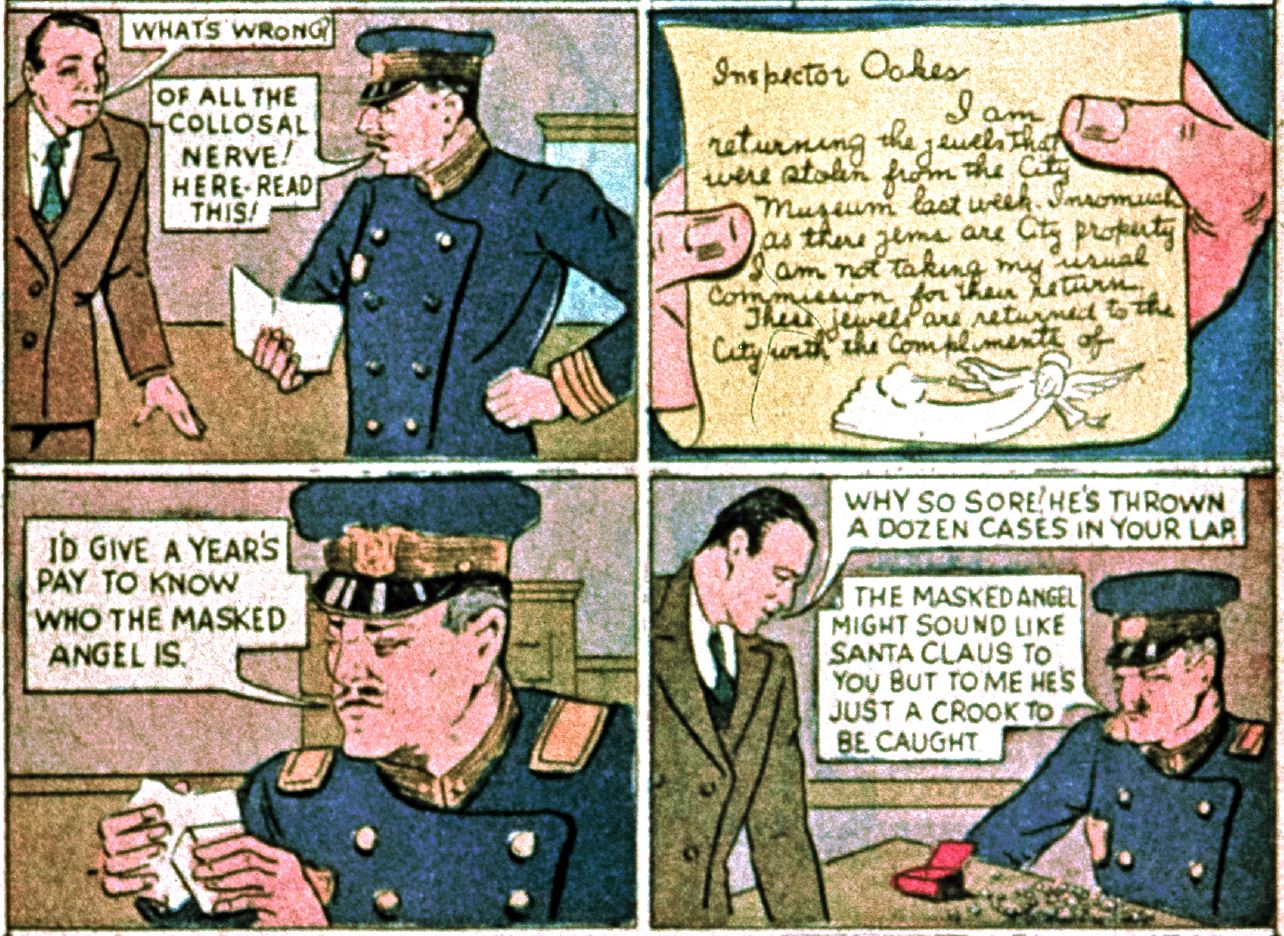
    Steve Oakes, wealthy playboy just so happens to also be the Masked Angel, vigilante feared by the underworld and wanted by the police.

    Steve’s father Detective Inspector John Oakes was murdered by crooks, so the Masked Angel act is his way of getting back at the criminal fraternity. It also seems to be a way to troll his brother, Detective Inspector John Oakes II, who is an asshole and who hates the Masked Angel in your classic way that a police officer does when they’re part of a vigilante’s supporting cast. Also please note the fun “angel shooting a gun” signature on the Masked Angel’s taunting note. (Miracle Comics 001 1940)

    Uncle Sam:

    We’re skirting the edge of what might be considered “minor” here, at least to DC Comics fans, but I have no Median Super-Hero category and however you slice it your parents almost certainly have not heard of him so here goes:

    Uncle Sam is the physical embodiment of the patriotic ideal of the United States: good, kind, powerful and just. He emerges to lend a physical hand in times of turmoil by inhabiting of reshaping the body of a recently slain patriot.

    This time around, Uncle Sam is (implicitly, all of this isn’t really spelled out until later) reborn from the death of Ezra Smith, who stands up to fascist agitators the Purple Shirts and gets a bullet in the back for his trouble. He sticks around to beat Axis ass for the duration of the war and then is not seen again until DC integrates the Quality characters into Earth-2 continuity in the 1970s. (National Comics 001, 1940)

    National Comics 005 expands the Uncle Sam lore slightly, firstly by making it a bit more explicit that he incorporates the spirits of dying patriots into himself with what is perhaps the initial time he did so, when a man named Sam sacrifices his own life to advance the cause during the American Revolution.

    Secondly, Sam is seen merging with a living patriot named Samuel in order to help drive the fascist Black Legion out of Glen Valley. Is this a common event? Does Uncle Sam roam the land absorbing patriots? Who can say, but it certainly would put a new spin on the character.

    Buddy Smith:

    When Ezra Smith is murdered by the Purple Shirts, his grandson Buddy is left alone, presumably some sort of double-orphan. He is almost immediately found, shamed for crying, and adopted by Uncle Sam (and hopefully the near immediate recovery Buddy has from the grief of seeing his grandfather gunned down in front of his eyes is a function of Uncle Sam being partially Ezra Smith and not some sort of deep traumatic repression left to fester in his soul).

    Buddy fills a pretty standard kid sidekick role: getting into trouble, getting Uncle Sam out of trouble, inventing things, befriending people, spotting clues, etc. He is unusual in that he is one of the few kid sidekicks who is a proper kid as opposed to being a young teenager (I know the common wisdom is that Dick Grayson was eight when he became Robin but that’s mostly because Golden Age artists – and particularly Bob Kane – were mostly very bad at drawing kids. Robin was absolutely supposed to be somewhere in the 12-15 range when he debuted). He’s also notable for – as far as I know – never ever showing up again post-Quality, not even in that event earlier this year that was specifically focused on bringing back all the old (and new) Golden Age kid sidekicks. Maybe Uncle Sam ate absorbed him once he got old/patriotic enough. (National Comics 001, 1940)

    Merlin the Magician:

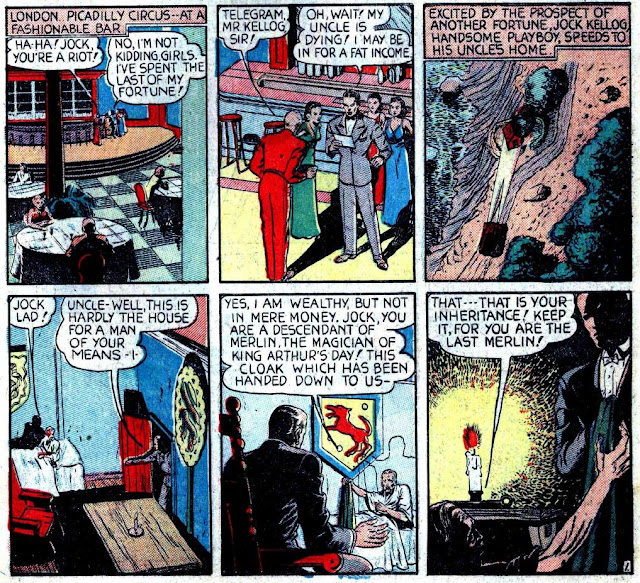
    Jock Kellog, a wealthy playboy in the classic mold, spends the last of his family fortune on the same day he is summoned to the bedside of his sole relative, an unnamed uncle. Instead of the fat stacks of cash that he is hoping for, Kellog comes away with a cloak and the knowledge that he is supposedly the last descendant of Merlin of Arthuriana fame.

    It turns out that he is in fact the last descendant of Merlin, of course, and that the cloak is a source of unlimited magical power in the grand tradition of mystic super-heroes like Zatara. Lucky for the world at large, the application of vast power has the opposite of its usual effect on the young wastrel and Jock devotes his newfound power to the defense and betterment of humanity. (National Comics 001, 1940)

  • MINOR SUPER-HERO ROUND-UP 027

    Guess what? More minor super-heroes, that’s what.

    the Black Arrow:

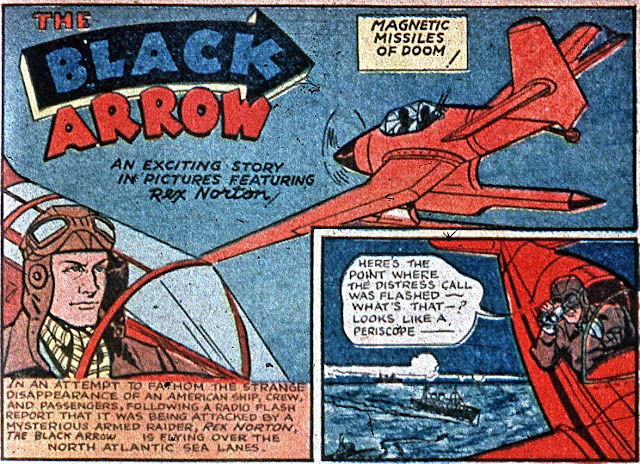
    Black Arrow, aka Rex Norton, is a detective/pilot, ho-hum. As per standard he has a great codename. (Green Giant Comics 001, 1940)

    the Researcher:

    A dapper super-scientist armed with x-ray flashlights, paralysis-inducing walking sticks and mind-reading rays. Perhaps the most charming thing about him is that everyone from his enemies to his friends to his lab assistant/love interest refer to him solely as “the Researcher.” (Green Giant Comics 001, 1940)

    the Green Mask:

    The Green Mask started out in Mystery Men Comics as your standard Green Hornet or Crimson Avenger style masked vigilante: capable with his fists and with a gun but otherwise an ordinary if unnamed human man, believed by the police and the underworld to actually be a crook and thus hunted by both, the works. 

    After about a year and a half, he got a bit of a revamp: the Green Mask is now Michael Shelby, son of Senator Shelby, enemy of crime. In an attempt to prevent the Senator from introducing a law that would make crime illegal, gangsters gun him down and shoot up Michael in the process. Lucky for him, family friend Professor Lascomb is present and has a healing vita-ray machine at his disposal – Michael’s life is saved and as happy side effect he is given the power of flight and some ill-defined enhanced physical abilities. His crimefighting career is much the same as before but without the ire of the police. 

    (Like Fox Features’ other big non-Blue Beetle heroes Samson and the Flame, in 1941 the Green Mask gets a bit more of a supporting cast, in his case wealthy socialite Olivia Tracy and her bumbling chauffeur Peters. Like Samson and the Flame this didn’t save him from oblivion when Fox had its troubles in 1942-1943 but unlike them he did return eventually. Kind of) (Mystery Men Comics 001, 1939/ Green Mask v1 001, 1940)

    Domino the Miracle Boy:

    In the same story in which the Green Mask becomes super-powered Michael Shelby (and also Michael Shelby becomes the Green Mask) an unnamed youngster is blown up by a grenade and must be healed by Professor Lascomb’s vita-ray. This youth was called Don (no last name forthcoming) and wasn’t just a blown-up teen but a blown-up teen orphan and so was summarily adopted by Michael Shelby. Domino’s powers are a little less extensive than the Green Masks, as Prof Lascomb foolishly fixed the vita-ray machine’s short circuit in between the two being treated, the main upshot of which is that Domino doesn’t seem to be able to fly but rather gets around on a rope tied to a boomerang. (Green Mask Comics v1 001, 1940)

    Update 1941

  • MINOR SUPER-HERO ROUND-UP 025

    Just a great bunch of guys.

    David:

    I read the Samson stories in Big 3 before those in his home comic Fantastic, so while I knew about his sidekick David I didn’t really know what his whole deal was. I had read that Samson just found him sitting around somewhere and assumed that that was hyperbole but no, it’s not: Samson is investigating some mysterious plane crashes in the Rockies when he just finds a kid, who turns out to be the only survivor of the latest crash, and just… brings him along. There’s no real attempt to address the fact that he must be an orphan now (or if not and he was travelling alone for some reason, that his family now thinks he is dead) or to find him a familial guardian – heck, his name isn’t even David. It’s low-key one of the weirdest sidekick origins in comics and that’s before he gets his own pair of fur briefs. (Fantastic Comics 010, 1940)

    UPDATES: Even in the updated Samson origin, David is still a hanger-on (Samson 001, 1940)

    UPDATE – the Fantom of the Fair:

    The Fantom of the Fair gets his own short-lived book that sees him spending more and more time fighting crime outside the New York World’s Fair, if you can believe it. To that end he adopts the more generic name of the Fantoman. The costume changes (blue instead of black, uncovered lower face) happened at the end of 1939 and technically I’ve read more Fantom stories in which he had the new one than the old but it never feels right to me. At least you can still see his hair through the cowl.

    Though he has a new name and a not-so-new look, Fantoman retains one of his most iconic properties: every time you start thinking of him as just another masked adventurer he busts out another heretofore-unseen superpower or bit of lore suggesting he is a thousand year old demigod or something. See above as he either teleports or passes through matter for the first and last time. (Fantoman 003, 1940)

    the Spy Fighter:

    It kind of says something about the mood of America in 1940 that there are multiple comic book series that take place in the 1990s after what we know as World War II has stretched on for fifty years (Marvel’s Breeze Barton is the other one that I can recall off the top of my head, while MLJ’s Doc Strong is from a future ravaged by a whole century of WWII). In this version of that, the war has resulted in an amalgamation of the world into three rival nations: Russmany (Europe and Africa), Mongo (Asia) and Greater America (the Americas), and in this world of super nations, a super spy is required to ensure the sanctity of the Greater American way of life.

    That man is Saber, the Spy Fighter! Who does eventually put on a shirt. Saber starts out as physically gifted telepath who roots out enemy agents by reading their ill intent in their own minds and then beats them up for it. Over time, the challenges he faces get larger and less specifically espionage related, and he develops new abilities to meet them, including that of changing his own size at will, to the point that he is eventually able to travel through space on his own power to fight planet-sized enemies. And what can Mongo do to challenge that? (Fight Comics 001, 1940)

    Update 1941

    the Skull Squadron:

    Chip Collins’ Skull Squadron is extremely unremarkable but at this point I have to make note of every skull-adjacent comic book thing. They operate somewhere in between a commando group and the Suicide Squad and barely even have skulls painted on their planes. SKULL SCORE: 1/2 and only for the name. (Fight Comics 001, 1940)