The Curse of Skeleton Munroe

Category: Robin

  • SUPER-VILLAIN YEARBOOK: CLAYFACE 1940

    SUPER-VILLAIN YEARBOOK: CLAYFACE 1940

    What did Clayface get up to in 1940?

    Detective Comics v1 040, ‘Untitled’ **First Appearance**

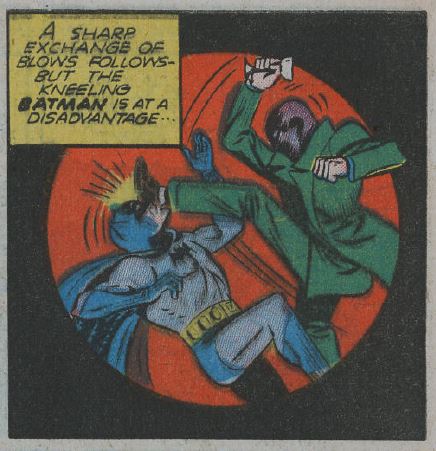
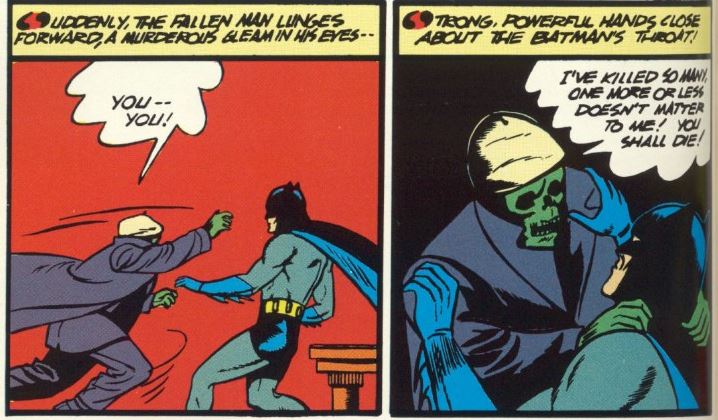
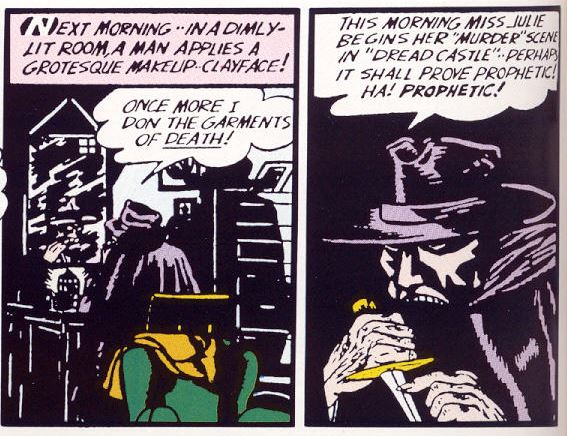
    I’m not surprising anyone when I reveal that Clayface is actually Basil Karlo, an oldtime horror movie star who tanked his own career and couldn’t take it when they started remaking his old movies, thus necessitating a costumed murder spree to ruin the filming of Dread Castle.

    Batman and Robin get involved because one of the prospective victims is Julie Madison, Bruce Wayne’s fiancé (in her last appearance as his fiancé). Much of the action is not, in fact, Clayface-related but rather concerned with the actions of various Clayface suspects such as drunk director Ned Norton, variously-gruntled actors Kenneth Todd and Fred Walker, and Gangster Roxy Brenner.

    Clayface himself wears the common purple hat and cloak combo of an early Batman villain. He doesn’t actually spend much time on-panel, so the degree of grotesqueness of his makeup is hard to judge, whatever the narration boxes say.

    And finally the reveal: Basil Karlo did it and he did it because of horror movies. He might just be the first character in comics to get the Don Quixote “the problematic media of the day is the real villain!” origin for his madness but he certainly won’t be the last.

    Number of Episodes of the “Super-Villains of Hollywood” podcast: Basil’s got to be an entire season all by himself, doesn’t he? If we’re dealing strictly with the events of the year 1940 we’re talking two episodes on his rise and fall, followed by one about the actual Clayface debut.

    Body Count: 2

    End-of-year Status: Captured

  • SUPER-VILLAIN YEARBOOK: CATWOMAN 1940

    I have decided that I’m neglecting non-minor super-villains! Thus: super-villain yearbooks! We’re hopping back in time slightly to round up the ones who appeared in comics I have already read as I revisit them, so here comes a big blob of Batman villains!

    So, what was Catwoman up to in 1940?

    1. Batman Comics v1 001, ‘Untitled’ **first appearance**

    In Catwoman’s first appearance, she’s a mysterious figure known as the Cat about whom little enough is known that Robin’s chief suspects are a couple of chunky dudes in their 50s.

    Key to Batman’s relationship with Catwoman, however, is that he is very horny for her. Thus, my theory is that he horny-sensed that seeming frail old lady Miss Peggs is actually a hot dame with nice gams, no matter what he tries to tell Robin later about “clues” and “evidence.”

    The reveal of the Cat’s true identity is of course the source for a couple of the classic out-of-context comics panels.

    Finally, this is the first of many times that Batman will just let Catwoman go because, as mentioned, he’s horny for her. 

    2. Batman Comics v1 002, ‘Untitled’

    Most of this is a Joker story, but there are a few points of interest for the Cat.

    The little old lady disguise is back in play!

    As befits the subject of Batman’s affections, she shows moments of virtue even as she plunders the castle of a dead man.

    At the very last second, as she plunges to her potential doom, a “-Woman” is added to her name, basically for all time.

    3. Batman Comics v1 003, ‘The Batman vs the Cat-Woman!’

    The most important part of this adventure comes early:

    The cat head Catwoman costume! Not well-loved but it has a place in my heart. Catwoman has at least as many lackluster costumes as great ones, so one that goes all-out like this definitely ranks in the top 50% over mediocrities like the 60s green outfit or the black one-piece swimsuit with buccaneer boots.

    The story is less about Batman vs Catwoman than it is about crappy business partners. Specifically, two of the three men involved in a diamond business team up and hire the Catwoman to steal their goods and then one of them betrays the other one. Things look bad for Catwoman until Batman and Robin show up.

    Batman again lets her get away because he like-likes her, but this time:

    The feeling is mutual! Fireworks go off! The nations rejoice! The nascent spirits of fanfic grow stronger! WHAT A 1940 CATWOMAN HAS HAD!

    Body Count: 0 (assuming that the security guard that gets taken out in her first appearance was just knocked out, which I am because even Golden Age Batman didn’t get horny enough to excuse murder)

    End-of-year Status: At Large

  • MINOR SUPER-VILLAIN 164: THE MASKED MAN

    MINOR SUPER-VILLAIN 164: THE MASKED MAN

    (Batman Comics 008, 1941)

    I got pretty excited when reading this story, as it concerns murders among the cast and crew of a play called the Superstition Murders and there’s a lot of kerfuffle about bad luck and jealousy and drunk has-been actors and I was hopeful that it might boil down to my favourite motive for supercrime: mad art. Just as mad as mad science but it really makes you think, you know?

    Sadly, the real motive for the crimes is simply base capitalism: if playwright Johnny Glim (good name) can tank the production, rights to the script revert to him and he can sell it to Hollywood for beaucoup bucks. But while you know I am all in favour of creator-owned properties I cannot stress enough that multiple homicide is not a good way to go about securing them and his capture by the Batman is a righteous one.

    Number of Episodes of the “Super-Villains of Hollywood” podcast: Part of a poorly-received later season attempt to profile villains who almost got to Hollywood.

  • MINOR SUPER-VILLAIN 163: PROFESSOR RADIUM

    (Batman Comics 008, 1941)

    Professor Henry “Radium” Ross has things stacked against him from at least three different angles by my count. First, he’s a classic Victim of Orthodoxy as his research is rejected as too fantastic by a stick-in-the-mud institute director and he feels compelled to test his radium-based cure for death on himself. It works, but turns him into a radioactive man in the process, and he starts to go mad from a combination of radiation poisoning and (presumably) grief after he accidentally kills both his partner and his sweetheart (that’s angle no. 2, by the way).

    The third misfortune to strike Professor Radium is Batman, who is much more of a protector of capital than he will be later and consequently is more concerned with preventing Ross from stealing the valuable drug that he need to treat his condition than with helping him get better. They fight and Prof Rad goes into the harbour, presumably to drown. OR DOES HE, the final caption box asks? No, depending on which comic book reality you live in. He makes an appearance as part of a squad of radioactive bad guys in Infinite Crisis, so at least one version of him evidently hangs out for up to 70 years before getting motivation to do some evil.

    They should have brought him back beforehand (or used him since). He’s neat.

  • MINOR SUPER-VILLAIN 163: PROFESSOR RADIUM

    (Batman Comics 008, 1941)

    Professor Henry “Radium” Ross has things stacked against him from at least three different angles by my count. First, he’s a classic Victim of Orthodoxy as his research is rejected as too fantastic by a stick-in-the-mud institute director and he feels compelled to test his radium-based cure for death on himself. It works, but turns him into a radioactive man in the process, and he starts to go mad from a combination of radiation poisoning and (presumably) grief after he accidentally kills both his partner and his sweetheart (that’s angle no. 2, by the way).

    The third misfortune to strike Professor Radium is Batman, who is much more of a protector of capital than he will be later and consequently is more concerned with preventing Ross from stealing the valuable drug that he need to treat his condition than with helping him get better. They fight and Prof Rad goes into the harbour, presumably to drown. OR DOES HE, the final caption box asks? No, depending on which comic book reality you live in. He makes an appearance as part of a squad of radioactive bad guys in Infinite Crisis, so at least one version of him evidently hangs out for up to 70 years before getting motivation to do some evil.

    They should have brought him back beforehand (or used him since). He’s neat.

  • MINOR SUPER-VILLAIN 162: THE CLOCK MAKER

    (Batman Comics 006, 1941)

    A few different longstanding comic book bits make early appearances in the tale of the Clock Maker. First, Bruce Wayne has to go to a boring old board meeting at one of the many companies that he has an stake in, but that meeting sows the seeds of crime. Specifically, they all go to a clock store together afterward and Atkins, the evil board member who wants to gain sole ownership of the clock company for some reason, meets Elias Brock, an unhinged old man who loves clocks so much that he gets violently angry at the thought of wasting or killing time.

    Which leads to the second recurring comics motif: the calculating villain convinces an unstable person to do their killing for them. Brock takes out two board members and almost gets Bruce Wayne before Batman works out the plan, then kills Atkins and almost blows up a decent part of Gotham before being pitched out a window by Robin.

    A side note is that the comic itself seems to somewhat agree with the clockmaker with regard to the precious nature of time – the man himself is a bit of an anticapitalist…

    … while Batman expresses more of a rise and grind mentality, completely unsurprisingly.

  • MINOR SUPER-VILLAIN 161: THE BLACK WITCH

    (Batman Comics v1 005, 1941)

    Batman and Robin’s first interdimensional jaunt took them to Fairyland, where they were tasked with rescuing the daughter of one Professor Anderson, who it seems he was using as a test subject for his narrative-dimensional travel device? There they face off against sundry giants and dragons and so forth before confronting the top evildoer of the realm: the Black Witch.

    One could argue that a villain whose existence is defined by peasant morality tales that have been passed through a series of bowdlerizations is not necessarily completely responsible for their evil nature, but Grant Morrison didn’t write this one, so Batman beats her up and she commits suicide.

  • MINOR SUPER-VILLAIN 160: THE FOUR CARDS

    (Batman Comics 005, 1941)

    A while ago I decided that groups were going to go into my lists (and charts and graphs) of super-villains. After all, if I was willing to accord one fellow who went around as the Masked Bandit, why should I spurn four guys who do exactly the same, only pluralized? Accordingly, masked gangs get as much credit as masked crooks, if they fulfil enough other criteria. The Four Cards, however, introduce a new wrinkle.

    Simply put: if any other four people with card-based nicknames had formed a card-themed gang I’d count them as minor super-villains, but one of them is the Joker. So the group is minor and three quarters of its members are – is that enough? Evidently!

    Aside from my categorization panic, the Four Cards are a bit basic: they operate a semi-legal gambling ship in international waters off Gotham and a disguised Joker, seductive Black Queen and socially adroit Jack of Diamonds line up wealthy targets for the King of Clubs to beat up and rob.

    Inevitably, Batman and Robin step in. The Black Queen falls in love with Batman and she and the Jack of Diamonds bump one another off over him. Meanwhile, the Joker has pulled his inevitable double cross and left (having set the ship on fire as he went), leaving poor Clubbsy as the only one left to be hauled away to jail.

  • MINOR SUPER-VILLAIN 092: THE PAINTER OF DEATH

    MINOR SUPER-VILLAIN 092: THE PAINTER OF DEATH

    (Detective Comics 042, 1940)

    The Painter of Death (never actually called that in-comic, sadly) engaged in a campaign against the subjects of paintings by up-and-coming portraitist Antal. He first attacked the painting of the person and then killed them in the same manner: via dart, arrow, gunshot etc. Eventually, Bruce “Batman” Wayne commissioned a painting from Antal and used it to set a trap which netted Wylie, an art collector who had invested heavily in Antal’s work and saw the murders as a way to raise the value of his investment via morbid publicity.

    Though Wylie bumped himself off at the end of the adventure, the bullet-riddled Antal portrait of Bruce Wayne sticks around to become one of the minor stock trophies in the Batcave. The Painter of Death or Prophetic Portraits Case is also mentioned a couple of times as Batman and Robin’s “first big case” and the reason for their fame. Does this reflect some attitude of the creators about the story itself or is it just a plot contrivance? I have no idea!

  • MINOR SUPER-VILLAIN 092: THE PAINTER OF DEATH

    (Detective Comics 042, 1940)

    The Painter of Death (never actually called that in-comic, sadly) engaged in a campaign against the subjects of paintings by up-and-coming portraitist Antal. He first attacked the painting of the person and then killed them in the same manner: via dart, arrow, gunshot etc. Eventually, Bruce “Batman” Wayne commissioned a painting from Antal and used it to set a trap which netted Wylie, an art collector who had invested heavily in Antal’s work and saw the murders as a way to raise the value of his investment via morbid publicity.

    Though Wylie bumped himself off at the end of the adventure, the bullet-riddled Antal portrait of Bruce Wayne sticks around to become one of the minor stock trophies in the Batcave. The Painter of Death or Prophetic Portraits Case is also mentioned a couple of times as Batman and Robin’s “first big case” and the reason for their fame. Does this reflect some attitude of the creators about the story itself or is it just a plot contrivance? I have no idea!