The Curse of Skeleton Munroe

Category: Hillman

  • MINOR SUPER-VILLAIN 716: DEVALO

    (Rocket Comics 002, 1940)

    “Rocket Riley, Prince of the Planets” was the namesake strip of Rocket Comics, about lab assistant and pilot Rocket Riley, his boss and amazing hair-haver Professor Sterling and Sterling’s daughter/ Riley’s fiance Griselda. While preparing for an official unveiling of Professor Sterling’s new interplanetary rocket ship, the trio are accosted by spy Kurt von Stengle and his hireling and the whole bunch of them end up accidentally blasting off in the out-of control rocket.

    After a brief stop on an unnamed asteroid where von Stengle’s hireling is eaten by Octopus Men, Rocket and crew end up crash landing on Saturn, where things go even more pear-shaped as they are captured by the planet’s dictatorial ruler, Devalo.

    Devalo, also known as Divalo, has a real Satanic look going on and so I spent some time looking for a classical link between Saturn, Satan, the quality of being saturnine, etc., only to find very little. I’m sure that it’s something I’ve encountered before if only due to a general linking of the more evil-flavoured bits of Greek and Roman mythology and Christian underworld imagery, but there doesn’t seem to be an official-enough link to show up in places like Brewer’s Dictionary of Phrase and Fable, or indeed, Wikipedia.

    Nevertheless, Devalo is both Saturnian and Satanic and I would bet a small sum of money that he won’t be the last character we meet who fits both of those descriptions.

    The Saturnian Saturnite society ruled by Devalo is caste-based, with the military at the top, supported by the enslaved scientist caste. All manual labour is done by the Zeroes, whose bodies have been enhanced and intelligences stunted for maximum efficiency.

    Since von Stengle is the kind of villain who would, for instance, try to commandeer a spacecraft that is currently careening through space, he seizes the opportunity afforded him when everyone is rounded up by Devalo’s men to suggest that they might team up to invade the Earth. Stupidly opportunistic in his evil, that’s von Stengle for you.

    Our heroes manage to escape Devalo’s palace along with Saturnite scientist Xenox and his daughter Ladana, but after an encounter with some Sharkmen the group is scattered and only Rocket and Griselda manage to make it back to Professor Sterling’s ship. And that’s it! Rocket Comics ended with issue 3 and Devalo gets to remain not just uncaptured but firmly in charge. All we can do is rest assured that he would have been deposed in one to ten issues if the series had continued.
  • MINOR SUPER-VILLAIN 715: THE STEEL SHARK

    MINOR SUPER-VILLAIN 715: THE STEEL SHARK

    (Rocket Comics 001, 1940)

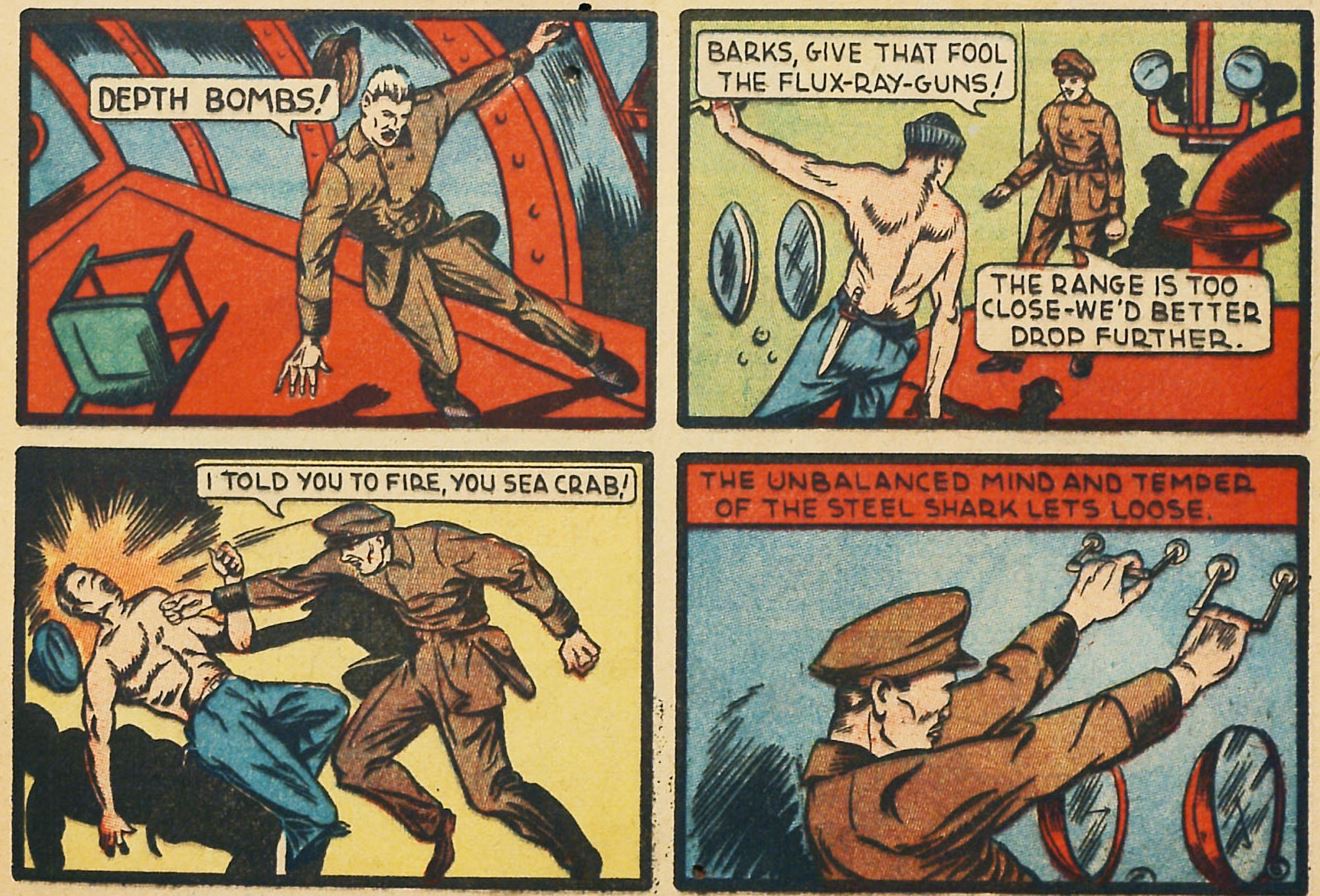
    The Steel Shark has a couple of distinctive notes right off the bat. Firstly, he is part of the elite society of villains who star in their own series and secondly that series is set in the far future world of the year 1960 CE, for no particular reason as far as I can tell. Indeed, I suspect that the people working on the strip did not themselves remember that is was set in the future as early as the second instalment but without some explicit indication of such I’m going to assume that all Steel Shark stories are set in the Swinging Sixties.

    The Steel Shark himself is a satisfyingly weird looking weirdo, right down to his weird green skin. After engaging in some submarine piracy using his vessel’s high-powered heat ray, he sets upon the idea of abducting the daughter of the governor of Monango Island, and does so handily after using unspecified technology to put the entire island into a deep sleep.

    (it’s not quite a calling card but I must take a second to point out this whimsical little detail: after the Steel Shark attempts to bash in the sleeping head of Lieutenant Dick Jones, his future nemesis, he leaves behind a… bruise? scab? in the shape of a submarine. Does the Steel Shark have a cool raised carving of a submarine on the butt of his revolver or has Fate stepped in to mark the pursuer with the sign of the pursued?)

    In a sad turn, the second and third instalments of the Steel Shark’s adventures are illustrated by a different hand, and though he continues to be an unstable madman he no longer looks like someone 2/3 of the way through a zombie metamorphosis. By his third outing even most of the high-tech accoutrements have fallen by the wayside and Lt Jones is merely having to contend with ordinary run-of-the-mill submarine piracy. Still: good name, good MO (submarine pirates is one of the best kinds of pirates) and of course it’s always fun when a villain’s series ends before they themselves are actually dealt with. Somewhere out there in th 1960s the Steel Shark even now.

  • MINOR SUPER-VILLAIN 715: THE STEEL SHARK

    (Rocket Comics 001, 1940)

    The Steel Shark has a couple of distinctive notes right off the bat. Firstly, he is part of the elite society of villains who star in their own series and secondly that series is set in the far future world of the year 1960 CE, for no particular reason as far as I can tell. Indeed, I suspect that the people working on the strip did not themselves remember that is was set in the future as early as the second instalment but without some explicit indication of such I’m going to assume that all Steel Shark stories are set in the Swinging Sixties.

    The Steel Shark himself is a satisfyingly weird looking weirdo, right down to his weird green skin. After engaging in some submarine piracy using his vessel’s high-powered heat ray, he sets upon the idea of abducting the daughter of the governor of Monango Island, and does so handily after using unspecified technology to put the entire island into a deep sleep.

    (it’s not quite a calling card but I must take a second to point out this whimsical little detail: after the Steel Shark attempts to bash in the sleeping head of Lieutenant Dick Jones, his future nemesis, he leaves behind a… bruise? scab? in the shape of a submarine. Does the Steel Shark have a cool raised carving of a submarine on the butt of his revolver or has Fate stepped in to mark the pursuer with the sign of the pursued?)

    In a sad turn, the second and third instalments of the Steel Shark’s adventures are illustrated by a different hand, and though he continues to be an unstable madman he no longer looks like someone 2/3 of the way through a zombie metamorphosis. By his third outing even most of the high-tech accoutrements have fallen by the wayside and Lt Jones is merely having to contend with ordinary run-of-the-mill submarine piracy. Still: good name, good MO (submarine pirates is one of the best kinds of pirates) and of course it’s always fun when a villain’s series ends before they themselves are actually dealt with. Somewhere out there in th 1960s the Steel Shark even now.

  • MINOR SUPER-HERO ROUND-UP 031

    MINOR SUPER-HERO ROUND-UP 031

    Great guns! More of them?

    the Masked Angel:

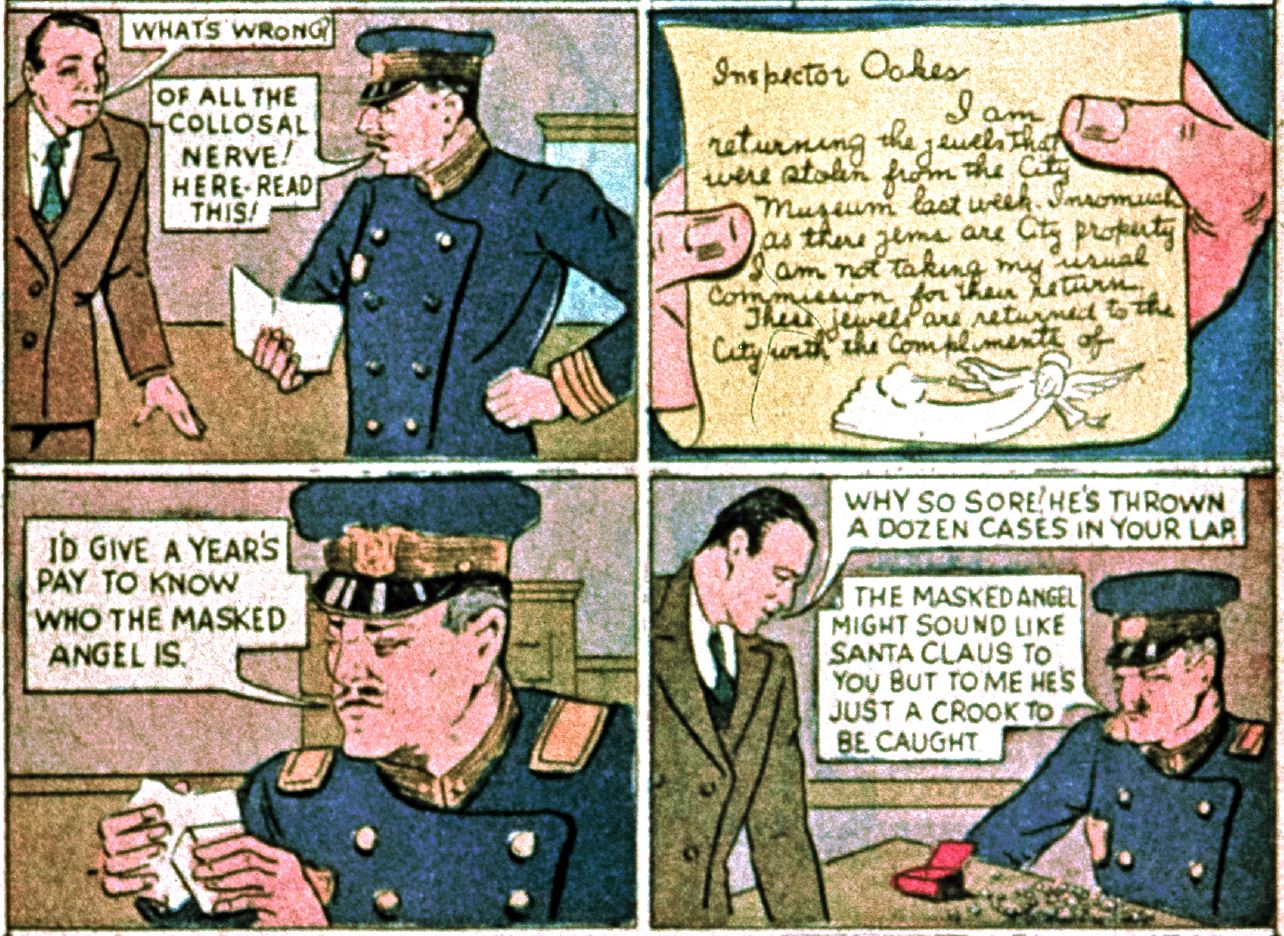
    Steve Oakes, wealthy playboy just so happens to also be the Masked Angel, vigilante feared by the underworld and wanted by the police.

    Steve’s father Detective Inspector John Oakes was murdered by crooks, so the Masked Angel act is his way of getting back at the criminal fraternity. It also seems to be a way to troll his brother, Detective Inspector John Oakes II, who is an asshole and who hates the Masked Angel in your classic way that a police officer does when they’re part of a vigilante’s supporting cast. Also please note the fun “angel shooting a gun” signature on the Masked Angel’s taunting note. (Miracle Comics 001 1940)

    Uncle Sam:

    We’re skirting the edge of what might be considered “minor” here, at least to DC Comics fans, but I have no Median Super-Hero category and however you slice it your parents almost certainly have not heard of him so here goes:

    Uncle Sam is the physical embodiment of the patriotic ideal of the United States: good, kind, powerful and just. He emerges to lend a physical hand in times of turmoil by inhabiting of reshaping the body of a recently slain patriot.

    This time around, Uncle Sam is (implicitly, all of this isn’t really spelled out until later) reborn from the death of Ezra Smith, who stands up to fascist agitators the Purple Shirts and gets a bullet in the back for his trouble. He sticks around to beat Axis ass for the duration of the war and then is not seen again until DC integrates the Quality characters into Earth-2 continuity in the 1970s. (National Comics 001, 1940)

    National Comics 005 expands the Uncle Sam lore slightly, firstly by making it a bit more explicit that he incorporates the spirits of dying patriots into himself with what is perhaps the initial time he did so, when a man named Sam sacrifices his own life to advance the cause during the American Revolution.

    Secondly, Sam is seen merging with a living patriot named Samuel in order to help drive the fascist Black Legion out of Glen Valley. Is this a common event? Does Uncle Sam roam the land absorbing patriots? Who can say, but it certainly would put a new spin on the character.

    Buddy Smith:

    When Ezra Smith is murdered by the Purple Shirts, his grandson Buddy is left alone, presumably some sort of double-orphan. He is almost immediately found, shamed for crying, and adopted by Uncle Sam (and hopefully the near immediate recovery Buddy has from the grief of seeing his grandfather gunned down in front of his eyes is a function of Uncle Sam being partially Ezra Smith and not some sort of deep traumatic repression left to fester in his soul).

    Buddy fills a pretty standard kid sidekick role: getting into trouble, getting Uncle Sam out of trouble, inventing things, befriending people, spotting clues, etc. He is unusual in that he is one of the few kid sidekicks who is a proper kid as opposed to being a young teenager (I know the common wisdom is that Dick Grayson was eight when he became Robin but that’s mostly because Golden Age artists – and particularly Bob Kane – were mostly very bad at drawing kids. Robin was absolutely supposed to be somewhere in the 12-15 range when he debuted). He’s also notable for – as far as I know – never ever showing up again post-Quality, not even in that event earlier this year that was specifically focused on bringing back all the old (and new) Golden Age kid sidekicks. Maybe Uncle Sam ate absorbed him once he got old/patriotic enough. (National Comics 001, 1940)

    Merlin the Magician:

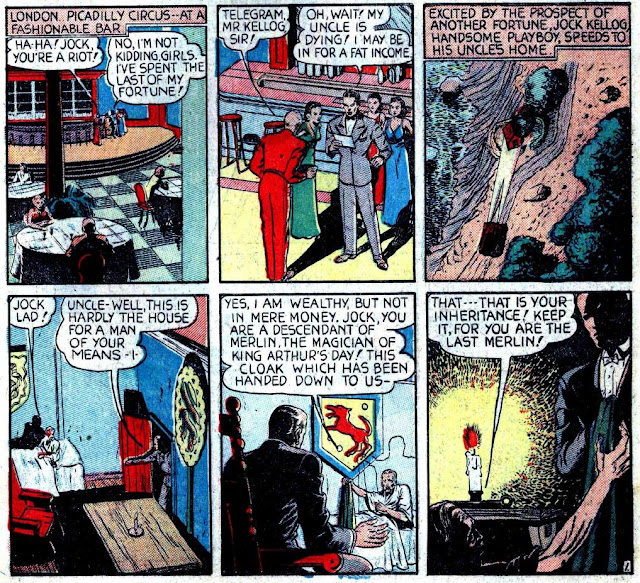
    Jock Kellog, a wealthy playboy in the classic mold, spends the last of his family fortune on the same day he is summoned to the bedside of his sole relative, an unnamed uncle. Instead of the fat stacks of cash that he is hoping for, Kellog comes away with a cloak and the knowledge that he is supposedly the last descendant of Merlin of Arthuriana fame.

    It turns out that he is in fact the last descendant of Merlin, of course, and that the cloak is a source of unlimited magical power in the grand tradition of mystic super-heroes like Zatara. Lucky for the world at large, the application of vast power has the opposite of its usual effect on the young wastrel and Jock devotes his newfound power to the defense and betterment of humanity. (National Comics 001, 1940)

  • MINOR SUPER-VILLAIN 676: THE DEATH

    (Miracle Comics 003, 1940)

    A scientist/spy who is sabotaging diplomatic talks between the UK and South America by killing diplomats with fog-activated poisoned wallpaper, the Death, aka Jaeger, meets his end at the hands of Secret Agent K-7 and his assistant Yvonne. He’s just the latest in a long line of villains with extremely metal names and not much else going on, except of course for the poisoned wallpaper.

  • MINOR SUPER-VILLAIN 676: THE DEATH

    (Miracle Comics 003, 1940)

    A scientist/spy who is sabotaging diplomatic talks between the UK and South America by killing diplomats with fog-activated poisoned wallpaper, the Death, aka Jaeger, meets his end at the hands of Secret Agent K-7 and his assistant Yvonne. He’s just the latest in a long line of villains with extremely metal names and not much else going on, except of course for the poisoned wallpaper.

  • MINOR SUPER-VILLAIN 675: THE EYES

    (Miracle Comics 002, 1940)

    The Eyes is a spy chief (singular) who has a cool gimmick (contact lenses or similar which can emit powerful light beams to spooky effect) and goes all in on it as a theme. Specifically, the Eyes is all about destroying eyes via blinding light, acid or simple traumatic injury – honestly a pretty effective thing to threaten most people with, even if they are for example very loyal to the aircraft company they work for. It ultimately takes Dash Dixon, whose eyes are presumably three times as powerful as the average man’s, to take him down.

    One more thing about the Eyes is that his henchmen all have their own gangster-style nickname – variously Finger, the Switch and Trusty – and that’s pleasing to me.

  • MINOR SUPER-VILLAIN 675: THE EYES

    (Miracle Comics 002, 1940)

    The Eyes is a spy chief (singular) who has a cool gimmick (contact lenses or similar which can emit powerful light beams to spooky effect) and goes all in on it as a theme. Specifically, the Eyes is all about destroying eyes via blinding light, acid or simple traumatic injury – honestly a pretty effective thing to threaten most people with, even if they are for example very loyal to the aircraft company they work for. It ultimately takes Dash Dixon, whose eyes are presumably three times as powerful as the average man’s, to take him down.

    One more thing about the Eyes is that his henchmen all have their own gangster-style nickname – variously Finger, the Switch and Trusty – and that’s pleasing to me.

  • MINOR SUPER-VILLAIN 674: THE SCALENE ANGLES

    (Miracle Comics 001, 1940)

    “Police athlete” Dash Dixon’s first super-heroic adventure involves him travelling to the small European Republic of Scalene in search of the murderers of several US exporters. Turns out that they were killed to prevent arms and other supplies from being brought into the country, because the Scalene Angles, a group of wealthy jerks, were looking to conquer it.

    The most important thing about the Scalene Angles is of course their name. It’s fun, but it also depends on their country being named Scalene and once you consider that you have to imagine the whole nation being lousy with places like Triangle Square and Three Sides of Different Lengths Locksmithing and the Pythagoras Doesn’t Know Us Bakery (and maybe a few places talking about the neck in some way). It’s still a great name but it’s also probably the name of a triangleball team that one of their kids plays on so no points for originality here.

    (they do leave a note with a little triangle signature and I always like that, so one point to them there. But Dash Dixon does find and destroy them because of that note so the point is a treacherous one)

  • MINOR SUPER-HERO ROUND-UP 030

    Some real obscurities from the Hillman House of Ideas:

    the Sky Wizard:

    The Sky Wizard is an otherwise-unnamed super-scientist who seemingly dresses in his futuristic super suit 24/7. There’s not too much else to him other than that because he’s one of those characters who has so many gadgets and gizmos that all the narrative focus goes to them rather than him. A partial list: wing suits, super planes, super strength serum (the amazingly named “powerstrength formula”), a paralyzing Q-Ray gun…

    … and by far the coolest of the Sky Wizard’s accessories, his laboratory base, the grounds of which are composed of the elastic metal rubberium and which can be filled with helium so that the entire estate becomes a mobile floating island. (Miracle Comics 001, 1940)

    Dash Dixon:

    Dash Dixon works for an unnamed police department in an unnamed city in an undefined role (he is described only as a “top athlete with the police force” in his first appearance), Assigned to protect one Dr Lorenz and succeeding in doing so, Dixon is rewarded with a chance to be the subject of an experiment in which he is injected with “perpetual life rays” which render him super strong, at least partially invulnerable and presumably immortal.

    To counter the fact that the ray would seep out of Dixon’s body within 24 hours, Lorenz equips him with a suit of pliable metal that he will presumably have to wear for the rest of his presumably immortal existence. Two things about this suit:

    1. Dr Lorenz has a fantastic look with his lab getup and green dome helmet. Why Dixon’s suit is charitably Very Bad Looking is beyond me.

    2. It might not be clear from this picture but the suit includes a haircut-shaped black helmet held on by a strap. It can thus be implied that the ray will leak out of Dash Dixon’s scalp but will not do so from his face and hands.

    Frankly the whole suit thing gives me mild anxiety. If I were Dash Dixon I might just opt to receive my immortality treatment daily.

    One last thing about Dash Dixon is that the first issue seems to imply that he exists in a near future world with air taxis and commuter rockets but it doesn’t really come up otherwise. A mystery for the ages. (Miracle Comics 001, 1940)

    the Scorpion:

    A regular-style two-fisted vigilante, hated and feared by the underworld, occasionally wanted by the police, etc. The real thing that makes the Scorpion (aka Hal Ward) stand out is that he doesn’t really bother with a mask or any other way to not be immediately recognized by all of his mortal enemies. (Miracle Comics 001, 1940)

    Blanda the Jungle Queen:

    Blanda the Jungle Queen really lives up to her name by being the most by-the-book version of the White Goddess style of jungle adventurer, right down to the fact that she immediately abandons her adoptive people and their ways in a wave of horniness the second that a mediocre white guy hoves into view. (Miracle Comics 001 1940)