The Curse of Skeleton Munroe

Category: aviator

  • MINOR SUPER-HERO ROUND-UP 066

    They’re just doing their best over here.

    Nevada Jones: 

    Nevada Jones starts out as a detective working for the Cattleman’s Association in what is probably meant to be the Old West (though at this point my trust in that fact is fragile) but in his second appearance is framed for murder and so adopts a masked alter ego. He also acquired a sidekick named Little Joe, who speaks with the cadence of a guy who was orphaned in the jungle and raised by apes rather than just being Mexican.

    The only really distinct thing about Nevada is that he never seems to actually adopt a new name for himself, he just doesn’t offer a name at all. This means that everyone calls him “masked man” or “stranger” the whole time. There’s an argument to be made that his masked identity is called “Quick-Trigger Man” but the aesthetic part of my soul won’t let me acknowledge it. (Zip Comics 001, 1940) 

    Kalthar: 

    Kalthar, aka God-Son, the Giant Man, King of the Jungle, is the son of an unnamed man who saved the Ugarnas (possibly Urgana? They are only ever referred to in the plural, alas) tribe from slavers but lost his life in the process. Raised by the grateful Urganas, Kalthar of course becomes much cooler than any of them and can speak the language of jungle animals. 

    Kalthar also has the support of Ta-Lo, possibly the only non-evil witch doctor in comics, who brews up a big batch of magic grains that allow him to grow into a fifteen foot tall, bulletproof giant. This is, as you might imagine, a pretty decisive advantage in jungle combat (he can for example punch out a bull elephant), so a large portion of each Kalthar story is spent with him tied up or otherwise unable to reach the magic grains in their hiding place in his hair. (Zip Comics 001, 1940)

    In Zip Comics 009, Kalthar marries Kate Goodwill, an explorer who he had been getting serious with over the prior few issues, but though the Next Issue blurb promises us further adventures of Kalthar and Kate, King and Queen of the Jungle this would be their final appearance. That’s a real shame, because if nothing else this arrangement would be a change from the usual chaste, long-term courtships you see in most jungle comics, where the jungle adventurer hooks up with the first white person they meet in their life but then constantly defers actually doing anything with the relationship. 

    the Devil’s Twins: 

    I just can’t resist a fighter pilot with a cool name, in this case brothers Tom and Tim Shane, aka the Devil’s Twins, aka the Devil’s Flying Twins (or should that be the Devil’s flying Twins), possibly aka the War Eagles unless that’s just the name of the strip. In addition to a great name, the twins have a totally stupid reason for being in the RAF: the German Ace Schultz once fouled them both in a polo match and now they want revenge on him. 

    The brothers earn their main nickname for being such colossal pains in the ass of their immediate superior, Captain Rex: they adopt unsanctioned but very effective tactics supposedly derived from polo, they constantly take off on self-ordained missions that draw unwanted attention to the airfield, they fall in love with the same woman and are huge babies about it, etc, etc. Just a couple of ding dongs. (Zip Comics 001, 1940)

    Mr Satan: 

    Mr Satan is really Dudley Bradshaw, “international detective and soldier of fortune,” who is so bored with the ins and outs of everyday life that he advertises for excitement in his local paper (and then later on he just follows the trouble-prone Doris O’Day around, despite the fact that she hates Dudley for not being as dynamic as Mr Satan). 

    Mr Satan’s purple bodysuit and horned cowl mask are both very charming and not a little reminiscent of the later Daredevil, and he has the distinction (along with most of the other heroes of Zip Comics) of never having been resurrected in any of the various revivals of the Archie/MLJ characters, a perhaps understandable decision in the case of a guy named Mr Satan, but a sad one. (Zip Comics 001, 1940)

  • MINOR SUPER-HERO ROUND-UP 066

    They’re just doing their best over here.

    Nevada Jones: 

    Nevada Jones starts out as a detective working for the Cattleman’s Association in what is probably meant to be the Old West (though at this point my trust in that fact is fragile) but in his second appearance is framed for murder and so adopts a masked alter ego. He also acquired a sidekick named Little Joe, who speaks with the cadence of a guy who was orphaned in the jungle and raised by apes rather than just being Mexican.

    The only really distinct thing about Nevada is that he never seems to actually adopt a new name for himself, he just doesn’t offer a name at all. This means that everyone calls him “masked man” or “stranger” the whole time. There’s an argument to be made that his masked identity is called “Quick-Trigger Man” but the aesthetic part of my soul won’t let me acknowledge it. (Zip Comics 001, 1940) 

    Kalthar: 

    Kalthar, aka God-Son, the Giant Man, King of the Jungle, is the son of an unnamed man who saved the Ugarnas (possibly Urgana? They are only ever referred to in the plural, alas) tribe from slavers but lost his life in the process. Raised by the grateful Urganas, Kalthar of course becomes much cooler than any of them and can speak the language of jungle animals. 

    Kalthar also has the support of Ta-Lo, possibly the only non-evil witch doctor in comics, who brews up a big batch of magic grains that allow him to grow into a fifteen foot tall, bulletproof giant. This is, as you might imagine, a pretty decisive advantage in jungle combat (he can for example punch out a bull elephant), so a large portion of each Kalthar story is spent with him tied up or otherwise unable to reach the magic grains in their hiding place in his hair. (Zip Comics 001, 1940)

    In Zip Comics 009, Kalthar marries Kate Goodwill, an explorer who he had been getting serious with over the prior few issues, but though the Next Issue blurb promises us further adventures of Kalthar and Kate, King and Queen of the Jungle this would be their final appearance. That’s a real shame, because if nothing else this arrangement would be a change from the usual chaste, long-term courtships you see in most jungle comics, where the jungle adventurer hooks up with the first white person they meet in their life but then constantly defers actually doing anything with the relationship. 

    the Devil’s Twins: 

    I just can’t resist a fighter pilot with a cool name, in this case brothers Tom and Tim Shane, aka the Devil’s Twins, aka the Devil’s Flying Twins (or should that be the Devil’s flying Twins), possibly aka the War Eagles unless that’s just the name of the strip. In addition to a great name, the twins have a totally stupid reason for being in the RAF: the German Ace Schultz once fouled them both in a polo match and now they want revenge on him. 

    The brothers earn their main nickname for being such colossal pains in the ass of their immediate superior, Captain Rex: they adopt unsanctioned but very effective tactics supposedly derived from polo, they constantly take off on self-ordained missions that draw unwanted attention to the airfield, they fall in love with the same woman and are huge babies about it, etc, etc. Just a couple of ding dongs. (Zip Comics 001, 1940)

    Mr Satan: 

    Mr Satan is really Dudley Bradshaw, “international detective and soldier of fortune,” who is so bored with the ins and outs of everyday life that he advertises for excitement in his local paper (and then later on he just follows the trouble-prone Doris O’Day around, despite the fact that she hates Dudley for not being as dynamic as Mr Satan). 

    Mr Satan’s purple bodysuit and horned cowl mask are both very charming and not a little reminiscent of the later Daredevil, and he has the distinction (along with most of the other heroes of Zip Comics) of never having been resurrected in any of the various revivals of the Archie/MLJ characters, a perhaps understandable decision in the case of a guy named Mr Satan, but a sad one. (Zip Comics 001, 1940)

  • MINOR SUPER-HERO ROUND-UP 063

    Pilots! Vexatious pilots! Will they give me no peace?  

    the Skull Squad: 

    Yet another gang of pilots with some pretty lacklustre skull theming to go with their name. The Skull Squad is an international affair, with American Jimmy Jones, Englishman Kent Douglas and Scotsman Jock “Sandy” MacGregor all flying a bomber for the RAF and predictably getting into wild and wooly scrapes. (Wings Comics 001, 1940)

    SKULL SCORE:  0.5/5 

    the Parachute Patrol:

    The Parachute Patrol are Tommy, Curly and Blimpo (and I know every kid gang has to have a fat kid or an ethnic kid with a cruel nickname, but “Blimpo” seems a bit extreme for a kid who is husky at best), three American teens who for some never-explained (I assume) reason live in a picket fenced neighbourhood in Central France, complete with an even more incongruous grumpy neighbour straight out of an Our Gang short. One must assume that they were originally based out of the US somewhere until someone raised the point that having them casually fly over the Atlantic Ocean in their single-engine plane in their first adventure strained credulity somewhat.

    The “parachute” in Parachute Patrol comes from their signature mode of transport, the parachute balloon, which allows them to smoothly ascend and descend from any height. (Wings Comics 001, 1940) 
    (The above only applies to the first appearance of the Parachute Patrol. From Wings Comics 002 onward the same three kids are a trio of British Boy Scouts who are loosely attached to the RAF and get into all kinds of scrapes with Axis spies and other threats. Blimpo is still called that, even though he’s about the same size as Tommy. The parachute balloon and Mrs Measly never appear again – the “parachute” in Parachute Patrol refers to parachute-spotting, i.e., looking for incoming paratroopers) 

    the Phantom Falcons: 

    A private air force founded by airplane manufacturer Davis and a handful of WWI fighter aces, the Phantom Falcons operate out of an underground air base that is probably somewhere in Switzerland but also probably moves around in order to facilitate storytelling. In their first appearance, young pilot Tom Slade stumbles across their operation and becomes the fifth Phantom Falcon. (Wings Comics 001, 1940)

    the Spitfire Ace: 

    Though the Spitfire Ace is ultimately just another WWII pilot with a cool nickname, he is remarkable for having what is one of the more complicated origins that I have ever read, and all to end up as an RAF pilot just like any number of characters who just volunteered. Here’s the skinny:

    -Tom Cassidy is a hard-boiled airplane salesman trying to sell fighter planes to the Polish government, and so is in Warsaw when the Nazis attack. Disgusted by the slaughter of civilians, he hops in his sample plane and attacks the Germans, putting in a good showing before being shot down by the Nazi ace Hornigg.

    -Hornigg blackmails the captured Cassidy by having his face disfigured and threatening to leave it that way. Cassidy is forced to participate in mock dogfights with Hornigg as a propaganda exercise, with himself as an example of a misguided former antagonist won over to the Nazi side. BUT! Cassidy is also learning all of Hornigg’s air combat tricks.

    -With the aid of a British secret agent, Cassidy and captured RAF pilot Captain Sheridan escape in a stolen plane. They are shot down near Dunkirk and Captain Sheridan is killed.

    -Cassidy takes Sheridan’s papers and joins the evacuation of Dunkirk. Once in England, he poses as Sheridan in order to have an opportunity to fight the Nazis again. He is able to claim that his face was injured and reconstructed thanks to his plastic surgery scars, and he is soon instated as RAF Captain Sheridan.

    Cassidy/Sheridan makes a name for himself thanks to his inadvertent training with Hornigg, and soon gets a chance to shoot his former captor down. Having done so kind of makes all of the above meaningless of course, but whatever. At this point, “Spitfire Ace” is just a regular aviation comic. (Wings Comics 004, 1940) 

  • MINOR SUPER-HERO ROUND-UP 055

    Some more super-folk for your delectation. 

    Doc Strange:

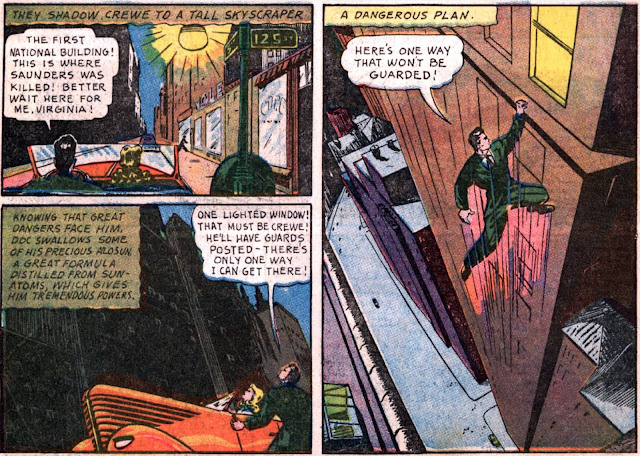
    Doc Strange (called “Dr Strange” for the first half dozen or so of his appearances, but why cause unnecessary confusion) is an almost prototypical scientist-hero: no real origin beyond being a well-known brilliant scientist who is primed and ready for adventure having just perfected Alosun, a “formula distilled from sun-atoms.” After taking his first dose of Alosun in his initial adventure, Strange has super-strength and invulnerability sufficient to take on an entire gang single-handed, and if he takes a supplemental dose he becomes exponentially more powerful.

    Doc’s sidekick Mike won’t be showing up until 1942, but in the meantime his fiance Virginia Thompson (as so often is the case, the woman he rescues during his first super-heroic adventure) acts as his adventuring companion/frequent kidnap victim in the meantime.


    In Thrilling Comics 007 Doc Strange mixes up a new formulation of Alosun that completes his powerset by allowing him to fly while under its effects. This is also the issue in which he stops fighting crime in suits and adopts his classic red t-shirt/blue jodhpurs/brown boots look. 

    Finally, I’ve noticed a lot of sites listing his name as “Hugo Strange” or “Thomas Hugo Strange” and while the Thomas is definitely an Alan Moore addition from Tom Strong I can only report that the Hugo has not yet appeared in the 1940 issues of Thrilling. (Thrilling Comics 001, 1940) 

    the Ghost:

    Young George Chance is orphaned in India and so is of course raised by yogis. He learns all of their magical secrets and is eventually sent out into the world to fight crime, as I assume all yogis are. I must say that it is something of a change of pace to see a magic-man come into his powers in India after such a long string of Tibetan origins.

    Like most magical heroes, the Ghost is a nigh-omnipotent force of nature who can be stopped only by a sneaky blow to the head, and even then only temporarily. His adventures are distinguished by the fact that his long-time foe is Professor Fenton, a scientist who has developed time travel technology, so the Ghost’s adventures are distinguished by the sheer variety of times and places he ends up.

    The Ghost takes his name from his early habit of painting his face (all the way to the back of his neck!) so as to resemble a skeleton while he is fighting crime. Sadly though the name sticks the look doesn’t. 

    In Thrilling Comics 008, the Ghost travels back to Revolutionary America and meets a patriotic woman named Betty Morris who ends up coming back to the 20th Century with him as his companion/love interest. I keep seeing claims online that she is his wife, but strongly suspect that that is another swipe from Alan Moore’s version of the characters. (Thrilling Comics 003, 1940)

    the Lone Eagle: 

    Another classic example of a pilot-hero-with-a-cool-name and not much else going on. The Lone Eagle does seem to have been a World War I veteran, which I always like to note. (Thrilling Comics 003, 1940)

    the Woman in Red: 

    The Woman in Red (an extremely good name) has what just might be the simplest origin story in comics: she is really Peggy Allen, undercover police officer, and the Woman in Red disguise is her way of investigating crimes without blowing her cover if she is caught snooping around. See? Simple! 

    Woman in Red mysteries tend to be structured as whodunnit murder mysteries, which I obviously like, and so Peggy is also frequently wanted by her comic foil, the bumbling Inspector Cavanaugh, as a suspect because he sees her creeping around the crime scene and doesn’t have a lot of critical thinking skills. (Thrilling Comics 002, 1940) 

  • MINOR SUPER-VILLAIN 794: THE GHOST OF ROCKY STONE

    (Target Comics v1 005, 1940)

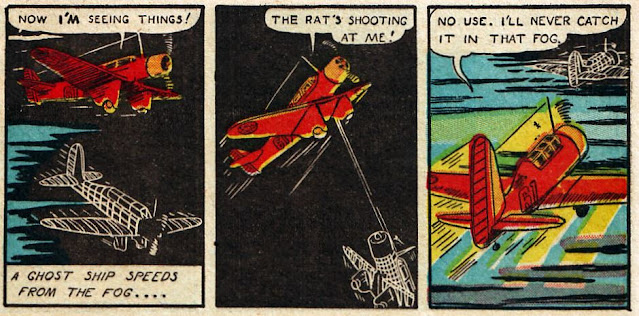
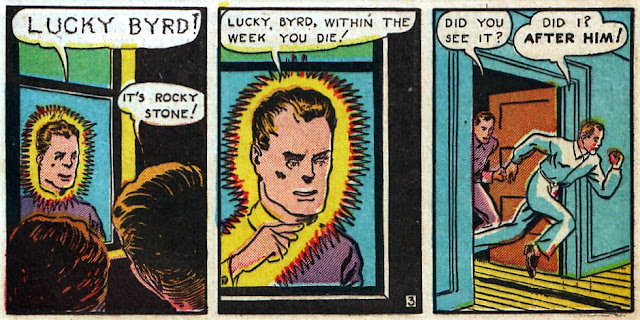
    If there’s one type of character that the people at Novelty Press liked, it was a young man getting an American-style military education, and Lucky Byrd was one of those very men. A flying cadet at Randolph Field, Texas, Byrd managed to ferret out a variety of espionage and criminal plots as a sideline to his studies, the first of which involved fellow cadet Rocky Stone, a bully turned murderer turned reluctant saboteur who ended up dead at the hands of his unseen handler when he tried to confess all.

    Now, some months later, the ghost of Byrd’s old rival has seemingly returned for revenge as a glowing spectre piloting an eerie ghost plane that looks just sick as hell.

    As is so often the case with unexpected ghosts, it turns out that Rocky Stone had an identical twin brother, Bob, who has been seeking revenge on Lucky Byrd due to some unreliable information supplied to him by his nogoodnik sibling. And Lucky, good guy that he is, refuses to press charges once everything comes out in the open, so Bob Stone comes out of the whole thing with nothing more than an amazing icebreaker to bust out at parties. Assuming that he also was not prosecuted for stealing that plane from the US Army.

  • MINOR SUPER-VILLAIN 794: THE GHOST OF ROCKY STONE

    (Target Comics v1 005, 1940)

    If there’s one type of character that the people at Novelty Press liked, it was a young man getting an American-style military education, and Lucky Byrd was one of those very men. A flying cadet at Randolph Field, Texas, Byrd managed to ferret out a variety of espionage and criminal plots as a sideline to his studies, the first of which involved fellow cadet Rocky Stone, a bully turned murderer turned reluctant saboteur who ended up dead at the hands of his unseen handler when he tried to confess all.

    Now, some months later, the ghost of Byrd’s old rival has seemingly returned for revenge as a glowing spectre piloting an eerie ghost plane that looks just sick as hell.

    As is so often the case with unexpected ghosts, it turns out that Rocky Stone had an identical twin brother, Bob, who has been seeking revenge on Lucky Byrd due to some unreliable information supplied to him by his nogoodnik sibling. And Lucky, good guy that he is, refuses to press charges once everything comes out in the open, so Bob Stone comes out of the whole thing with nothing more than an amazing icebreaker to bust out at parties. Assuming that he also was not prosecuted for stealing that plane from the US Army.

  • MINOR SUPER-HERO ROUND-UP 027

    Guess what? More minor super-heroes, that’s what.

    the Black Arrow:

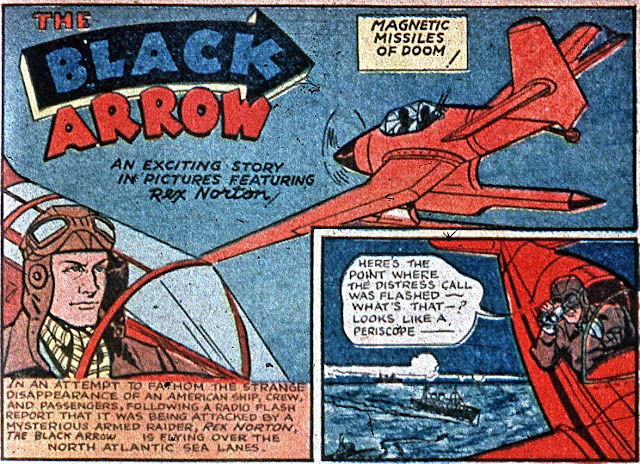
    Black Arrow, aka Rex Norton, is a detective/pilot, ho-hum. As per standard he has a great codename. (Green Giant Comics 001, 1940)

    the Researcher:

    A dapper super-scientist armed with x-ray flashlights, paralysis-inducing walking sticks and mind-reading rays. Perhaps the most charming thing about him is that everyone from his enemies to his friends to his lab assistant/love interest refer to him solely as “the Researcher.” (Green Giant Comics 001, 1940)

    the Green Mask:

    The Green Mask started out in Mystery Men Comics as your standard Green Hornet or Crimson Avenger style masked vigilante: capable with his fists and with a gun but otherwise an ordinary if unnamed human man, believed by the police and the underworld to actually be a crook and thus hunted by both, the works. 

    After about a year and a half, he got a bit of a revamp: the Green Mask is now Michael Shelby, son of Senator Shelby, enemy of crime. In an attempt to prevent the Senator from introducing a law that would make crime illegal, gangsters gun him down and shoot up Michael in the process. Lucky for him, family friend Professor Lascomb is present and has a healing vita-ray machine at his disposal – Michael’s life is saved and as happy side effect he is given the power of flight and some ill-defined enhanced physical abilities. His crimefighting career is much the same as before but without the ire of the police. 

    (Like Fox Features’ other big non-Blue Beetle heroes Samson and the Flame, in 1941 the Green Mask gets a bit more of a supporting cast, in his case wealthy socialite Olivia Tracy and her bumbling chauffeur Peters. Like Samson and the Flame this didn’t save him from oblivion when Fox had its troubles in 1942-1943 but unlike them he did return eventually. Kind of) (Mystery Men Comics 001, 1939/ Green Mask v1 001, 1940)

    Domino the Miracle Boy:

    In the same story in which the Green Mask becomes super-powered Michael Shelby (and also Michael Shelby becomes the Green Mask) an unnamed youngster is blown up by a grenade and must be healed by Professor Lascomb’s vita-ray. This youth was called Don (no last name forthcoming) and wasn’t just a blown-up teen but a blown-up teen orphan and so was summarily adopted by Michael Shelby. Domino’s powers are a little less extensive than the Green Masks, as Prof Lascomb foolishly fixed the vita-ray machine’s short circuit in between the two being treated, the main upshot of which is that Domino doesn’t seem to be able to fly but rather gets around on a rope tied to a boomerang. (Green Mask Comics v1 001, 1940)

    Update 1941

  • MINOR SUPER-HERO ROUND-UP 025

    Just a great bunch of guys.

    David:

    I read the Samson stories in Big 3 before those in his home comic Fantastic, so while I knew about his sidekick David I didn’t really know what his whole deal was. I had read that Samson just found him sitting around somewhere and assumed that that was hyperbole but no, it’s not: Samson is investigating some mysterious plane crashes in the Rockies when he just finds a kid, who turns out to be the only survivor of the latest crash, and just… brings him along. There’s no real attempt to address the fact that he must be an orphan now (or if not and he was travelling alone for some reason, that his family now thinks he is dead) or to find him a familial guardian – heck, his name isn’t even David. It’s low-key one of the weirdest sidekick origins in comics and that’s before he gets his own pair of fur briefs. (Fantastic Comics 010, 1940)

    UPDATES: Even in the updated Samson origin, David is still a hanger-on (Samson 001, 1940)

    UPDATE – the Fantom of the Fair:

    The Fantom of the Fair gets his own short-lived book that sees him spending more and more time fighting crime outside the New York World’s Fair, if you can believe it. To that end he adopts the more generic name of the Fantoman. The costume changes (blue instead of black, uncovered lower face) happened at the end of 1939 and technically I’ve read more Fantom stories in which he had the new one than the old but it never feels right to me. At least you can still see his hair through the cowl.

    Though he has a new name and a not-so-new look, Fantoman retains one of his most iconic properties: every time you start thinking of him as just another masked adventurer he busts out another heretofore-unseen superpower or bit of lore suggesting he is a thousand year old demigod or something. See above as he either teleports or passes through matter for the first and last time. (Fantoman 003, 1940)

    the Spy Fighter:

    It kind of says something about the mood of America in 1940 that there are multiple comic book series that take place in the 1990s after what we know as World War II has stretched on for fifty years (Marvel’s Breeze Barton is the other one that I can recall off the top of my head, while MLJ’s Doc Strong is from a future ravaged by a whole century of WWII). In this version of that, the war has resulted in an amalgamation of the world into three rival nations: Russmany (Europe and Africa), Mongo (Asia) and Greater America (the Americas), and in this world of super nations, a super spy is required to ensure the sanctity of the Greater American way of life.

    That man is Saber, the Spy Fighter! Who does eventually put on a shirt. Saber starts out as physically gifted telepath who roots out enemy agents by reading their ill intent in their own minds and then beats them up for it. Over time, the challenges he faces get larger and less specifically espionage related, and he develops new abilities to meet them, including that of changing his own size at will, to the point that he is eventually able to travel through space on his own power to fight planet-sized enemies. And what can Mongo do to challenge that? (Fight Comics 001, 1940)

    Update 1941

    the Skull Squadron:

    Chip Collins’ Skull Squadron is extremely unremarkable but at this point I have to make note of every skull-adjacent comic book thing. They operate somewhere in between a commando group and the Suicide Squad and barely even have skulls painted on their planes. SKULL SCORE: 1/2 and only for the name. (Fight Comics 001, 1940)

  • MINOR SUPER-HERO ROUND-UP 019

    Look at all these dang guys

    Lobo, the Flying Sleuth: 

    Lobo, the Flying Sleuth, aka the Lobo, had a pretty short run. But! He’s a cowboy and a pilot and a detective. That’s a lot of things! (Champion Comics 006, 1940)

    Doctor Miracle:

    We’ve seen guys like Dr Miracle before: the nigh-omnipotent magician with so much power at his fingertips that his only real challenge is in finding a foe tough enough that he doesn’t defeat them instantly. He’s even got the obligatory Huge Asian Manservant, a Nepalese man named Akim depicted with all of the racial sensitivity that one might expect from 1940s comics.

    Dr Miracle’s real mark of distinction is that he is also a scientific hero, as likely to be blasting a foe with disintegration rays as to be slinging spells. 

    It’s a neat bit of variation in his adventures and of course it gets dropped almost immediately, as his second appearance establishes him as a student of the Elders of the aptly-named City of the Elders in Tibet. After passing a test to show his magical aptitude, Dr Miracle is sent out into the world to battle injustice, with Akim coming along as a… gift? Unsettling. (Champion Comics 009, 1940)

    Doctor Hormone:

    Doctor Hormone exemplifies a particular sort of cultural ingestion/ regurgitation of scientific ideas that permeates all fiction but really found a home in the medium of comic books. Any sufficiently impressive scientific discovery can be reinterpreted as being tantamount to magic, the major example of which is of course the part that radiation would play as a catch-all origin in the Silver Age (and nanotech and genetic engineering in turn as time marched on) but as in any field there are many also-rans for every big hit: vitamins and radio waves and transistors (in the case of Silver Age Iron Man) as science-magic that can accomplish any task. With Doctor Hormone it’s hormones. Obviously.

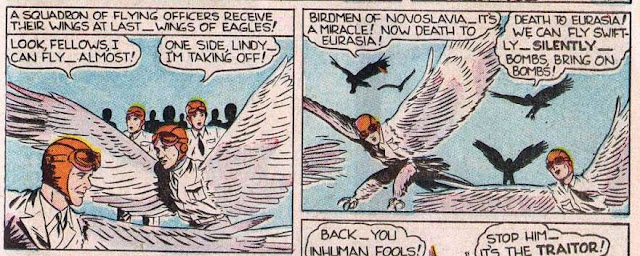
    As we join the Doctor and his destined-to-be-bullied granddaughter Jane Hormone, he has just been saved from age-related death by a youthening hormone. He and Jane subsequently set out to help the beleaguered nation of Novoslavia defend themselves from the depredations of Germany/Russia analog Eurasia.

    Hormone’s first major antagonist is Rassinoff, aka Assinoff, a Novoslavian official secretly working for Eurasia and dosed with donkey hormones by Jane due to his initial bad vibes. Assinoff is exactly the jackass that his form reflects and is a very satisfying villain to see be repeatedly defeated and humiliated.

    Highlighting some of the more noteworthy hormone effects: the youth hormone (calibrated to make anyone who takes it 25 years old) is cool and fun when used on the elderly but the implications of using it on the young swiftly become horrific. At least the baby was turned into an adult man to save his life – these poor boy scouts are signing up to be adult child soldiers.

    It’s not particularly visually interesting but Hormones second appearance concerns his deploying a gas-based hormone that turns Eurasians into Novoslavians, which raises the question of just what they thought a hormone was over at Popular Comics.

    In Popular Comics 056, Assinoff tries to destroy Hormone’s credibility by injecting Novoslavian citizens with random samples from a captured selection of Hormone’s work, which completely backfires when it turns out that the Novoslavian national character is extremely okay with being turned into some random animal. It’s a nation of furries! 

    These eagle-men pilots are the first of many Novoslavian animal-man hybrids, btw.

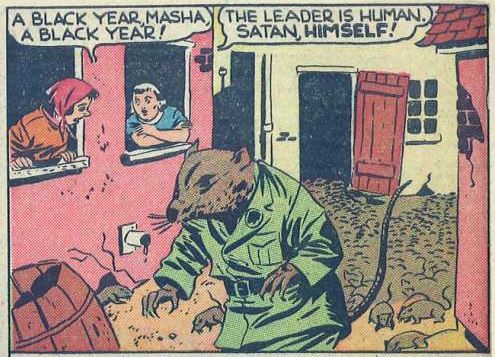
    Issue 57 of Popular Comics involves Novoslavian locust, wasp, termite and rat hybrids going out into the world to gather up plagues of their respective animals to unleash on Eurasia. Pictured here is the rat-man, my personal fave.

    The ultimate expression of Hormone’s hybridization efforts are these five Novoslavian volunteers who were turned into fleas and then restored to human form. Though they no longer look like fleas, they retain proportional jumping, flea-strength, etc, Spider-Man style. And the transformation is very gross-looking!

    So that’s Doctor Hormone in a nutshell: a bit light, plotwise, but full of charming characters and a cavalcade of new and interesting concepts in body horror. (Popular Comics 054, 1940)

    Martan the Marvel Man:

     I feel a bit bad making Martan follow Dr Hormone, honestly, because his adventures are at least as wild, but they aren’t as unique. In brief: Martan and his wife Vana are Antacleans, aliens from a super-advanced race a few million light years off. They kind of accidentally land on Earth and almost immediately get mixed up in the affairs of primitive humans. At first it’s regular old “they war amongst themselves, how foolish!” stuff but eventually they discover in incipient invasion by Antaclea’s ancient enemy the Martians and really throw their weight behind the Earth cause: supplying technology, setting up a world government etc. – Martan and Vana’s impact on the world is much greater than your typical comic book characters’. (Popular Comics 046, 1939)

  • MINOR SUPER-VILLAIN 558: DOXOL

    (Wonderworld Comics 004, 1939)

    We (and the Flame) start in media res, as a young woman unsuccessfully attempts to flee a car full of hooded goons, is captured and brought back to an ominous manor in the woods. The Flame cottons on to this and follows them.

    Inside we find Doxol! Doxol is a wizened green fellow who is using mind control drugs (mystic ones!) to create his own little crime cult. This is where the slice-of-life nature of the story gets a bit frustrating from an analytical perspective: is Doxol still setting up or has this cult been a going concern for a while? Were the new recruits all kidnapped or recruited regular cult-style? Even Doxol’s appearance – magic mutation or dramatic disguise? It’s a mystery!

    The Flame has even less information about Doxol than we do because he was dropped into a pit with crushy walls as soon as he stepped through the door. Lucky for him/ unlucky for Doxol his induction ceremony involves a flaming brazier for the Flame to appear in like he does (also lucky for that lady because she doesn’t get shot full of grody mind control drugs).

    Doxol makes his escape while the hooded riffraff deal with the Flame, or so he thinks. Turns out that the Flame was fortuitously flying his plane when he stumbled into this mess. 

    You’d think that engaging a guy like the Flame in a dogfight would level the playing field for a fellow like Doxol but no, he just leans out the window and lights Doxol’s plane on fire.