The Curse of Skeleton Munroe

Category: aviator

  • MINOR SUPER-VILLAIN 529: RATZER

    (Blue Ribbon Comics 018, 1941)

    Ratzer is a Nazi agent who tangles with American-serving-in-the British-Army Corporal Collins a couple of times. There’s not a lot to say about him, honestly: the first time he meets Collins he’s trying to spring a load of Nazi prisoners and destroy a lot of British gun cotton in then-Bombay, while the second time he’s stealing oil in Iraq. He is not notably villainous, particularly in the ranks of Nazi super-villains.

    He does, however, have a certain style, so I’ll speak on that. Starting with his plane! I really like the question mark! Custom planes are absolutely the on the list of things that make aviator characters at least a bit interesting.

    I wouldn’t call Ratzer’s costume one of the greatest of all time but it does have some flair, particularly with the little scarf dangling off the top of his head. And as a bonus it doesn’t have any swastikas on it, which I appreciate a lot more than I did before I started posting pictures of super-villains online regularly.

    Ratzer’s second appearance doesn’t really involve flying and so he’s dressed in what I guess is his Desert Combat Costume – perhaps he has a whole closet full of slight variations on the theme, like a 1990s action figure line. Look out for Ocean Exploration Ratzer!

    In any case, I like this costume best – he looks a bit like a pro wrestler.

    At the end of his second appearance Ratzer gets away again and just… never returns. This is probably down to the end of Blue Ribbon Comics when Corporal Collins moved over to being a supporting character to MLJ’s other military hero Sergeant Boyle. No room for the secondary characters to have their own villains, after all.

  • MINOR SUPER-VILLAIN 529: RATZER

    (Blue Ribbon Comics 018, 1941)

    Ratzer is a Nazi agent who tangles with American-serving-in-the British-Army Corporal Collins a couple of times. There’s not a lot to say about him, honestly: the first time he meets Collins he’s trying to spring a load of Nazi prisoners and destroy a lot of British gun cotton in then-Bombay, while the second time he’s stealing oil in Iraq. He is not notably villainous, particularly in the ranks of Nazi super-villains.

    He does, however, have a certain style, so I’ll speak on that. Starting with his plane! I really like the question mark! Custom planes are absolutely the on the list of things that make aviator characters at least a bit interesting.

    I wouldn’t call Ratzer’s costume one of the greatest of all time but it does have some flair, particularly with the little scarf dangling off the top of his head. And as a bonus it doesn’t have any swastikas on it, which I appreciate a lot more than I did before I started posting pictures of super-villains online regularly.

    Ratzer’s second appearance doesn’t really involve flying and so he’s dressed in what I guess is his Desert Combat Costume – perhaps he has a whole closet full of slight variations on the theme, like a 1990s action figure line. Look out for Ocean Exploration Ratzer!

    In any case, I like this costume best – he looks a bit like a pro wrestler.

    At the end of his second appearance Ratzer gets away again and just… never returns. This is probably down to the end of Blue Ribbon Comics when Corporal Collins moved over to being a supporting character to MLJ’s other military hero Sergeant Boyle. No room for the secondary characters to have their own villains, after all.

  • MINOR SUPER-VILLAIN 076: THE BLUE RAIDER

    (Action Comics 027, 1940)

    What makes them a super-villain? It’s 100% the name plus the fact that “air pirate” along with “submarine pirate” and for that matter “regular pirate” are styles of crime that just reek of super-villainy for me.

    What about them is interesting? Aside from the inherent romantic nature of the air pirate, the only real thing of note about the Blue Raider is that his plane is named Hank.

  • MINOR SUPER-HERO 004: THE THREE ACES

    (Action Comics 018-063, 1939-1943)

    The Three Aces consist of Gunner Bill (blonde, bland), Fog Fortune (fat, Cockney – the kind of character who starts out 1% comic relief and increases by increments until he is unrecognizable. In this case he gets fatter and more faux-Cockney until his word balloons are up to 1/2 apostrophe) and Whistler Will (dark haired ladies man – more on him in a moment). They’re fairly standard aviator type heroes except for a couple of things: they have a greater than average rate of running into stuff like lost civilizations and minor super-villains and they have Whistler Will.

    Okay, maybe I’m bigging up Will a bit. For most of their adventures he’s just your standard square-jawed lothario, but in Action Comics 022 they did a peek into his backstory and it made a big impression on me:

    Whistler Will is some sort of feral desert child or fey spirit of the American Southwest or something, an implacable and free spirit of justice. He has a mystic othersense that tells him in this issue that his adopted sister is in trouble with enough advance notice to fly across the continent to help her. He does stuff like this fairly regularly and his mystic senses express themselves as eerie whistling. All of this is very cool. All of this is never referenced again.

    Anyway, the Three Aces all fought in WWI so I guess I’ll mark them as dead, with a dead? for Will because maybe he just went back to his home in the halls of Avalon or wherever.

  • MINOR SUPER-HERO 003: THE FLYING FOX

    (More Fun Comics 037-051, 1938-1940)

    Rex Darrell! The Flying Fox! One of the most dull Golden Age aviator heroes, but as with so many of them, he has a cool name so here he is.

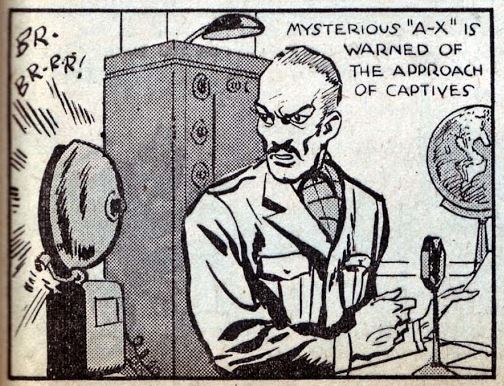
  • MINOR SUPER-VILLAIN 056: MR A-X

    (More Fun Comics 046, 1939)

    Air pirate who bedeviled minor aviation hero the Flying Fox on multiple occasions.

  • MINOR SUPER-HERO 002: THE GUARDIAN ANGEL

    (All American Comics 025-028, 1941)

    On the list of Obscure Comic Book Characters, Hop Harrigan doesn’t rate very high. Any discussion of Golden Age comic books will eventually mention the teen aviator whose feature was popular enough to support a fan club, radio serial and movie and also ephemeral enough to have completely disappeared from public consciousness around 1948 CE.

    Most writeups of Hop will mention that he adopted a couple of costumed identities over the years, and while I have yet to read any comics featuring him as the Black Lamp, here’s the lowdown on his brief time as the Guardian Angel: his pals Prop Wash and Ikky Tinker are recruited by the US Government to act as deniable assets/ air pirates in situations where direct action would cause diplomatic complications, such as a Nazi-coded ambassador fleeing the country with an attaché of documents that the CIA would like to look at, please. Hop is deliberately left out of this scheme because he is a minor.

    Inevitably, they get in over their heads on these missions and are recued by the Guardian Angel, who is in reality Hop in disguise, flying an experimental VTOL seaplane that the other two… just forgot that they owned? In any case, the ruse only lasts for a few issues. 

  • MINOR SUPER-HERO 001: CAPTAIN DESMO

     (New Adventure Comics 026-More Fun 072, 1938-1941)

    Captain Desmo is a pretty standard Golden Age adventure character: together with his pal Gabby McGuire, the Brooklyn Terror, he jaunts around the world (mostly in Asia), getting into scraps with colonized people on behalf of white folks. 

    The only thing that really makes him stand apart (aside from the fact that he’s a WWI vet, making him a generation older than most Golden Age protagonists) is illustrated in the moderately homoerotic exchange above: Captain Desmo is kind of always in costume, which kind of makes him part of the “bridge between pulp hero and super-hero” crew, like early Crimson Avenger, early Sandman or the various guys like the Clock or the Mouthpiece who ran around in suits and domino masks in the early days.

    The final interesting thing about Captain Desmo is that he never actually got around to explaining just why he wore his goggles an helmet at all times, which I respect.