The Curse of Skeleton Munroe

Category: yearbook

  • SUPER-VILLAIN YEARBOOK: HATH-SET 1940

    What was Hath-Set up to in 1940?

    That’s actually a tricky question, because Hath-Set is a tricky character! Technically, he did absolutely nothing in 1940, because he died somewhere in the 1200s BC. Because, yes, Hath Set is mixed up in the unholy mess that is Hawkman and Hawkgirl’s origin story.

    Of course, it didn’t start out complicated: Hath-Set was an evil priest of Anubis who murdered Prince Khufu and his lover Shiera and then they all got reincarnated some 3000 years later to do it all over again. Nice and simple. But comic books are comic books, so all three of these fools have been reincarnated more times than any reasonable person would care to count, including retroactively as characters like the Silent Knight. Hath-Set himself doesn’t always show up – his piddly number of appearances in any incarnation would probably net him the status of minor super-villain if he wasn’t such an integral part of the Hawks’ origin story.

    As for Doctor Hastor: he electrocutes passengers on the New York subway system in an attempt to extort the city for big bux but before he can get any further Hawkman shows up, there’s some back-and-forth that includes an attempt to sacrifice Shiera Sanders to Anubis, and Hawkman shoots Hastor dead with a crossbow.

    Don’t worry, he’ll be back!

  • SUPER-VILLAIN YEARBOOK: THE PENGUIN 1941

    What was the Penguin up to in 1941?

    (Detective Comics v1 058) ‘Untitled’ **First Appearance**

    Heeeey, it’s the Penguin, the perennial second-tier Batman villain!

    The Penguin really hits the ground running: he’s already got his look and his suite of trick umbrellas, so all he really needs is his weird bird-obsession, which kicks in in 1942. 

    As is frequently the case with a recurring villain, the Penguin’s first outing is one of his most successful: he takes over a gang using his gift for planning crimes and then when Batman starts to butt in he frames him but good.

    To really stick the landing, Penguin’s men kidnap Batman while he’s being transported to jail – Gotham’s finest are convinced that he is a crook! The Penguin is getting ready to bump him off! 

    Too bad for the Penguin that Robin shows up and the whole plan comes crashing down. Too bad for Batman and Robin that the Penguin actually manages to get away. The next story picks up where this one left off but that’s in 1942 so I’ll be telling you about it in like six months.

    BODY COUNT: 2

    END-OF-YEAR STATUS: At large.

  • SUPER-VILLAIN YEARBOOK: THE PENGUIN 1941

    SUPER-VILLAIN YEARBOOK: THE PENGUIN 1941

    What was the Penguin up to in 1941?

    (Detective Comics v1 058) ‘Untitled’ **First Appearance**

    Heeeey, it’s the Penguin, the perennial second-tier Batman villain!

    The Penguin really hits the ground running: he’s already got his look and his suite of trick umbrellas, so all he really needs is his weird bird-obsession, which kicks in in 1942. 

    As is frequently the case with a recurring villain, the Penguin’s first outing is one of his most successful: he takes over a gang using his gift for planning crimes and then when Batman starts to butt in he frames him but good.

    To really stick the landing, Penguin’s men kidnap Batman while he’s being transported to jail – Gotham’s finest are convinced that he is a crook! The Penguin is getting ready to bump him off! 

    Too bad for the Penguin that Robin shows up and the whole plan comes crashing down. Too bad for Batman and Robin that the Penguin actually manages to get away. The next story picks up where this one left off but that’s in 1942 so I’ll be telling you about it in like six months.

    BODY COUNT: 2

    END-OF-YEAR STATUS: At large.

  • SUPER-VILLAIN YEARBOOK: CLAYFACE 1941

    Detective Comics v1 049, ‘Clayface Walks Again!’

    Clayface’s 1941 adventure starts with two asylum guards learning a very important lesson a bit too late: if you exist in a fictional setting, never transport a homicidal maniac in a storm. It’s as true in a 1941 comic book as it was in any of the Halloween movies.

    Sadly, they remain unaware of the laws of narrative causality right un until their demise while Basil “Clayface” Karlo, protected by those same laws, escapes into the night to kill a man for theatrical makeup.

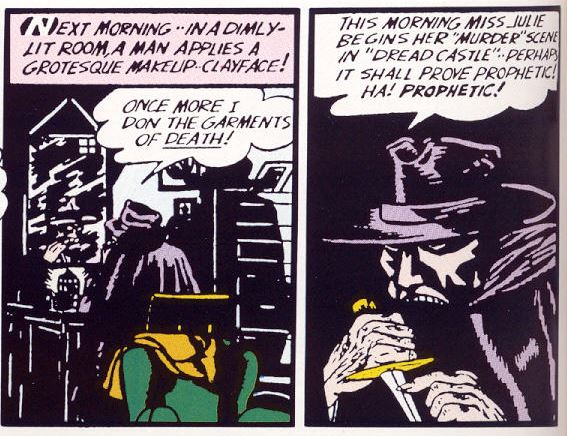
    We are finally treated to a clear look at the Clayface mask and it’s appropriately horrible.

    Since it’s his second outing, there’s no need for the mystery element of the story, which ends up making this a far less bloody yarn than the last one: Clayface sets out to burn down his former movie studio but since this is a very predictable thing for him to do he is interrupted by Batman and Robin. He does almost manage to kill the two of them, but they get out of it as you might have guessed.

    From here on Clayface focusses his efforts on Julie Madison, as-of-this-issue former fiancé of Bruce Wayne and newly famous actress rebranded as “Portia Storme” to fulfil the whims of 1940s Hollywood. It’s never spelled out so his motivation is equally likely to be that she escaped him on his last murder spree as it is that her death would prove most harmful to the studio. 

    Has any wag made much of Bruce Wayne's fiance being exactly the same size as Robin? It seems like the sort of thing they would go on about.

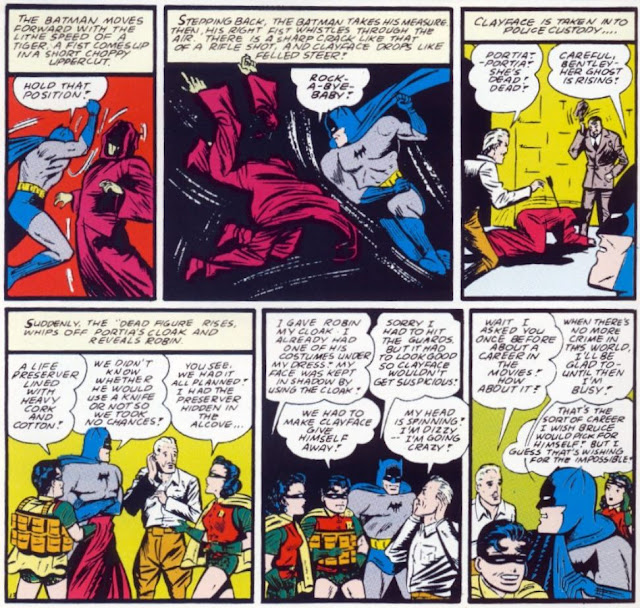
    Clayface is eventually reapprehended after a complicated slight-of hand trick that substitutes Robin for Portia and relies on him using only piercing weapons to the torso. It pays off, so who am I to quibble or suggest that Portia simply wear the life preserver from the start?

    That’s it for Clayface for about thirty years!

    Number of Episodes of the “Super-Villains of Hollywood” podcast: Just one episode for 1941, I’m afraid. It’s an eventful time but not enough to sustain more than an hour and half of podcasting.

    Body Count: 1

    End-of-year Status: Captured

  • SUPER-VILLAIN YEARBOOK: THE JOKER 1940

    What did the Joker get up to in 1940?

    1. Batman Comics v1 001, ‘Untitled’ **first appearance**

    The Joker really hits the ground running in his first crime-outing. He establishes his character – prideful, mercurial and on-theme – and methods that are still in his repertoire to this day

    He indulges in the old standard of warning the police ahead of time, then killing his target and stealing their named gems (uh, this is a personal term for any gem famous enough to have a name, like the Hope Diamond. they make more frequent appearances in comics than real life, unsurprisingly). Not the most creative of crime sprees by his own eventual standard, but everyone has to start somewhere. He also murders a number of people who challenge him, including a gang boss and a judge who once sent him to jail (a perfect 1/1 judge and jury revenge slaying! Aim low, kids!).

    Also established this adventure: the smiling-death style of Joker Venom, as well as:

    …the classic hideous Joker calling card design.

    But despite racking up an impressive success rate and almost killing both Batman and Robin on several occasions, the Joker ends his first outing in the slammer.

    2. Batman Comics v1 001, ‘The Joker Returns’

    That’s right, the Joker makes his second appearance in the same issue as his first! They knew he was a hot property from the very start!

    After a very dramatic escape from prison and a relocation to his secret cemetery hideout, the Joker settles into his familiar pattern: a taunting message, then theft or the murder of his enemies. In achieving the latter, he employs two of my very favourite deathtraps in comics:

    To bump off the Chief of Police: a sound-activated poison dart launcher concealed in his telephone – and he activates it by shouting his own name real loud! Tremendous style points there.

    The second is just sharpened playing cars with poison on the edges, but again there’s some tremendous style on display in the commitment to the bit of having an entire pack of jokers. Completely worth going around to every gaming supply store in Gotham to buy packs of the same brand of cards.

    A minor point in this adventure is that it highlights that the Joker is primarily a jewel thief, something that I associate with the Golden Age version of the character but that might just be me extrapolating from this issue.

    And finally we have the death of the Joker, truly one of the great on-brand death scenes of all time as he gets stabbed while struggling over a knife with Batman. It was a good run but the Joker is dead.

    OR IS HE???

    3. Batman Comics v1 002, ‘Untitled’

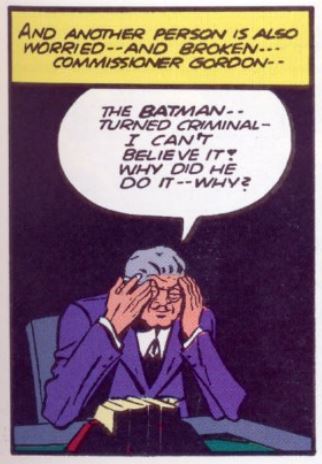
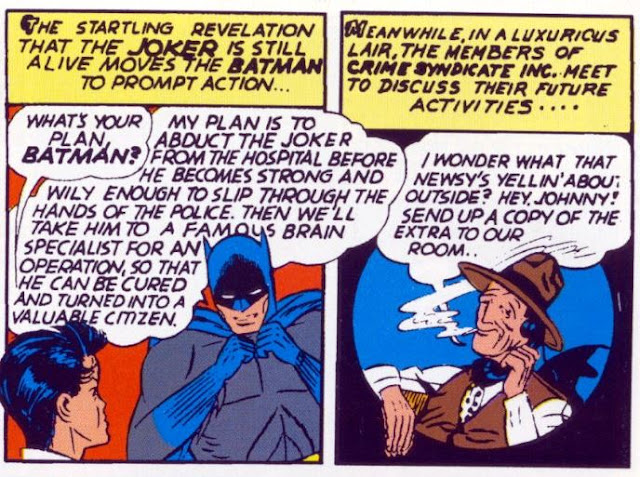
    Since the Joker actually survived the last issue, both Batman and the members of Crime Syndicate Inc  have the same idea: kidnap him while he’s being treated for his injuries, the former for some sort of gruesome lobotomy and the latter as a replacement for their recently deceased leader. More than half of the story is taken up with the dueling Joker kidnappings, after which he predictably betrays the crooks, strikes out on his own and ends up left for dead in a burning castle.

    More interesting to me is that this is the end of a sequence of events that, well, here’s a timeline:

    -Initial Joker crime spree. No time period is specified in the story but it seems a fairly rapid-fire series of crimes. Somewhere between 1 and 2 weeks, we’ll say. Joker is captured.

    -Two days later, Joker escapes. His crime spree resumes at the same pace, with at least two robberies occurring sequentially. Say another 1 to 2 weeks. Joker is seriously injured and rushed to hospital.

    -Crooks spirit Joker away following his treatment. His recovery lasts one week, after which he seemingly dies in a fire.

    What this all adds up to is a situation like Friday the Thirteenth 2 through 4, but whereas that was an astonishingly bloody weekend told over the course of three movies, this is the Joker committing at least 6 high-profile robberies and 13 murders over the course of one to two months! A huge debut for the big guy!

    4. Detective Comics v1 045, ‘The Case of the Laughing Death’

    Predictably, the Joker is not, in fact, dead! He remains alive to this day if you can believe it!

    He has, though, adopted a brand new modus operandi. Perhaps drawing on his brief time with Crime Syndicate Inc, he slips for the first time into an alter ego with the infuriating surname of Rekoj and forms a little gang of his own. Then, after his gang pulls a heist, he robs them as the Joker so that he doesn’t have to split the profits with them. IT’S A DUMB PLAN BUT IT WORKS.

    I’m willing to forgive, but only because of the great deathtraps, and this is a fun one: a record that releases Joker Toxin as it plays, thus killing even as its message is delivered. Insidious!

    At story’s end, the Joker is in the drink, presumed dead. For good? No.

    5. Batman Comics v1 004, ‘The Case of the Joker’s Crime Circus!’

    For his final outing of 1940, the Joker assembles another gang. This time, it’s one of my favourite styles of gang, the circus of crime! They specialize in casing wealthy patrons’ estates and manors and then using their circus skills to rob the various joints.

    Batman being Batman, he pieces together the clues and tracks down the Joker, who ends the adventure in the traditional manner by seemingly plummeting to his death.

    Body Count: at least 14

    End-of-year Status: Presumed Dead

  • SUPER-VILLAIN YEARBOOK: THE JOKER 1940

    What did the Joker get up to in 1940?

    1. Batman Comics v1 001, ‘Untitled’ **first appearance**

    The Joker really hits the ground running in his first crime-outing. He establishes his character – prideful, mercurial and on-theme – and methods that are still in his repertoire to this day

    He indulges in the old standard of warning the police ahead of time, then killing his target and stealing their named gems (uh, this is a personal term for any gem famous enough to have a name, like the Hope Diamond. they make more frequent appearances in comics than real life, unsurprisingly). Not the most creative of crime sprees by his own eventual standard, but everyone has to start somewhere. He also murders a number of people who challenge him, including a gang boss and a judge who once sent him to jail (a perfect 1/1 judge and jury revenge slaying! Aim low, kids!).

    Also established this adventure: the smiling-death style of Joker Venom, as well as:

    …the classic hideous Joker calling card design.

    But despite racking up an impressive success rate and almost killing both Batman and Robin on several occasions, the Joker ends his first outing in the slammer.

    2. Batman Comics v1 001, ‘The Joker Returns’

    That’s right, the Joker makes his second appearance in the same issue as his first! They knew he was a hot property from the very start!

    After a very dramatic escape from prison and a relocation to his secret cemetery hideout, the Joker settles into his familiar pattern: a taunting message, then theft or the murder of his enemies. In achieving the latter, he employs two of my very favourite deathtraps in comics:

    To bump off the Chief of Police: a sound-activated poison dart launcher concealed in his telephone – and he activates it by shouting his own name real loud! Tremendous style points there.

    The second is just sharpened playing cars with poison on the edges, but again there’s some tremendous style on display in the commitment to the bit of having an entire pack of jokers. Completely worth going around to every gaming supply store in Gotham to buy packs of the same brand of cards.

    A minor point in this adventure is that it highlights that the Joker is primarily a jewel thief, something that I associate with the Golden Age version of the character but that might just be me extrapolating from this issue.

    And finally we have the death of the Joker, truly one of the great on-brand death scenes of all time as he gets stabbed while struggling over a knife with Batman. It was a good run but the Joker is dead.

    OR IS HE???

    3. Batman Comics v1 002, ‘Untitled’

    Since the Joker actually survived the last issue, both Batman and the members of Crime Syndicate Inc  have the same idea: kidnap him while he’s being treated for his injuries, the former for some sort of gruesome lobotomy and the latter as a replacement for their recently deceased leader. More than half of the story is taken up with the dueling Joker kidnappings, after which he predictably betrays the crooks, strikes out on his own and ends up left for dead in a burning castle.

    More interesting to me is that this is the end of a sequence of events that, well, here’s a timeline:

    -Initial Joker crime spree. No time period is specified in the story but it seems a fairly rapid-fire series of crimes. Somewhere between 1 and 2 weeks, we’ll say. Joker is captured.

    -Two days later, Joker escapes. His crime spree resumes at the same pace, with at least two robberies occurring sequentially. Say another 1 to 2 weeks. Joker is seriously injured and rushed to hospital.

    -Crooks spirit Joker away following his treatment. His recovery lasts one week, after which he seemingly dies in a fire.

    What this all adds up to is a situation like Friday the Thirteenth 2 through 4, but whereas that was an astonishingly bloody weekend told over the course of three movies, this is the Joker committing at least 6 high-profile robberies and 13 murders over the course of one to two months! A huge debut for the big guy!

    4. Detective Comics v1 045, ‘The Case of the Laughing Death’

    Predictably, the Joker is not, in fact, dead! He remains alive to this day if you can believe it!

    He has, though, adopted a brand new modus operandi. Perhaps drawing on his brief time with Crime Syndicate Inc, he slips for the first time into an alter ego with the infuriating surname of Rekoj and forms a little gang of his own. Then, after his gang pulls a heist, he robs them as the Joker so that he doesn’t have to split the profits with them. IT’S A DUMB PLAN BUT IT WORKS.

    I’m willing to forgive, but only because of the great deathtraps, and this is a fun one: a record that releases Joker Toxin as it plays, thus killing even as its message is delivered. Insidious!

    At story’s end, the Joker is in the drink, presumed dead. For good? No.

    5. Batman Comics v1 004, ‘The Case of the Joker’s Crime Circus!’

    For his final outing of 1940, the Joker assembles another gang. This time, it’s one of my favourite styles of gang, the circus of crime! They specialize in casing wealthy patrons’ estates and manors and then using their circus skills to rob the various joints.

    Batman being Batman, he pieces together the clues and tracks down the Joker, who ends the adventure in the traditional manner by seemingly plummeting to his death.

    Body Count: at least 14

    End-of-year Status: Presumed Dead

  • SUPER-VILLAIN YEARBOOK: HUGO STRANGE 1940

    What did Hugo Strange Get up to in 1940?

    1. Detective Comics v1 036, ‘Untitled’ **first appearance**

    Hugo Strange starts his crime career pre-seasoned with a goodly dose of “I’ve heard of this guy. This guy is a big deal” from Batman. 

    His actual plan is nothing special: using a machine he stole, Strange floods Gotham with fog night after night, leaving the police helpless to stop his gang as they loot and plunder at prearranged locations.

    The biggest thing that this story establishes, of course, is the dichotomy of Hugo Strange being a weird little lumpy-headed dork who is also a physical threat to someone like the Batman, something that he manages to retain when he is brought back as an Earth-One villain in the 70s when a lot of the other nerds in Batman’s rogues gallery like the Joker have become minimal physical threats.

    2. Batman Comics v1 001, ‘Untitled’

    Strange wastes no time in staging an escape and soon he’s embarking on one of his signature capers: creating the Monster Men!

    Having kidnapped five men from an insane asylum, Strange treats them with growth hormones which mutate them into brutish giants. They are then used in the same way as the fog machine was in his first caper: while the Monster Men battle the police, Strange’s gang get to work looting.

    Strange even manages to capture Batman, and almost turns him into a Monster Man while conveniently laying out his entire plot.

    But of course Batman manages to get free, brutally murder the Monster Men and (seemingly) Strange, and formulate an antidote for himself.

    3. Detective Comics v1 046, ‘Untitled’

    Strange’s final foray into crime in 1940 involves using fear-inducing dust to incapacitate bank guards and such so his men can rob and plunder. And of course it was inevitable that he would eventually figure on using some of his technology to take over the US. In fairness to him, using fear dust to conquer is slightly more plausible than say doing so as a single nude invisible man, but it’s probably a bit of a stretch even so.

    Strange once again makes the critical error of battling Batman on a cliff or cliff-adjacent structure and that’s the last we’ll see of him for about 40 years.  

    Body Count: 19 (plus 5 Monster Men, arguably)

    End-of-year Status: Presumed dead.

  • SUPER-VILLAIN YEARBOOK: CLAYFACE 1940

    SUPER-VILLAIN YEARBOOK: CLAYFACE 1940

    What did Clayface get up to in 1940?

    Detective Comics v1 040, ‘Untitled’ **First Appearance**

    I’m not surprising anyone when I reveal that Clayface is actually Basil Karlo, an oldtime horror movie star who tanked his own career and couldn’t take it when they started remaking his old movies, thus necessitating a costumed murder spree to ruin the filming of Dread Castle.

    Batman and Robin get involved because one of the prospective victims is Julie Madison, Bruce Wayne’s fiancé (in her last appearance as his fiancé). Much of the action is not, in fact, Clayface-related but rather concerned with the actions of various Clayface suspects such as drunk director Ned Norton, variously-gruntled actors Kenneth Todd and Fred Walker, and Gangster Roxy Brenner.

    Clayface himself wears the common purple hat and cloak combo of an early Batman villain. He doesn’t actually spend much time on-panel, so the degree of grotesqueness of his makeup is hard to judge, whatever the narration boxes say.

    And finally the reveal: Basil Karlo did it and he did it because of horror movies. He might just be the first character in comics to get the Don Quixote “the problematic media of the day is the real villain!” origin for his madness but he certainly won’t be the last.

    Number of Episodes of the “Super-Villains of Hollywood” podcast: Basil’s got to be an entire season all by himself, doesn’t he? If we’re dealing strictly with the events of the year 1940 we’re talking two episodes on his rise and fall, followed by one about the actual Clayface debut.

    Body Count: 2

    End-of-year Status: Captured

  • SUPER-VILLAIN YEARBOOK: CATWOMAN 1940

    I have decided that I’m neglecting non-minor super-villains! Thus: super-villain yearbooks! We’re hopping back in time slightly to round up the ones who appeared in comics I have already read as I revisit them, so here comes a big blob of Batman villains!

    So, what was Catwoman up to in 1940?

    1. Batman Comics v1 001, ‘Untitled’ **first appearance**

    In Catwoman’s first appearance, she’s a mysterious figure known as the Cat about whom little enough is known that Robin’s chief suspects are a couple of chunky dudes in their 50s.

    Key to Batman’s relationship with Catwoman, however, is that he is very horny for her. Thus, my theory is that he horny-sensed that seeming frail old lady Miss Peggs is actually a hot dame with nice gams, no matter what he tries to tell Robin later about “clues” and “evidence.”

    The reveal of the Cat’s true identity is of course the source for a couple of the classic out-of-context comics panels.

    Finally, this is the first of many times that Batman will just let Catwoman go because, as mentioned, he’s horny for her. 

    2. Batman Comics v1 002, ‘Untitled’

    Most of this is a Joker story, but there are a few points of interest for the Cat.

    The little old lady disguise is back in play!

    As befits the subject of Batman’s affections, she shows moments of virtue even as she plunders the castle of a dead man.

    At the very last second, as she plunges to her potential doom, a “-Woman” is added to her name, basically for all time.

    3. Batman Comics v1 003, ‘The Batman vs the Cat-Woman!’

    The most important part of this adventure comes early:

    The cat head Catwoman costume! Not well-loved but it has a place in my heart. Catwoman has at least as many lackluster costumes as great ones, so one that goes all-out like this definitely ranks in the top 50% over mediocrities like the 60s green outfit or the black one-piece swimsuit with buccaneer boots.

    The story is less about Batman vs Catwoman than it is about crappy business partners. Specifically, two of the three men involved in a diamond business team up and hire the Catwoman to steal their goods and then one of them betrays the other one. Things look bad for Catwoman until Batman and Robin show up.

    Batman again lets her get away because he like-likes her, but this time:

    The feeling is mutual! Fireworks go off! The nations rejoice! The nascent spirits of fanfic grow stronger! WHAT A 1940 CATWOMAN HAS HAD!

    Body Count: 0 (assuming that the security guard that gets taken out in her first appearance was just knocked out, which I am because even Golden Age Batman didn’t get horny enough to excuse murder)

    End-of-year Status: At Large