The Curse of Skeleton Munroe

Category: Spirit

  • MINOR SUPER-VILLAIN 813: YAGOR

    (The Spirit, “The Death Dolls”, 4 August, 1940)

    In terms of villainy, Yagor ain’t much. Formerly chief engineer at the Battle Arms Co, Yagor murdered the inventor Kalin and stole his inventions and is trying to sell them on when the Spirit tracks him down in a small New England town. Though he gets the drop on the Spirit and captures him when he shows up to take him in, Yagor is undone by his own poor salesmanship and the crucial lack of imagination possessed by munitions buyer Emil Kampf, who dismisses a working robot soldier as a useless toy without, for instance, considering the possibility inherent in a bit of armour plating.

    Among Yagor’s many shortcomings is dismal salesmanship and specifically his failure to present Kampf with the other invention that he stole from Kalin, a smaller automaton capable of tracking a person across tens if not hundreds of kilometres, navigating such obstacles as sheer walls and subway systems, in order to kill them via explosion. Instead, he sends one, charmingly named Jepetto, to kill Kampf.

    (perhaps the oddest thing about this assassination is that as Jepetto is tracking down and killing Kampf Yagor and the Spirit are in New England listening for news of the explosion on the radio, and while this is in the days when the Spirit’s adventures were still set in New York City, the whole process must have taken hours if not days to complete, even if the “dark. mysterious fishing village” of Cape Haven were somehow both at the Southern border of Connecticut and “out of the tourist route.” Just standing around at gunpoint for three days while a small robot walks down the East Coast)

    But perhaps I am giving Yagor too much grief. After all, he was the chief engineer at that munitions company, not the chief salesman. Surely after bungling two whole opportunities to sell his robots (I’m counting the assassination because I think that loading that little robot up with a couple of water balloons or the like would have been a very good proof of concept indeed) he will rally and hike up his pants and really put in a good effort in his next black market arms presentation. What’s that? He just loaded all of his remaining Death Dolls (which is what the little assassin-bots are called) into a big robot soldier and sent them to attack New York for no good reason? Yagor, no. You’re going to get caught by the Spirit!

    Yagor got caught by the Spirit, you guys. 

  • MINOR SUPER-VILLAIN 812: PALYACHI, THE KILLER CLOWN

    (The Spirit, “Palyachi the Killer Clown”, 28 July, 1940)

    Ah, the crime clown. Always glad to see another one, and one with such an illustrious name, kind of! (I wanted to do some sort of riff on “but doctor, I am Palyachi” but a) it seems like the basic joke has existed jince the 1800s, the first place that Pagliacci was specifically named as the sad clown on the doctor’s couch might actually have been in Watchmen and b) I couldn’t think of one)

    This particular clown turns to crime at the urging of Nonspecific Circus Performer Marka, who puts off his marriage proposals with suggestions that he first kill her enemy Flipo the acrobat and then steal various riches for her. As is obvious to the reader but not to Palyachi, he will never actually do enough to win her heart, but that Palyachi, he just keeps on killing and trying.

    Marva does eventually see the danger of turning your unrequited suitor into an unstoppable killing machine, and so sells him out to the Spirit at the first opportunity. Unfortunately for her, while the Spirit is out hunting for Palyachi, Palyachi returns to where Marva is waiting for the Spirit (completely nude, by the way, because Marva is the horniest woman in a comic full of horny women). Palyachi finally goes completely mad and Marva meets her end at his hands.

    That’s a wrap on Palyachi, and despite the Spirit’s weird defense of him in the final panels, I have to say that no, I don’t think that it was all Marva’s fault. Call me a crank, but I don’t think that being really, really horny is a valid excuse for committing at least four murders, even if you sincerely believe that murdering people might help you get some.

  • MINOR SUPER-VILLAIN 810: MR MIDNIGHT

    (The Spirit, “Mr Midnight”, 14 July, 1940)

    Mr Midnight is your classic police taunter, a crook who not only thinks that they have the wherewithal to pull off the perfect crime but is so confident that they decide to tip off the cops to their plans. In this specific instance, the villain is a dapper blue-skinned fellow who has not only informed the police but the Spirit as well, and further has declared that he will commit his murder in the very office of Police Commissioner Dolan. And he does it! Ellison Wright, Midnight’s erstwhile blackmailer, dutifully shows up and drops dead at the stroke of midnight, and since Happy O’Day, the coroner, declares the death as due to heart failure, Mr Midnight walks right on out the door afterward.

    This is where your “perfect crime” criminals often make their mistake, because while the fact that it can’t actually be proven that Mr Midnight killed Wright might keep the police off of his back, the Spirit is a vigilante, and doesn’t exactly have to worry about things like “the letter of the law” or “evidence” or “not showing up in someone’s house unexpectedly”. He just has the fact that Midnight said that he was going to commit murder to go off of, plus the knowledge that Happy O’Day just loves to call any unexplained death heart failure – not a month and a half earlier he said that Denny “the Spirit” Colt had died of heart failure, after all.

    Indeed, Mr Midnight is almost comically eager to confess that he did it. Midnight, aka John Caliban, was once a stage heartthrob whose life was ruined when he fell in love with a married woman. Blackmailed into poverty by Ellison Wright and turned blue seemingly incidentally by a cosmetics mishap, Caliban murders first his lover and then Wright. 

    What was Caliban’s next move going to be? Impossible to say now, because though he almost gets away when he beans the Spirit with his human skull prop and sets his house on fire, Midnight is captured and dragged back to police headquarters, only to take the ultimate way out via his own poisoned fingernails. A shame – a dapper blue guy would have made a fine addition to any rogue’s gallery.

  • MINOR SUPER-VILLAIN 808: THE BLACK QUEEN

    (The Spirit, “The Black Queen”, June 16, 1940)

    We first meet the Black Queen as the otherwise-unnamed defense lawyer in the murder trial of gangster Slot Gorgan. She already has a reputation for being brilliant, and that reputation proves to be accurate, as Gorgan is acquitted despite the evidence against him.

    Upon returning to the Black Queen’s penthouse, we learn that she is in fact the very first in the Spirit’s long line of female villains, as it turns out that she is the brains behind Gorgan’s gang. Unfortunately for Gorgan and the Black Queen, the Spirit has been engaging in the long-standing comic book tradition of getting mad about not-guilty trial results, and so has preceded them to the apartment. Now he knows about about the Black Queen’s crime ties and that Slot was actually guilty.

    The Spirit manages to wrangle a confession out of Slot in the presence of the District Attorney, which results in a retrial for the same murder he was originally accused of (and while I am not even remotely a lawyer I reckon that this is exactly what double jeopardy is supposed to be about? Or is it one of those things where he was tried for second degree murder the first time and first degree the second?). This time, the Black Queen’s brilliant legal mind is merely able to get his sentenced reduced from death to life imprisonment, but importantly she herself is still running the gang when the episode concludes.

    The Black Queen returns a few weeks later having made the astonishing decision to move from being the secret head of her gang (smart, secure) to personally leading them in a raid on the New York Sub-Treasury building* (dumb, risky). Why do this when her prior setup was so good that she got to the end of a “crime doesn’t pay” comic with her crime career still intact? Since she talks about taking 25 million dollars for herself and splitting town, I can only assume that she has grown tired of the admin of running a gang while being a successful attorney and just wants to retire.

    *this might be the fifth time I have read a story in which crooks try to rob the New York Sub-Treasury, and having looked it up to see if it was a thing I have found that a) it was – the US used to keep stores of cash and gold in a few major cities, presumably due to longer travel times in the past and b) the sub-treasury system was phased out in the 1920s. The Black Queen and her fellows are actually trying to break into a building now known as Federal Hall, administered by the National Park Service, and in 1940 occupied by exhibits relating to the New York World’s Fair. This raises the question: is the major divergence of the various super-hero universes from our own in fact the passing of the Independent Treasury Act of 1920?

    Though the Black Queen’s gang are captured before they can get away with either fifty million dollars or some dioramas about the history of finance, she alone manages to escape in her private yacht. Thanks to a timely intervention by the Governor’s island defense batteries, the yacht is disabled (a very rare artillery-based entry in my collection of cops shooting fleeing suspects), but the Black Queen herself remains at large for a second appearance in a row thanks to a frankly amazing hand grenade throw that disables the Spirit’s flying car. 

    The Black Queen’s third and final appearance is also the one in which she makes the jump to being a full-fledged femme fatale in the (eventual) grand Spirit tradition, and I say that not just because she has started wearing hot pants and a bustier as her everyday outfit.

    No, what really puts the fatale into this femme is the fact that she is going around giving men the literal kiss of death via some poisoned lip gloss. I’m not even sure why she kills this guy – just for the hell of it, I suppose, as he seems to be totally okay with working for her.

    But just what was that guy killed for? Why a formula for creating artificial diamonds, which means that along with the sub-treasury thing from earlier, the Black Queen has engaged in two of the biggest non-crimes in comics history!

    The Black Queen has also seduced a jeweller named Abner Ames into acting as a fence for her. The Spirit goes pretty far out of his way to rescue this guy from getting the Kiss of Death and make sure that he isn’t held criminally responsible, and while I commend him for being nice to Ames’ poor wife in this way I would humbly suggest that she would be better off without him.

    (the above panels also reveal that the Black Queen’s calling card is the queen of spades, and as someone who loves categorizing things I am just pleased as punch to have confirmation on exactly which black queen she was going for with than name) 

    Ames having been saved, there is a thrilling chase that culminates in a fight on the superstructure of a bridge. Though the Black Queen almost gets him, the Spirit manages to take her in. Sadly for those of us who enjoy her style, the Black Queen chooses to take her own life rather than face trial, even though she might have been the first person in history for whom self-representation was a good idea.

  • GENERIC COSTUMED VILLAIN ROUND-UP 022

    Just look at them go.

    This gang has hit upon the very effective technique of faking an appearance by the Arrow in order to steal other crooks’ takings when they intelligently run away from a potential ass-kicking by a seven-foot-tall vigilante. 

    The important corollary to any plan to impersonate a super-hero, of course, is that that hero will eventually get wind and show up to see just what they are supposedly doing, which leads to, yes, a collective ass-kicking by a seven-foot-tall vigilante. (The Arrow 002, 1940)

    I’d probably make more of this “ring of big shots” and their plan to take over NYC by blowing up the various dams that contain its water reservoirs (for instance: is a flooded New York without a fresh water supply really worth taking over?) but Phantasmo really torpedoes their whole plan by literally torpedoing their leader as he’s trying to torpedo the New Croton Dam, so the whole plot fizzles before it can really get off the ground. (The Funnies 047, 1940)

    He may be an extremely generic Central American revolutionary leader who bungles things spectacularly enough that his entire force is destroyed before they actually get around to doing any revolution, but I do find the name “El Tiger” to be as charming as it is linguistically nonsensical. (The Funnies 050, 1940)

    Is Eldas Thayer, a cranky old terminally ill miser who stages his own murder in order to frame the Spirit, yet another example of me possibly straying a bit too far from the concept of the “generic costumed villain” that this round-up supposedly exists to showcase? Probably, but that doesn’t matter because I am in charge here.

    Though the reason for this plot is ultimately “this is a more interesting comic if the Spirit is wanted by the police” (which is why the Spirit is never actually exonerated for this crime), I do really appreciate Thayer’s forthright statement that he is doing this because he is an evil old man. Not enough villains have the guts to own up to that kind of thing, you know? (The Spirit, “Eldas Thayer”, 21 July, 1940) 

    ADDENDUM: I have made a proverbial fool of myself. The Spirit was cleared of the murder of Eldas Thayer like three months later. 

  • MINOR SUPER-VILLAIN 807: DR COBRA

    (The Spirit, “The Origin of the Spirit”, June 2, 1940)

    Poor Dr Cobra. He goes to all the trouble to put together a sewer lair and develop some weird green slop that puts people into a state of suspended animation and he doesn’t even get to lay out what his plans for the stuff were. No, PI Denny Colt has to show up and get doused in slop and become the Spirit and now that’s all that anyone ever remembers about the affair. 

    Dr Cobra ends up being the first collar by the newly-disinterred Spirit, with a little help from Police Commissioner Dolan. Oh the ignominy. 

    Unfortunately for Dr Cobra, he knows that the Spirit is Denny Colt, and so the laws of narrative demand that he be tied up as a looses end. In the second installment of “the Spirit” he escapes by bamboozling Dolan’s daughter Ellen, but of course he is immediately tracked down by the Spirit and ends up exploding.

    This all feels a bit thin, and that’s because there’s not too much to Dr Cobra beyond being an origin catalyst. It’s a terrible thing to happen to a villain. He has a handful of appearances over the years, but I’m 90% certain that every one of them is a retelling of the Spirit’s origin story, and though I can’t find an example I am certain that there’s at least one of those in which Cobra is replaced with the Octopus. It’s no way to treat a criminal scientist, I tell you.

  • MINOR SUPER-HERO SPECIAL: THE SPIRIT

    For almost two years, this blog had a huge post buffer thanks to its origins as a Twitter thread. At it’s height, the buffer was almost two months long, but for most of its life there were somewhere between two weeks and a month of pre-written posts sitting at my fingertips, and that meant that I could establish certain habits, like trying to make sure that a Minor Super-Hero Round-Up containing the relevant protagonist was published before talking about the villains that they had faced off against, stuff like that. But over time the buffer eroded, as do all things, to the point that now I’m posting about comics that I just finished reading, like some sort of animal.

    All this is to say that I don’t have the usual four super-heroes required for a proper Minor Super-Hero Round-Up but the villains are piling up in my now days-long buffer so here’s a special one-hero one-shot:

    the Spirit: 

    Yeah, yeah, I hear you: we all know who the Spirit is. Why, he’s got to be a median super-hero at least, right? Well, tough. I have too many categorizations to keep track of as it is, and as influential as the Spirit is odds are that your parents don’t have a clue about him, so he fits the brief as specified by yours truly.

    The Spirit is ambitious young private detective Denny Colt, who attempts to bring in criminal scientist Dr Cobra and is doused in suspended animation fluid for his trouble. Believed dead, Colt is buried in Wildwood Cemetery and upon waking decides to become a spooky vigilante, with a lot more emphasis on the “spooky” in the early days. 

    “The Spirit” might just be the perfect synthesis of the nascent super-hero genre and the established newspaper adventure comics. It also has a large barrier to entry for the modern reader in the form of Ebony White, the Spirit’s driver/sidekick/ethnic stereotype African American comic relief character. Frankly, I don’t really want to spend a lot of time talking about Ebony, so here’s his weirdly positive Wikipedia article that kind of deemphasizes the fact that Will Eisner removed Ebony from the comic after repeated complaints about him in 1946. And also completely omits the fact that Ebony was instantly replaced by Blubber, a sidekick/ethnic stereotype comic relief Inuit character, in what I personally have always seen as a fit of creative pique on Eisner’s part.

    Aside from Ebony, the Spirit’s supporting cast consisted of Police Commissioner Dolan, friend of Denny Colt and initially the only one to know the Spirit’s secret identity, and the Commissioner’s daughter Ellen, the Spirit’s primary love interest and thorn in his side. Over time, the Spirit would also collect a galaxy of femmes fatale occupying basically every square on the D&D alignment chart, but they’re a bit thin on the ground in the 1940 comics. 

    The Spirit is a two-fisted criminologist, probably the best to ever wear the “suit + domino mask” costume, and embodies the pulp detective technique of Getting the Tar Beat Out of You Until You Get to the Bottom of Things. And of course you probably already knew all of that.


    The Spirit also handed out little tombstone calling cards/messages for his first few appearances, which I think is neat. (The Spirit, “The Origin of the Spirit”, June 2, 1940)

    ADDENDUM:

    However could I have forgotten that the Spirit also had a flying car, and one of the goofiest-looking ones in comics, to boot. 

  • NOTES – JUNE 2025

    NOTES – JUNE 2025

    Letters to the Editor: 

    I rag on Novelty Press and their horrible and possibly fictional readership every chance I get, but I think I need to start presenting the letters they print in their comics so that I have some evidence to back up my grumbling. Here’s Clarence Pool of Seattle Washington advocating for the nice sensible adventures of an Army Air Force cadet who manages to foil a Fifth Column plot ever week over the exploits of a magic robot. (Target Comics v1 011, 1940)

    Skeletons with Jobs: 

    Driver is a job, certainly. Onto the pile! (The Funnies 047, 1940) 

    Honours: 

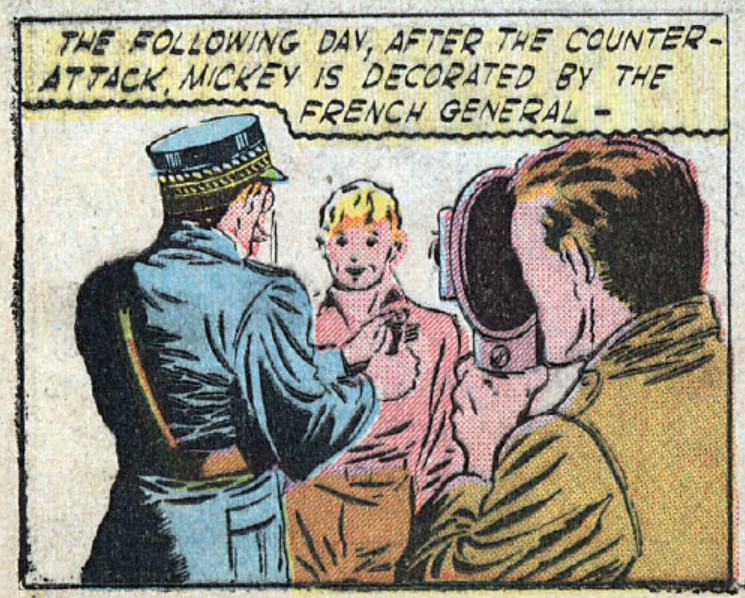
    Mickey Kelly, sidekick to swashbuckling newsreel cameraman Speed Martin, gets a medal from the French Army for foiling a spy. (The Funnies 048, 1940)

    Two issues later Mickey Riley (they forgot that he already had a last name, it seems) is decorated by the British for saving Gibraltar from the Axis. (The Funnies 050, 1940)

    Heroes Going to Costume Parties as Themselves: 

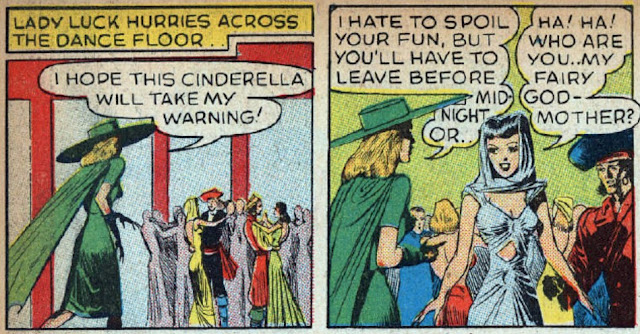
    Brenda Banks attends the Grand Costume Ball as Lady Luck, in an attempt to save a life. (The Spirit Section, “The Cinderella Murder Case”, 28 July, 1940)

    Mr Mystic also attends a costume party as himself in 1940, and a guy with no secret identity doing this might just be the most baffling thing I’ve read today, and this is the episode in which Mystic’s fiance is seduced by Death. (The Spirit Section, 22 December, 1940)

    Cops Shooting at Fleeing Suspects: 

    Sure, the Spirit has just confessed to a murder he did not commit for complicated reasons, but forgive me if I don’t agree with Mayor Aldrich here that that means that Commissioner Dolan has free license to shoot him in the back. (The Spirit “Eldas Thayer”, 21 July, 1940) 

    Interior Decoration: 

    This child’s ducky bed is just barely charming and not eerie. (The Spirit Section, 1 December, 1940) 

  • NOTES – JUNE 2025

    NOTES – JUNE 2025

    Letters to the Editor: 

    I rag on Novelty Press and their horrible and possibly fictional readership every chance I get, but I think I need to start presenting the letters they print in their comics so that I have some evidence to back up my grumbling. Here’s Clarence Pool of Seattle Washington advocating for the nice sensible adventures of an Army Air Force cadet who manages to foil a Fifth Column plot ever week over the exploits of a magic robot. (Target Comics v1 011, 1940)

    Skeletons with Jobs: 

    Driver is a job, certainly. Onto the pile! (The Funnies 047, 1940) 

    Honours: 

    Mickey Kelly, sidekick to swashbuckling newsreel cameraman Speed Martin, gets a medal from the French Army for foiling a spy. (The Funnies 048, 1940)

    Two issues later Mickey Riley (they forgot that he already had a last name, it seems) is decorated by the British for saving Gibraltar from the Axis. (The Funnies 050, 1940)

    Heroes Going to Costume Parties as Themselves: 

    Brenda Banks attends the Grand Costume Ball as Lady Luck, in an attempt to save a life. (The Spirit Section, “The Cinderella Murder Case”, 28 July, 1940)

    Mr Mystic also attends a costume party as himself in 1940, and a guy with no secret identity doing this might just be the most baffling thing I’ve read today, and this is the episode in which Mystic’s fiance is seduced by Death. (The Spirit Section, 22 December, 1940)

    Cops Shooting at Fleeing Suspects: 

    Sure, the Spirit has just confessed to a murder he did not commit for complicated reasons, but forgive me if I don’t agree with Mayor Aldrich here that that means that Commissioner Dolan has free license to shoot him in the back. (The Spirit “Eldas Thayer”, 21 July, 1940) 

    Interior Decoration: 

    This child’s ducky bed is just barely charming and not eerie. (The Spirit Section, 1 December, 1940)