The Curse of Skeleton Munroe

Category: hero update

  • MINOR SUPER-HERO ROUND-UP 069

    Mostly, but not all, updates. 

    Ibis the Invincible **UPDATE**:

    1941 sees Ibis the Invincible’s omnipotence tempered a bit via a slight limitation that is added to the Ibistick: it is not directly able to affect things created by or otherwise powered by evil magic, and it might not work at all in overtly magical areas such as a giant’s floating castle.

    This is balanced out somewhat by the fact that it gives Ibis the chance to demonstrate his lateral thinking skills by indirectly affecting these things, whether it be with a right hook or a summoned Egyptian god. (Whiz Comics 016, 1941)

    the Lieutenant Marvels:

    The Lieutenant Marvels are also the members of the Billy Batson Club, being three other kids with the name Billy Batson who all gather in New York Fawcett City to… share the pain of having the same name as a media figure with the figure in question? I guess that’s what they were doing? Turns out they all get along well enough to form a club, and to distinguish themselves they all choose a nickname: the lanky Westerner becomes Tall Billy, the squat Brooklynite is Fat Billy, the Southerner chooses to be Hill Billy and the famous one is acclaimed as Real Billy. This is the sort of nicknaming system that seems fine when you’re thirteen but can really fester over the years.

    The meetup is not all about comparing names and making friend, however, because these guys all have access to the comic books from our universe somehow and as such they all know about the link between yelling “SHAZAM!” while being named Billy Batson and becoming Captain Marvel, BUT ALSO are surprised when Real Billy does so and transforms. It’s a real pickle how they might have most of the info but not that last piece – perhaps the comics in this world that will eventually be designated Earth-S posit that Billy summons Captain Marvel by yelling for him. 

    Thanks to some name-based misunderstandings, the four all end up being captured by Dr Sivana and his group the Vengeful Four and tied to a deathtrap loud enough that all four Billys need to shout together to get the SHAZAM through to the lightning dispatcher. Surprisingly, the “any Billy Batson yelling SHAZAM = Captain Marvel” idea that they all had in their heads was accurate, and they all transform into equivalently powerful super-beings, with a ready-made names that are not actually used until their second appearance: Tall Marvel, Fat Marvel and Hill Marvel.

    (I have to admit here that I had for many years thought that the “Lieutenant” in Lieutenant Marvels was like when a villain’s top guy is called their lieutenant, like these guys are Captain Marvel’s helpers. I just now realized that it is in fact a straight military hierarchy joke) 

    The Lieutenant Marvels show up now and then to this day when Captain Marvel needs three other guys to help him do something, but given that they debut just a few months before Captain Marvel Jr and a year and a bit before Mary Marvel, their services aren’t as in-demand as one might expect.  (Whiz Comics 021, 1941) 

    Golden Arrow **Update**: 

    Though as previously noted the Golden Arrow strip essentially switched from a Modern West to Old West setting after about two or three issues, there has always been a bit of ambiguity as to the specific century the action was taking place in. Though some might point to the presence of a working stagecoach system or other anachronisms in earlier issues as evidence that Golden Arrow was firmly Old West, I have been burned before and it took something like this declaration of the train as a new-fangled arrival to convince me that the comic wasn’t suddenly going to feature Nazi fifth columnists. (Whiz Comics 021, 1941)

    the Arrow **Update**: 

    The Arrow finally gets an alter ego in his final comic book appearance, and it’s US Intelligence agent Ralph Payne. Is this an improvement over being an unnamed giant of a man? I leave that as an exercise for the reader. He also gets a more conventional super-hero cowl mask (with just a hint of the visible hairline that made his fellow Centaur character the Fantom of the Fair look so distinctive) and some cool boots at the same time. (The Arrow 003, 1941)
  • MINOR SUPER-HERO ROUND-UP 068

    MINOR SUPER-HERO ROUND-UP 068

    A few classic minor super-heroes. Bulletman and Bulletgirl in particular have just barely managed not to remain relevant – I suppose the pointy helmet is too much of a hurdle for the modern audience.

    Bulletman: 

    Jim Barr is perhaps the most thoroughly-motivated super-hero of the Golden Age. He is:

    a. from a long line of police officers

    b. the son of a famed police officer who was murdered for being too good a cop and who

    c. told the young Jim that he must become a police officer while on his death bed 

    d. and after all that he was too scrawny and bookish to be a cop and so had to settle for being a forensic scientist

    Jim ends up working in his father’s old station under the command of Sergeant Kent, a pro-torture bully who is often held up as the greatest of all the cops in the city, and who is also the father of love interest Susan Barr. 

    Jim’s personal project is a serum that will destroy “all germs and toxins” in the human body, including that which he believes to be the source of crime and violence. He chooses to test this serum out on himself and his body, freed from a variety of invisible ailments, develops into a physical paragon over the course of a night’s sleep.

    (Sergeant Kent really earns his reputation as a great police officer by failing to notice that his colleague has basically doubled in size over night. In his defense, Jim is wearing big clothes)

    Jim decides that the best way to use this new power is to operate outside of the law, probably due to all of his time hanging around with top cop Kent. He uses his now super intelligence to build the Gravity-Regulator Helmet, which allows him to fly and also generates a force field that augments his natural resilience to make him nigh-invulnerable and able to smash through things head-first (I swear that somewhere I read a story in which it was explained that it made him bulletproof by drawing the bullets to the helmet but danged if I can find it now.). His costume, yellow jodhpurs and all, is assembled out of things that were lying around at the police station, no mention of where. (Nickel Comics 001, 1940)

    If I had to classify Bulletman’s personality, I would go with “extremely no-nonsense” or maybe “wooden, which is why it is important that he is eventually joined by his female counterpart: 

    Bulletgirl: 

    Bulletgirl is the aforementioned Susan Kent, daughter to good cop/bad cop Sergeant Kent and member of Bulletman’s supporting cast from the beginning. For about the first year of Bulletman’s adventures she fills a low-effort version of the Lois Lane role: curious about the hero’s identity but not especially proactive about trying to uncover it. She also gets kidnapped and targeted for death a lot thanks to her father’s skill at making enemies. Then, in Master Comics 012, Bulletman is knocked out in a collision with Triple Threat’s super vehicle and Susan learns that he is actually Jim Barr. Jim obligingly tells Susan the secret of his origin but resolutely refuses to consider teaming up with her.

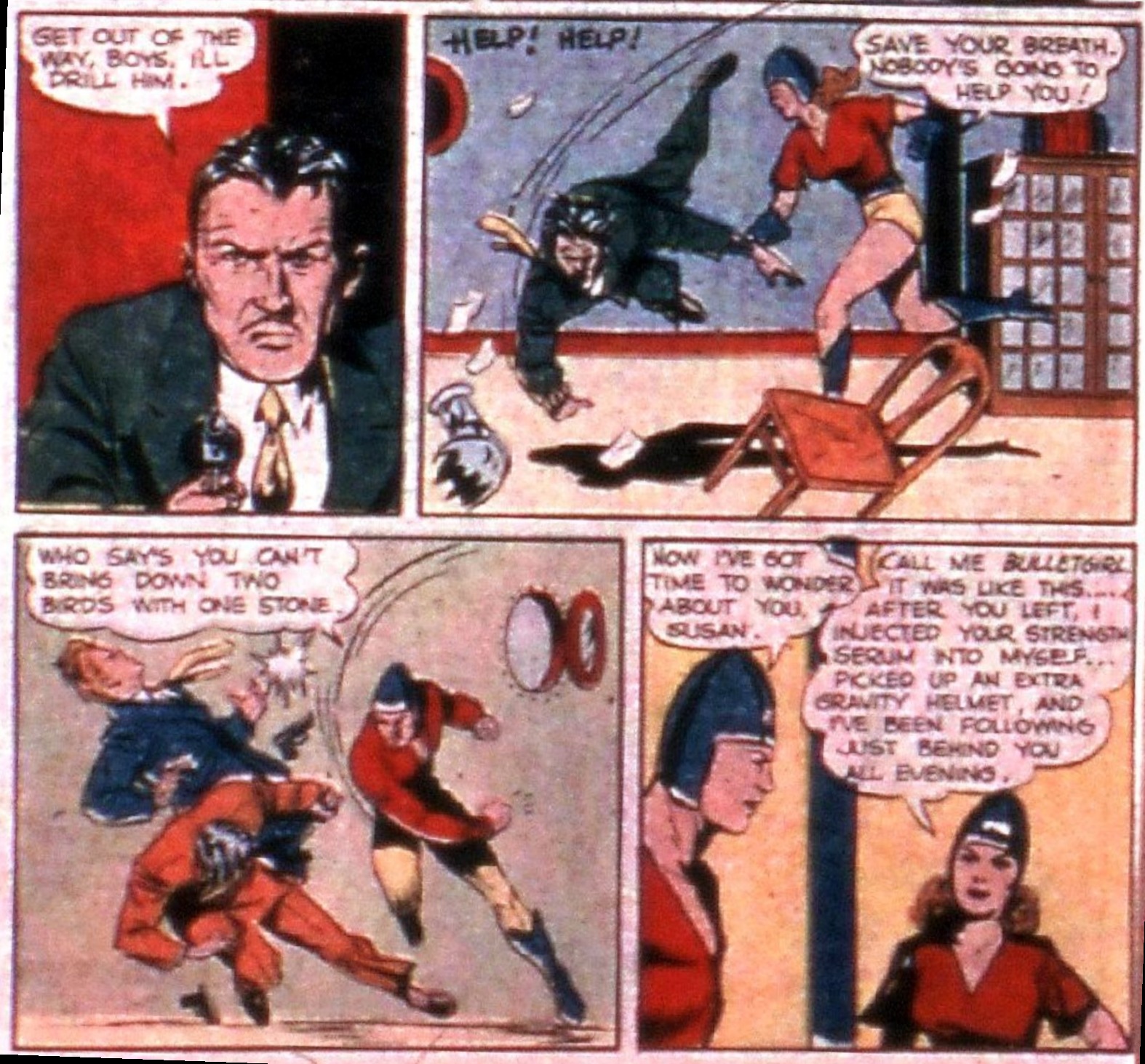
    Susan of course injects herself with the serum and crabs a spare Gravity-Regulator Helmet and costume (though she goes for hot pants over jodhpurs) the instant that Bulletman is out of the room, and This is a very good illustration of why I am so fond of Bulletgirl: she has all of the personality that Bulletman lacks. She’s scrappy and quippy and after an issue or two of “too dangerous for girls” chauvinism from Jim is a full partner in the superheroic exercise. She does get kidnapped and left behind a bit more than I’d like but that’s comic books in a nutshell. 

    In conclusion: Bulletgirl! (Master Comics 013, 1941)

    Minute-Man: 

    Like Jim Barr, Jack Weston is the son of a dead hero, though Jack’s father Robert Weston died during the Battle of Chateau-Thierry in World War I. We don’t get nearly as much background on Jack, other than the fact that he was raised by his father’s friend General Milton, but thanks to Milton, Jack becomes Minute-Man, a patriotic super-hero, in what is kind of presented as a draft.

    Jack is sent to join the Army as a lowly Private so that he can keep an eye out for sabotage and espionage affecting the armed forces. Despite having no super serum or particular special training, he proves to be physically near-superhuman as he engages a variety of costumed and non-costumed foes over the course of his mid-length career.

    Minute-Man also dabbles in leaving calling cards, which I always like to make note of. (Master Comics 011, 1941)

    Doctor Voodoo **UPDATE**: 

    In Whiz Comics 017, Doctor Voodoo returns home to find that Maxinya (the Heaven-Woman, natch) has gone missing. He tracks her abductors through the jungle until he comes across their destination: a European castle, smack in the middle of the Amazon. 

    The mystery deepens as Voodoo enters the castle and finds what seems to be an entire Medieval court, headed by the boorish King Richard, who seeks his aid in conquering the jungle. 

    Doctor Voodoo refuses to help King Richard, and so is forced to meet the knight Sir Ganal in combat. Voodoo prevails and wins Ganal over to his side, complete with a promise to reveal the origin of the castle’s presence in the jungle. Alas, this shall never come to pass, because the story does a hard pivot in the next issue. 

    King Richard plays the whole jungle conquest/attempted murder thing off as if it was some sort of test, and sends Doctor Voodoo off to meet with his court wizard. He. in turn, transports Voodoo back in time to the 1400s or thereabouts to retrieve a magical McGuffin called the Golden Flask, with another promise to explain what this whole affair is about once he returns.

    Unfortunately for all us completionists out there, the explanation never comes because Doctor Voodoo never returns. He bops around the oceans for about a year and actually does manage to get his hands on the Golden Flask but his feature is cancelled before he can return it to the wizard and find out just what the heck is going on. Maxinya is waiting for him still, presumably. (Whiz Comics 018, 1941)

  • MINOR SUPER-HERO ROUND-UP 067

    Something for everyone* in this one.

    *not really. 

    Zambini the Miracle Man: 

    Zambini the Miracle Man, aka Zambini the Great, is your fairly typical comic book magic man, albeit a bit more flamboyantly dressed than even that crowd normally are.

    Though Zambini has a lot of the regular magic abilities of his peer group his signature trick involves his magical Boomerang Amulet, which causes evil to rebound on its sender. This takes forms as diverse as a cobra returning to the one who released it to bombs flying back up to the plane that dropped them to magic spells rebounding on their casters. 

    (please also note the final panel above, in which Zambini is being made a Knight of Ritania, which I here recognize as an honour)

    Finally, while I generally do enjoy when a magic user has a weakness to counter their nigh-omnipotence, Zambini might just have the worst one in comics: the touch of a human hand renders him completely powerless and unable to resist, to the point that this Hundanian spy is able to gently lead him to their headquarters and he is only saved when her boss gets jealous – thank heavens that Hundania doesn’t have a robust anti-workplace romance policy. This weakness kind of falls by the roadside as time goes on but does occasionally crop up now and then in horrible ways. (Zip Comics 001, 1940)

    Perhaps the most interesting thing about Zambini is his magical system: for his first two appearances he casts spells by spouting nonsense words (as far as I can tell), but from Zip Comics 003 onward, he uses a version of Ubbi Dubbi that involves inserting the syllable “ab” instead of “ub”. I don’t know if it’s strictly better than speaking backward, Zatara style, but it certainly is unique.

    Atom Blake, Boy Wizard **UPDATE**:

    I had read the 1940-1941 issues of Wow Comics before embarking on my great comics-reading project, so I already knew going in that Atom Blake would essentially speed-run the process of getting tired of living among mere mortals and heading off into space, Dr Manhattan style, but I had forgotten that he is doing so in order to look for his long-lost father. Also, while I did remember that Blake duplicated himself before setting out I had misremembered it as him leaving behind a non-super version of himself on Earth while the superhuman part set off for adventure. What I’m saying here is that the version of Atom Blake that I had remembered is way more interesting than the actual character. (Wow Comics 002, 1941) 

    the Hunchback: 

    The Hunchback is in actuality wealthy playboy Allan Lanier, who became obsessed with the figure of Quasimodo after seeing the 1939 film version of the Hunchback of Notre Dame (or possibly a literal picture of the character – the text box isn’t 100% clear) and combined that with his interest in wiping out crime to become a weird spectre of the night, Batman-style.

    Lanier is refreshingly up-front about his interest in criminology, to the extent that he is seen droning on and on about it before a date with his fiance Betty Brenton. I don’t know if I’d like every fellow with a secret identity to abandon the “disaffected socialite” act, but it is nice to see the odd one do without it and just be a weird eccentric.

    The Hunchback really leans into two specific aspects of his inspiration: he is absurdly acrobatic, and he metes out insane and terrifying violence to his foes. The latter has git to be one of the better justifications for the dread a masked figure of the night inspires among the criminal fraternity.

    We’re on a bit of a run of characters who share their secret identity with their love interest and Alan Lanier is one of them: his fiance Betty has to be told before she will let the Hunchback help her (this might be the downside of the whole “reputation for insane violence” thing). (Wow Comics 002, 1941)

    In the Hunchback’s second adventure, in Wow Comics 003, Lanier switches to a slightly more conventional super-hero outfit. It’s a generic but not terrible design, and I always appreciate a character making a bold hat choice, but I think that it is perhaps a bit too twee for a character who is supposed to be some sort of rampaging engine of madness and destruction. The old uniform came back out of the closet for the Hunchback’s remaining appearances.

    Pinky the Whiz Kid: 

    Pinky the future Whiz Kid (not technically called that until 1942, but whatever, we’re loose and goosey around here) is already a fan of Mr Scarlet before he is rendered a crime orphan by the villainous Mr Hyde (upcoming), who seemingly randomly murders his mother.

    Pinky ends up at Oaklawn Orphanage, which just so happens to be run by Mr Hyde’s alter ego, Dr Jelke. When Hyde/Jelke and Mr Scarlet inevitably clash, Pinky is right there in his homemade sidekick costume to help out.

    Pinky is adopted by District Attorney Brian Butler, ostensibly to keep him out of trouble, but since Pinky has worked out that Brian is secretly Mr Scarlet he is able to blackmail him into becoming his sidekick. It sounds more sinister than it reads, honestly.

    The real downside to Mr Scarlet getting a sidekick is that Miss Wade, formerly a romantic sparring partner for Brian and occasional daring assistant in her own right, is relegated to the role of scolding caretaker as she sensibly attempts to prevent a teenager from flinging himself into danger. It’s a real loss to the comic.(Wow Comics 004, 1941)

  • MINOR SUPER-HERO ROUND-UP 056

    Some hot Archie/MLJ super-hero action. 

    **Hero Update** Bob Phantom:

    Perhaps in honour of his making the jump from Blue Ribbon Comics to Top-Notch Comics, Bob Phantom gets two hitherto-unseen powers: super-breath powerful enough to turn aside oncoming bullets and the ability to summon cyclones by flapping his cape. (Top-Notch Comics 003, 1940) 

    Bob Phantom also demonstrates super strength sufficient to tear an airplane to pieces in mid air. (Top-Notch Comics 004, 1940)

    And not content with three new super powers, in Top-Notch 010, Bob is shown to be completely bulletproof.

    Bob Phantom’s modus operandi, to reveal crimes and taunt both police and criminals in his gossip column as Walt Whitman and then bust things up as Bob Phantom, has never been particularly kind to the police of his corner of MLJ New York, and at this point they openly hate him in both of his identities. (Top-Notch Comics 009, 1940) 

    **Hero Update** the Wizard: 

    The Wizard’s powers also get expanded once 1940 rolls around: not only can he now hypnotically mind control people with a mere glance but he can mentally contact his thralls across distances of at least 500 miles (the above message was broadcast from somewhere in the vicinity of Dallas to somewhere in Mexico). 

    1940 is also the year that the Wizard’s already-formidible strength was rounded up to full-on super, seen here as he is bodily heaving an entire u-boat Bundonian submarine out of the water with only the power of his little kicking feet to hold him up.

    The Wizard’s arsenal of weapons and gadgets also gets a fair few additions this year, including:

    – more rays guns than one would assume could fit in a suit with such clean lines: death rays, two different engine-killing rays (the vibra-ray gun and the neutronic ray gun), an explosive ray (the destructo-ray), a metal-melting ray (the VB-ray gun), a paralysis ray (the electrolysis ray), a rainmaking ray (the H2-VX-0 ray), fire-extinguishing ray (the Hydra Gun), and the dynamagno saw ray projector, a cutting ray which can be tuned to selectively destroy mechanical parts such as the wires that hold a plane together.

    – secret chemicals including: Secret Chemical L-77 (solidifies liquids), Ethyl Formula 2X-Y-BZ (superfuel additive) and Super-Caloric Capsules and Secret Formula Ho Mg 4, which put pep back in a weary Wizard’s step.

    – special vehicles, the greatest of which is the Contra-Gravity Flask, pictured above, which allows the Wizard to float harmlessly to the ground from a height or run through the air, merely by virtue of being in his pocket.

    (Top-Notch Comics 002, 1940) 

    I somehow also failed to note in the original Wizard entry that he is not only a calling card guy but an obnoxiously patriotic one. (Top-Notch Comics 001, 1939) 

    After being blinded by his enemies the Mosconians, the Wizard changes out his tuxedo costume for a more super-heroic one with even less room for ray guns. This is supposedly to protect him from getting acid splashed in his eyes again, but since the Mosconians don’t actually get a chance for a second try the actual mechanism by which the same mask but a different shirt might help in that situation is not explored. (Top-Notch Comics 007, 1940)

    Finally, Blane Whitney abandons the life of the wealthy playboy to become a crusading newspaper publisher with ex-fiance Jane Barlowe as his star reporter, though he of course does not get a break for this. (Top-Notch Comics 008, 1940)

    Roy the Super-Boy: 

    He’s not quite the Sensational Character Find of 1940, but Roy the Super-Boy is the Marvel of 1940 and that has to count for something. He’s also our first Archie/MLJ sidekick (yes, yes, Tommy the Super-Boy, but he was a reference to Roy and we only covered him first because of the alphabet and its tricks). Does he suffer the “just running around without a mask calling yourself by your own name” problem common to a lot of Golden Age sidekicks? Sure he does, but at least he has a partial code name. And I was wrong: he totally wears a mask most of the time! 

    As is often the case, Roy is just a scrappy young orphan making his way in the world as a bootblack, when he ends up in a fight with some grown-ass men and impresses the Wizard with his sweet moves and devotion to justice. He soon finds himself with an invite to a rich man’s private gymnasium!

    Thanks to an intensive training regimen, Roy is quickly developed into an impressive physical specimen. The Wizard claims that they are equivalent barring the Wizard’s mind-powers, but I haven’t seen Roy bench-press a submarine yet. (Top-Notch Comics 008, 1940) 

    Kardak the Mystic: 

    There is a general consensus online that Kardak the Mystic is the same character as the Mystic, who appeared in Top-Notch Comics 001 and 002, but I ain’t buying it. For one, where the Mystic was an ordinary stage magician who used his skills at slight-of-hand to battle crime, Kardak has actual magical power. For another, where the Mystic was already engaged to an unnamed woman in his first adventure, Kardak’s adventures are all set in motion when a girl he just met on a cruise to India is kidnapped by undersea creatures. Certainly, relationships break up all the time, but not the Mystic and Unnamed Woman! Their love is forever!

    Kardak’s adventures take him and his gal-pal Lorna from the bottom of the Indian Ocean to Louisiana, where they enter a series of extra-dimensional lands populated by hostile weirdos. It’s a pretty good setup to showcase the power of a magical hero without having story after story of him just destroying regular gangsters.

    Kardak also acquires the services of Balthar, a huge dude with a magic turban, and he’s just as annoying as Tong and the other members of the Shirtless Broken English Magicians’ Assistants Collective. (Top-Notch Comics 004, 1940) 

  • MINOR SUPER-HERO ROUND-UP 053

    They really do just keep coming. 

    **Update** The Arrow:

    While the Arrow has always been portrayed as a mysterious seven-foot-tall physical prodigy, this particular adventure really goes all in on his being super-humanly strong. This seems significant somehow, even if it is is second-to-last appearance by my reckoning. (The Arrow 002, 1940)

    **UPDATE** the Flame: 

    This is the first actual version of the Flame’s origin that I’ve encountered in a comic book, so here it is. It is also the first time that I’ve encountered the notion of baby the Flame being proclaimed as the Grand High Lama. It’s a weird detail! (The Flame 001, 1940)

    Phantasmo: 

    And speaking of the ancient secrets of Tibet…

    Phantasmo! He spent 25 years in Tibet learning mystic secrets and now he’s returned to the US to mete out supernatural justice! Phantasmo! His main deal is that he can project his astral body and that in that form he is basically omnipotent! Phantasmo! He can grow, shrink, heal, kill, he is an invulnerable and infinitely strong magic man! Phantasmo! He does have one key weakness: while his astral form is out and about, his physical body is vulnerable, so teenaged Whizzer McGee tags along on his adventures to watch over it! Phantasmo!

    Thanks to a combination of an already fairly minimal costume combined with his transparent nature and some odd colour choices, Phantasmo is possibly also the nudest Golden Age super-hero, at least in his cover appearances. (The Funnies 045, 1940)

    Update 1941

    the Black Knight: 

    A young village blacksmith who first helps the Good King Victor of England when his leg is broken in a boar hunt and then goes on to foil several simultaneous attempts on the monarch’s life, the unnamed youth receives the customary reward for doing an excellent job: additional responsibilities. The Black Knight acts as a sort of state-sanctioned vigilante, rooting out evil among the chivalry of England.

    And speaking of England, the more history-minded of you might have noted that “Good King Victor of England” I mentioned as being very much not an actual British monarch. This raises the question of just when the Black Knight stories are set: it’s broadly Medieval (5th to 15th Centuries), operating under the Chivalric Code (12th to 15th Centuries), the King has a Damascus steel sword (post 10th to 11th Century), there is talk of doctors being fairly available (13th Century at earliest)… so what does all this add up to? Absolutely nothing. The Black Knight exists in a pastiche of knight-haunted England that is as historical as your average retelling of the Arthurian mythos, and in fact the whole thing would be a lot neater if Victor were actually Arthur. We must work with what we have, I suppose. (The Funnies 046, 1940) 

    ADDENDUM: I wrote this before I had read the last couple of Black Knight stories for 1940, and immediately after posting it I cracked open The Funnies 049, featuring a tale in which the Black Knight helps defend Cornwall (becomes part of England proper around the 10th to 11th Century) from a force of Huns (4th to 6th Centuries) and their enslaved Viking (8th to 11th Centuries) crew, and let me tell you I was relieved.

    Update 1941 

  • MINOR SUPER-HERO ROUND-UP 051

    It’s Day Three of Round-Up Week here at the Curse of Skeleton Munroe. 

    **UPDATE** the White Streak:

    Novelty Press is back at it again, exercising their compulsion to tone down the “fantastic” in their comic book stories. The White Streak has gotten a job as an FBI agent, and so he gets plastic surgery in order to make his inhuman face into that of a square-jawed white guy. Now instead of being the utterly fantastical ancient android in a bright costume running around blasting people with electron vision and zooming through the skies on an electric ladder, he’s… the same thing but he looks like a normal guy. Plus he tries to limit his power usage so as to stay inconspicuous, so he sticks to x-ray vision and electrified punches. Very realistic stuff. 

    If this move was in the cards for the White Streak, this might also be the explanation we were looking for for why Dr Simms went off the rails and blew up his entire life as Dr Death: it was a good old-fashioned slash-and-burn of a comic book’s supporting cast before a change to the status quo. Feels like I’m in the Nineties again! (Target Comics v1 010, 1940)

    Galar: 

    A childhood friend of Spacehawk’s from the same near-human species as him, Galar is turned from his six hundred year-long career as a space pirate by the intervention of his old friend and sent out into the galaxy to act as the protector of some random solar system, which it turns out is the reason that Spacehawk is protecting our solar system: he just arbitrarily chose it. (Target Comics v1 011, 1940)

    the Stratosphere Patrol: 

    Speaking of Spacehawk, here’s “Spacehawks,” a Basil Wolverton strip that didn’t really get the room to shine before its home comic was given the axe. While “stratosphere” in the context of 1940s comics is often a flowery way to describe everything up to and including interplanetary space, the meaning here is quite literal: Steve Grover and Bart Bixby and their colleagues are charged with policing the vast array of air traffic that is constantly whizzing around in the near-future, and their greatest challenge occurs when they encounter an evil scientist who can go into the upper, upper atmosphere! Heady stuff. (Circus, the Comics Riot 001, 1938)

    the Ghost Rider: 

    There are a seemingly infinite number of masked cowboy vigilantes roaming the various Wests of assorted comic book universes, and the Ghost Rider is one of them. In his one recorded adventure he stops the wretched gambler and crime boss of the town of Last Chance, Poker Slade, from murdering miner Robert Burton and his daughter Rose and stealing their gold claim. Also, though it’s not particularly visible in the image above, this particular Ghost Rider is the only one to have a mustache.

    As always, there are no new super-hero names under the sun, and “Ghost Rider” might just be one of the ones to unexpectedly crop up the most times. (Amazing Mystery Funnies v2 004, 1939)

  • MINOR SUPER-HERO ROUND-UP 051

    It’s Day Three of Round-Up Week here at the Curse of Skeleton Munroe. 

    **UPDATE** the White Streak:

    Novelty Press is back at it again, exercising their compulsion to tone down the “fantastic” in their comic book stories. The White Streak has gotten a job as an FBI agent, and so he gets plastic surgery in order to make his inhuman face into that of a square-jawed white guy. Now instead of being the utterly fantastical ancient android in a bright costume running around blasting people with electron vision and zooming through the skies on an electric ladder, he’s… the same thing but he looks like a normal guy. Plus he tries to limit his power usage so as to stay inconspicuous, so he sticks to x-ray vision and electrified punches. Very realistic stuff. 

    If this move was in the cards for the White Streak, this might also be the explanation we were looking for for why Dr Simms went off the rails and blew up his entire life as Dr Death: it was a good old-fashioned slash-and-burn of a comic book’s supporting cast before a change to the status quo. Feels like I’m in the Nineties again! (Target Comics v1 010, 1940)

    Galar: 

    A childhood friend of Spacehawk’s from the same near-human species as him, Galar is turned from his six hundred year-long career as a space pirate by the intervention of his old friend and sent out into the galaxy to act as the protector of some random solar system, which it turns out is the reason that Spacehawk is protecting our solar system: he just arbitrarily chose it. (Target Comics v1 011, 1940)

    the Stratosphere Patrol: 

    Speaking of Spacehawk, here’s “Spacehawks,” a Basil Wolverton strip that didn’t really get the room to shine before its home comic was given the axe. While “stratosphere” in the context of 1940s comics is often a flowery way to describe everything up to and including interplanetary space, the meaning here is quite literal: Steve Grover and Bart Bixby and their colleagues are charged with policing the vast array of air traffic that is constantly whizzing around in the near-future, and their greatest challenge occurs when they encounter an evil scientist who can go into the upper, upper atmosphere! Heady stuff. (Circus, the Comics Riot 001, 1938)

    the Ghost Rider: 

    There are a seemingly infinite number of masked cowboy vigilantes roaming the various Wests of assorted comic book universes, and the Ghost Rider is one of them. In his one recorded adventure he stops the wretched gambler and crime boss of the town of Last Chance, Poker Slade, from murdering miner Robert Burton and his daughter Rose and stealing their gold claim. Also, though it’s not particularly visible in the image above, this particular Ghost Rider is the only one to have a mustache.

    As always, there are no new super-hero names under the sun, and “Ghost Rider” might just be one of the ones to unexpectedly crop up the most times. (Amazing Mystery Funnies v2 004, 1939)

  • MINOR SUPER-HERO ROUND-UP 043

    A grab bag of old characters I skipped over back in the early days when I thought that this blog wasn’t going to be completely self-indulgent. 

    Mr Clue: 

    He only had one adventure in which he solves the murder of a mayor by a police chief, but Mr Clue is too great a name not to take note of. (Master Comics 001, 1940)

    the Red Gaucho: 

    A swashbuckling hero in the Zorro mode, the Red Gaucho protects the South American nation of Santa Palos from threats both foreign and domestic before eventually just kind of wandering North to have adventures in a sort of generic Central America. He’s a fun character! He has one of the biggest hats in comics!

    The Red Gaucho is also a character I think about whenever the topic of white supremacy comes up. White supremacy is one of those topics that gets a lot of people very angry, but at its base it’s simply the belief that the world consists of white people and everyone else and more specifically that it’s white people versus everyone else in a competition to keep white people on top, where they belong. And the further back you go, the less people felt the need to hide the fact that that was their worldview, and possibly the place that that attitude is most on display is in early Golden Age comics – just read any set outside North America and you’ll catch on to it pretty quickly.

    Anyway, that is all to say that even though it’s more subtle than a lot of other examples of this worldview in comics, ever since I noticed that every single appearance of the Red Gaucho includes a disclaimer assuring readers that he was in fact the child of two Americans and not some horrible South American – heavens forfend! – his smiling face pops into my head whenever the subject comes up.(Nickel Comics 004, 1940)

    the Hawk:

    On a less heavy note, here’s the Hawk! Created by George Brenner, who also created the Clock, the Hawk has the distinction of being the first masked crimefighter to appear in a comic that would eventually be amalgamated into the DC Comics fold (the Clock had only appeared in Centaur comics up until this point and wouldn’t make his way into a Quality book for a few months yet). A heady and heavily qualified distinction!

    The Hawk is secretly T. James Harrington II, wealthy and useless playboy who hangs around looking bored until some crime happens and it’s time for the Hawk to hit the streets. It’s a bit Bruce Wayne/Batman only without the parental murder.

    Unlike Batman, the Hawk leans pretty minimal on the costume front, with his major identifying feature being a set of slip-on claws. 

    The Hawk also has a couple of assistants named Link and Rollo who are touted as the only people who know the Hawk’s identity but who don’t get much time to show their stuff in this, their one-panel appearance. Astute readers might note that the crook that the Hawk has just captured likely also knows his secret identity at this point but please note that Link and Rollo are identified as the only living people to know the secret. Sinister stuff!

    DC has already gone with the Crimson Avenger as the Official First Golden Age Super-Hero but I reckon that the Hawk would be a fun guy to be brung back for some future story involving early mystery men antics. (Feature Funnies 002, 1937)

    *Hero Update* Shock Gibson:

    It had to happen someday: Shock Gibson disguises himself as a cowboy and in the process abandons his iconic helmet forever. Fare the well, helmet. (Speed Comics 007, 1940)

  • MINOR SUPER-HERO ROUND-UP 040

    Lev Gleason’s finest!

    Lance Hale:

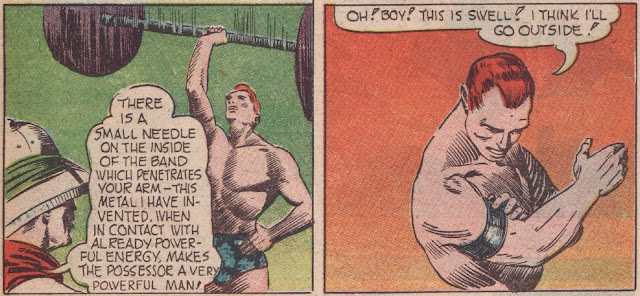
    Lance Hale is a soldier of fortune and jungle adventurer who is notable mainly for the fact that in his first appearance he is given super strength by a fellow with the pleasing name of Dr Grantland Grey so that he can help out on an expedition to the stars, and then after returning to Earth he just… stops using the armband that gives him his enhanced strength. He keeps on adventuring, don’t get me wrong, but as a regular jungle guy, ie, a colonialist race science fantasy figure. 

    Hale is slightly more interesting than his contemporaries in the jungle guy community by virtue of the variety of situations that he gets in: there’s the initial space trip that ends up turning into an interdimensional one and then a battle with invading animal men from a parallel world, a delve into a lost underground kingdom in which he incidentally becomes immortal, cursed demon-summoning gemstone action… I assume that the thrills are eventually going to stop coming but 1940 was almost all hits. (Silver Streak Comics 002, 1940)

    Mister Midnite **HERO UPDATE**:

    As you may or may not recall, Mister Midnite is a hero in the classic formal wear style who has one very specific power, to stop clocks by yelling “time stop!” Well! So we thought! It turns out that in his second appearance, Midnite demonstrates a second power, that of being teleported to a vaguely defined location, and also when he has shouts “time stop!” I really wish that there were more than two Mister Midnite stories so that we would have some more data to use in piecing all this together, but as of now I must assume that he has some sort of vaguely defined wishing power and that “time stop!” is its trigger phrase, like Johnny Thunder and “say you.” (Silver Streak Comics 002, 1940)

    the Silver Streak:

    The Silver Streak! Is notable for two (2) reasons, the first of which is that he is a the-title-of-the-comic-book character who doesn’t show up until issue 3, which is the opposite to how it often works, where the title character goes from proudly front and centre to gone in as many issues.

    The second and more interesting thing about the Silver Streak is his origin, which I have tried and failed to summarize in paragraph form, so here goes as bullet points:

    – the Silver Streak is a race car, or rather a series of race cars because every Silver Streak crashes, killing the driver. Nobody wants to drive for the Silver Streak team. The cars are crashing because they are being attacked by a giant fly.

    – the Silver Streak’s owner is Hindu mystic known only as the Swami. When an unnamed cab driver volunteers to drive the Silver Streak, the Swami hypnotizes him to be a great race car driver.

    – the unnamed driver is immediately killed by a giant fly.

    – BUT! The Swami has a hunch that the man is not in fact dead! He and a pal go to the cemetery and dig up the driver’s unmarked grave, and they are proved right! And what’s more, the prior hypnotic conditioning combined with the near-death experience has made the man (henceforth the Silver Streak) superhuman!

    The first adventure of the Silver Streak concludes with him stealing the latest prototype of his namesake car and using it to destroy the giant fly that “killed” him, and as presented he seems to have been on track to be a car-based super-hero. However, between Silver Streak Comics 003 and 004, the character was handed off from Jack Binder to Jack Cole and the Silver Streak became a guy with super speed, no car required. I don’t know if his origin is ever revised, but I do know that the Silver Streak has several sidekicks over the years and that they all get their powers via a blood transfusion from the man himself, so something’s going on there. Unless his blood was hypnotized too, of course – the Swami never returns, so his deal is never fully explored.

    Like a lot of super speed characters, the Silver Streak ends up being more about cool speed tricks than having a distinct personality, but he’s a fun read nonetheless. (Silver Streak Comics 003, 1940)

    UPDATE 1941 

    Dickie Dean, Boy Inventor:

    We love to see a boy inventor, if only because our brains have been warped enough by the Venture Brothers that we can’t help but imagine their dysfunctional adulthood, and by “we” I mean “I”. Dickie Dean here is particularly good fodder for that little thought experiment, as he is compelled to sign over his inventions to the US government by his misplaced sense of patriotism, so he’s either in for a rude awakening or an increasingly delusional relationship to reality as he gets older. 

    Some inventions that Dickie fails to patent in 1940 include: 

    – a device that can replay sound waves and visualize shadows up to 2-3 weeks old

    – a device designed to stop all war by making air as thick as molasses and thus preventing bullets etc from moving fast enough to do harm (importantly, this air is still breathable)

    – an enclosed, submersible speedboat equipped with a device that abates flood waters via rapid electrolysis

    He does sell a magnetic antigravity device for use as a mid-air brake for airplanes, but only because his father is in dire financial straits.

    Dickie Dean is also interesting for the fact that he is from New Castle, Pennsylvania, a real place with a regular amount of history but not otherwise a big name in city circles. Also I just reread the bit where I roasted Dickie for giving away his patents and I want to make it cleat that the part I think is foolish is giving them to, like, the FBI, not donating them to humanity. (Silver Streak Comics 003, 1940)

    UPDATE 1941 

  • MINOR SUPER-HERO ROUND-UP 039

    MINOR SUPER-HERO ROUND-UP 039

    We’re reading Shield-Wizard Comics, bay-bee, so here’s some stuff about the Shield and the Wizard.

    the Shield UPDATE:

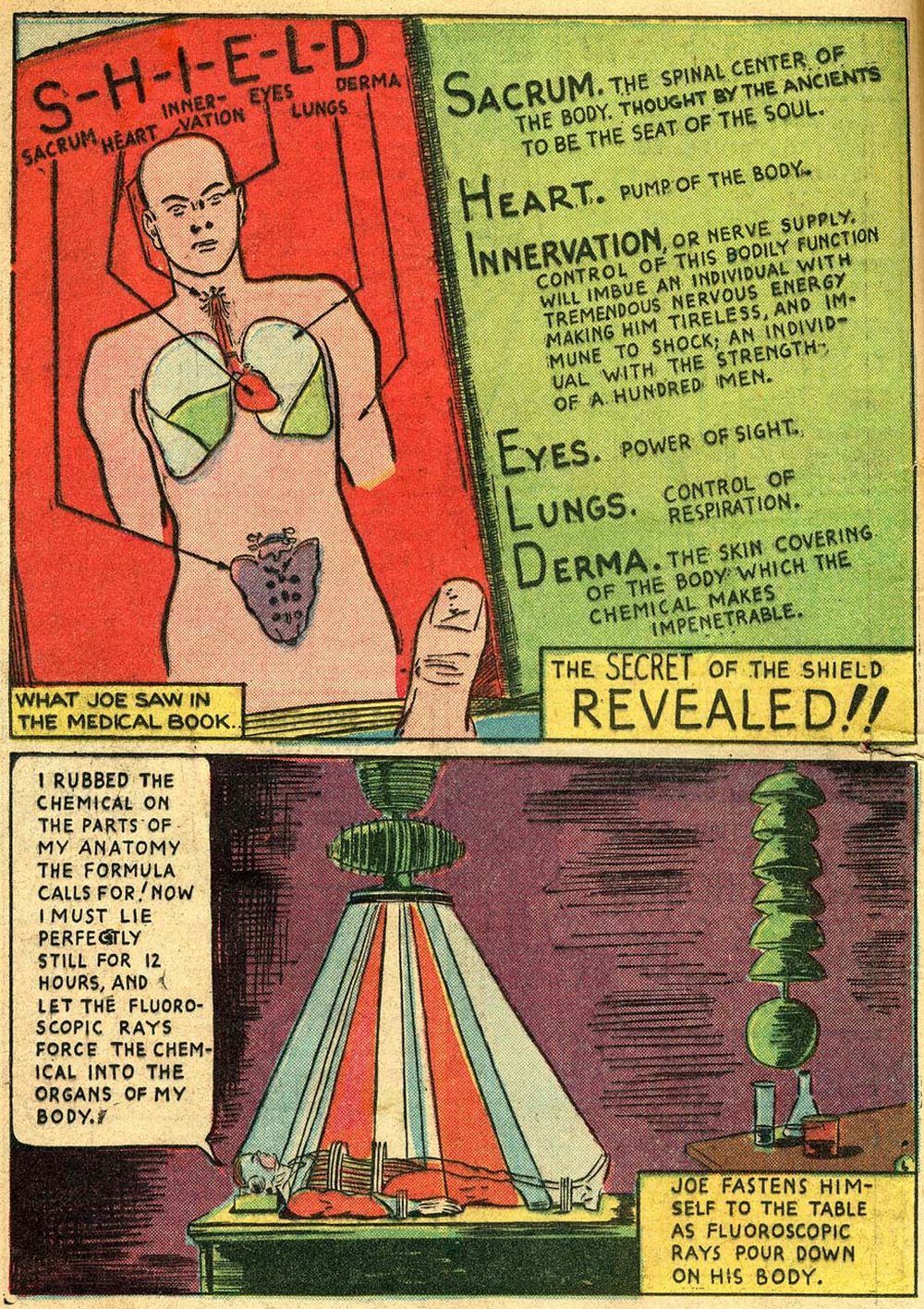
    In our original write-up of the Shield, we noted that the origin of his powers shifted from being solely down to his super-suit to being more of an ingrained thing over time, and the time is now! Yes, Shield-Wizard Comics 001 provides a slightly tweaked version of the Shield’s origin, in which Joe Higgins’ father Tom was not just a US Army Intelligence agent but a gifted scientist who discovered the secret of inducing superpowers but died juuuust before being able to tell Joe the full secret.

    Joe grows up to become a chemist himself but remains puzzled by his father’s last instructions to remember “anatomy formula S•H•I•E•L•D,” and with good reason, because it’s a nonsense jumble of anatomical parts that must have been put together only in the specific medical textbook that Joe eventually finds it in. But hey, he needed to find out where exactly to rub the chemical formula, and how would he otherwise know that it boiled down to “your eyes and skin, but especially the skin over your chest and groin” without that handy mnemonic device?

    The all-white costume that Joe is sporting before he settles down for a 12-hour session under the fluoroscopic ray shows up in at least a few retellings of the Shield’s origin going forward and I always thought that it was a pretty snappy look. Unfortunately, the rays dye his suit (and possibly his limbs?) in patriotic colours and so we get a red-white-and-blue Shield rather than merely a white one.

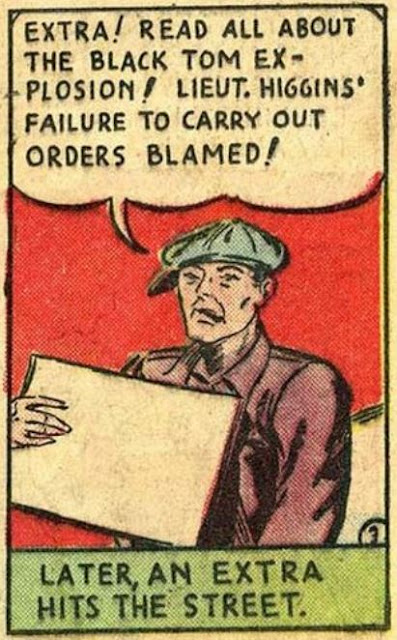
    The other tweak to the Shield’s origin is that rather than merely dying in the Black Tom Explosion of 1916, Tom Higgins is blamed for it, so the Shield now not only has a Batman-style motivation (spies killed my dad and now I must battle espionage) but also a Geoff Johns-Barry Allen-Flash one (I fight crime as part of my attempt to clear my father’s name). Thankfully, his first case involves rounding up the very German Hans Fritz and forcing him to confess, thus clearing Tom Higgins’ name without it becoming a whole thing. (Shield-Wizard Comics 001, 1940)

    the Wizard I:

    In the original account of the Wizard’s origin in Top-Notch Comics 001, the Whitney family’s close connection to American history is pretty thoroughly emphasized, with Whitneys present and getting things done at all major American wartimes. Well, Shield-Wizard Comics took up that gauntlet and ran with it: John Whitney organized the Mayflower expedition, and his son John Whitney organized the first Thanksgiving, and his son or grandson John Whitney thought up the idea of uniting the colonies. 

    But that wasn’t all: the third John Whitney’s son Blane (the main line of Whitneys only have time for three male names: John, Blane and Grover. All other named Whitneys are from dead end branches of the family tree, it seems) is just as super-human as his descendant, and in fact was the first of a line of Whitney family superhumans to call themself the Wizard (adopted as an ironic name after John Whitney was burned at the stake for witchcraft after acting on his son’s extrasensory visions to protect the colonies).

    The Wizard ends up making quite a big difference in the tides of the American Revolution, including:

    – informing Paul Revere that the British were approaching Concord and lighting the “one if by land, two if by sea” lanterns

    – showing up to participate in the fighting at Concord and turning the tide

    – wielding a cannon as a sidearm in the Battle of Bunker Hill and again at the Battle of Saratoga

    – saving Nathan Hale from being executed as a spy only not really because he chooses to die and be an inspiration instead

    – orchestrating the crossing of the Delaware and the surprise attack on the Hessian forces

    -very nearly getting Benedict Arnold before he gets away to join the British forces

    – proving instrumental in the capture of Major André

    – participating in several key battles, including the charge of Mad Anthony Wayne and the defeat of Cornwallis

    – orchestrating the support of the French for the revolution

     This original Wizard also creates a number of anachronistic inventions, including:

    – a glider that seems to function a bit more like a full-fledged airplane

    – a steam powered speedboat

    – something in between a deep sea diving rig and a scuba suit

    – a machine gun

    – radio communication

    – an electrified, battery-powered suit

    – a self-propelled sled

    – a tiny high-powered cannon

    All in all, the tale of the original Wizard holds up as a classic of the form, with the form being “super-heroes added to historical events.” Comics love to showcase the great moments of US history in particular, but as a comic book must prioritize action, any super-heroic character who is present must have an extraordinary amount of influence on history. It’s great! (Shield-Wizard Comics 001, 1940)

    the Wizard II:

    The second Wizard, like his father the original Wizard, is essentially a carbon copy of the modern character in appearance, name (Blane Whitney, natch) and abilities. Blane Whitney II also takes after his father in his commitment to inserting himself into important US historical events, including:

    – participating in various military engagements, including the defeat of the HMS Gurrierre, the Battle of Lake Erie, the Battle of the Thames (I think?) and the Battle of Bladensburg

    – saving William Henry Harrison from an assassination attempt

    – almost preventing the burning of the White House by the British

    – planning the defense of Fort McHenry and then participating in it

    – accidentally enabling Francis Scott Key to get inspired to write the Star-Spangled Banner

    This Wizard also has a lot of ahead of its time technology, including:

    – a version of his father’s glider

    – smoke (possibly tear gas) grenades

    – a dang tank

    The second Wizard obviously has less of a direct impact on the events of US history, if only because the War of 1812 has fewer Stand Up and Cheer moments than its predecessor. Still, he’s in there, and there’s every indication that we’d continue on to see a Civil War Wizard and a World War I Wizard and so forth, and the stated reason that we don’t see them is that as of Shield-Wizard Comics 003, the Wizard’s sidekick Roy the Super-Boy was too popular to not feature and so it was contemporary Wizard from then on out. (Shield-Wizard Comics 002, 1940)

    And speaking of Roy the Super-Boy:

    Tommy the Super-Boy:

    A part of any big project is choosing a methodology and then sticking to it and as my project is “reading all comics, in order” I had to figure out what “in order” meant. And while doing things in a month by month basis might be more true to the spirit of the experience, for my own sanity I opted to go alphabetical by year instead – the prep work alone for that other method hurts my head a bit to contemplate.

    All that is by way of explaining that Tommy, “the Original Super-Boy of History” (aka the original wonder-boy according to that one panel) is a retroactively created predecessor of the Wizard’s sidekick Roy the Super-Boy, who we will not meet until I have read the around 180 other comics between Shield-Wizard Comics 002 and Top-Notch Comics 008. He’s your classic orphan kid who gets to hang around a super-hero because he’s scrappy, and it turns out that that’s not unheard-of in historical youths.

    This particular scrappy kid, Tommy by name, is peeling potatoes when he meets an incognito Blane Whitney II and ends up discovering his secret identity after the Wizard participates in a sea battle and Tommy runs off afterward to berate Blane for cowardice, like a normal person does. And once you have discovered a super-hero’s identity, you get to become a super-hero! If you are a scrappy kid, of course. (Shield-Wizard Comics 002, 1940)